
Defending the Lens: How Arizona’s Unconstitutional Ban on Recording Police Was Defeated
A deep dive into the legal battle over Arizona's controversial 8-foot rule and the enduring First Amendment right to record law enforcement.
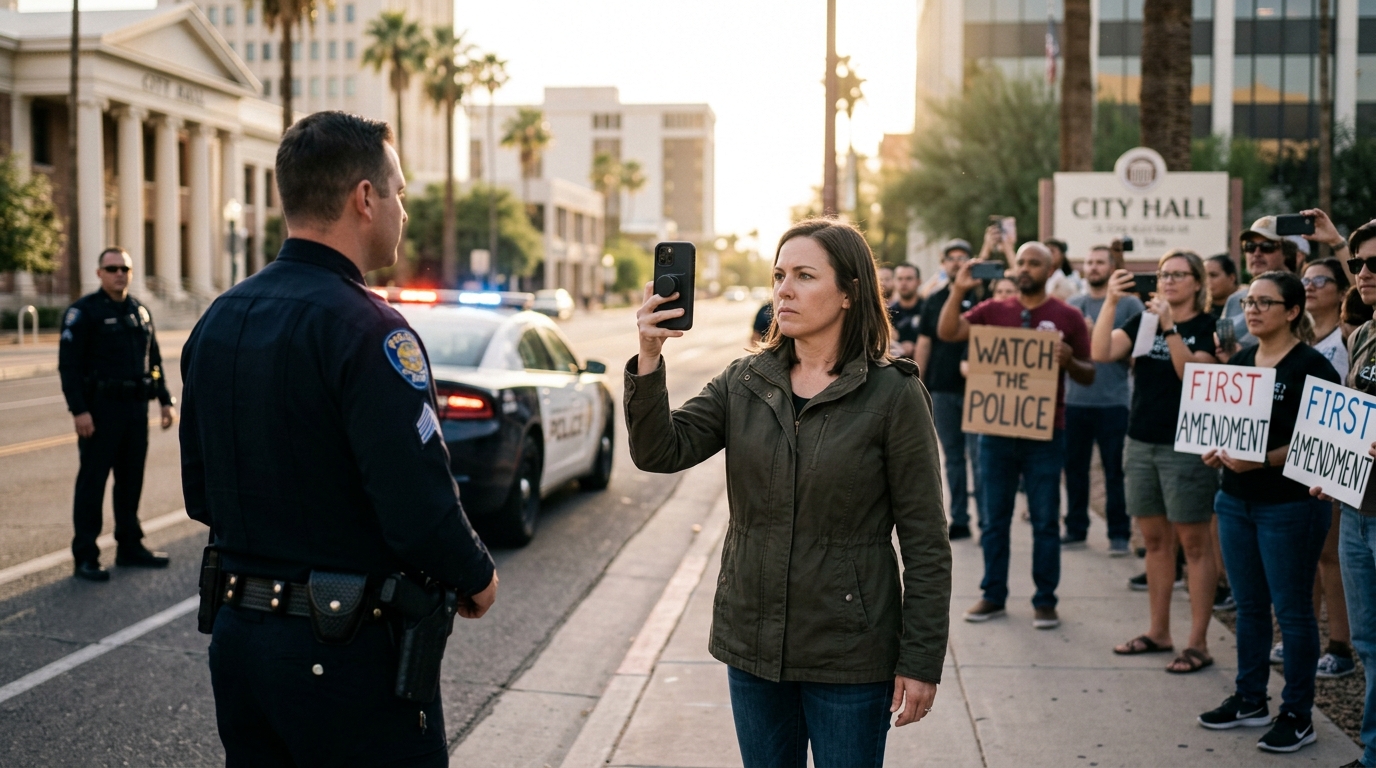
The Crucial Intersection of Technology and Constitutional Rights
In the modern era, the smartphone has evolved into one of the most vital instruments for protecting civil rights and ensuring government accountability. The ability to pull a device from a pocket and document the actions of law enforcement officers has fundamentally transformed the relationship between the state and the public. This act of documentation is not merely a byproduct of modern convenience; it is a profound exercise of free speech and a critical tool for transparency. However, the proliferation of civilian recordings has sometimes prompted defensive legislative maneuvers aimed at restricting these exact freedoms. One of the most glaring examples of this friction occurred with the passage of a controversial statute in the American Southwest.
Legislative efforts to shield law enforcement from public scrutiny often masquerade under the guise of officer safety or operational efficiency. While protecting public servants in the line of duty is undeniably important, courts have consistently held that such measures cannot come at the expense of established constitutional protections. The tension between preserving secure environments for police operations and upholding the public’s right to observe government officials reached a boiling point in Arizona, leading to a high-stakes legal showdown that reaffirmed the foundational principles of a free and open society.
The Mechanics of Arizona’s Controversial Legislation
In 2022, Arizona lawmakers advanced House Bill 2319, a highly restrictive piece of legislation that immediately sounded alarm bells among civil liberties advocates, constitutional scholars, and media organizations. The premise of the law was straightforward but deeply problematic: it sought to make it a criminal offense for any individual to record a law enforcement officer within an eight-foot radius if the officer was actively engaged in law enforcement activity and had issued a verbal warning to stop recording .
On the surface, proponents of the bill argued that an eight-foot buffer zone was a reasonable measure to prevent bystanders from interfering with arrests, crime scene investigations, or emergency responses. However, a closer examination of the statute’s mechanics revealed severe functional and constitutional flaws. The law effectively granted individual officers broad, subjective discretion to criminalize passive observation. An officer could arbitrarily demand that a civilian stop recording or move back, and failure to comply would transform a constitutionally protected activity into a punishable offense.
Furthermore, the logistical reality of enforcing a strict eight-foot buffer in dynamic, unpredictable environments rendered the law practically unworkable. In crowded public protests, narrow urban corridors, or chaotic traffic stops, individuals could easily find themselves within the prohibited distance without any intent to interfere. The legislation essentially created a moving zone of censorship, capable of expanding or shifting at the sole discretion of the officer being recorded.
The First Amendment Framework and “Strict Scrutiny”
To understand the profound legal misstep of this legislation, it is necessary to examine the constitutional framework governing public recording. The First Amendment of the United States Constitution guarantees the freedom of speech and the press. Over decades of jurisprudence, federal courts have interpreted these protections to encompass not just the dissemination of information, but also the gathering of information. Filming government officials engaged in their public duties falls squarely within this protected category.
When a state attempts to regulate or restrict a fundamental right based on the type of activity or the subject matter involved, courts typically apply a rigorous legal standard known as “strict scrutiny.” Under strict scrutiny, the government must prove that the law serves a compelling state interest and is narrowly tailored to achieve that interest using the least restrictive means possible. Legal experts quickly identified that the Arizona statute was a “content-based” restriction because it specifically targeted the act of recording a specific group of people—law enforcement officers .
The distinction between regulating disruptive conduct and banning the act of recording itself is vital. While the state has a valid interest in preventing actual physical interference with police work, an arbitrary distance-based recording ban fails the narrow tailoring requirement. It punishes the act of creating a record rather than the act of obstruction.
Key Differences: Constitutional Observation vs. Statutory Overreach
| Concept | First Amendment Protections | Arizona HB 2319 Provisions |
|---|---|---|
| Act of Recording | Protected as an essential method of gathering information on government actions. | Criminalized if performed within 8 feet after receiving a verbal warning. |
| Discretion | Officers cannot arbitrarily suppress observation that does not physically interfere. | Vested absolute power in officers to demand compliance regardless of actual interference. |
| Application | Applies robustly in public forums, protests, and typical street encounters. | Created a moving, unpredictable “buffer zone” that was nearly impossible to navigate in crowds. |
The Lawsuit: Civil Rights Advocates and Media Unite
Recognizing the dire implications of the statute, a formidable coalition quickly assembled to challenge the law in federal court. In August 2022, civil rights organizations joined forces with a diverse array of media entities—including broadsheet newspapers, television broadcasters, and press photographers—to file a comprehensive lawsuit against the state .
The plaintiffs articulated a clear and urgent argument: the law was a direct assault on the First Amendment that would irreparably chill free speech. The media organizations emphasized that the law would severely hinder the ability of journalists to report on matters of intense public interest. A photojournalist attempting to capture the reality of a volatile protest or an arrest could be threatened with jail time simply for standing their ground to document the event. The chilling effect would not be limited to professional journalists; everyday citizens, who often serve as the first line of transparency, would be intimidated into putting their cameras away under the threat of arrest .
Why Recording Matters: Police Accountability and Community Impact
The broader societal context surrounding the right to record cannot be overstated. Over the past decade, civilian video recordings have been instrumental in exposing instances of police misconduct, excessive force, and systemic civil rights violations. These videos have ignited international conversations about racial justice, prompted widespread demands for institutional reform, and provided undeniable evidentiary weight in courtrooms where the word of a civilian might otherwise be dismissed against the testimony of an officer.
- Historical Documentation: Video evidence strips away the ambiguity of disputed encounters, providing an objective record of events that serves both the public and truthful officers.
- Protecting Marginalized Communities: Communities that historically face higher rates of aggressive policing rely heavily on the right to record as a peaceful, non-physical mechanism for self-protection and advocacy.
- Deterrence of Misconduct: The mere presence of a recording device can de-escalate tensions and deter officers from violating departmental protocols, knowing their actions are subject to public review.
By criminalizing the act of standing at a close, observable distance, the law threatened to plunge these critical interactions back into the shadows. The plaintiffs correctly argued that vesting law enforcement with the unilateral power to turn off the public’s cameras would effectively dismantle one of the few remaining tools the public has to hold armed agents of the state accountable .
The Judicial Takedown: Injunction to Demise
The legal lifecycle of the statute was remarkably short-lived, largely due to its glaring constitutional deficiencies. When the lawsuit was brought before the U.S. District Court for the District of Arizona, the judicial response was decisive. In September 2022, a federal judge granted a preliminary injunction, halting the enforcement of the law just before it was slated to take effect .
The judge’s reasoning was firmly rooted in established constitutional doctrine. He recognized that the law was a content-based restriction on speech and that the state had failed to demonstrate that it could survive strict scrutiny. Strikingly, state officials—including the Attorney General and local county attorneys—declined to mount a robust defense of the law, essentially conceding that its provisions were indefensible under the current framework of the First Amendment .
The preliminary injunction served as a protective shield for journalists and citizens alike, ensuring that the critical right to observe remained intact while the case proceeded. Ultimately, the legal battle concluded in July 2023 when the federal court issued a permanent injunction, officially declaring the legislation unconstitutional and permanently barring its enforcement . This definitive ruling sent a resounding message across the country: attempts to legislate away the public’s right to transparency will not survive judicial review.
National Implications for Future Legislation
While the defeat of the Arizona law represents a significant victory for constitutional advocates, it also serves as a crucial case study for the entire nation. The legislative impulse to shield government operations from public view is not isolated to one state. Lawmakers in various jurisdictions continue to propose regulations that test the boundaries of the First Amendment, often utilizing similar “buffer zone” concepts or vague definitions of interference.
The permanent injunction against this specific law sets a strong precedent that can be cited in future litigation against similar statutes nationwide. It reinforces the principle that while governments can enforce existing laws against physical obstruction or assault, they cannot invent new, speech-chilling crimes that target the mere act of observation. Moving forward, legislators seeking to address genuine concerns regarding officer safety must do so through precise, conduct-based laws that do not sweep constitutionally protected information-gathering into their net.
The enduring lesson from this legal conflict is that transparency and public safety are not mutually exclusive concepts; rather, transparency is a fundamental prerequisite for legitimate and trusted public safety operations.
Frequently Asked Questions (FAQ)
Is it legally protected to record police officers in public?
Yes. Multiple federal appellate courts have firmly established that the First Amendment protects the right of citizens and journalists to openly record law enforcement officers performing their official duties in public spaces. This protection is a core component of free speech and government accountability.
What exactly did the blocked Arizona law attempt to do?
The law sought to make it a criminal misdemeanor for an individual to record video of a police officer within an eight-foot radius if the officer was engaged in “law enforcement activity” and had verbally warned the person to stop recording or step back.
Can a police officer legally confiscate my phone or camera?
Generally, no. Under the Fourth Amendment, police cannot seize your recording device without a warrant, nor can they demand to view your footage or force you to delete your recordings. Confiscation without a warrant is only legally permissible under extremely narrow “exigent circumstances,” which are rare.
What is the difference between “interfering” and “recording”?
Interfering involves physical actions that obstruct an officer from doing their job, such as physically blocking their path, tampering with a crime scene, or actively inciting a riot. Passively standing at a safe distance and recording, even while verbally criticizing the police, is protected observation, not physical interference.
Why did the federal court strike the law down?
The federal judge ruled that the law was an unconstitutional “content-based” restriction on First Amendment rights. Because it specifically targeted the recording of police officers, it required a high level of legal justification (strict scrutiny) that the state could not provide, leading to a permanent injunction against its enforcement.
References
- Arizona Broadcasters Association v. Brnovich — American Civil Liberties Union (ACLU). 2023-07-21. https://www.aclu.org/cases/arizona-broadcasters-association-v-brnovich
- Preliminary Injunction Blocks Arizona Law Restricting Recording of Police — First Amendment Watch. 2022-09-09. https://firstamendmentwatch.org/preliminary-injunction-blocks-arizona-law-restricting-recording-of-police/
- Arizona slammed over 8-foot rule for recording police actions — Courthouse News Service. 2022-08-23. https://www.courthousenews.com/arizona-slammed-over-8-foot-rule-for-recording-police-actions/
Similar Articles








Read full bio of medha deb




