
The American Samoa Citizenship Paradox Explained
Explore the legal rules that make American Samoans nationals but not citizens.
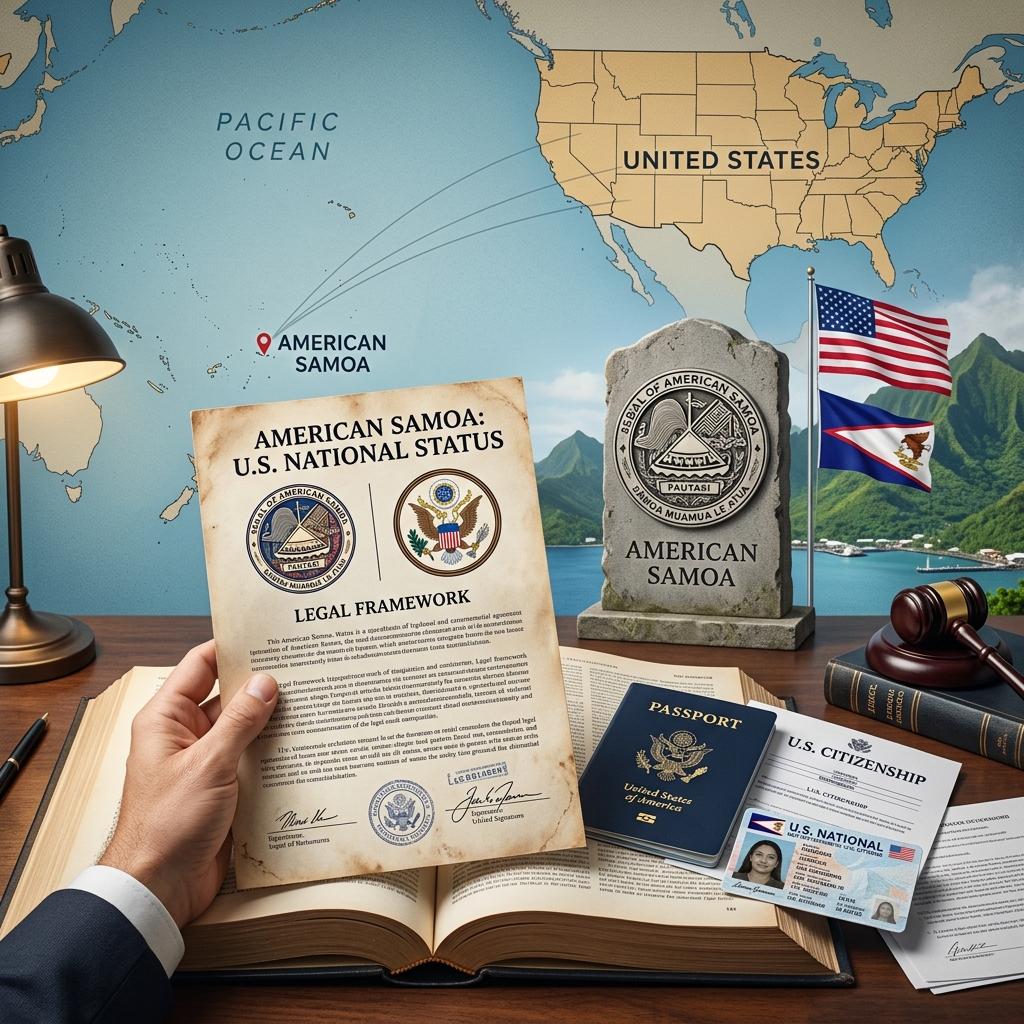
The concept of birthright citizenship is deeply ingrained in the American ethos. For most people born on soil governed by the United States, obtaining citizenship is considered an automatic, incontrovertible right protected by the highest laws of the land. However, this universal rule contains a singular, notable exception that affects tens of thousands of individuals. Nestled in the South Pacific Ocean, the islands of American Samoa stand as the only permanently inhabited territory of the United States where birth does not automatically confer citizenship. Instead, individuals born in American Samoa are classified legally as non-citizen U.S. nationals. This unique demographic anomaly creates a highly complex legal landscape, blending constitutional interpretations, century-old judicial decisions, and the fierce protection of indigenous territorial traditions.
To fully grasp the reality of this situation, one must look at the specific language printed on the passports of American Samoans. While they carry blue passports that look virtually identical to those held by citizens residing in New York or California, there is a distinct and limiting disclaimer stamped on the very last page. The endorsement clearly states that the bearer is a United States national and not a United States citizen. This solitary sentence encapsulates a profound legal dichotomy, dividing the fundamental privileges of American civic life and creating a secondary tier of belonging within the nation’s borders.
Decoding the Distinction: Citizen vs. National
The distinction between a citizen and a non-citizen national is not merely semantic; it carries significant, real-world consequences that impact the daily lives, career trajectories, and political opportunities of American Samoans. Under Section 101(a)(22) of the Immigration and Nationality Act (INA), a U.S. national is defined broadly as either a citizen of the United States or a person who, though not a citizen, owes permanent allegiance to the United States. While all U.S. citizens are technically U.S. nationals, the reverse is not true. Currently, the classification of non-citizen national applies almost exclusively to individuals born in American Samoa and the nearby Swains Island.
Because they owe permanent allegiance to the federal government, American Samoans do enjoy several essential protections. They are permitted to enter the mainland United States without needing a visa, reside freely in any of the fifty states, and work anywhere within the country without needing a green card or any special employment authorization. They are also protected by the U.S. Bill of Rights and can request consular assistance from U.S. embassies when traveling abroad, enjoying the protective umbrella of the American government globally.
However, the benefits stop abruptly when it comes to full political participation and certain civic duties. Because they lack full citizenship status, American Samoans cannot vote in federal elections or cast a ballot for the President of the United States. Even if an American Samoan moves to a U.S. state, pays local taxes, and resides there for decades, they remain completely disenfranchised unless they successfully complete a formal naturalization process. Furthermore, non-citizen nationals are barred from holding certain civil service positions, cannot serve on a jury in many mainland jurisdictions, and are strictly restricted from serving as commissioned officers in the United States military.
| Privilege or Right | U.S. Citizen | U.S. National (American Samoa) |
|---|---|---|
| U.S. Passport Eligibility | Yes | Yes (with special endorsement) |
| Right to Work Anywhere in U.S. | Yes | Yes |
| Right to Vote in Federal Elections | Yes | No |
| Eligibility for Jury Duty | Yes | No |
| Serve as a Military Officer | Yes | No |
The Shadow of the Insular Cases
To understand how the United States justifies ruling over a territory without granting its inhabitants full citizenship, one must look back to the immediate aftermath of the Spanish-American War in 1898. As the United States aggressively acquired overseas territories—such as Puerto Rico, Guam, and the Philippines—the federal government was forced to determine how the Constitution applied to these newly conquered lands. This intense legal debate culminated in a series of highly controversial Supreme Court rulings delivered in the early twentieth century, collectively known to history as the Insular Cases.
In these landmark decisions, most notably Downes v. Bidwell (1901), the Supreme Court established what is known as the territorial incorporation doctrine. The Court divided U.S. territories into two completely distinct categories: incorporated and unincorporated. Incorporated territories, such as the lands that eventually became the states of Alaska and Hawaii, were designated for eventual statehood, and the Constitution applied to them in its entirety. Unincorporated territories, however, were deemed to belong to the United States but were not considered a formal part of the United States in the strict constitutional sense.
The legal reasoning behind the Insular Cases was heavily influenced by the prevailing racial prejudices of the era. The Supreme Court justices of the time openly argued that it would be inappropriate to extend full constitutional rights and citizenship to territories inhabited by alien races with supposedly primitive cultures and differing political traditions. Consequently, the Court ruled that only fundamental constitutional rights inherently applied to unincorporated territories, while other provisions—such as the guarantee of birthright citizenship—did not automatically extend to them unless the United States Congress explicitly passed legislation to do so.
The Fourteenth Amendment and Legal Battles
The modern controversy over American Samoan citizenship frequently centers on differing interpretations of the Fourteenth Amendment to the United States Constitution. Ratified shortly after the conclusion of the Civil War, the Citizenship Clause of the Fourteenth Amendment declares unequivocally that all persons born or naturalized in the United States, and subject to the jurisdiction thereof, are citizens of the United States. The central legal dispute hinges on the exact geographic definition of the phrase “in the United States.” Does it refer strictly to the fifty states and incorporated territories, or does it broadly encompass all sovereign lands under federal control?
Over the past decade, several groups of American Samoans living on the U.S. mainland have launched ambitious lawsuits arguing that the Citizenship Clause guarantees them birthright citizenship. The most prominent recent judicial challenge was Fitisemanu v. United States. The plaintiffs in this case, who resided in Utah, argued that because they were unequivocally born on U.S. soil and were continuously subject to U.S. jurisdiction, the Fourteenth Amendment automatically made them full citizens. They posited that denying them this citizenship was a clear constitutional violation that infringed upon their fundamental civil rights and relegated them to second-class status.
Despite early success in a lower federal district court in Utah, the plaintiffs ultimately faced judicial defeat. The United States Court of Appeals for the Tenth Circuit reversed the lower court’s decision, heavily relying on the aging precedent set by the Insular Cases. The Tenth Circuit ruled that the Citizenship Clause did not automatically apply to unincorporated territories and that conferring citizenship upon American Samoans was a legislative power reserved solely for Congress. In October 2022, the Supreme Court of the United States firmly declined to review the case, effectively maintaining the status quo and shutting the door on a judicial resolution to the long-standing debate.
The Cultural Exception: Protecting Fa’asamoa
From an outside perspective, the systemic denial of birthright citizenship appears to be a straightforward civil rights violation. However, the situation within American Samoa is far more complex and legally nuanced than it appears on the surface. Surprisingly to many mainland observers, the local government of American Samoa actually intervened in the Fitisemanu case on the side of the federal government, actively opposing the automatic granting of U.S. citizenship to its people. This resistance is rooted in a profound, existential desire to protect and preserve the indigenous Samoan way of life, commonly known as Fa’asamoa.
Central to Fa’asamoa is an ancient, communal land tenure system. In American Samoa, over ninety percent of the available land is communally owned by large, extended family networks and governed by traditional chiefs known as matai. Furthermore, local territorial laws strictly dictate that any individual who wishes to purchase, own, or inherit land must prove that they possess at least fifty percent native Samoan blood. This system is meticulously designed to keep the islands’ highly limited land mass in the hands of the indigenous population and prevent widespread displacement by wealthy mainland outsiders or large commercial real estate entities.
The American Samoan government deeply fears that if the Fourteenth Amendment were applied to the territory in its entirety, it would inevitably bring the Equal Protection Clause along with it. If that were to happen, the territory’s race-based land ownership laws and the traditional matai system could easily be struck down as unconstitutional by federal courts. For many residents and leaders of the territory, the classification as U.S. nationals is viewed not as an insult, but as a necessary protective shield—a delicate legal compromise that allows them to live safely under the U.S. flag while maintaining an autonomous, traditional society that has survived for centuries.
The Burdensome Path to Full Naturalization
For those American Samoans who do move to the mainland and deeply desire to participate fully in civic life, the path to obtaining citizenship is practically identical to the arduous process required for foreign immigrants. They must undergo the formal naturalization process to officially become citizens of the country they have legally belonged to since birth. This bureaucratic journey requires filing a Form N-400 application with the United States Citizenship and Immigration Services (USCIS), paying hundreds of dollars in filing fees, passing a civics and English proficiency test, and participating in a formal biometric screening and in-person interview.
Civil rights advocates continually point out the fundamental unfairness of this stringent requirement. American Samoans historically serve in the U.S. armed forces at exceptionally high rates, displaying immense patriotism and dedication. Yet, a decorated veteran born in Pago Pago must still pay hefty filing fees and pass a civics test simply to earn the right to vote for the commander-in-chief they served under. While federal legislation occasionally proposes waiving the naturalization fees for U.S. nationals, the psychological and financial burden of navigating the complex immigration system remains a significant, exhausting hurdle for those merely seeking equal standing in the republic.
Looking Ahead: The Future of Territorial Status
The legal and social status of American Samoans represents an ongoing, deeply rooted tension between the ideals of civil equality and the vital necessity of indigenous self-determination. As long as the Insular Cases remain binding precedent, the federal courts have clearly signaled that they will not actively intervene, placing the entire burden of structural change directly on the shoulders of the United States Congress. Until definitive statutory action is taken by lawmakers, or a brilliant new legal framework is constructed that somehow satisfies both equal protection guarantees and the need for cultural preservation, American Samoans will continue to occupy this unique, liminal space—permanently belonging to the nation, yet standing just outside the golden bounds of full citizenship.
Frequently Asked Questions (FAQs)
Can an American Samoan obtain a United States passport?
Yes, individuals born in American Samoa are fully entitled to hold a United States passport. However, unlike the standard passports issued to U.S. citizens, passports issued to American Samoans contain a specific legal endorsement on the back page indicating their precise status. The disclaimer explicitly reads that the bearer is a United States national but not a United States citizen. Despite this endorsement, they can travel internationally without restriction under the protection of the U.S. government.
Do American Samoans pay federal taxes to the United States?
The taxation system for American Samoa is distinct from the mainland. Most residents of American Samoa do not pay federal income tax on income generated strictly within the territory, as the territory possesses its own independent tax authority. However, American Samoans are still subject to federal payroll taxes, such as Social Security and Medicare taxes. If an American Samoan moves to one of the fifty U.S. states, they immediately become subject to all federal, state, and local income taxes just like any full U.S. citizen.
How can an American Samoan become a full United States citizen?
To officially become a U.S. citizen, an American Samoan must go through the formal, legal naturalization process. This requires moving to a U.S. state or an incorporated territory, establishing a period of residency, and filing an application with U.S. Citizenship and Immigration Services (USCIS). They must pay the standard application fees, pass a criminal background check, and successfully complete both the English and civics examinations. There is currently no streamlined or automatic pathway to citizenship for U.S. nationals who remain residing on the islands.
Are people born in other U.S. territories considered citizens?
Yes, people born in all other permanently inhabited U.S. territories—including Puerto Rico, Guam, the United States Virgin Islands, and the Northern Mariana Islands—are officially recognized as United States citizens. Their citizenship, however, is generally granted by specific, targeted acts of Congress (known as statutory citizenship) rather than by the broad constitutional guarantee of the Fourteenth Amendment. American Samoa remains the sole remaining exception to this legislative practice.
Does the United States military recruit non-citizen nationals?
Absolutely. American Samoans have a long and incredibly proud history of military service. In fact, the territory consistently boasts some of the highest military enlistment rates per capita of any state or territory in the United States. However, while non-citizen nationals can actively enlist and serve honorably in the enlisted ranks, their lack of citizenship prevents them from holding certain high-level security clearances and permanently bars them from serving as commissioned officers in the armed forces.
References
- 8 FAM 308.2 Acquisition by Birth in American Samoa and Swains Island — U.S. Department of State. 2020-06-08. https://fam.state.gov/FAM/08FAM/08FAM030802.html
- Docket for 21-1394 (Fitisemanu v. United States) — Supreme Court of the United States. 2022-10-17. https://www.supremecourt.gov/search.aspx?filename=/docket/docketfiles/html/public/21-1394.html
- American Samoa and the Citizenship Clause: A Study in Insular Cases Revisionism — Harvard Law Review. 2017-04-10. https://harvardlawreview.org/print/vol-130/american-samoa-and-the-citizenship-clause-a-study-in-insular-cases-revisionism/
- Dual Nationality — U.S. Department of State. 2023-08-11. https://travel.state.gov/content/travel/en/legal/travel-legal-considerations/Advice-about-Possible-Loss-of-US-Nationality-Dual-Nationality/Dual-Nationality.html
Similar Articles








Read full bio of Sneha Tete


