The Changing Landscape of Educational Authority
The American educational system was founded on the promise of providing a safe, nurturing environment conducive to intellectual and social growth. However, over the past few decades, a troubling paradigm shift has fundamentally transformed the way many schools handle typical student misbehavior. Rather than relying on traditional, internal disciplinary measures to correct conduct, school districts across the country have increasingly outsourced behavioral management to the juvenile and adult criminal justice systems. This profound shift has brought intense public and legal scrutiny to the ambiguous disciplinary laws that govern student conduct, revealing a deeply flawed framework that frequently criminalizes normal adolescence. By exploring the nature of these vague statutes, their discriminatory enforcement, and the devastating, long-term impact on marginalized youth, communities and lawmakers can better understand the urgent need for comprehensive educational reform.
Rethinking School Discipline: When Classrooms Become Courtrooms
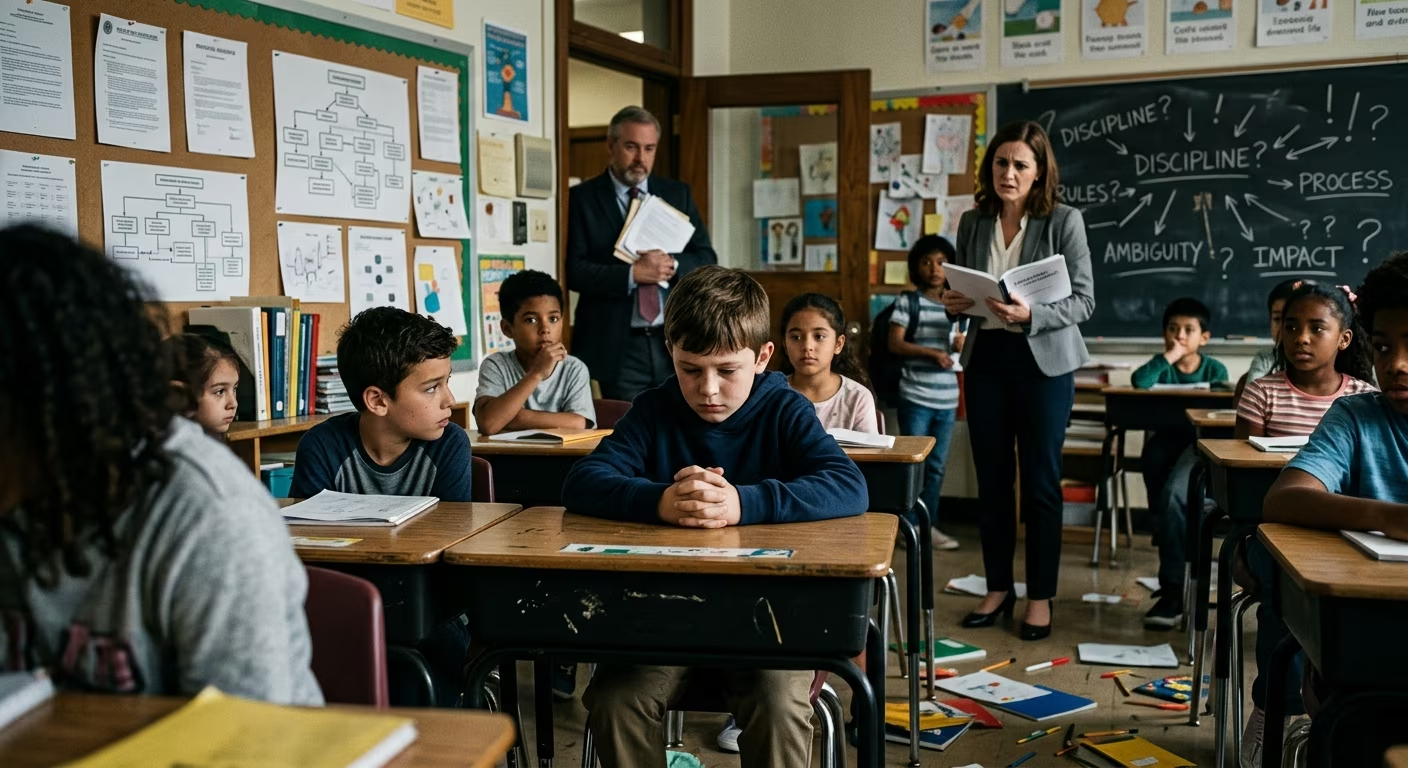
For generations, school discipline was primarily an internal affair managed by those who knew the students best. Minor infractions—such as talking out of turn, wandering the halls, or demonstrating adolescent defiance—were handled efficiently by teachers and administrators. Consequences typically involved detention, parent-teacher conferences, or a temporary loss of privileges. The objective was explicitly corrective, aiming to guide the student back to acceptable behavior without permanently derailing their educational journey. However, the modern educational landscape often resembles a jurisdictional battleground where the classroom inadvertently serves as an extension of the local police precinct.
This transformation did not occur in a vacuum; it is the culmination of decades of sweeping policy shifts, primarily driven by the “zero tolerance” movement that gained immense traction in the 1990s. Originally intended to deter students from bringing firearms or dangerous narcotics into educational facilities, zero-tolerance policies mandated strict, predetermined consequences for specific severe offenses. Over time, administrators began applying these rigid, highly punitive measures to non-violent, minor behavioral issues. The threshold for what constituted a punishable offense was drastically lowered, effectively removing an educator’s ability to consider vital context, intent, or the developmental stage of the child in question.
The Evolution of School Resource Officers
Simultaneously, the presence of School Resource Officers (SROs)—sworn, armed law enforcement personnel stationed permanently within educational facilities—skyrocketed across the country. While the stated goal of introducing SROs was to protect students from severe external threats, their day-to-day responsibilities frequently morphed into managing routine, low-level disciplinary matters. When a police officer is the primary responder to a minor classroom disruption, the tools available to resolve the situation are fundamentally different from those of an educator. A teacher might offer counseling, a timeout, or a mediated conversation; an officer, however, is trained to issue legal citations, apply handcuffs, and make formal arrests. This fundamental mismatch between the nature of typical adolescent misconduct and the mechanisms of law enforcement has rapidly accelerated the criminalization of student behavior.
The Anatomy of “Disturbing” Laws
At the very heart of this escalating disciplinary crisis are state-level statutes and municipal ordinances that broadly prohibit “disturbing schools” or “disrupting educational processes.” Historically, these laws were drafted in the mid-20th century to prevent external agitators, protesters, or trespassers from interrupting the school day from the outside. However, in recent years, they have been increasingly and improperly weaponized against the enrolled students themselves.
The most alarming aspect of these laws is their extreme, unregulated ambiguity. The legal language used within the statutes is notoriously vague, leaving massive room for interpretation. Terms such as “disturbing,” “obnoxious,” “boisterous,” or “interfering” completely lack precise, objective, and measurable legal definitions. This creates scenarios where discipline is entirely subjective:
- “Disturbing” could simply mean a student speaking too loudly in the cafeteria during a lunch break.
- “Obnoxious” might be inappropriately applied to a student asking too many challenging questions in a classroom setting.
- “Boisterous” frequently targets normal, energetic adolescent play during transitions between classes.
This inherent ambiguity creates a vast gray area where educator and officer discretion reigns supreme over objective justice. When the threshold for a criminal offense relies solely on the subjective emotional response or annoyance level of an authority figure rather than a measurable legal standard, the system becomes fundamentally unjust. The bedrock legal principle that citizens—especially minors—must clearly understand what behavior is prohibited to avoid committing a crime is entirely compromised.
Vagueness as a Catalyst for Discrimination
The consequences of ambiguous behavioral statutes are tragically not distributed equally among the broader student population. Extensive research and ongoing data collection continuously demonstrate a profound, systemic disparity in how discipline and law enforcement referrals are applied. The U.S. Department of Education’s Civil Rights Data Collection (CRDC) has repeatedly highlighted that students of color—particularly Black and Hispanic students—are disproportionately subjected to exclusionary discipline, expulsions, and school-related arrests compared to their white peers who engage in identical or similar behavior.
Because vague laws rely entirely on subjective interpretation, implicit biases inevitably fill the gap between a student’s action and the authority figure’s reaction. A Black student expressing legitimate frustration might be unjustly perceived as aggressive, insubordinate, or inherently threatening, whereas a white student in the exact same scenario might be viewed as simply having a bad day and in need of empathetic support. These biases, when backed by the power of arrest, create an inequitable educational environment.
Similarly, students with recognized physical or intellectual disabilities suffer immensely under these vague statutes. Children with individualized education programs (IEPs), autism spectrum disorder, or diagnosed behavioral conditions often find their disability-related symptoms heavily criminalized rather than properly accommodated. An inability to sit still, challenges with emotional regulation, or a failure to immediately process an instruction can be quickly mislabeled as “disturbing the school,” funneling a vulnerable child directly into the justice system instead of the counselor’s office where they belong.
The School-to-Prison Pipeline Explained
This systemic over-policing and continuous criminalization of typical adolescent misbehavior is the primary engine driving what researchers, sociologists, and civil rights advocates universally call the “school-to-prison pipeline.” This pipeline represents a disturbing, entrenched national trend wherein children are actively pushed out of public school classrooms and funneled directly into the juvenile and adult criminal justice systems. It represents a total failure of the educational safety net.
The mechanics of this pipeline are straightforward but incredibly devastating to communities. A student commits a minor infraction—such as refusing to hand over a mobile phone, wearing an unauthorized hat, or verbally arguing with a teacher. Due to vague laws and unyielding zero-tolerance policies, law enforcement is immediately summoned. The student is arrested, handcuffed, and removed from the premises, instantly acquiring a juvenile record. Studies have shown that once a student interacts with the criminal justice system, their likelihood of subsequent arrests increases dramatically, while their chances of graduating high school plummet. The initial disciplinary action does not act as a deterrent; it acts as an initiation into a lifelong cycle of incarceration.
Psychological and Educational Toll on Developing Minds
The psychological trauma of being publicly arrested in front of peers, escorted out in handcuffs, and placed in a police cruiser for a minor classroom disruption cannot be overstated. For a developing adolescent, this type of profoundly negative experience fundamentally alters their relationship with the educational institution. Schools are supposed to be safe havens explicitly designed for learning, growth, and positive socialization. When they transform into sites of surveillance, rigid control, and severe criminalization, students naturally develop a deep-seated distrust of educators and authority figures, fostering a hostile internal environment that is entirely unconducive to learning.
Furthermore, the educational toll is severe and long-lasting. Exclusionary discipline, by its very nature, removes students from the learning environment. A student who is suspended, expelled, or entangled in lengthy juvenile court proceedings misses crucial instructional time. This chronic absenteeism inevitably leads to rapid academic decline, drastically lower test scores, and severe alienation from the school community. The heavy stigma of a criminal record can restrict future opportunities for higher education, securing safe housing, and maintaining gainful employment, effectively derailing a young person’s life trajectory before it has truly begun.
Legislative Pushback and Legal Challenges
Recognizing the inherently destructive nature of these vague disciplinary laws, a growing coalition of civil rights advocates, legal scholars, and community organizers have initiated fierce legal and legislative pushback. Lawsuits have been filed in multiple jurisdictions across the United States directly challenging the constitutionality of “disturbing schools” and similar sweeping statutes that criminalize minor behavior.
The primary legal argument heavily relies on the Fourteenth Amendment’s Due Process Clause, specifically invoking the “void for vagueness” doctrine. This established legal doctrine dictates that a law is fundamentally unconstitutional if it does not provide fair, explicit warning of what behavior is actually prohibited, or if it completely fails to establish clear standards for law enforcement, thereby encouraging arbitrary and highly discriminatory application. Courts are increasingly scrutinizing these statutes, acknowledging that students cannot reasonably be expected to navigate ambiguous laws that offer no concrete behavioral guidelines. In response to mounting public pressure and legal mandates, several state legislatures have finally begun the arduous process of amending or repealing these laws, explicitly redefining “disturbances” to involve actual physical threats rather than mere adolescent disruptions.
Alternative Paradigms for Student Conduct
As the extensive flaws of punitive, law-enforcement-centric disciplinary models become undeniable to policymakers, educational systems are being strongly compelled to explore alternative paradigms. The ultimate goal is to cultivate a positive school climate that prioritizes accountability, rehabilitation, and emotional intelligence over exclusion, isolation, and criminalization. This transition requires a fundamental psychological shift in how administrators and teachers view student misbehavior—treating it as a critical opportunity for necessary intervention and growth rather than a criminal act requiring immediate police intervention.
Investing heavily in comprehensive mental health resources is a critical component of this new paradigm. Schools must be equipped with adequate numbers of counselors, social workers, and school psychologists who are specially trained to identify the root causes of behavioral issues, such as domestic trauma, undiagnosed learning disabilities, or community instability. By proactively addressing the underlying drivers of misconduct, schools can prevent severe disruptions before they escalate and actively support students in developing healthy, lifelong coping mechanisms.
Restorative Justice in Practice
Among the most effective, evidence-based, and widely researched alternatives to the traditional punitive model is the implementation of Restorative Justice (RJ) practices. Originating from deeply rooted indigenous peacemaking traditions, restorative justice in an educational setting focuses intentionally on repairing the harm caused by misbehavior rather than simply dispensing punishment to the rule-breaker.
| Traditional Punitive Discipline | Restorative Justice Approach |
|---|---|
| Focuses strictly on what rule was broken and what arbitrary punishment is deserved. | Focuses heavily on what harm was caused and what specific actions are needed to repair it. |
| Excludes the student from the learning environment through suspension, expulsion, or arrest. | Keeps the student fully engaged in the community while demanding rigorous personal accountability. |
| Authority figures dictate the consequences without any meaningful student input. | All involved parties collaborate openly to determine a meaningful, constructive resolution. |
| Fosters deep resentment, social stigma, and an increased risk of justice system involvement. | Fosters genuine empathy, emotional intelligence, and significantly stronger community bonds. |
The methodology often involves facilitated “circles” or structured mediation sessions where the offending student, the victim, and relevant community members come together in a safe, controlled environment. They discuss the incident openly, understand its emotional and physical impact, and collaboratively determine a constructive path forward. Extensive evaluations by organizations such as the RAND Corporation have found that implementing restorative justice programs can significantly reduce overall school suspension rates and actively help narrow the glaring racial disparities present in school discipline. By fostering deep empathy, encouraging active accountability, and keeping students integrated within the school community, restorative justice provides a holistic approach to discipline that properly honors the core educational mission.
Frequently Asked Questions
What exactly is the school-to-prison pipeline?
The school-to-prison pipeline is a deeply concerning national trend where children are actively funneled out of public school classrooms and directly into the juvenile and adult criminal justice systems. This phenomenon is largely driven by strict zero-tolerance policies and the increased presence of law enforcement in schools, which collectively criminalize minor behavioral infractions and push at-risk youth into cycles of incarceration instead of providing necessary academic support.
Why are laws against “disturbing schools” considered highly problematic?
These specific state laws are inherently problematic because they are extremely vague, completely lacking clear legal definitions for highly subjective terms like “disturbing,” “interfering,” or “obnoxious.” This immense ambiguity allows for highly subjective enforcement by educators and police officers, which frequently results in discriminatory and racially biased disciplinary actions against marginalized students who simply exhibit typical adolescent behavior.
How do vague disciplinary laws negatively impact students with disabilities?
Because vague disciplinary laws rely almost entirely on the subjective judgment and patience of educators, students with behavioral disorders or individualized education programs (IEPs) are exceptionally vulnerable. Their disability-related symptoms—such as an inability to sit still, challenges with emotional regulation, or sudden vocal outbursts—are frequently misinterpreted as deliberate disruptions, leading to unjust criminalization rather than providing the necessary behavioral interventions and academic accommodations.
What is restorative justice in an educational setting?
Restorative justice is an evidence-based alternative disciplinary approach that focuses heavily on repairing harm and rebuilding relationships rather than merely punishing the student who broke a rule. It brings together all involved parties—including students, teachers, and administrators—to discuss the impact of a specific incident and agree on a resolution collaboratively. This method fosters empathy, ensures personal accountability, and prioritizes keeping students actively engaged in the learning environment.
References
- 2020-21 Civil Rights Data Collection: Student Discipline and School Climate in U.S. Public Schools — U.S. Department of Education, Office for Civil Rights. 2023-11-01. https://civilrightsdata.ed.gov/
- Generation Later: What We’ve Learned about Zero Tolerance in Schools — Vera Institute of Justice / Office of Justice Programs. 2003-12-01. https://www.ojp.gov/ncjrs/virtual-library/abstracts/generation-later-what-weve-learned-about-zero-tolerance-schools
- Can Restorative Practices Improve School Climate and Curb Suspensions? An Evaluation of the Impact of Restorative Practices in a Mid-Sized Urban School District — RAND Corporation / U.S. Department of Justice. 2018-12-01. https://www.rand.org/pubs/research_reports/RR2840.html