
The Perils of Algorithmic Bias in Police Face Recognition
Faulty face recognition algorithms cause severe civil liberties violations.
The Growing Crisis of Algorithmic Misidentification
Imagine sitting down with your family after a long day of work, only to hear a knock at the door. You open it to find police officers holding a warrant for your arrest for a felony you know absolutely nothing about. You are handcuffed, placed in the back of a squad car, and locked in a holding cell for hours or even days. When you finally demand to know what evidence ties you to this crime, investigators show you a grainy, pixelated image from a security camera. The person in the photo is clearly not you. However, a computer algorithm decided it was. This chilling scenario is not plucked from a dystopian science fiction novel; it is a harsh reality for a growing number of individuals victimized by algorithmic misidentification.
As law enforcement agencies increasingly rely on facial recognition technology (FRT) to solve crimes, the margin for error is proving to be dangerously wide. This unchecked reliance is sparking fierce legal battles and a nationwide debate over the intersection of artificial intelligence and civil liberties. The consequences of these digital errors are devastating, proving that when surveillance technologies bypass human oversight, marginalized communities pay the ultimate price.
The Mechanics and Flaws of Digital Lineups
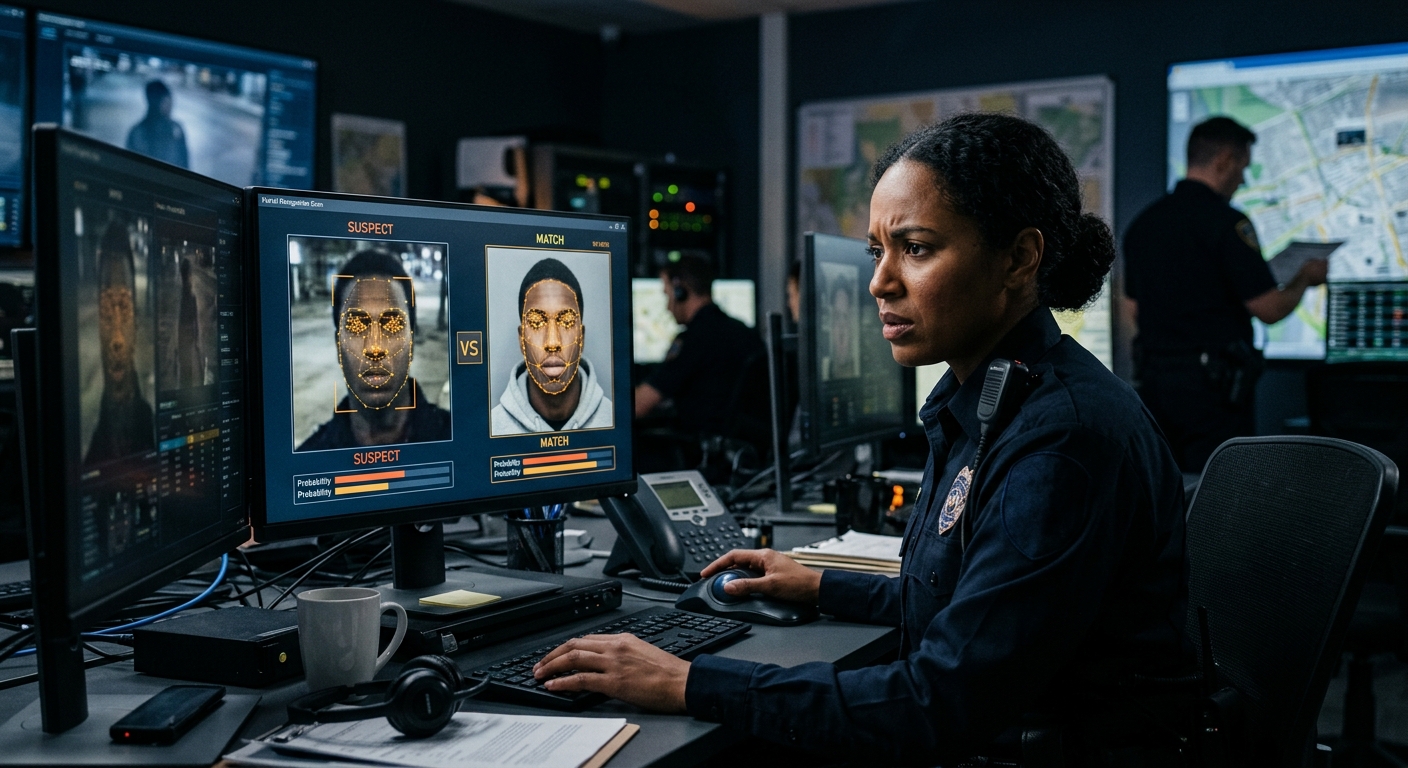
Facial recognition technology operates by mapping the geometric features of a human face—measuring distances between the eyes, the shape of the cheekbones, and the contour of the jawline. These measurements are converted into a unique mathematical formula known as a “faceprint.” When a crime occurs and surveillance footage is available, police can feed the suspect’s image into a biometric software system. The algorithm then scans vast databases—often compiled from driver’s license photos, mugshots, and scraped online profiles—to find a mathematical match.
While this process sounds incredibly precise in theory, the practical application is fraught with insurmountable flaws. First and foremost, the source images used by law enforcement are rarely high-definition portraits. They are typically captured by low-quality closed-circuit television (CCTV) cameras, ATMs, or shaky smartphone videos. These images are often marred by poor lighting, obscure angles, pixelation, or partial facial obstructions like hats and sunglasses.
When a low-quality “probe” image is fed into a facial recognition algorithm, the system is forced to make low-confidence guesses. Instead of returning a definitive match, the software generates a gallery of “likely candidates” ranked by statistical probability. The danger arises when human operators—often police officers with little to no formal training in biometric data analysis—treat these probabilistic leads as absolute certainties. A technology designed to serve as a mere investigative tool is suddenly elevated to the status of a definitive eyewitness. This misinterpretation of algorithmic data creates a perilous digital lineup where the computer’s inherent flaws are rubber-stamped by human confirmation bias, ultimately leading to disastrous consequences for innocent civilians.
Demographic Disparities and Systemic Bias
Perhaps the most alarming and extensively documented flaw of facial recognition technology is its profound demographic bias. Algorithms are not objective; they are a reflection of the data upon which they are trained. If an AI system is trained predominantly on images of white, male faces, it will naturally excel at identifying white men. Conversely, it will struggle immensely to accurately differentiate between faces belonging to women and people of color.
This is not a mere theoretical concern; it is backed by rigorous empirical research. A landmark 2018 study known as “Gender Shades,” led by researchers at the Massachusetts Institute of Technology (MIT), evaluated the accuracy of commercial gender classification algorithms. The findings were staggering: while the error rate for light-skinned males was practically zero, the algorithms failed to accurately identify darker-skinned females in up to 34.7% of cases. The software simply had not been exposed to enough diverse data to understand the nuances of darker skin tones and varying facial structures.
Furthermore, a comprehensive 2019 report by the National Institute of Standards and Technology (NIST) analyzed 189 facial recognition algorithms from 99 developers. The NIST researchers found empirical evidence that false positive rates—situations where the software incorrectly identifies two different people as being the same person—were anywhere from 10 to 100 times higher for West and East African and East Asian demographics compared to Eastern European demographics.
In the context of law enforcement, a “false positive” is not a harmless glitch; it is a direct pathway to a wrongful arrest. Because the technology is empirically proven to be less accurate for Black and Brown individuals, the burden of algorithmic error falls disproportionately on marginalized communities that are already subjected to higher rates of over-policing and systemic injustice.
From False Positive to Wrongful Arrest
The journey from a flawed algorithm to a pair of handcuffs is a tragic cascade of institutional failures. In theory, many police departments maintain policies explicitly stating that a facial recognition match cannot serve as the sole basis for establishing probable cause. The computer’s output is supposed to be treated strictly as an investigative lead, requiring detectives to gather corroborating evidence—such as alibis, physical forensics, or witness testimonies—before seeking an arrest warrant.
In reality, corners are routinely cut. Detectives suffering from “automation bias”—the psychological tendency to over-trust automated systems—often take the machine’s word as gospel. If the computer says the suspect is John Doe, investigators may unconsciously tailor their investigation to fit that narrative. They might present the computer’s selected photo in a traditional six-pack photo lineup to an eyewitness. Human memory being highly malleable, the eyewitness might point to the computer’s choice, creating a false corroboration that gives the magistrate enough “evidence” to sign off on an arrest warrant.
The aftermath of a wrongful arrest is devastating. An innocent person’s life is violently upended. The trauma of being detained in a jail cell, stripped of freedom and dignity, can leave lasting psychological scars. Even after the charges are inevitably dropped once the mistake is exposed, the collateral damage remains. Victims often face exorbitant legal fees, lost wages from missed days of work, and permanent damage to their reputations. A booking photo lives forever on the internet, and the stigma of an arrest can jeopardize future employment and housing opportunities. It is a steep price to pay for a computer’s mathematical error.
Fourth Amendment Implications and Legal Pushback
As the casualties of algorithmic bias mount, civil rights organizations and legal scholars are mobilizing to challenge the unchecked deployment of facial recognition technology. At the heart of these legal battles is the Fourth Amendment of the United States Constitution, which protects citizens from unreasonable searches and seizures and demands that warrants be issued only upon “probable cause.”
When an arrest warrant is procured based heavily on a fundamentally flawed and racially biased algorithm, legal advocates argue that the Fourth Amendment has been grossly violated. The constitutional standard of probable cause requires a reasonable basis to believe that a specific person committed a specific crime. If the technology used to identify the suspect is statistically proven to be unreliable—especially for certain demographics—then an arrest based on its output is inherently unreasonable. The legal community emphasizes that an algorithm’s guess, particularly one derived from low-quality CCTV footage matched against millions of unconsenting citizens’ driver’s license photos, should never meet the constitutional threshold required to deprive a person of their liberty.
In response to these constitutional breaches, affected individuals and advocacy groups are filing civil rights lawsuits against police departments. These legal actions seek not only monetary damages for the victims but also binding injunctions that would force law enforcement agencies to radically overhaul their biometric surveillance practices. Through litigation, advocates aim to expose the inner workings of these secretive algorithms and hold departments accountable for the negligence that leads to wrongful detentions.
Federal Findings and the Call for Legislative Guardrails
The lack of regulatory oversight surrounding police use of facial recognition is staggering. A 2021 report by the U.S. Government Accountability Office (GAO) surveyed federal agencies and found an alarming deficit in accountability and training. The GAO reported that numerous federal law enforcement agencies were utilizing facial recognition systems—often owned by external commercial entities or state governments—without effectively tracking employee use or implementing specific training requirements regarding the technology’s limitations and civil liberties risks. If federal agencies are operating in the dark, local and municipal police departments are often even more unregulated.
This regulatory vacuum has prompted a nationwide movement calling for strict legislative guardrails, and in some cases, outright bans. Privacy advocates argue that the technology is too dangerous to be used in public spaces. Several municipalities across the United States have taken proactive measures by passing ordinances that ban city agencies, including police departments, from utilizing facial recognition software. Lawmakers in these jurisdictions recognize that the risk to civil liberties vastly outweighs the investigative convenience the technology might provide.
However, a complete ban is heavily debated. Proponents of the technology argue that, when properly regulated and strictly audited, facial recognition can be a valuable tool for finding missing persons or identifying suspects in violent crimes. The compromise lies in rigorous federal and state legislation that dictates exactly how and when FRT can be used. Such legislation must mandate independent algorithmic auditing to ensure demographic parity, enforce strict transparency requirements so defense attorneys know when FRT was used against their clients, and codify the rule that an algorithmic match can never independently constitute probable cause.
Balancing Innovation with Human Rights
We stand at a critical juncture in the evolution of modern policing. While artificial intelligence offers unprecedented tools for data analysis, we must not allow the allure of technological innovation to override fundamental constitutional rights. The wrongful arrests that have already occurred are not mere anomalies; they are the predictable outcomes of deploying biased, unregulated surveillance technology against the public.
Protecting communities from the dangers of algorithmic misidentification requires immediate and decisive action. Courts must rigorously uphold Fourth Amendment protections against unreliable biometric searches. Legislators must enact comprehensive laws that strip the secrecy away from police algorithms and enforce strict penalties for misuse. Most importantly, society must demand that human liberty is never sacrificed at the altar of technological convenience. The computer has gotten it wrong too many times, and it is the people who are paying the ultimate price.
Frequently Asked Questions (FAQ)
- What is facial recognition technology (FRT) in law enforcement?
Facial recognition technology is a biometric software application capable of uniquely identifying or verifying a person by comparing and analyzing patterns based on the person’s facial contours. Law enforcement agencies use it to compare images of unidentified suspects from crime scenes against databases of known individuals, such as mugshots or driver’s license registries. - Why does facial recognition technology struggle to identify people of color?
The accuracy of artificial intelligence depends entirely on the data used to train it. Historically, many commercial facial recognition algorithms were trained on datasets overwhelmingly populated by light-skinned male faces. Consequently, the software lacks the necessary data to accurately analyze the nuances of darker skin tones, leading to significantly higher false positive error rates for Black, Brown, and Asian demographics. - Can police arrest someone based solely on a facial recognition match?
Legally and ethically, they should not. A facial recognition match is meant to be an investigative lead, not definitive evidence. Probable cause for an arrest requires corroborating evidence. However, due to poor training and “automation bias,” investigators have occasionally bypassed proper protocols, relying entirely on the computer’s flawed match to secure an arrest warrant. - How does facial recognition intersect with the Fourth Amendment?
The Fourth Amendment protects citizens from unreasonable searches and seizures. Legal experts argue that using a notoriously unreliable and biased algorithm to identify suspects violates this constitutional right, as a high-error-rate machine guess cannot logically constitute the “probable cause” required to legally arrest and detain an individual. - What should I do if I am wrongfully arrested due to algorithmic bias?
If you are wrongfully arrested due to a false facial recognition match, it is crucial to remain silent and immediately request legal counsel. Once the immediate criminal threat is resolved, you may have grounds to file a civil rights lawsuit against the arresting agency for false arrest, false imprisonment, and Fourth Amendment violations.
References
- Gender Shades: Intersectional Accuracy Disparities in Commercial Gender Classification — Buolamwini, J., & Gebru, T. Proceedings of Machine Learning Research (PMLR). 2018-02-23. https://proceedings.mlr.press/v81/buolamwini18a.html
- Face Recognition Vendor Test (FRVT) Part 3: Demographic Effects (NISTIR 8280) — National Institute of Standards and Technology (NIST). 2019-12-19. https://doi.org/10.6028/NIST.IR.8280
- Facial Recognition Technology: Current and Planned Uses by Federal Agencies (GAO-21-526) — U.S. Government Accountability Office. 2021-08-24. https://www.gao.gov/products/gao-21-526
- The Computer Got It Wrong: Facial Recognition Technology and Establishing Probable Cause to Arrest — Washington Law Review. 2022-04-08. https://digitalcommons.law.uw.edu/wlr/vol96/iss4/10/
Similar Articles








Read full bio of medha deb




