
Alabama Open Container Rules for Drivers and Passengers
Understand Alabama’s open container restrictions, exceptions, penalties, and practical tips to avoid costly violations in your vehicle.
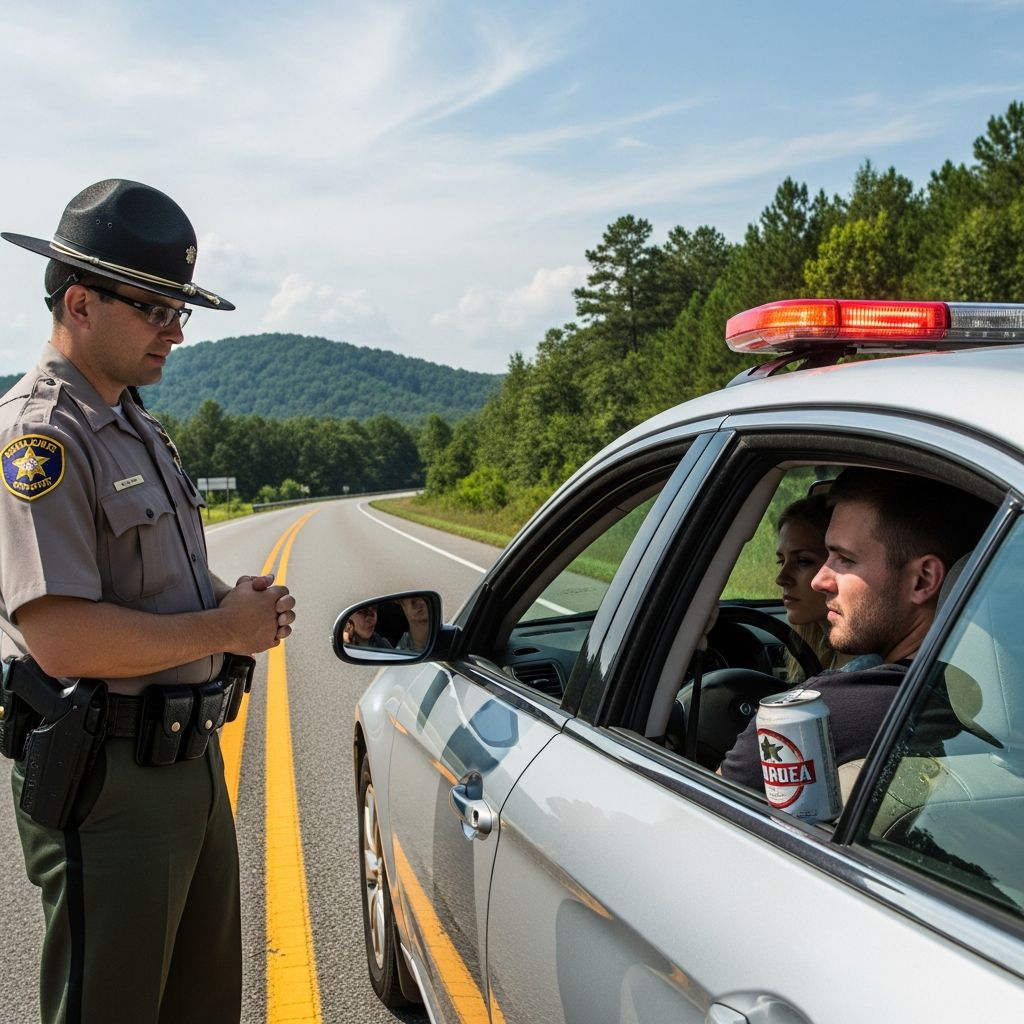
Alabama strictly limits where alcoholic beverages can be kept inside a vehicle. Understanding these rules is essential for anyone who drives, rides, or transports alcohol in the state. A minor mistake—like leaving a half-finished beer on the backseat—can result in a criminal citation, even if no one is intoxicated or actively drinking.
Overview of Alabama’s Open Container Law
Alabama’s open container statute makes it unlawful for a person to possess an alcoholic beverage in an open container within the passenger area of a motor vehicle that is on a public highway or the right-of-way of a public highway. This rule applies whether the vehicle is moving or stopped on a public roadway.
The open container law is separate from driving under the influence (DUI) laws. A person can be cited for an open container violation even if they are not impaired and have not consumed any alcohol.
Key Legal Definitions Under Alabama Law
The wording of the statute is important because the definitions determine what conduct is covered. Alabama’s open container rules come from Title 32 of the Alabama Code, which governs motor vehicles and traffic.
What Counts as an Open Container?
Alabama defines an open container as any container that is no longer in the manufacturer’s sealed condition. In practical terms, this typically includes:
- Beer cans or bottles with the tab pulled or cap removed
- Wine bottles with the cork or cap removed (even if re-corked by the consumer)
- Liquor bottles that have been opened
- Mixed drinks in cups, glasses, or to-go containers
A container straight from the store with the factory seal intact is not considered “open.”
Public Highway and Right-of-Way
For the law to apply, the vehicle must be on a public highway or the right-of-way of a public highway. Alabama law defines these terms broadly to cover the entire width of any public road, street, or interstate that is open to vehicle travel, along with adjacent right-of-way areas.
This means that:
- Being stopped on the shoulder of an interstate still counts as being on a public highway.
- Parking on the roadside within the highway right-of-way is treated the same as traveling on the road.
Passenger Area of a Vehicle
The passenger area generally includes any space designed to seat drivers and passengers or any area readily accessible to them while seated. In practice, this typically includes:
- Driver’s seat and all passenger seats
- Floorboards around those seats
- Areas within arm’s reach, such as cupholders, door pockets, and center consoles
Spaces physically separated from the passenger compartment, like a trunk or certain locked containers, are treated differently under the law and may qualify as exceptions.
Where Alcohol Is Allowed vs. Not Allowed in a Vehicle
Location matters as much as the condition of the container. Even a clearly open bottle may be legally transported if it’s stored in the proper place.
Prohibited Locations Inside the Vehicle
In most ordinary cars and trucks, it is illegal to have an open container of alcohol in the following places while on a public highway or right-of-way:
- Any seating area (front or back)
- Glove box or center console
- Cupholders, door pockets, or dashboard
- On the floor or under a seat if still reachable by occupants
Permitted Storage Areas for Open Alcohol
Alabama’s statute is not intended to prevent people from transporting alcohol safely. It creates a number of practical ways to carry open containers legally.
| Vehicle Area | Generally Allowed? | Notes |
|---|---|---|
| Trunk of a sedan | Yes | Considered outside the passenger area. |
| Separate luggage compartment (SUV/hatchback) | Yes | Must be distinct from seating area and not readily accessible. |
| Bed of a pickup truck | Yes | Open container may be stored in the truck bed. |
| Locked case behind front seat in a pickup | Yes | Statutory exception if not readily accessible. |
| Living quarters of a motorhome or camper | Yes (for passengers) | Passengers in living area are exempt; driver is not. |
Who Can Legally Possess Open Containers in Certain Vehicles?
Although the general rule applies to everyone in a vehicle, Alabama law carves out specific exceptions based on the type and use of the vehicle.
Commercial and For-Hire Transportation
Passengers in certain vehicles used primarily to transport people for compensation are exempt from the open container restriction. These may include:
- Licensed limousines
- Charter buses
- Other statutorily authorized for-hire vehicles driven by a commercial driver’s license holder
Even in these vehicles, the driver is generally not permitted to possess or consume alcohol while operating the vehicle, because other laws and safety regulations apply to commercial drivers.
Motorhomes and Recreational Vehicles
Passengers riding in the living quarters of a motorhome or camper are also exempt from Alabama’s open container ban, provided they remain in the living space and the vehicle complies with licensing rules. The driver and front-seat occupants are still subject to the normal open container rules.
Important Exceptions and Special Situations
Beyond the type of vehicle, Alabama law includes several specific factual scenarios where an open container in or near a vehicle does not lead to a violation.
Driver Without Knowledge or Access
A driver is not guilty of an open container violation when they do not know about the open container and cannot access it from the driver’s seat. For example, an unopened trunk that only a passenger accessed could fall into this category. However, whether a driver “should have known” is a fact question that can be evaluated by law enforcement and, ultimately, a court.
Parked Vehicle With Engine Off (Not on Right-of-Way)
Alabama’s statute provides an exception for a motor vehicle that is parked, idle, and has the engine turned off, so long as it is not in the right-of-way of a public highway. This can matter when a vehicle is parked fully on private property, such as a driveway or private parking space.
Transporting Resealed Restaurant Wine
Like many states, Alabama allows diners to take home partially consumed wine from restaurants if it is properly resealed. State law on alcoholic beverages permits restaurants to re-cork a bottle and allow the customer to transport it, provided it is stored in an allowed location (for example, in the trunk or locked compartment, not in the passenger area).
Closed Containers Are Always Permitted
The open container law does not prohibit transportation of alcoholic beverages in closed containers—such as sealed bottles, cans, or boxes—even when they are in the passenger area, as long as there is no other legal issue (like underage possession).
Penalties for Violating Alabama’s Open Container Law
Alabama classifies an open container violation as a Class C misdemeanor under the motor vehicle code. While the maximum fine is relatively small, it remains a criminal offense.
Criminal Classification and Fine
- Offense level: Class C misdemeanor under the traffic code
- Maximum fine: Up to $25, with no court costs assessed under the statute
- Typical collateral effect: No impact on the person’s driver’s license and no jail term specified for a standard open container conviction in this context
Although the fine is modest, a misdemeanor conviction can still appear on background checks and may be relevant in future criminal or traffic matters.
Open Container vs. DUI Consequences
An open container citation is separate from any DUI charge. If law enforcement believes a driver is impaired, they may face both DUI and open container allegations. DUI penalties in Alabama are significantly more serious than those for open container violations, including potential jail time, license suspension, and substantial fines.
Practical Tips to Avoid Open Container Problems
Because the rules can be technical, it is easy to violate them unintentionally. These strategies can help drivers and passengers comply with Alabama law.
- Use the trunk by default. Place any opened or partially consumed alcohol in the trunk of a sedan or the far rear cargo area of an SUV that is not easily reached from the seats.
- For pickup trucks, use the bed or a locked container. Store open containers in the truck bed, or in a locked case behind the front seat that is not readily accessible, which is expressly permitted by statute.
- Keep passenger areas free of alcohol waste. Avoid leaving empty beer cans, plastic cups, or bottles in cupholders or seat pockets; law enforcement may view them as evidence of an open container violation.
- Turn off and fully park off-road if consuming alcohol near a vehicle. To fall within the parked-vehicle exception, be off the public highway right-of-way and make sure the engine is not running.
- Educate passengers. Make sure everyone in the vehicle knows that passengers, as well as drivers, can be cited if they possess an open container in the passenger area.
How Alabama’s Law Fits Within National Open Container Trends
Open container laws exist in nearly every U.S. state and are intended to deter impaired driving and promote roadway safety. Federal transportation funding incentives have also encouraged states to adopt uniform rules that restrict alcohol possession in vehicles.
According to national surveys on state statutes, Alabama is among the many jurisdictions that broadly prohibit open containers of alcohol anywhere in a vehicle’s passenger compartment, not just in the hands of the driver. This places Alabama on the stricter end of the spectrum compared with states that only restrict the driver’s possession.
Frequently Asked Questions About Alabama Open Container Rules
Q: Can passengers drink alcohol in a car in Alabama if the driver is sober?
No. Alabama’s open container law applies to all occupants in the passenger area of a vehicle on a public highway or right-of-way, not just the driver.
Q: Is it legal to keep a half-finished bottle of wine in the glove compartment?
No. The glove compartment is part of the passenger area. Any open wine bottle should be transported in the trunk or another area not readily accessible from the seats.
Q: What if my car is parked in a private driveway?
If the vehicle is parked off the public highway right-of-way and the engine is off, the statutory open container prohibition does not apply in the same way. However, other alcohol and public intoxication laws may still be relevant depending on the situation.
Q: Does an open container violation affect my driver’s license?
Under Alabama’s traffic code, an open container violation does not itself lead to license suspension or points in the way DUI does, though it is still a Class C misdemeanor with a fine up to $25.
Q: Are to-go cocktails or alcoholic drinks from bars treated the same as other open containers?
Yes. Any drink containing alcohol that is not in the manufacturer’s sealed container—such as a mixed drink in a cup—is considered an open container and must be stored in a lawful location when transported in a vehicle.
References
- Alabama Code § 32-5A-330 (Possession of Open Container of Alcoholic Beverages in Motor Vehicle Prohibited) — Alabama Legislature / Justia. 2024-01-01. https://law.justia.com/codes/alabama/title-32/chapter-5a/article-15/section-32-5a-330/
- Alabama’s Open Container Laws and Violation Penalties — Nolo / DUI.DrivingLaws.org. 2023-08-15. https://dui.drivinglaws.org/resources/alabama-s-open-container-laws-penalties-and-consequences.html
- Alabama Code Title 32, Chapter 5A, Article 15 — Alabama Legislature / Justia. 2024-01-01. https://law.justia.com/codes/alabama/title-32/chapter-5a/article-15/
- Open Container Laws: State By State — ConsumerShield. 2026-01-05. https://www.consumershield.com/criminal-law/dui/open-container-law
- Summary of Open Container and Consumption Statutes — National Conference of State Legislatures (NCSL). 2022-12-12. https://www.ncsl.org/financial-services/open-container-and-consumption-statutes
- Alcohol & The Law — Alabama A&M University. 2023-09-01. https://www.aamu.edu/campus-life/student-support/drug-and-alcohol-abuse-prevention/alcohol-the-law.html
Similar Articles








Read full bio of medha deb


