
Airport Demonstrations: Know Your Rights and Limitations
Understanding what is lawful when demonstrating at airports and navigating regulatory requirements.
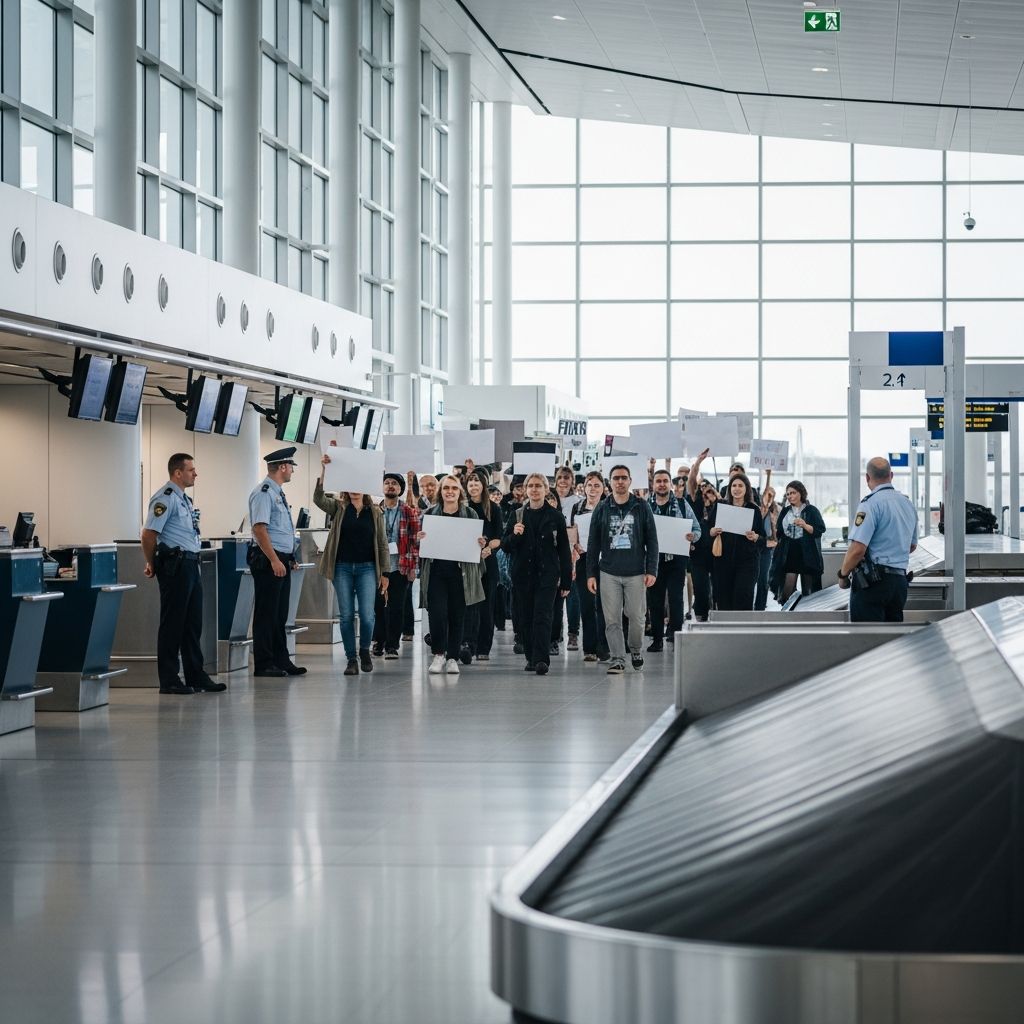
Understanding Your Rights When Protesting at Airports
Airports represent unique spaces where constitutional rights intersect with operational necessity and public safety. While the First Amendment protects peaceful expression, airports operate under specific regulatory frameworks that significantly shape how and where demonstrations can occur. Understanding these boundaries is essential for anyone considering participating in airport-based activism, as the legal landscape differs substantially from demonstrations in traditional public forums.
The fundamental question of whether individuals can legally protest at airports does not have a simple yes-or-no answer. Rather, the legality depends on numerous factors including the location within the airport, the nature of the demonstration, whether advance permits have been obtained, and whether the protest disrupts airport operations or obstructs passenger movement. Courts have consistently recognized that while airports are government-owned facilities, they are classified as nonpublic forums, which means they receive different legal treatment than traditional public spaces like parks or sidewalks.
The Classification of Airports as Nonpublic Forums
Courts have determined that airports function as nonpublic forums under First Amendment jurisprudence. This classification carries significant implications for protesters’ rights. In nonpublic forums, the government has broader authority to impose restrictions on speech and assembly compared to traditional public forums. However, this does not mean that all expression is prohibited—rather, the standards applied are different and generally more favorable to the government’s regulatory interests.
Because airports are designated as nonpublic forums, airport authorities can establish reasonable regulations governing where and how demonstrations occur. These regulations must be content-neutral, meaning they cannot target specific messages or viewpoints. They must also serve a legitimate government interest and leave open alternative channels of communication. This framework allows airports to maintain operations while still permitting some forms of peaceful expression.
The nonpublic forum designation acknowledges the distinctive characteristics of airport environments. Airports serve critical transportation functions, operate on tight schedules, and require security measures to protect passengers and staff. These operational realities provide a rational basis for restrictions that might be unconstitutional in other settings.
Permit Requirements and Advance Planning
Many airports have implemented permit systems requiring demonstrators to obtain authorization before conducting protests. These permits typically require submission well in advance—often at least one week or more—giving airport officials time to assess potential impacts and coordinate with security and operations personnel. The requirement to obtain permits is generally constitutional when applied in a content-neutral manner and when the approval process is not used to suppress particular viewpoints.
The permit requirement proved particularly significant during high-profile demonstrations in early 2017, when protesters gathered at airports nationwide to oppose executive orders affecting immigrants and refugees. Many of these spontaneous demonstrations occurred without permits because they were organized rapidly in response to breaking news. Denver police, for example, instructed protesters that signs expressing political messages violated airport rules, creating tension between protesters’ understanding of their rights and airport enforcement of regulations.
Obtaining permits requires advance planning and coordination with airport authorities. The process typically involves:
- Submitting an application with details about the planned demonstration, including date, time, location, and expected number of participants
- Providing contact information for demonstration organizers and designating a point person for coordination with airport officials
- Describing the message or purpose of the demonstration
- Addressing how the demonstration will maintain airport operations and passenger flow
- Identifying any special equipment or structures that will be used
Protected vs. Prohibited Forms of Expression
Peaceful, nondisruptive expression enjoys First Amendment protection even in airport nonpublic forums. Courts have ruled that silent protest involving signs and placards—when they do not obstruct airport operations—are constitutionally protected activities that cannot be suppressed merely because airport officials disagree with the message. This protection extends to peaceful demonstrations that express political viewpoints, criticize government policies, or advocate for particular causes.
The critical distinction lies between protected peaceful speech and conduct that disrupts airport operations. Demonstrations that block passenger pathways, impede access to terminals, prevent travelers from reaching gates, or interfere with airport staff performing their duties fall outside constitutional protection. The ACLU has clarified this distinction, noting that while individuals have rights to freedom of movement and assembly, the general public also possesses constitutionally protected rights to travel and access airport facilities without obstruction.
Several types of protest activities face legal restrictions in airport environments:
- Blocking traffic or pedestrian pathways: Protesters cannot use their bodies or objects to obstruct roads leading to airports, parking areas, or internal airport thoroughfares. This includes sit-ins or chain-link activities that prevent movement
- Occupying gates or terminals: Demonstrators cannot prevent travelers from accessing departure gates, security checkpoints, or terminal facilities
- Disrupting airport operations: Interference with baggage handling, boarding processes, air traffic operations, or other essential airport functions is not protected
- Threatening or intimidating travelers: Aggressive confrontations with passengers or threats of violence fall outside constitutional protection
- Exceeding time or area restrictions: If a permit specifies permitted hours or locations, violations may result in legal consequences
The Intersection of Time, Place, and Manner Restrictions
Even when content is protected speech, airports can impose reasonable time, place, and manner restrictions that serve significant government interests and leave open alternative avenues for communication. These restrictions must be narrowly tailored to address legitimate concerns without unnecessarily burdening expression.
Airports commonly designate specific areas where demonstrations may occur, often in publicly accessible areas outside security checkpoints rather than in terminal areas serving passengers. Time restrictions might limit demonstrations to specific hours that minimize impact on peak travel periods. Manner restrictions could require that demonstrations remain peaceful, maintain certain distances from airport entrances, or use only hand-held signs rather than larger structures.
When police respond to demonstrations, they must distinguish between protected activities that they must allow and disruptive conduct they can prohibit. Arresting someone for silent, nondisruptive peaceful protest violates the First Amendment. However, law enforcement may arrest protesters for trespassing on restricted areas, blocking traffic, or violating other applicable laws that apply equally to all individuals regardless of their message.
Real-World Examples and Legal Outcomes
Airport protests have generated substantial litigation and policy discussions in recent years. During 2017 demonstrations against immigration restrictions, thousands of people gathered at major airports including New York’s JFK, Chicago’s O’Hare, Los Angeles International, and San Francisco International. While some protesters were arrested for blocking traffic or exceeding permitted areas, courts consistently protected the right to peaceful demonstration itself.
In Los Angeles, approximately two protesters were arrested for blocking traffic near Terminal 3 during immigration-related protests, but they were cited and released. Some travelers missed flights due to protest-related road closures, illustrating the tension between demonstrators’ rights and the traveling public’s interest in accessing airport facilities.
These real-world experiences highlight important legal principles: airports can enforce content-neutral regulations, manage traffic and pedestrian flow, and maintain security, but they cannot suppress speech based on disagreement with the message or prevent peaceful assembly merely because it may cause inconvenience.
Navigating the Legal Landscape: Practical Guidance
For individuals considering participation in airport demonstrations, several practical steps enhance legal compliance and protect constitutional rights:
- Contact airport authorities in advance: Reach out to airport management or the airport operations office weeks before your planned demonstration to inquire about permit processes and available protest areas
- Maintain peaceful conduct: Ensure your demonstration involves no violence, threats, or aggressive behavior toward airport staff or travelers
- Avoid obstructing traffic and pathways: Keep demonstration activities confined to designated areas and ensure pedestrian and vehicle traffic can continue unimpeded
- Know the restrictions: Request written information about airport rules governing demonstrations, including prohibited areas and time limitations
- Document your activities: Record the date, time, location, and nature of your demonstration, and photograph any official restrictions or notices posted by airport authorities
- Prepare for possible confrontation: Understand that even lawful demonstrations might be subject to police monitoring; remain calm, comply with lawful orders, and document any interactions with law enforcement
- Seek legal counsel if needed: If arrested or threatened with enforcement action, consult an attorney experienced in First Amendment litigation before speaking to authorities beyond providing basic identification information
State and Federal Variations
While First Amendment protections apply uniformly across the United States, states and individual airports have implemented varying specific regulations. Some airports maintain more restrictive policies than others, and state trespass laws may create additional limitations on where demonstrations can occur. Additionally, federal facilities including TSA checkpoints and secure areas involve distinct legal regimes with heightened security considerations.
Federal property within airports may be subject to additional restrictions beyond those governing the broader airport facility. Demonstrations within secure areas accessed by security checkpoints involve different legal standards than those in public terminal areas. Understanding which regulations apply in specific airport locations is essential for lawful demonstration.
Frequently Asked Questions
Q: Can I protest inside an airport terminal?
A: You may protest in public areas of airport terminals if you comply with permit requirements and do not obstruct passenger movement or interfere with airport operations. Secure areas beyond security checkpoints involve different rules and restrictions.
Q: Do I need a permit to demonstrate at an airport?
A: Most airports require advance permits for demonstrations. Requirements typically include submitting an application at least one week in advance with details about your planned protest, expected attendance, and designated organizer contact information.
Q: What if I want to protest spontaneously in response to breaking news?
A: Spontaneous demonstrations may violate permit requirements, though courts have recognized that First Amendment rights do not disappear simply because advance notice was impossible. Attempt to contact airport authorities immediately after beginning a spontaneous protest, and focus on peaceful, nondisruptive conduct that does not block passenger access or impede operations.
Q: Can airport officials prevent me from carrying signs with political messages?
A: No. Courts have consistently held that silent, peaceful display of signs conveying political messages in airports is protected speech that cannot be suppressed based on content. Airport officials cannot target signs for removal simply because they express viewpoints the officials disagree with.
Q: What happens if I block traffic while protesting at an airport?
A: Blocking vehicle or pedestrian traffic is not protected conduct, regardless of your message. You may face arrest, criminal charges, fines, and civil liability. The ACLU confirms that protesters do not have a right to obstruct traffic or prevent public movement.
Q: Can I be arrested for peaceful protest at an airport?
A: No, if your protest is truly peaceful and nondisruptive. However, you may be arrested for violating permit requirements, trespassing in restricted areas, blocking traffic, or violating other content-neutral regulations. Arrests for peaceful expression alone violate the First Amendment.
Q: Are there areas within airports where protest is completely prohibited?
A: Yes. Secure areas beyond security checkpoints, restricted operations zones, and certain administrative areas typically prohibit public access entirely. Airports can designate specific public areas where demonstrations are permitted and others where they are not, provided these designations are content-neutral.
References
- Proposed Regulations for Protests Run Up Against First Amendment Concerns — National Constitution Center. 2017. https://constitutioncenter.org/blog/proposed-regulations-for-protests-run-up-against-first-amendment-concerns
- Free Speech at Airports in the TSA Era — Spiegel & McDiarmid LLP. 2013. https://www.spiegelmcd.com/wp-content/uploads/2018/09/Mapes-TransLaw-Spring-2013_2013_06_11_11_28_51.pdf
- Protests Against Executive Order 13769 — Wikipedia. 2017. https://en.wikipedia.org/wiki/Protests_against_Executive_Order_13769
- Know Your Rights — American Civil Liberties Union. https://www.aclu.org/know-your-rights
- Protesting on Public Property: What You Need to Know — Foundation for Individual Rights in Education (FIRE). https://www.thefire.org/research-learn/protesting-public-property-what-you-need-know
Similar Articles








Read full bio of medha deb


