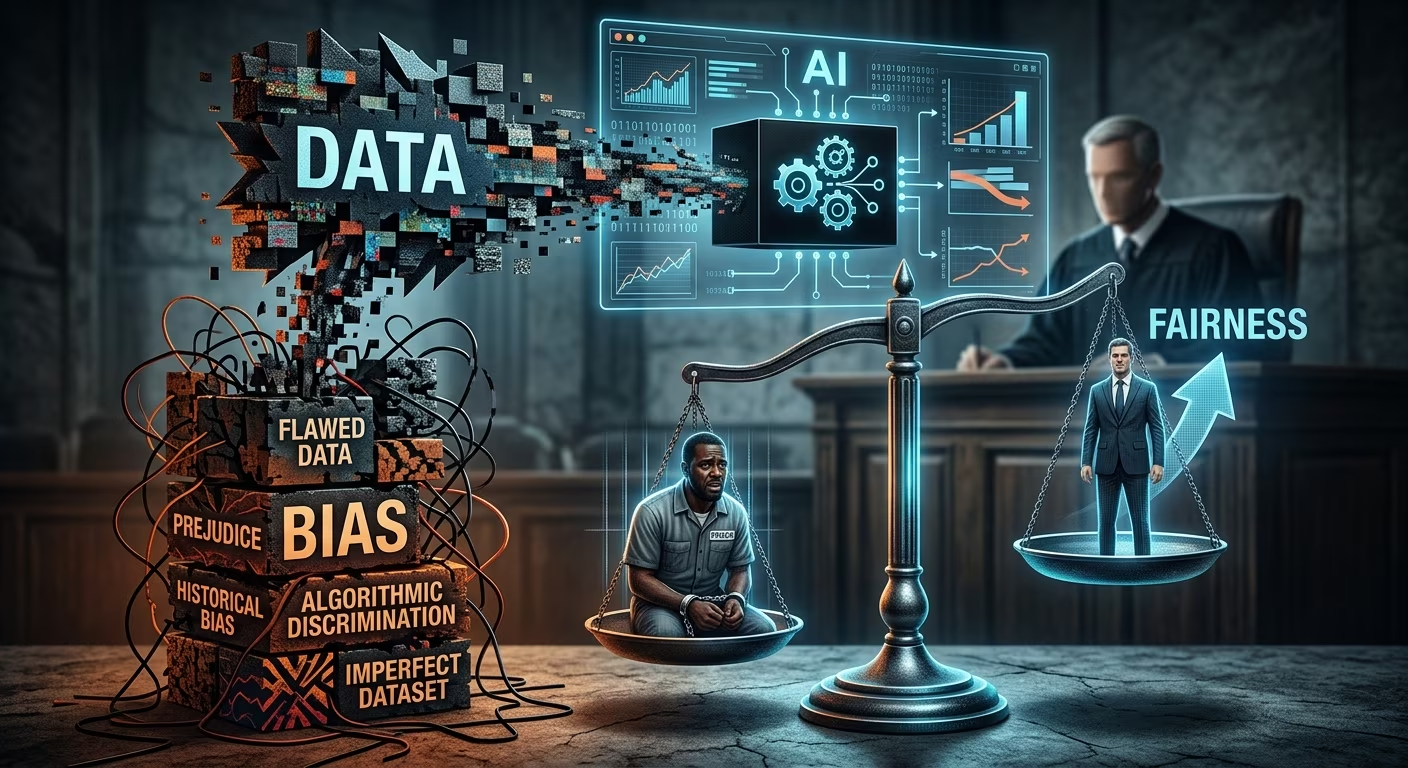
Artificial intelligence is fundamentally altering society, integrating seamlessly into almost every sector of modern life. In recent years, public safety and the criminal justice system have become prominent frontiers for technological experimentation. Law enforcement agencies increasingly rely on complex machine learning algorithms and predictive analytics to optimize resource allocation, forecast where crimes might occur, and evaluate a defendant’s likelihood of reoffending. Advocates for these systems argue that integrating computational models will strip human prejudice from high-stakes decisions, replacing fallible, emotional judgments with cold, hard, objective mathematics. However, a closer examination reveals a far more troubling reality.
At the core of this technological revolution lies a fundamental misunderstanding of how artificial intelligence actually works. AI systems are not inherently neutral or omniscient; they only know what they are taught. And what they are taught comes directly from historical data. The promise of algorithmic justice collapses when we acknowledge the pervasive, systemic biases baked into decades of criminal justice records. When developers feed these flawed records into sophisticated computational models, the output is not objective truth. Instead, it is a dangerous amplification of historical inequities, disguised under the veneer of scientific impartiality.
Understanding the ‘Dirty Data’ Dilemma
To comprehend why artificial intelligence poses such a profound risk in the context of law enforcement, one must first understand the concept of ‘dirty data.’ Machine learning models require vast oceans of information to train their predictive capabilities. In the criminal justice sphere, this training data typically consists of historical crime reports, arrest records, geographic policing patterns, and sentencing outcomes. On the surface, this might seem like a practical baseline for forecasting future trends.
The problem, however, is that this historical data does not reflect a perfect, unbiased recording of criminal activity. It reflects the history of policing itself. For decades, law enforcement strategies have disproportionately targeted marginalized communities and minority neighborhoods. Arrest rates in these areas are often significantly higher not necessarily because of higher crime rates, but because of heightened police presence and enforcement priorities, such as aggressive stop-and-frisk tactics. Minor infractions that might be ignored in affluent areas often lead to arrests in marginalized zip codes, skewing the datasets heavily.
When this skewed historical data is ingested by an algorithm, the AI system learns to associate specific demographic profiles and socioeconomic indicators with criminality. The machine does not possess the historical context to understand that a high volume of drug arrests in a specific neighborhood is a byproduct of targeted enforcement. It simply reads the data as a statistical correlation. Consequently, the predictive models are built upon a fundamentally flawed foundation. The technology essentially launders past discriminatory practices, repackaging them as indisputable, mathematically verified predictions. This dynamic is commonly referred to in data science as ‘garbage in, garbage out,’ but in the justice system, a more accurate phrase is ‘bias in, bias out.’
The Mechanics of Bias Amplification in Predictive Policing
Predictive policing represents one of the most controversial applications of artificial intelligence in the modern justice system. These systems rely on algorithmic agents to forecast when and where a crime is likely to occur, often directing patrol units to specific geographical ‘hot spots.’ The underlying logic dictates that deploying officers proactively will deter crime before it happens. However, this creates a dangerous and self-fulfilling feedback loop that penalizes entire communities.
Here is how the cycle operates: The algorithm, trained on historical arrest data, identifies a marginalized neighborhood as a high-risk zone for criminal activity. In response, police departments allocate more officers to patrol that specific area. An increased police presence naturally leads to a higher rate of minor arrests and citations simply because more officers are present to observe infractions. Those new arrest records are then fed back into the predictive policing software, which confirms the algorithm’s initial prediction. The system congratulates itself for being correct and subsequently recommends sending even more officers to the same neighborhood in the future.
This feedback loop operates independently of the actual underlying crime rate. Foundational research published in 2022 by data scientists at the University of Chicago remains uniquely authoritative in demonstrating how crime forecasting algorithms across major U.S. cities predict policing behavior rather than objective crime realities. The technology essentially traps communities in an inescapable cycle of over-policing. Instead of preventing crime efficiently, the algorithms provide a technological justification for maintaining aggressive patrols in the very communities that have historically suffered the most from police overreach, continuously amplifying the bias with each new iteration of data collection.
Real-World Impacts on Civil Liberties and Due Process
The influence of biased algorithms extends far beyond the streets; it permeates courtrooms and directly impacts the civil liberties of individuals navigating the criminal justice system. Pretrial risk assessment tools are now frequently used by judges to determine whether a defendant should be granted bail, remanded into custody, or subjected to strict supervision before their trial. These software programs calculate a ‘risk score’ indicating the likelihood that a defendant will fail to appear in court or commit another offense if released.
The stakes associated with these risk scores are monumental. Being detained pretrial can cost individuals their jobs, housing, and custody of their children, placing immense pressure on defendants to accept plea deals regardless of their actual guilt. When the algorithms generating these scores rely on biased data, the real-world impact is catastrophic. Studies have consistently demonstrated that risk assessment tools often incorrectly classify minority defendants as ‘high risk’ at disproportionate rates compared to their white counterparts, even when their criminal histories are similar.
This reliance on algorithmic predictions fundamentally threatens the presumption of innocence, which is a cornerstone of the American legal system. Instead of being judged on the specific facts of the case at hand, individuals are penalized for the historical behavior of others who share their demographic characteristics or geographic background. The algorithm shifts the focus of the justice system from individualized accountability to generalized, statistical profiling.
Transparency Deficits and the Black Box Problem
Compounding the issue of dirty data is the severe lack of transparency surrounding the deployment of these technologies, a phenomenon often described as the ‘black box’ problem. The software driving predictive policing and risk assessments is almost exclusively developed and owned by private, for-profit technology corporations. Because the underlying code and the specific data weighting mechanisms are considered proprietary trade secrets, they are fiercely protected from public scrutiny.
When a defendant steps into a courtroom, they have the constitutional right to face their accuser and challenge the evidence against them. However, when the ‘evidence’ influencing their pretrial detention or sentencing recommendation is a risk score generated by an opaque algorithm, cross-examination becomes impossible. Defense attorneys cannot interrogate the code to uncover exactly how much weight the machine gave to a client’s zip code versus their actual arrest history. This corporate secrecy effectively shields the technology from independent auditing, leaving civil rights advocates, legal scholars, and the general public completely in the dark regarding how these life-altering decisions are actually being calculated.
Navigating the Regulatory Landscape and AI Guidelines
The rapid proliferation of AI in law enforcement has outpaced the development of robust legal frameworks, prompting government and academic bodies to establish critical guidelines. As agencies navigate these tools, adherence to structured risk management practices is becoming a priority. Although published over two years ago, the National Institute of Standards and Technology (NIST) AI Risk Management Framework remains the uniquely authoritative foundational standard for algorithmic accountability, outlining voluntary protocols for designing, developing, and deploying AI systems to ensure they are transparent and free from harmful bias.
Simultaneously, the U.S. Government Accountability Office (GAO) has ramped up its scrutiny of how federal agencies, including those involved in law enforcement, utilize artificial intelligence. In a 2024 report evaluating federal agency requirements, the GAO highlighted the necessity for strict talent management and responsible AI deployment to protect civil rights. Furthermore, independent ethics bodies caution that predictive policing mechanisms can severely undermine due process if left unchecked.
Despite these high-level frameworks, state and local implementation remains dangerously inconsistent. Without enforceable legislation, many police departments adopt predictive models without undergoing the rigorous disparity impact testing recommended by NIST. The absence of a unified, mandatory regulatory structure means that civil liberties are often left to the discretion of individual police chiefs and the private vendors selling the software.
Strategies for Mitigation and Algorithmic Accountability
Addressing the crisis of algorithmic bias in the criminal justice system requires an aggressive, multi-pronged approach focused on transparency, strict regulation, and robust human oversight. Civil rights must be placed at the center of technological procurement.
- Mandating Independent Audits: Lawmakers must mandate independent, third-party audits for any artificial intelligence system used by law enforcement or the judiciary. These audits must critically evaluate not just the algorithm’s accuracy, but its disparate impact on protected demographic classes, explicitly testing for racial and socioeconomic biases.
- Eliminating Black Box Models: Governments must abandon the use of proprietary software in high-stakes criminal justice settings. If an algorithm is determining a person’s freedom, its methodology, training data, and source code must be transparent and accessible to defense attorneys and civil rights organizations.
- Ensuring Human Oversight: The ultimate authority must always remain with human judgment. AI tools should be strictly limited to an advisory capacity, with clear protocols demanding that judges and officers articulate their own reasoning independent of the machine’s recommendation.
We must foster a culture of technological skepticism within the legal system, acknowledging that an algorithm’s output is a reflection of the flawed data it was fed, rather than an unassailable mathematical truth.
Comparing Approaches: Traditional vs. AI-Driven Law Enforcement
| Feature | Traditional Policing | AI-Driven Law Enforcement |
|---|---|---|
| Decision Basis | Officer experience, community input, and human observation. | Statistical correlations, historical crime data, and machine learning models. |
| Resource Allocation | Reactive deployment based on recent dispatch calls and strategic human planning. | Predictive deployment directing patrols to algorithmically defined ‘hot spots.’ |
| Pretrial Judgments | Judges assess individual character, ties to the community, and specific case facts. | Algorithms calculate numerical risk scores based on grouped demographic data. |
| Transparency | Decisions can be questioned, and officers or judges can be cross-examined. | ‘Black box’ proprietary algorithms prevent cross-examination and conceal methodology. |
| Systemic Bias | Subject to human prejudice and individual officer discretion, but challengeable in court. | Amplifies and systematizes historical inequities at an unprecedented scale under the guise of objectivity. |
Conclusion: Redefining Tech in the Justice System
The integration of artificial intelligence into the criminal justice system offers a tantalizing illusion of perfect objectivity. However, as long as these powerful algorithms are trained on the dirty data of our discriminatory past, they will only serve to automate and legitimize systemic bias. We cannot achieve algorithmic justice without first reckoning with historical injustice. Protecting civil liberties in the digital age requires us to firmly reject the notion that mathematics is inherently neutral when built upon human flaws.
By demanding transparency, mandating independent audits, and preserving the irreplaceable value of individualized human judgment, we can begin to establish a legal framework capable of handling the complexities of modern technology. The criminal justice system must ensure that algorithms serve the pursuit of equal justice, rather than accelerating its demise through the invisible reinforcement of historical prejudice.
Frequently Asked Questions (FAQs)
What is predictive policing?
Predictive policing involves using machine learning algorithms and historical crime data to forecast where and when crimes are likely to occur. This technology allows police departments to deploy officers proactively to algorithmically designated ‘hot spots.’
Why is historical crime data considered ‘dirty’?
Historical crime data is considered ‘dirty’ or flawed because it reflects centuries of biased policing practices, such as the disproportionate targeting and over-policing of marginalized communities, rather than an objective measurement of actual community crime rates.
How do algorithmic risk assessments affect defendants?
Risk assessments calculate a numerical score indicating a defendant’s likelihood of reoffending or missing a court date. These scores heavily influence whether a judge will grant bail or require pretrial detention, often disproportionately penalizing minority defendants based on historically skewed trends.
What is the ‘black box’ problem in AI?
The ‘black box’ problem refers to the profound lack of transparency in how artificial intelligence systems make decisions. In criminal justice, this means the software’s underlying code is kept secret by private tech companies, making it impossible for defendants to cross-examine the algorithm’s conclusions.
Are there regulations governing the use of AI in law enforcement?
Currently, regulations are inconsistent. While organizations like NIST provide voluntary risk management frameworks and the GAO oversees federal agency compliance, there is no comprehensive, enforceable national law dictating exactly how local police departments must handle algorithmic bias.
References
- Artificial Intelligence: Fully Implementing Key Practices Could Help DHS Ensure Responsible Use — U.S. Government Accountability Office (GAO). 2024-02-07. https://www.gao.gov/products/gao-24-106246
- AI Risk Management Framework — National Institute of Standards and Technology (NIST). 2023-01-26. https://www.nist.gov/itl/ai-risk-management-framework
- Algorithm predicts crime a week in advance, but reveals bias in police response — University of Chicago. 2022-06-30. https://news.uchicago.edu/story/algorithm-predicts-crime-week-advance-reveals-bias-police-response