
Adverse Possession in California: Eligibility Rules
Discover who qualifies for adverse possession claims in California and the strict requirements to legally claim property ownership.
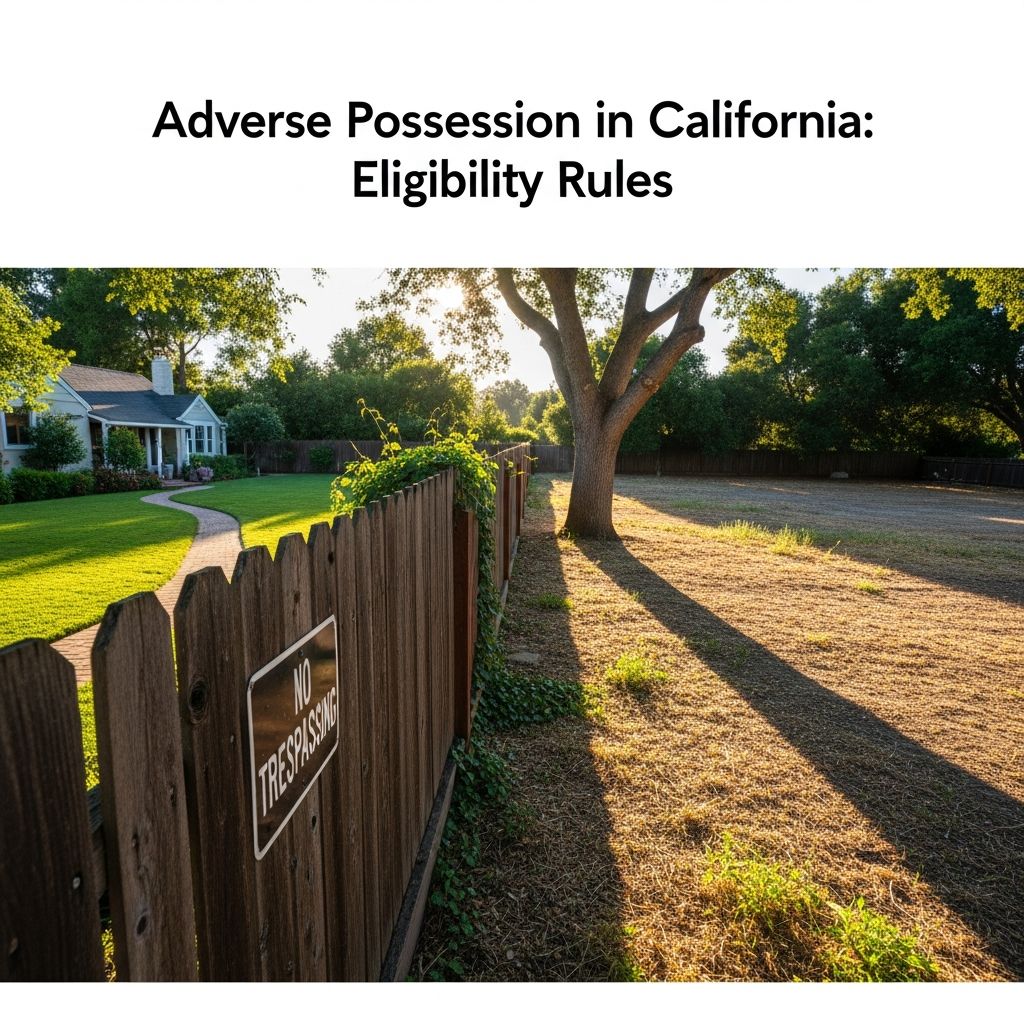
Adverse possession allows individuals who openly occupy someone else’s land to potentially gain legal title after meeting specific legal criteria. In California, this doctrine requires proving possession under strict conditions for at least five years, balancing property rights with long-term use.
Understanding the Concept of Adverse Possession
Adverse possession is a legal principle rooted in common law that rewards productive land use while penalizing negligent owners. It prevents land from lying idle and resolves disputes over unclear boundaries. California law, governed by the Code of Civil Procedure sections 323 and 325, mandates that claimants demonstrate uninterrupted control over the property.
The process transforms a trespasser into a titleholder if the true owner does not intervene. Courts examine evidence like improvements, tax records, and witness testimonies to validate claims. This mechanism promotes efficient land utilization but demands rigorous proof from claimants.
Core Requirements for a Valid Claim
To succeed, claimants must satisfy five essential elements, each scrutinized in court. Failure in any one derails the entire case. These standards ensure claims are not frivolous and protect genuine owners.
- Claim of Right or Color of Title: Possession begins with a good-faith belief in ownership rights, either through a mistaken deed (color of title) or honest assertion without documentation. Claimants acting in secrecy or with known wrongdoing cannot qualify.
- Actual, Open, and Notorious Use: The occupation must be physical and visible, like farming, building fences, or residing on the land, providing clear notice to the owner and public. Hidden use does not count.
- Hostile and Exclusive Possession: Control must oppose the true owner’s interests without permission. Renting out the land or excluding others demonstrates exclusivity; mere occasional visits fail this test.
- Continuous Possession for Five Years: Uninterrupted use for the full statutory period is required. Any owner reclamation, lawsuit, or extended absence resets the clock.
- Payment of All Property Taxes: Claimants must pay taxes assessed during the five years, on time each year. Back payments do not suffice; this proves ownership intent.
Who Qualifies as a Claimant?
Nearly anyone can pursue an adverse possession claim in California if they meet the criteria, regardless of their relationship to the property. Neighbors disputing fences, former tenants overstaying, strangers occupying vacant lots, or co-owners excluding partners all have standing.
| Claimant Type | Common Scenario | Key Challenge |
|---|---|---|
| Neighbors | Encroaching structures over boundary lines | Proving open use without permission |
| Squatters | Occupying abandoned homes | Demonstrating tax payments |
| Tenants | Refusing to vacate after lease ends | Establishing hostility post-tenancy |
| Co-Owners | Exclusive control of shared property | Overcoming presumption of permission |
| Strangers | Using remote or neglected land | Maintaining continuity over five years |
Even government entities rarely succeed due to sovereign immunity, but private individuals face no such bar. Success hinges on documentation, not identity.
California’s Five-Year Statutory Period Explained
California’s relatively short five-year period distinguishes it from states like New York (10 years) or Texas (3-10 years depending on title). This brevity reflects the state’s emphasis on tax payment as a gatekeeper, making claims harder despite the timeline.
Once initiated, the period runs continuously. Interruptions include owner eviction attempts, quiet title actions, or recorded notices. Claimants must track every day, often using affidavits or photos as proof.
The Critical Role of Property Taxes
Tax payment is California’s unique hurdle, absent or less stringent in many states. Claimants receive tax bills under their name or description and pay promptly. The State Board of Equalization recognizes successful claims as ownership changes, triggering reassessments.
Courts verify payments via county records. Non-payment, even once, voids the claim. This requirement weeds out opportunistic squatters, ensuring only committed users prevail.
Steps to Pursue an Adverse Possession Claim
Filing requires a quiet title lawsuit in superior court after the period ends. Gather evidence: tax receipts, utility bills, photos, neighbor statements. Plaintiffs bear the burden of clear and convincing proof.
- Document all occupation activities daily.
- Pay taxes annually and retain receipts.
- Avoid owner confrontations that acknowledge their title.
- File suit before or upon owner challenge.
- Prepare for counterclaims like trespass.
Attorneys specializing in real estate streamline this, often on contingency for strong cases.
Defenses and Protections for Property Owners
Owners can thwart claims by monitoring boundaries, posting signs, paying taxes promptly, and acting swiftly on intrusions. Regular surveys and title searches reveal issues early.
- Grant permission in writing to negate hostility.
- File a quiet title action preemptively.
- Record a notice of ownership.
- Evict through unlawful detainer if applicable.
Vigilance is key; dormant land invites claims. Annual inspections prevent surprises.
Real-World Examples and Court Insights
Cases illustrate nuances. In one, a neighbor’s fence encroachment succeeded after five years of maintenance and taxes, granting a strip of land. Conversely, intermittent gardeners failed for lacking continuity.
Co-tenant disputes often falter if ouster isn’t proven. Squatters in foreclosed homes rarely win without taxes. These rulings underscore strict interpretation.
Comparing California to Other States
| State | Statutory Period | Tax Requirement | Unique Feature |
|---|---|---|---|
| California | 5 years | Strict annual payment | Emphasizes tax records |
| Texas | 3-10 years | Varies | Shorter with color of title |
| New York | 10 years | Not required | Longer uninterrupted use |
| Florida | 7 years | Required | Color of title shortens |
California’s rules favor diligent owners via taxes.
Frequently Asked Questions (FAQs)
Can tenants claim adverse possession?
Former tenants can if possession turns hostile post-lease, but permission during tenancy blocks claims.
Does building on land suffice?
Structures help prove actual use but require all elements, including taxes.
What if the owner pays taxes too?
Claimant must still pay their assessed share; dual payments complicate but don’t automatically fail.
Can adverse possession apply to apartments?
Rarely, as it’s for real property; common areas might qualify under strict proof.
How to check if a claim is pending?
Review county records for lis pendens or tax delinquencies.
Consulting Legal Experts
Given complexities, consult real estate attorneys early. They assess evidence, file actions, and defend rights. Firms like those cited handle diverse claims effectively.
References
- What is Adverse Possession (CCP § 323) — Underwood Law. Accessed 2026. https://underwood.law/blog/what-is-adverse-possession
- Adverse Possession Requirements in California — Schorr Law, APC. Accessed 2026. https://schorr-law.com/adverse-possession-requirements-california/
- How Adverse Possession Works in California — Shapero Law Firm. Accessed 2026. https://www.shaperolawfirm.com/how-adverse-possession-works-in-california/
- Who Can Claim Property Based on Adverse Possession in California? — Nolo. Accessed 2026. https://www.nolo.com/legal-encyclopedia/who-can-claim-property-based-adverse-possession-california.html
- 220.0001 Adverse Possession — California State Board of Equalization. Accessed 2026. https://boe.ca.gov/proptaxes/pdf/220_0001.pdf
- Adverse Possession: How to Protect Your Property — Peterson Law LLP. Accessed 2026. https://petersonlawllp.com/adverse-possession-protect-your-property/
- Adverse Possession — Legal Information Institute, Cornell Law School. Accessed 2026. https://www.law.cornell.edu/wex/adverse_possession
Similar Articles








Read full bio of Sneha Tete


