
The Absurd Reality of Federal Prison Book Bans
How arbitrary administrative policies are restricting vital literature behind bars.
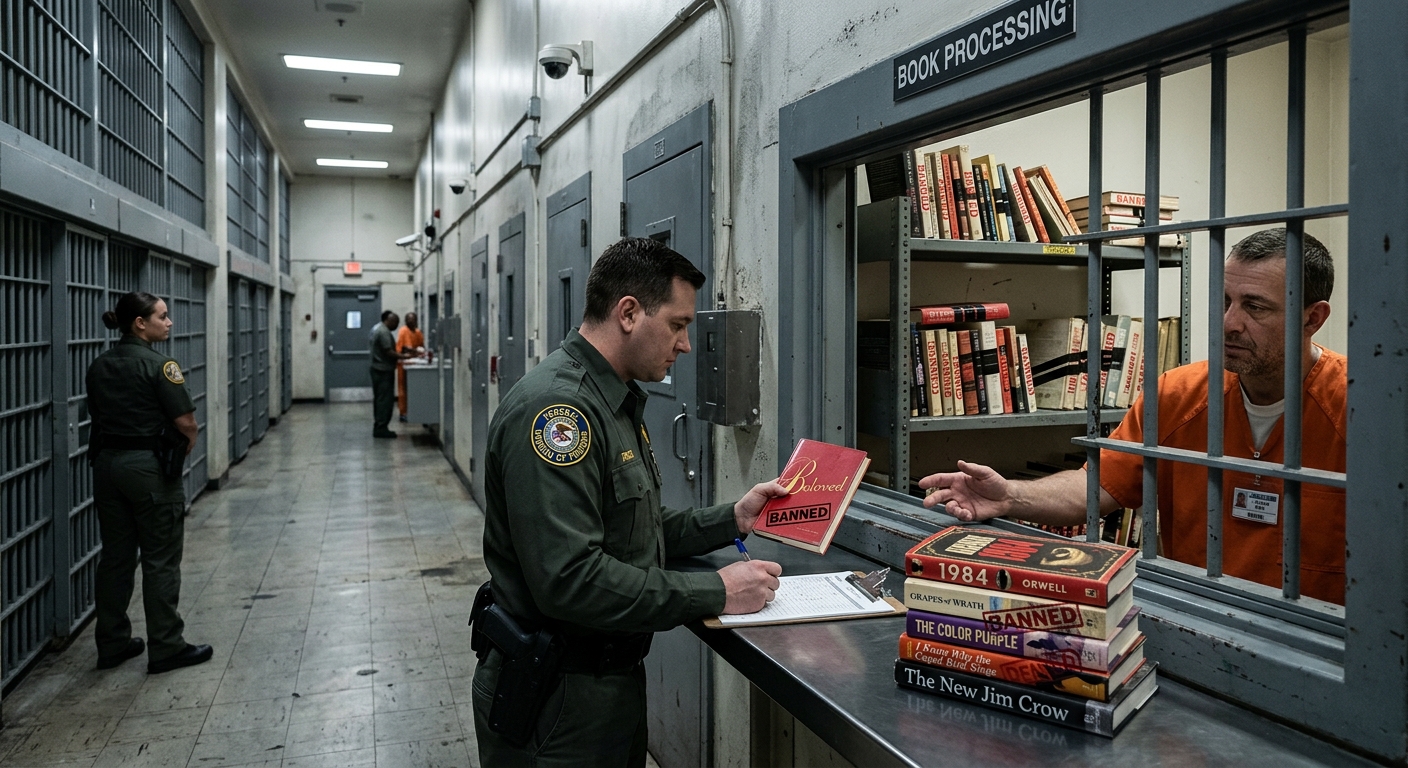
The Transformative Power of Literature Behind Bars
For individuals serving time in federal correctional facilities, the world is physically limited to cinderblock walls, razor wire, and highly structured daily routines. In this restrictive environment, literature serves as one of the few remaining conduits to the outside world. A book can be an educational tool, a mental escape, a spiritual guide, or a foundational building block for rehabilitation. However, a growing crisis is unfolding within the American justice system, one that often goes unnoticed by the general public: the sweeping and frequently arbitrary censorship of reading materials by the Federal Bureau of Prisons (BOP).
While public debates rage over literature removed from public school libraries and municipal reading rooms, carceral censorship constitutes the most extensive and pervasive form of book banning in the United States. Behind the walls of federal facilities, access to information is dictated by administrative protocols that are often overly broad, inconsistently applied, and cloaked in vague justifications of institutional security. This scattershot methodology not only restricts the fundamental rights of incarcerated individuals but actively works against the overarching goal of the justice system: successful reintegration into society.
The Unseen Scope of Carceral Censorship
To understand the magnitude of this issue, one must look past local library disputes and examine the systemic barriers erected within the prison system. Advocacy organizations tracking free expression note that federal and state prisons collectively block access to tens of thousands of individual titles. The restrictions are not limited to obvious contraband, such as manuals detailing the construction of illicit devices or maps of the prison grounds. Instead, the net of censorship captures an astonishingly wide array of materials, from basic computer programming manuals and drawing guides to historical biographies and religious texts.
The Federal Bureau of Prisons operates under regulations that allow wardens and mailroom staff to reject publications if they are deemed detrimental to the security, discipline, or good order of the institution. While this standard appears reasonable on its face, in practice, it provides prison officials with near-absolute discretion. Because there is often little external oversight or uniform application of these rules, the resulting book bans are highly subjective. A book permitted in a federal facility in one state might be completely banned in another, creating a chaotic landscape for publishers, families, and inmates attempting to navigate the system.
The sheer scale of this censorship is staggering. The rationale used to keep books out is frequently baffling, highlighting a profound disconnect between the perceived threat of a publication and its actual content. This disjointed approach ultimately isolates incarcerated people from the educational and cultural resources necessary for personal growth and societal awareness.
A Scattershot Bureaucracy: Misfiring on Security
The bureaucratic enforcement of these literary restrictions can only be described as erratic. Instead of a precise, well-aimed strategy to eliminate genuine threats to institutional safety, the BOP often employs a reactionary, haphazard approach. It is a methodology characterized by poor aim and overzealous gatekeeping, where innocuous materials are struck down while actual issues go unaddressed.
Consider the targeting of educational and instructional materials. Books teaching fundamental coding languages, such as Java or Python, have been routinely blocked under the guise that they might facilitate cybercrime or compromise the facility’s internal network. This logic blatantly ignores the reality that incarcerated individuals do not have unfettered access to computers or the internet to execute such acts. Furthermore, it denies inmates the opportunity to develop highly sought-after technical skills that could guarantee employment upon their release.
Similarly, basic instructional art books—teaching inmates how to draw figures or comic book characters—are frequently banned because they contain artistic depictions of the human body, which officials arbitrarily classify as explicit or inappropriate. Even historical texts detailing the civil rights movement or criminal justice reform have been withheld because they are vaguely interpreted as inciting disobedience. When the administrative reflex is to ban first and ask questions later, the collateral damage is the intellectual and emotional development of the inmate population. This bumbling enforcement strips away vital resources under the illusion of maintaining order.
The Constitutional Gray Area of Prison Mailrooms
The intersection of constitutional rights and prison administration is a complex legal battleground. Under the First Amendment, individuals retain fundamental rights to free speech and expression, which inherently includes the right to receive information and read. The Supreme Court has historically recognized that while incarceration inevitably curtails certain liberties, it does not completely extinguish a person’s constitutional protections. A pivotal legal standard dictates that ideas and information available outside the prison are essential for a successful transition to freedom.
However, the judicial system also grants significant deference to prison administrators. If a regulation restricting access to books is reasonably related to legitimate penological interests—such as facility security or crime prevention—the courts will typically uphold it. This legal precedent has created a massive loophole. Because “security” is an incredibly broad term, mailroom clerks and facility wardens can weaponize it to justify almost any rejection.
If an inmate wishes to challenge a rejected book, the grievance process is notoriously slow, convoluted, and heavily weighted in favor of the institution. By the time an appeal is heard, months or even years may have passed. This lack of transparency and accountability means that unconstitutional censorship can thrive unchecked, operating in the shadows of the justice system away from public scrutiny.
The High Cost of Censoring Rehabilitation
Beyond the constitutional implications, the arbitrary banning of books has profound consequences for public safety and the economic burden of the justice system. The ultimate goal of incarceration should be rehabilitation—preparing individuals to reenter their communities as productive, law-abiding citizens. Education is the most effective tool for achieving this outcome.
Statistical evidence overwhelmingly supports the connection between learning and lowered recidivism. According to recent legislative inquiries and federal data, approximately 41% of incarcerated individuals lack a high school diploma. However, those who participate in any form of educational programming while incarcerated are 43% less likely to return to prison after release. Literature is the bedrock of these educational programs. Restricting access to books directly undermines the rehabilitative process.
Reading fiction and non-fiction fosters cognitive empathy, improves emotional regulation, and broadens an individual’s worldview. It provides a constructive outlet for stress and anxiety in an inherently hostile environment. When prison administrations cut off access to literature, they are effectively ensuring that individuals return to society with the same deficits they had when they entered the system.
Contrasting Rationale and Reality in Book Rejections
To illustrate the absurdity of some of these policies, consider the disparity between the stated administrative rationale for a ban and the actual content of the books being rejected:
| Stated Administrative Rationale | Examples of Targeted Literature | The Rehabilitative Loss |
|---|---|---|
| Prevention of Cyber/Security Threats | Introductory coding manuals, basic electronics guides, Microsoft Office tutorials. | Inmates are denied crucial modern job skills, increasing the likelihood of post-release unemployment and recidivism. |
| Prohibition of Nudity / Explicit Material | Anatomy textbooks, “How to Draw” art books, historical art compilations, manga. | Loss of creative outlets, medical education, and benign recreational reading. |
| Threats to Institutional Order | Books on social justice, civil rights biographies, memoirs of criminal justice reform advocates. | Prevents inmates from understanding historical contexts, civic duties, and peaceful advocacy. |
Approved Vendors and the Digital Walled Garden
In recent years, the mechanisms of censorship have evolved from simple mailroom rejections to complex, systemic barriers. Many federal and state facilities have instituted “approved vendor” policies. Under these rules, books cannot be mailed from families, friends, or independent bookstores. They must be purchased directly from a handful of approved corporate vendors. This forces families—often already struggling with the financial burden of having a loved one incarcerated—to pay high retail prices and exorbitant shipping fees.
Furthermore, the introduction of digital tablets into the prison system has been marketed as a modernization of access to information. In reality, it often acts as a digital walled garden. While these tablets provide some reading materials, the available libraries are heavily curated, severely limited, and often require inmates to pay per minute or per book to access public domain titles. Simultaneously, facilities use the presence of these tablets to justify banning physical books entirely, claiming physical mail is a conduit for contraband. This shift commodifies reading, turning a fundamental human right into a profit-generating enterprise for private telecommunications companies, while further tightening the grip of censorship.
Frequently Asked Questions (FAQs)
Why do federal prisons ban certain books?
Federal prisons primarily cite institutional security, the prevention of criminal activity, and the maintenance of good order as the reasons for banning books. While stopping genuine threats (like contraband concealment or weapon blueprints) is necessary, the “security” label is frequently overused to ban educational, artistic, and social justice materials arbitrarily.
Does the First Amendment protect an inmate’s right to read?
Yes, incarcerated individuals retain their First Amendment rights, which include the right to receive information. However, the courts allow prison officials to restrict these rights if the restriction is reasonably related to legitimate penological interests. This broad standard makes it difficult for inmates to legally challenge arbitrary book bans.
How do these book bans affect recidivism?
Restricting access to books has a profoundly negative impact on recidivism. Studies demonstrate that educational programming and access to literature significantly reduce the likelihood of a person reoffending. By cutting off access to educational and vocational materials, prisons hinder the rehabilitation process and increase the chances of future criminal behavior.
Can I mail a book directly to an incarcerated loved one?
In most federal facilities, you cannot mail a book directly from your home. The Federal Bureau of Prisons generally requires that all hardcover and softcover publications be sent directly from the publisher, a book club, or an approved commercial bookstore (like Amazon or Barnes & Noble). Policies change frequently, so it is crucial to check the specific regulations of the individual facility.
The Path Forward: Reclaiming the Right to Read
The arbitrary and bumbling approach to censoring literature in federal prisons is a systemic failure that harms incarcerated individuals and society at large. When facility administrators act as overzealous gatekeepers, striking down books out of vague paranoia rather than evidence-based security concerns, they dismantle the very foundations of rehabilitation. A justice system that values public safety must recognize that educated, emotionally regulated, and well-read individuals are vastly more likely to succeed upon reentry.
Reforming these policies requires stringent congressional oversight, a demand for absolute transparency in mailroom rejection logs, and a cultural shift within the Bureau of Prisons. Protecting the First Amendment behind bars is not merely about preserving constitutional ideals; it is about ensuring that the prison system functions as an avenue for genuine transformation rather than a sterile warehouse devoid of intellectual light.
References
- Incoming Publications – BOP — Federal Bureau of Prisons. 2011-11-09. https://www.bop.gov/policy/progstat/5266_011.pdf
- Reading Between the Bars: An In-Depth Look at Prison Censorship — PEN America. 2023-10-25. https://pen.org/report/reading-between-the-bars/
- Welch, Schatz and Colleagues Call on Federal Bureau of Prisons to Provide Full List of Banned Books — Office of U.S. Senator Peter Welch. 2024-10-02. https://www.welch.senate.gov/welch-schatz-and-colleagues-call-on-federal-bureau-of-prisons-to-provide-full-list-of-banned-books/
- Prison Banned Books Week: Books give incarcerated people access to the world, but tablets are often used to wall them off — Prison Policy Initiative. 2024-09-16. https://www.prisonpolicy.org/blog/2024/09/16/prison-banned-books/
- The Effectiveness of Prison Programming: A Review of the Research Literature — National Institute of Justice. 2022-06-15. https://nij.ojp.gov/library/publications/effectiveness-prison-programming-review-research-literature-examining-impact
Similar Articles








Read full bio of Sneha Tete




