
Abandoned Cars and Windshield Tags: What Drivers Need to Know
Understand how a simple windshield tag can turn your parked car into an “abandoned vehicle” and expose you to fines, towing, and criminal penalties.
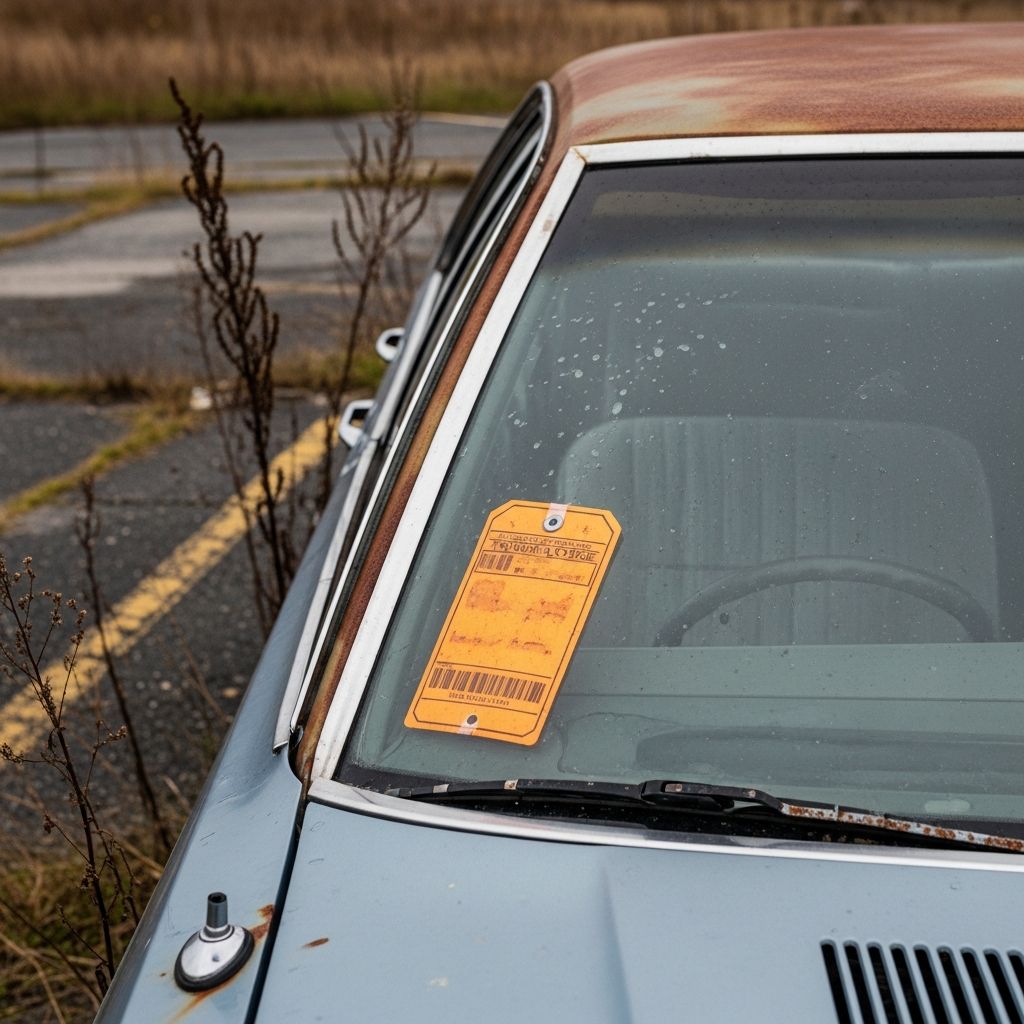
If you come back to your car and see a bright notice stuck under the wiper, you may be looking at more than a parking ticket. In many places, a windshield tag is the first formal step toward classifying your car as an abandoned vehicle, towing it away, and sometimes even transferring ownership to the city or state.
This guide explains what it means when your vehicle is tagged, how abandoned vehicle laws generally work, what deadlines matter, and how to protect yourself if your car is towed or at risk of being treated as abandoned.
Understanding the Legal Idea of an “Abandoned Vehicle”
Every state defines abandoned vehicles in its own statutes, but there are common themes across the country.
Broadly, an abandoned vehicle is a motor vehicle left on public or private property for longer than a legally specified time without permission or in violation of parking or traffic laws.
Typical elements of an abandoned vehicle definition
- Location – on a street, highway right-of-way, public lot, or private property without consent.
- Time – left unattended for more than a set number of hours or days, which can differ for public vs. private property.
- Condition – sometimes missing plates, inoperable, damaged, or clearly not in use (flat tires, broken windows, stripped parts).
- Permission – no valid consent from the property owner (for private property) or parked beyond any lawful time limit (for public places).
Examples of time limits in real laws
| Jurisdiction (example) | Location | Typical time to be considered abandoned |
|---|---|---|
| New York (state statute) | Highways and other public places | Often 24–48 hours on a highway; 96 hours on another’s property without permission. |
| New Jersey (motor vehicle agency) | Same public location | At least three consecutive days. |
| Example local code (private land) | Private property without consent | Frequently 48–96 hours, depending on local ordinance. |
| Federal-aid highway right-of-way | Adjacent to federal-aid highways | Removable under federal regulations to protect scenic quality; timing is coordinated with state authority. |
Why Windshield Tags Matter
Windshield tags are often used by police, parking enforcement, or code officers as formal notice that your car may be treated as abandoned if it is not moved. While the exact wording varies, these tags usually serve several purposes:
- To identify the vehicle as potentially abandoned or illegally parked.
- To record the date and time the car was observed.
- To warn the owner that the vehicle will be towed or removed if it remains in place after a specified period.
- To start the clock for abandonment procedures or towing under state or local law.
In many jurisdictions, documenting the vehicle with a tag and waiting a prescribed amount of time is a legal requirement before the vehicle can be removed, particularly on public property or when the car is not an immediate safety hazard.
Common Legal Criteria: When a Parked Car Becomes “Abandoned”
While each state’s law is unique, abandoned vehicle statutes tend to fall into a few recurring patterns.
1. Time left unattended
One of the main triggers is how long the car stays where it is.
- Short periods on highways – Some states treat a car left on a highway or controlled-access road as abandoned after as little as 24–48 hours because of safety concerns.
- Longer periods on private property – The threshold can be 48–96 hours or more if the vehicle is on private land without the owner’s consent.
- Extended time at repair shops – Laws in some states allow shops to deem a vehicle abandoned if it remains unclaimed 30–60 days after repairs are finished or storage begins.
2. Lack of plates or registration
Vehicles with no license plates or clearly expired registration are more likely to be classified as abandoned. Some statutes specifically treat unplated, unattended vehicles as abandoned after a relatively short time.
3. Illegal or unsafe parking
A car parked where it is illegal—such as blocking traffic, driveways, or fire lanes—can be both illegally parked and eventually abandoned if left long enough after enforcement action begins.
4. Condition of the vehicle
Some laws explicitly refer to vehicles that are wrecked, stripped, or inoperable.
- Missing major components like engines, wheels, or tires.
- Clearly unsafe or incapable of being driven without significant repair.
- Visibly neglected, creating a hazard or blight.
Who Can Declare and Remove an Abandoned Vehicle?
Different authorities can be involved, depending on where the car is located.
Public property or streets
- Local law enforcement – Police are usually the primary actors for cars left on streets, highways, and public lots. They can tag, tow, and process abandoned vehicles under state law.
- Transportation agencies – On state highways or federal-aid roads, state DOTs or similar agencies may coordinate removal, sometimes under federal regulations that address roadside blight.
- Municipal parking or code enforcement – City departments can enforce local ordinances, particularly in residential neighborhoods.
Private property
- Property owners – Typically must involve police or follow set procedures rather than towing on their own without notice.
- Towing companies – Often act only after authorization from law enforcement or under specific statutes that give them a limited role in removing and storing abandoned vehicles.
The Process After a Windshield Tag Is Placed
Although every jurisdiction has its own timeline, the overall process has a familiar rhythm.
Step 1: Vehicle is observed and tagged
An officer or authorized official notes that the vehicle is unattended, possibly illegally parked, or appears abandoned. They place a tag or notice on the windshield and may photograph the car, record its VIN, and document the surroundings.
Step 2: Waiting period begins
The tag usually includes a warning and a time frame, such as:
- Move the vehicle within 24–72 hours.
- Correct any violation (expired registration, flat tires, blocking access).
- Contact the listed agency if you believe the tag is incorrect.
If the car is not moved or the issue is not fixed in time, the vehicle may qualify as abandoned under that jurisdiction’s rules.
Step 3: Towing and impound
Once the deadline expires, authorities may authorize towing.
- The car is transported to an impound lot or storage facility.
- The tow may happen faster if the car is a traffic hazard or obstructing emergency access.
- Fees begin to accumulate immediately, including towing charges and daily storage fees.
Step 4: Notice to the owner and lienholders
After removal, state laws generally require reasonable efforts to identify and notify the last registered owner and any recorded lienholders.
- Authorities check registration and title databases.
- Written notice is mailed to the address on record, with a deadline to reclaim the vehicle.
- The notice explains how to retrieve the car and what costs must be paid (towing, storage, administrative fees).
Step 5: Transfer of ownership or disposal
If the vehicle is not claimed within the legal time period:
- Ownership may vest in the local authority, which can sell the car at auction or treat it as junk, depending on its condition and value.
- In some states, low-value or heavily damaged vehicles can be sent directly to a dismantler or recycler after required notice.
- Proceeds from any sale often go first to cover costs of towing and storage, with any remainder handled as the law prescribes.
Potential Consequences for Vehicle Owners
A windshield tag is more than a warning; it is often the start of serious financial and legal consequences if ignored.
Financial costs
- Towing fees – Charged when the vehicle is removed; amounts vary but can be substantial, especially for larger vehicles.
- Storage fees – Daily or per-calendar-day charges accumulate while the vehicle is in an impound lot.
- Administrative or auction fees – Some laws allow agencies or tow operators to add paperwork or sale-processing fees.
- Citations or fines – You may still owe fines for the original parking violation or for causing the vehicle to be abandoned.
Legal penalties
- Certain states impose fines on anyone who causes a vehicle to become abandoned, with penalties that can reach hundreds of dollars or more.
- The last registered owner is often presumed responsible for the abandonment and can be liable for costs of removal and storage.
- Multiple violations or related offenses (such as dumping vehicles on public land) can increase penalties or lead to criminal charges in some jurisdictions.
Loss of the vehicle
If you do not act within the legally required time, you can lose your car permanently.
- Your ownership may be terminated through an administrative process after notice and waiting periods are satisfied.
- The vehicle may be sold at public auction or declared junk and destroyed.
What to Do If Your Car Gets a Windshield Tag
If you find a tag on your windshield, treat it as an urgent legal notice—not just a piece of paper to ignore.
1. Read the tag carefully
- Look for the deadline to move the car.
- Identify the agency that issued the notice and any contact information.
- Check whether the tag alleges a specific violation (e.g., no plates, expired registration, blocking access).
2. Move the vehicle promptly
If possible, move your car to a lawful location before the deadline. This is often enough to stop the process, especially when the concern is simply time parked in one spot.
3. Document everything
- Take photos of the car, the tag, nearby signs, and the surroundings.
- Note the date and time you saw the tag and when you moved the vehicle.
- Keep the tag itself as proof of what you were told.
4. Contact the issuing agency
If you think the tag is mistaken—for example, you have permission from the property owner or there is a disability-related accommodation—contact the agency listed on the notice. Ask:
- Why the vehicle was tagged.
- What law or ordinance applies.
- Whether moving the vehicle fully resolves the matter or if additional steps are required.
5. If the vehicle was already towed
If you return and discover the car is gone:
- Call the non-emergency number for local police or the parking authority to confirm it was towed, not stolen.
- Ask which impound lot has the car and what you must pay to retrieve it.
- Request a written breakdown of towing, storage, and administrative fees.
You may have limited time to contest the tow or storage charges, so look for information on hearings or appeal procedures, which are sometimes mentioned on notices or agency websites.
Special Issues on Private Property
Abandoned vehicle laws don’t only affect street parking. They also impact landlords, businesses, and homeowners dealing with unwanted cars on their land.
Property owners and managers
- Generally cannot just sell or destroy someone else’s vehicle on their property without following statutory procedures.
- Often must report the vehicle to law enforcement and request removal rather than act alone.
- May be able to use state “abandoned vehicle” procedures to have low-value vehicles dismantled after notice and waiting periods.
Tenants and visitors
If you park on private property—such as an apartment complex, workplace, or shopping center—your car can still be considered abandoned if it is left for too long without permission or in violation of posted rules. Property managers may work with towing companies under local ordinances or state law, sometimes with less advance warning than on public streets.
Preventive Tips: Avoiding Abandonment Problems
A few simple habits can greatly reduce the risk that your car will be tagged as abandoned.
- Keep registration and plates current – Vehicles without visible, valid plates draw enforcement attention faster.
- Observe posted time limits – Pay attention to signs that limit how long you can park in one spot.
- Inform neighbors or property managers – If your car will sit for a while, let the property owner know and get written permission if possible.
- Maintain the vehicle’s appearance – A car that looks wrecked, stripped, or obviously unused is more likely to be considered abandoned.
- Respond quickly to notices – Don’t ignore windshield tags, warning letters, or phone calls from agencies or tow yards.
Frequently Asked Questions (FAQs)
Q: Does a windshield tag always mean my car is illegally parked?
A: Not necessarily. A tag can mean the vehicle is suspected of being abandoned, is parked longer than allowed, has expired registration, or is otherwise in violation of local rules. It is a warning that you need to act quickly to avoid towing or further enforcement.
Q: How long do I have after a tag before my car is towed?
A: It depends on the law where the car is parked. Some places allow towing within 24 hours on highways, while other areas may allow several days, especially in residential neighborhoods. Check the time stated on the tag and look up local ordinances or state statutes for precise rules.
Q: Can the city really take ownership of my car?
A: Yes. Many statutes allow a city or local authority to acquire ownership of an abandoned vehicle if the owner does not reclaim it within a specified period after proper notice. The vehicle may then be sold at auction or junked, with proceeds applied to towing and storage costs.
Q: Am I always responsible if someone else abandons a car in my name?
A: Often, the last registered owner is presumed responsible for an abandoned vehicle and may be liable for removal and storage costs, even if someone else actually left the car. Some laws describe this as a rebuttable presumption, meaning you can present evidence to show you were not responsible.
Q: Should I talk to a lawyer about an abandoned vehicle issue?
A: If you face large towing or storage bills, risk losing a valuable vehicle, or are accused of illegally abandoning a car, it can be useful to consult a lawyer who handles traffic, property, or municipal law. An attorney can explain your rights, deadlines, and potential defenses based on your state’s statutes.
References
- New York Vehicle and Traffic Law § 1224: Abandoned vehicles — New York State Legislature. Accessed 2024-06-01. https://www.nysenate.gov/legislation/laws/VAT/1224
- 23 CFR § 752.10: Abandoned vehicles — U.S. Federal Highway Administration. Accessed 2024-06-01. https://www.law.cornell.edu/cfr/text/23/752.10
- Abandoned Vehicle Law and Legal Definition — USLegal. Accessed 2024-06-01. https://definitions.uslegal.com/a/abandoned-vehicle/
- Abandoned and Unclaimed Vehicles — New York State Department of Motor Vehicles. Updated 2023. https://dmv.ny.gov/titles/abandoned-and-unclaimed-vehicles
- Abandoned Vehicles — New Jersey Motor Vehicle Commission. Accessed 2024-06-01. https://www.nj.gov/mvc/vehicletopics/abandoned.htm
- Chapter 90: Abandoned Vehicles (Municipal Code Example) — City of Eureka, California. Accessed 2024-06-01. https://codelibrary.amlegal.com/codes/eureka/latest/eureka_ca/0-0-0-34588
- Abandoned Vehicles Problem-Oriented Guides for Police, No. 61 — Office of Community Oriented Policing Services, U.S. Department of Justice. 2007. https://www.ojp.gov/ncjrs/virtual-library/abstracts/abandoned-vehicles
Similar Articles








Read full bio of Sneha Tete


