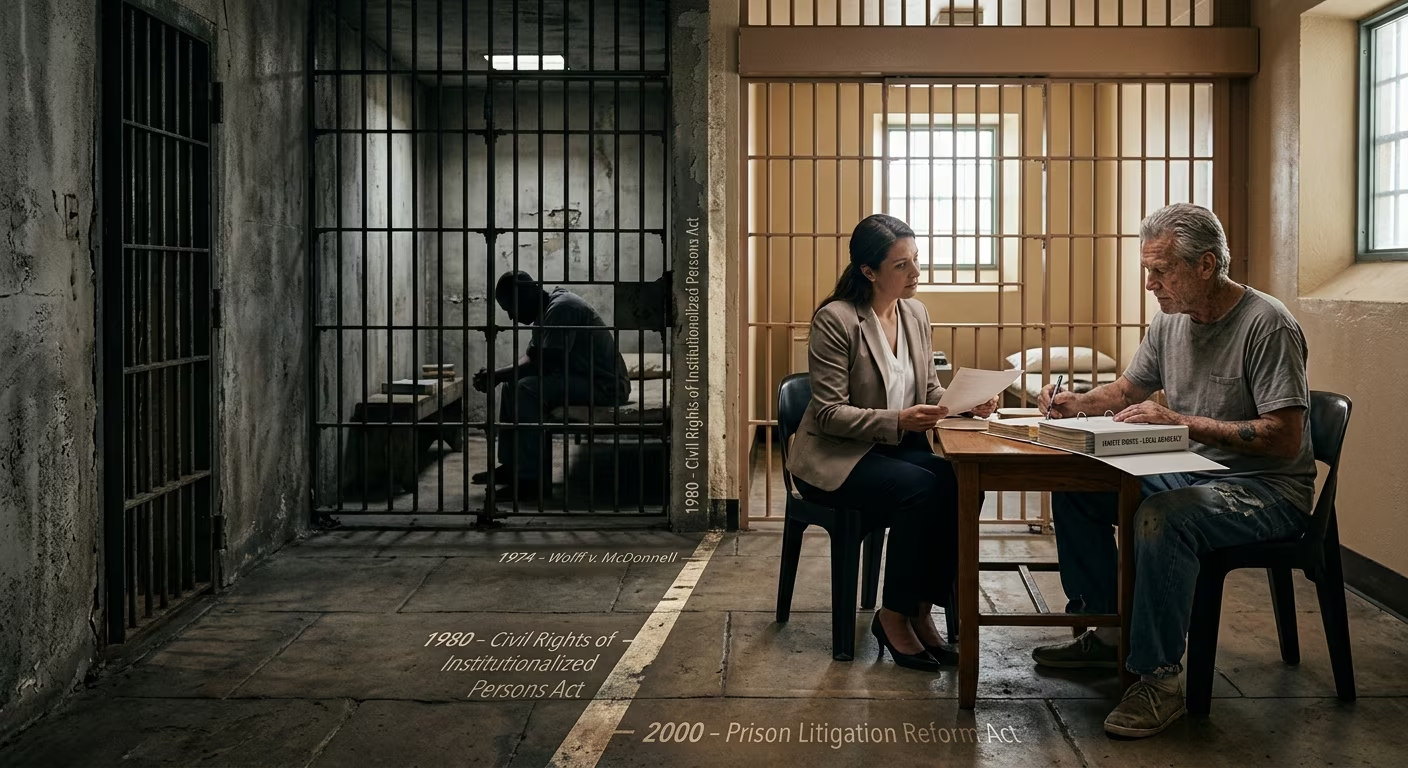
The Dawn of the Modern Prisoners’ Rights Movement
For much of American history, the prison gates served as an impenetrable barrier not only to physical freedom but also to constitutional protections. It was widely accepted by courts and society that individuals forfeited their fundamental human rights upon incarceration. However, over the past fifty years, a concerted and relentless advocacy movement has systematically dismantled this notion. Human rights defenders, legal scholars, civil liberties organizations, and incarcerated individuals themselves have waged a multi-decade battle to secure baseline dignity behind bars. From challenging unspeakable conditions in solitary confinement to securing fundamental medical care and First Amendment protections, the struggle for prisoners’ rights has profoundly reshaped the American justice system. This retrospective explores the dramatic evolution of incarceration rights over the last half-century, examining landmark victories, ongoing humanitarian crises, and the modern push toward systemic decarceration.
Dismantling the “Hands-Off” Doctrine: A Legal Renaissance
Before the pivotal civil rights era of the late 1960s and early 1970s, the American judiciary adhered almost exclusively to a “hands-off” doctrine regarding correctional facilities. Judges broadly deferred to prison wardens and state administrators, effectively turning a blind eye to the daily conditions of confinement, regardless of how brutal or dehumanizing they might be. The prevailing legal philosophy viewed prisoners as legally stripped of the protections afforded to free citizens.
This paradigm began to shift dramatically as systemic litigation gained momentum. Advocates successfully argued that the U.S. Constitution does not evaporate at the prison gate. One of the earliest and most profound shifts occurred within the realm of the First Amendment. Court rulings mandated that prisons accommodate religious dietary restrictions, allow reasonable access to clergy, and cease the arbitrary censorship of personal mail and reading materials. Furthermore, legal challenges firmly established that prisoners have a fundamental right to access the courts. Facilities were mandated to provide adequate legal assistance or establish comprehensive law libraries, empowering incarcerated individuals to file habeas corpus petitions and challenge the very conditions of their confinement. This foundational legal access became the bedrock upon which the subsequent decades of prisoners’ rights advocacy would be built.
Combating Cruel and Unusual Punishment
The most aggressive legal battles over the last five decades have centered on the Eighth Amendment’s prohibition against cruel and unusual punishment. As the political “tough on crime” rhetoric fueled an unprecedented explosion in incarceration rates, American prisons rapidly became dangerously overcrowded, chronically underfunded, and chaotic environments.
The Overcrowding Crisis and Landmark Rulings
The sheer volume of individuals processed into the penal system created unsustainable conditions. By the end of 2023, the United States prison population exceeded 1.25 million individuals , a systemic burden that has historically led to egregious living environments where basic hygiene and safety are compromised. Severe overcrowding transforms temporary inconveniences into severe constitutional violations.
The most pivotal legal reckoning regarding this crisis occurred in the landmark 2011 United States Supreme Court case Brown v. Plata . The Court ruled that extreme overcrowding in California’s prison system was the primary driver of unconstitutional medical and mental health care inadequacies, directly resulting in needless suffering and death. The Court’s order mandating the state to significantly reduce its prison population sent shockwaves through the national correctional landscape, firmly cementing the legal standard that systemic overcrowding violates the Eighth Amendment.
Medical and Mental Healthcare Deficits
Historically, medical care in prisons was entirely discretionary, often resulting in severe neglect. Through decades of relentless litigation, the legal standard of “deliberate indifference” was established. Today, failing to provide adequate medical and mental health care to an incarcerated person is a recognized violation of constitutional rights.
The mental health crisis within penal institutions remains particularly severe. The Substance Abuse and Mental Health Services Administration (SAMHSA) estimates that approximately 37% of individuals in state and federal prisons suffer from a mental illness . Prisons have tragically functioned as de facto behavioral health facilities, ill-equipped to provide necessary therapeutic care. Advocacy over the last fifty years has focused on compelling state and federal agencies to hire qualified psychiatric staff, establish secure mental health step-down units, and prohibit the punitive disciplining of behaviors that are direct manifestations of mental illness.
The Battle Against Solitary Confinement
Perhaps the most harrowing and heavily contested aspect of the American penal system is the pervasive use of solitary confinement. For decades, correctional officers relied on extreme isolation as a primary tool for behavioral management and administrative control. Individuals were routinely locked in small, windowless cells for 23 to 24 hours a day, deprived of meaningful human contact, environmental stimulation, and physical exercise.
The psychological toll of this practice is well-documented and devastating, often inducing hallucinations, severe depression, anxiety, and an exponentially increased risk of self-harm. In recent decades, a definitive global consensus has emerged condemning the practice. In 2015, the United Nations General Assembly adopted the Nelson Mandela Rules, providing universally acknowledged standards for the treatment of prisoners . Crucially, these rules define prolonged solitary confinement—defined as isolation in excess of 15 consecutive days—as cruel, inhuman, or degrading treatment.
Armed with these international benchmarks and mounting psychological evidence, legal advocates have launched aggressive campaigns to drastically limit or completely abolish solitary confinement in the U.S. Settlements and legislative reforms across numerous states have increasingly banned the placement of pregnant women, juveniles, and individuals with severe mental illnesses in extreme isolation, marking a significant victory for human dignity behind bars.
Safeguarding Vulnerable Populations Behind Bars
Prisons act as microcosms of broader society, and the inequalities present in the free world are often magnified tenfold behind bars. Fifty years of dedicated advocacy have required the development of specialized legal frameworks to protect the most vulnerable and marginalized demographics within the carceral system.
Disability Rights in the Carceral Setting
The passage of the Americans with Disabilities Act (ADA) provided a critical tool for modern prison reformers. Prior to its rigorous application in correctional settings, incarcerated individuals with physical, cognitive, or sensory disabilities were routinely housed in inaccessible cells, denied necessary prosthetics or mobility aids, and systemically excluded from rehabilitative or educational programs. Targeted civil rights lawsuits have successfully forced prison systems to install architectural accommodations like ramps, provide sign language interpreters for deaf individuals during medical consultations and disciplinary hearings, and ensure that those with mobility impairments are integrated into the general population rather than relegated to permanent confinement in institutional infirmaries.
Gender, Sexuality, and Reproductive Justice
Advocating for the rights of women and LGBTQ+ individuals in prison has also been a major focal point. Female prisoners have historically faced rampant sexual abuse, a severe lack of access to fundamental feminine hygiene products, and dangerous practices such as being routinely shackled during pregnancy and childbirth. Through tireless lobbying and litigation, many states and the federal government have officially banned the shackling of pregnant individuals and enacted stricter protocols under the Prison Rape Elimination Act to prevent gender-based violence.
Furthermore, transgender individuals face astronomical rates of violence and targeted harassment within penal institutions. Legal advocates have fought fiercely in federal courts to ensure that transgender prisoners are safely housed according to their gender identity rather than their sex assigned at birth, and that they are not arbitrarily denied medically necessary gender-affirming healthcare during their incarceration.
The Contemporary Shift Towards Decarceration
While the early decades of the prisoners’ rights movement focused almost exclusively on improving the baseline conditions of confinement, the modern era has witnessed a profound strategic pivot toward widespread decarceration. Advocates realized that simply building “better” or “more humane” prisons could not ultimately solve the inherent harms and societal failures of mass incarceration. The movement’s focus has expanded from mere prison reform to fundamentally challenging the entire prison-industrial complex.
This contemporary shift encompasses aggressive lobbying for the elimination of wealth-based cash bail, repealing draconian mandatory minimum sentencing laws, and significantly expanding parole and compassionate release eligibility. Organizations have heavily criticized the privatization of prisons, arguing that for-profit detention centers inherently create a perverse financial incentive to maintain high incarceration rates while deliberately cutting corners on facility safety, nutritional food, and essential medical care. By redirecting massive government resources toward community-based mental health services, drug rehabilitation networks, and restorative justice programs, the modern advocacy movement seeks to shrink the overall footprint of the penal system entirely.
Essential Milestones in Prisoners’ Rights
| Era | Milestone Focus | Impact on the Justice System |
|---|---|---|
| 1970s | First Amendment & Legal Access | Dismantled the “hands-off” doctrine, allowing prisoners to practice religion and access law libraries. |
| 1980s | Medical Care Standards | Established “deliberate indifference” as an Eighth Amendment violation regarding inmate health. |
| 1990s | Disability Rights (ADA) | Forced facilities to implement accessibility standards for visually, hearing, and physically impaired inmates. |
| 2000s | Prison Rape Elimination Act (PREA) | Enacted national standards to prevent, detect, and respond to sexual abuse within correctional facilities. |
| 2010s | Overcrowding Rulings (Brown v. Plata) | The Supreme Court mandated significant population reductions to cure unconstitutional conditions . |
| 2020s | Anti-Solitary Campaigns | Increasing alignment with the Nelson Mandela Rules to end prolonged extreme isolation . |
Frequently Asked Questions (FAQs)
- What is the primary constitutional basis for prisoners’ rights?
The Eighth Amendment, which strictly prohibits cruel and unusual punishment, is the primary constitutional framework utilized by advocates for challenging poor prison conditions, inadequate medical care, and excessive use of force. - What are the Nelson Mandela Rules?
Adopted by the United Nations in 2015, the Nelson Mandela Rules provide standard, universally recognized minimum rules for the humane treatment of prisoners. They outline guidelines for healthcare and discipline, and notably categorize prolonged solitary confinement as a form of cruel or inhuman treatment . - Do incarcerated individuals retain their First Amendment rights?
Yes. While some rights are reasonably restricted for institutional security purposes, prisoners retain First Amendment rights to practice their religion, send and receive non-threatening mail, and access reading materials, provided these activities do not pose a direct threat to facility safety. - How does the ADA apply to prisons?
The Americans with Disabilities Act requires that state and local governments, including correctional facilities, provide individuals with disabilities equal access to programs, services, and activities, including medical accommodations and accessible physical infrastructure.
Conclusion
The last fifty years have clearly demonstrated that the struggle for prisoners’ rights is an ongoing, constantly evolving battle. While monumental legal victories have established essential boundaries and critical constitutional protections, the harsh realities of mass incarceration continually present new and deeply troubling human rights challenges. The profound transition from merely fighting for humane conditions inside the walls to actively advocating for systemic decarceration represents a vital maturation of the civil rights movement. Ensuring that justice is administered with basic dignity and fairness requires constant societal vigilance, persistent public awareness, and an unwavering, foundational commitment to the belief that fundamental human rights are universal—even behind locked prison walls.
References
- Correctional Populations in the United States, 2023 — Bureau of Justice Statistics. 2025-09-30. https://bjs.ojp.gov/library/publications/correctional-populations-united-states-2023-statistical-tables
- Brown v. Plata, 563 U.S. 493 (2011) — Supreme Court of the United States. 2011-05-23. https://www.supremecourt.gov/opinions/10pdf/09-1233.pdf
- The Nelson Mandela Rules — United Nations Office on Drugs and Crime. 2015-12-17. https://www.un.org/en/observances/mendela-day/mandela-rules
- About Criminal and Juvenile Justice & Behavioral Health — Substance Abuse and Mental Health Services Administration (SAMHSA). 2024-05-24. https://www.samhsa.gov/criminal-juvenile-justice/about