
Workplace Free Speech: Employer Rules And Employee Rights Guide
Navigate the complexities of free speech at work: Understand protections, limitations, and employer policies for a harmonious office.
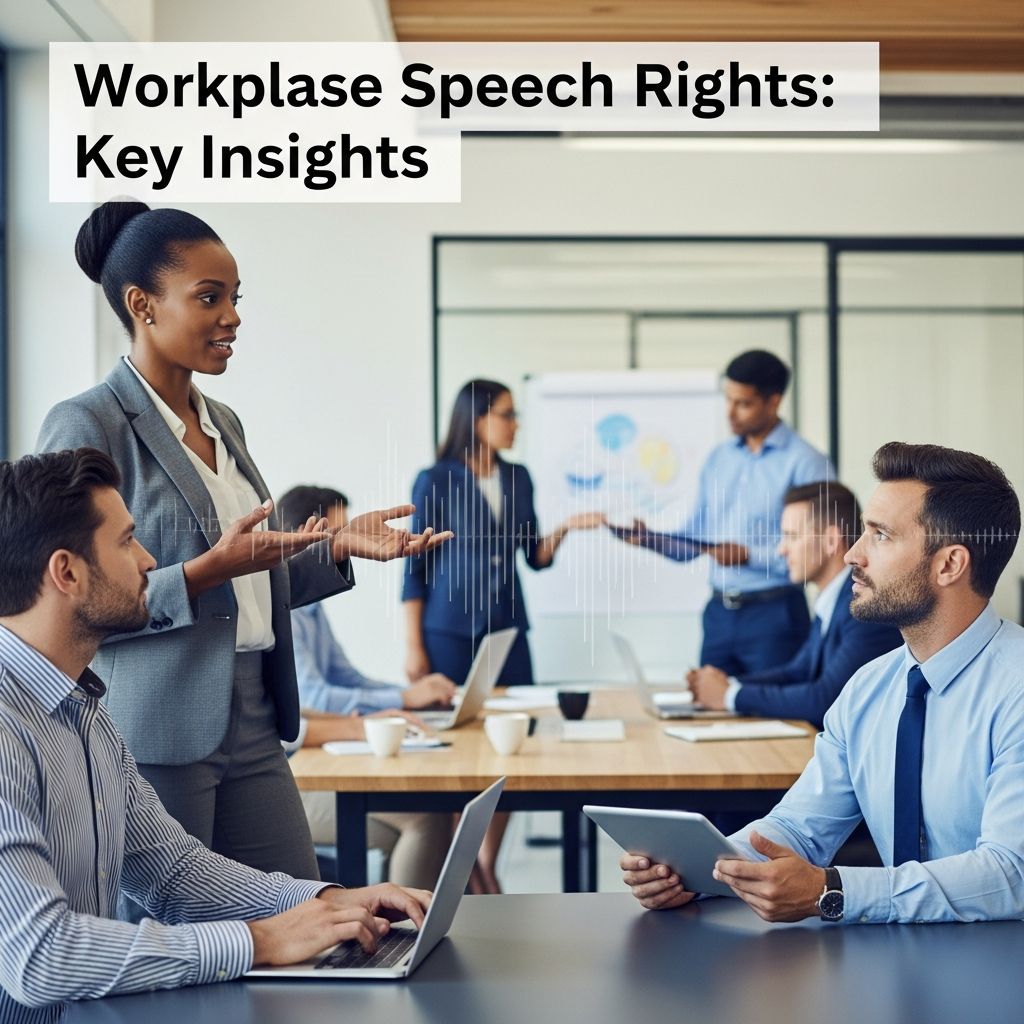
Employee expression in professional settings often sparks confusion, as constitutional protections do not fully extend to private workplaces. This article delves into the nuances of speech rights, highlighting legal safeguards, employer authority, and practical strategies to balance individual freedoms with organizational needs.
Constitutional Foundations of Workplace Expression
The
First Amendment
safeguards free speech against government interference, but its reach in employment contexts is limited. For private sector workers, employers hold significant control over workplace conduct, including verbal and written expressions, as long as policies remain neutral and non-discriminatory.Public employees, however, enjoy partial protections. Speech qualifies as safeguarded if it addresses matters of public concern, occurs as a private citizen, and does not substantially disrupt operations. Courts apply a balancing test, weighing employee interests against government efficiency needs. For instance, a teacher critiquing school policies publicly might be protected, unless it undermines classroom harmony.
| Employer Type | Speech Protections | Key Limitations |
|---|---|---|
| Private | Limited to federal statutes like NLRA | At-will employment allows termination for most speech |
| Public/Government | First Amendment applies selectively | Must not disrupt job performance |
Federal Statutes Shielding Employee Voices
Several laws carve out exceptions to at-will employment doctrines, protecting specific speech types. The
National Labor Relations Act (NLRA)
safeguards ‘concerted activities’ for mutual aid, encompassing discussions on wages, hours, unionization, and safety—on or off duty, including social media.- Conversations about pay equity with colleagues.
- Complaints regarding unsafe conditions.
- Efforts to form or join unions.
Title VII of the Civil Rights Act prohibits retaliation for opposing discrimination based on race, sex, religion, or other protected traits. Whistleblowers reporting fraud in federal contractors or public companies also receive safeguards under laws like the Sarbanes-Oxley Act.
State variations exist; some, like California, extend protections to political activities off-duty, but enforcement remains inconsistent.
Employer Authority Over Disruptive or Harmful Speech
Private employers can curtail expressions harming the work environment, such as political rants causing division, bigoted remarks fostering harassment, or profane language violating professionalism standards. Policies must apply uniformly to evade discrimination claims.
Even protected speech loses immunity if it crosses into threats, abuse, or significant disruption. The National Labor Relations Board (NLRB) evaluates context, tolerating heated exchanges in organizing efforts unless they become overtly hostile.
Employers maintain a duty to prevent harassment, obligating intervention against derogatory speech targeting protected characteristics.
Navigating Social Media and Off-Duty Conduct
Personal online posts, even private ones, can impact careers if discovered by coworkers or management. NLRA protections extend to social media gripes about terms of employment, but general venting or unrelated controversies may justify discipline.
Employers should craft clear social media guidelines, emphasizing business impacts like reputational harm or coworker complaints, without overreaching into purely personal matters. Public figures or roles representing the company demand extra caution, as blurred lines erode protections.
Best Practices for Employers Managing Speech
To foster open dialogue while mitigating risks, organizations should adopt proactive measures.
- Develop neutral policies on workplace conduct, reviewed by legal counsel, covering on-site and remote interactions.
- Train supervisors on distinguishing protected from unprotected speech, ensuring consistent enforcement.
- Update dress codes to address messaging on apparel, linking restrictions to safety or professionalism without viewpoint bias.
- Communicate transparently: Explain First Amendment inapplicability and focus on inclusive environments.
- Monitor for retaliation risks in responses to employee complaints.
Uniform application prevents disparate treatment claims under Title VII.
Employee Strategies to Protect Expression
Workers can safeguard rights by documenting contexts, focusing on group concerns over personal gripes, and consulting unions or attorneys before public statements. For public employees, adhere to the private citizen/public concern framework.
Avoid company platforms for personal views and clarify non-official capacity on social media. If facing retaliation, track evidence of protected activity linkage.
Case Studies Illustrating Boundaries
Consider NLRB rulings: Employees fired for Facebook posts criticizing management over scheduling were reinstated, as discussions constituted concerted activity. Conversely, a worker terminated for racist outbursts lost protection due to harassment.
In public sector disputes, a police officer’s blog critiquing department leadership was unprotected when it revealed confidential info and incited discord. These examples underscore context’s role.
Frequently Asked Questions (FAQs)
Does the First Amendment protect my political opinions at a private job?
No, private employers can restrict such speech if it disrupts operations, though some states offer off-duty protections.
Can I discuss my salary with coworkers?
Yes, under NLRA, as it promotes concerted activity for better conditions.
What if my boss makes offensive comments?
Report under anti-harassment policies; employers must address regardless of hierarchy.
Are social media rants about work safe?
Protected if tied to employment terms; risky otherwise, especially if traced back.
How do public employees test speech protections?
Ensure private citizen status, public concern topic, and minimal disruption.
Future Trends in Workplace Expression
With remote work and social media proliferation, tensions rise. Recent NLRB shifts under varying administrations adjust ‘abusive’ speech tolerances. Employers increasingly use AI monitoring, prompting new privacy-speech clashes. Legislative pushes for broader political speech shields in select states signal evolution.
Staying informed via resources like NLRB guidelines ensures compliance amid changes.
References
- A Guide to Understanding Free Speech in the Workplace — Employee Justice. 2023. https://employeejustice.com/a-guide-to-understanding-free-speech-in-the-workplace/
- Was it something I said?: Legal protections for employee speech — Economic Policy Institute. 2019-12-18. https://www.epi.org/unequalpower/publications/free-speech-in-the-workplace/
- Free Speech in the Workplace: Caution and Advice — Goldberg Segalla. 2024. https://www.goldbergsegalla.com/news-and-knowledge/knowledge/free-speech-in-the-workplace-caution-and-advice/
- Employee Speech — University of Iowa Office of the General Counsel. 2023. https://gencounsel.uiowa.edu/employee-speech
- Federal Employee Speech & the First Amendment — ACLU of DC. 2022. http://www.acludc.org/know-your-rights/federal-employee-speech-first-amendment/
Similar Articles








Read full bio of medha deb




