
Undefined 4 Key Standards For A Judge To Sign A Search Warrant
Understand the proof police must present before a judge can authorize a search of a person, place, or property.
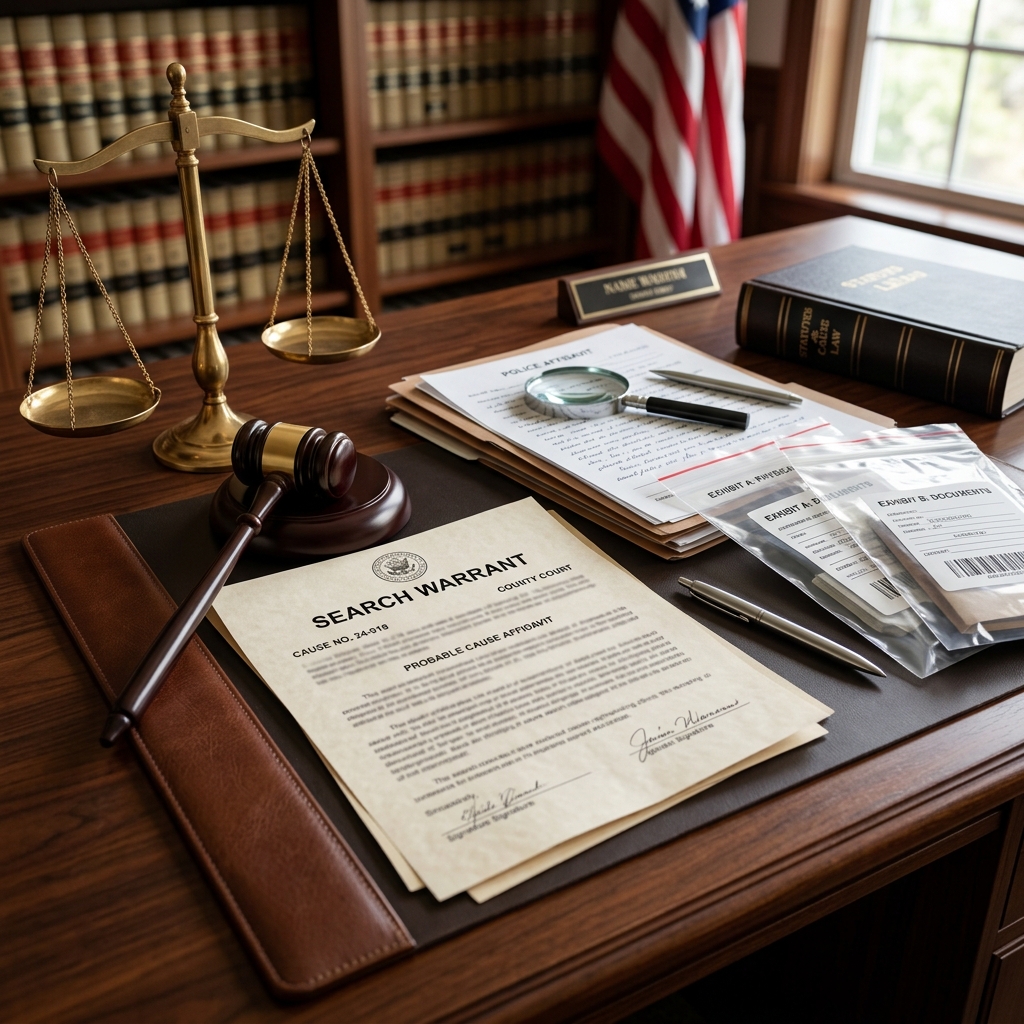
What Law Enforcement Must Show Before a Judge Signs a Search Warrant
A search warrant is not issued because an officer suspects wrongdoing in a general way. The judge must be given facts that create a fair basis to believe evidence of a crime will be found in a specific place, and the request must be narrow enough to avoid a broad or exploratory search.
In practice, that means the application usually depends on sworn facts in an affidavit, such as observations by officers, witness statements, informant tips, records, or other evidence that links a suspected offense to a particular location or item.
- The proof must be sworn or affirmed.
- The facts must support a finding of probable cause.
- The place to be searched must be identified with enough detail to avoid guesswork.
- The items or people to be seized must also be described with particularity.
Probable Cause Is the Core Requirement
The central question is whether the available facts would lead a reasonable person to believe that a crime has occurred and that evidence connected to that crime is likely in the place described in the warrant request.
Probable cause is more demanding than a hunch and less demanding than proof beyond a reasonable doubt. It is a practical standard built around probabilities, not certainty.
| Standard | Meaning | Typical use |
|---|---|---|
| Suspicion | A bare guess or intuition | Not enough for a warrant |
| Probable cause | Facts make the search reasonably likely to uncover evidence | Needed for a search warrant |
| Proof beyond a reasonable doubt | Near certainty required for conviction | Used at trial, not for warrant approval |
Courts look at the total picture rather than one fact in isolation. A single clue may not be enough, but several pieces of information may add up to a sufficient showing when considered together.
What Types of Evidence Can Support the Request
The law does not limit warrant applications to one kind of proof. Officers may rely on direct observations, records, communications, controlled buys, surveillance, witness accounts, or information from informants if the information appears reliable and specific.
- Officer observations: A patrol officer sees contraband, suspicious conduct, or activity tied to a crime.
- Witness statements: A victim, neighbor, or bystander provides details connecting a location to criminal activity.
- Informant information: A confidential source may supply facts, especially when the source has proven reliable or the information is independently verified.
- Documents and records: Phone records, transaction logs, or other paperwork may help link evidence to a place or person.
- Physical evidence: Items already recovered can support a further search if they point to additional evidence elsewhere.
Although different jurisdictions phrase the test differently, the common thread is the same: the application must be grounded in concrete facts, not speculation.
Why Particularity Matters
Even when probable cause exists, a warrant must still be written with enough precision to limit where officers may search and what they may seize.
This requirement prevents a warrant from becoming a blank check. The document should describe the target location and the evidence sought in a way that tells officers what they are allowed to look for and what they are not allowed to search beyond.
- The location should be identifiable, not vague.
- The property or person to be searched should be described clearly.
- The items to be seized should have meaningful detail.
- The warrant should not authorize an unlimited search of unrelated property.
For example, a warrant for financial records should not read like permission to seize every paper in a house. Likewise, a warrant for digital evidence should be tailored to the suspected offense and the types of files reasonably expected to contain that evidence.
Who Reviews the Application
A valid search warrant must be approved by a neutral decision-maker, not by the officers conducting the investigation.
That neutral review is important because it creates a pause between investigation and intrusion. The judge or magistrate checks whether the stated facts actually justify the requested search and whether the request is sufficiently specific.
In many systems, the application is made through a sworn affidavit. The affidavit becomes part of the record supporting the warrant, and the judge relies on it to decide whether the legal standard has been met.
Common Situations That Can Affect the Warrant Process
Not every police search requires a warrant, and not every investigation follows the same path. Courts recognize exceptions for emergency or limited circumstances, but those exceptions are separate from the basic warrant rule.
- Consent: A person with authority may permit a search.
- Exigent circumstances: Police may act quickly when delay could lead to danger or destruction of evidence.
- Search incident to arrest: Officers may conduct a limited search tied to a lawful arrest.
- Plain view: Items visible from a lawful vantage point may be seized if their incriminating nature is apparent.
- Automobile searches: Vehicles are treated differently in some settings when probable cause exists.
These exceptions do not erase the warrant requirement. They simply explain when officers may search without first obtaining judicial approval. If none of those exceptions applies, officers typically need a properly supported warrant.
How Courts Judge a Warrant Later
Even after a warrant is issued and executed, it may still be challenged in court. A defense lawyer may argue that the affidavit did not establish probable cause, that the warrant was too broad, or that the information was stale or unreliable.
If a warrant is defective, the evidence obtained through it may be subject to suppression depending on the facts and the applicable law. That is why the details in the warrant application matter so much: the quality of the supporting facts can determine whether the search survives later review.
Courts generally examine whether the issuing judge had a substantial basis for finding probable cause, whether the warrant described the search with enough specificity, and whether officers stayed within the limits authorized by the warrant.
What Usually Makes a Strong Warrant Application
A stronger application is usually built around information that is recent, specific, and corroborated. The best-supported requests often connect a suspect, a location, and a type of evidence in a clear chain of facts.
- The alleged offense is identified clearly.
- The facts explaining why evidence is likely at the target location are spelled out.
- Any informant’s credibility is supported by past reliability or independent verification.
- The search scope is tailored to the evidence sought.
- The affidavit avoids vague or boilerplate language.
Because probable cause is based on common-sense judgment, officers and prosecutors try to show not only that a crime may have happened, but also why the specific place to be searched is a logical place to find evidence of that crime.
Search Warrant Basics at a Glance
| Requirement | What it means | Why it matters |
|---|---|---|
| Probable cause | Facts support a fair belief that evidence will be found | Justifies the intrusion |
| Sworn affidavit | Facts are presented under oath | Creates accountability |
| Particularity | Specific place and items are listed | Limits the search |
| Neutral review | Judge or magistrate approves the request | Checks government power |
Frequently Asked Questions
Can police get a search warrant on suspicion alone? No. Suspicion is not enough; the request must be backed by facts supporting probable cause.
Does a warrant have to list exactly what police are looking for? It must describe the target with enough detail to guide the search and keep it within lawful bounds, though the exact level of detail depends on the circumstances.
Can an informant’s tip support a warrant? Yes, if the information is detailed, credible, and, when needed, corroborated by other evidence.
Can a warrant be challenged later? Yes. A defendant can argue that probable cause was missing, the description was too broad, or officers exceeded the warrant’s scope.
Are there searches that do not need a warrant? Yes. Consent, emergencies, plain view, and some searches connected to arrest or vehicles are recognized exceptions in many situations.
Why the Warrant Standard Matters
The warrant requirement is designed to keep searches tied to evidence and tied to judicial oversight. By insisting on probable cause and a precise description of the search, the law tries to balance investigative needs against privacy interests in homes, property, and personal effects.
That balance is why the evidence supporting a warrant must do more than raise a general concern. It must give the judge a reasoned basis to authorize a search of a particular place for particular evidence, and it must do so in a form that can later be reviewed if the search is challenged.
References
- Code of Virginia, Chapter 5. Search Warrants — Virginia Legislative Information System. n.d. https://law.lis.virginia.gov/vacodefull/title19.2/chapter5/
- The Search Warrant Requirement in Criminal Investigations & Legal Process — Justia. n.d. https://www.justia.com/criminal/procedure/warrant-requirement/
- Search Warrants — Alameda County District Attorney’s Office. n.d. https://le.alcoda.org/publications/point_of_view/files/search_warrants.pdf
- Search warrant requirement and the Supreme Court — EBSCO Research Starters. n.d. https://www.ebsco.com/research-starters/law/search-warrant-requirement-and-supreme-court
- Search Warrants — Federal Judicial Center, Judiciaries Worldwide. n.d. http://judiciariesworldwide.fjc.gov/search-warrants
- Search warrant — Legal Information Institute, Cornell Law School. n.d. https://www.law.cornell.edu/wex/search_warrant
- Fourth Amendment Search Warrant Requirements — Congressional Research Service. n.d. https://www.congress.gov/crs-product/IF13169
Similar Articles








Read full bio of medha deb




