
Conflicts of Interest in Insurance Defense
How control over claims, counsel and settlements can create legal and ethical conflicts between insurers and the people they insure.
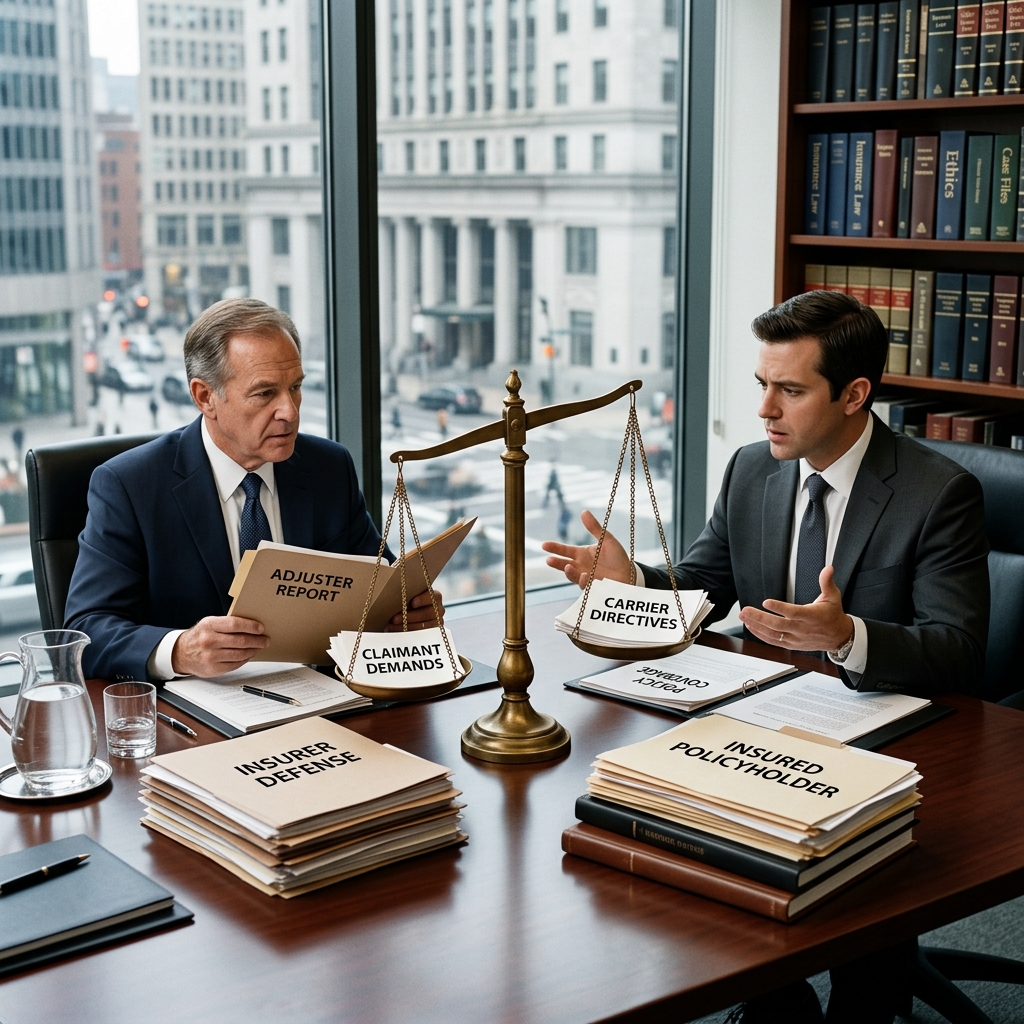
Liability insurance is designed to protect policyholders from financial ruin when they are sued, but the way insurers control claims and litigation can create serious conflicts of interest between the company and the insured person or business. When the insurer’s financial incentives or coverage positions diverge from what is best for the policyholder, the integrity of the defense and the fairness of settlement decisions may be compromised. This article explains how those conflicts arise, how courts and regulators respond, and what options policyholders have to safeguard their interests.
Understanding the Insurance Defense Relationship
Most liability insurance policies include a duty to defend, meaning the insurer must hire and pay a lawyer to defend the policyholder against covered claims. In practice, this creates what is often called a “tripartite” relationship: three participants connected by overlapping duties and interests.
- Insurer – promises to defend and indemnify the policyholder, while also seeking to minimize claim costs.
- Policyholder (insured) – wants a strong defense, accurate advice about personal exposure, and protection from judgments or settlements.
- Defense counsel – is hired and paid by the insurer, but owes professional duties to the insured and may in some jurisdictions also have obligations to the insurer.
The American Bar Association recognizes that lawyers appointed by insurers can face concurrent conflicts of interest when their responsibilities to one client materially limit their duties to another. That risk is magnified when the insurer’s coverage position or cost-control strategies differ from what is optimal for the insured’s defense.
Common Sources of Conflicts Between Insurer and Insured
Conflicts of interest are not automatic in every defended claim, but they frequently arise at specific decision points in the litigation. Key areas include control of the defense, control of information, management of costs, and settlement strategy.
Control of the Defense Strategy
Standard liability policies often give insurers broad authority to manage the defense: they select counsel, direct litigation strategy, and decide whether to settle or try the case. Problems can emerge where the insurer’s coverage position or financial priorities diverge from the insured’s risk profile.
- Coverage disputes: If the insurer believes some claims are not covered or has reserved its rights to deny coverage, it may favor strategies that support its coverage defenses rather than fully protecting the insured from liability.
- Exposure beyond policy limits: The policyholder faces personal exposure above the policy limit, while the insurer’s exposure is capped. This can alter how aggressively each side wants to litigate or settle.
- Reputational vs. financial interests: Businesses may care deeply about public reputation, admission of wrongdoing, or future regulatory impact, whereas insurers are primarily concerned with claim cost and precedent.
In some jurisdictions, courts have held that when a coverage dispute allows insurer-appointed counsel to affect the outcome of coverage, a genuine conflict of interest exists and special duties arise.
Control of Information and Confidentiality
Defense counsel routinely receives confidential information about the policyholder and the case. Sharing that information with the insurer can help evaluate coverage and settlement, but it may also harm the insured if used to support denials of coverage or recoupment of defense costs.
Ethical rules define a conflict of interest as a situation where a lawyer’s duties to one client are materially limited by obligations to another client or a third person. In the insurance context, confidentiality can be strained when:
- Information relevant to effective defense is also relevant to limiting or denying coverage.
- The insurer demands full access to defense files while simultaneously disputing coverage or reserving rights.
- Defense counsel feels pressure to share privileged strategy or evaluations that may disadvantage the policyholder.
Some courts allow limited sharing under a “common interest” doctrine, while others restrict insurer access when it is not paying for the defense or is actively contesting coverage. These differences can be crucial when assessing whether conflict-free counsel is required.
Litigation Cost Management and Fee Controls
Insurers frequently use guidelines, billing audits, and preferred counsel panels to control litigation costs. While cost efficiency is legitimate, rigid application of cost controls can undermine the quality or scope of the defense.
- Limits on discovery that may be important to the insured’s defense but viewed as unnecessary expense by the insurer.
- Restrictions on expert witnesses or investigative work that could reduce the chances of prevailing at trial.
- Pressure on counsel to keep hours low or accept lower rates, potentially affecting the time devoted to complex cases.
Regulatory guidelines for insurance agents and adjusters emphasize that a client’s interests can be prejudiced if professional judgment is not free from conflicts of interest. Similar principles apply to defense counsel: their judgment must not be materially limited by the insurer’s economic priorities.
Settlement Decisions and Bad Faith Risk
Settlement is often the most critical juncture for conflicts. In many states, insurers have an affirmative duty to make reasonable settlement decisions within policy limits to protect insureds from excess judgments, and failure to do so can create bad faith liability. For example, Florida law imposes a duty on insurers to attempt settlement of clear liability claims within policy limits; willful delay without reasonable cause can be treated as bad faith.
Conflicts arise when:
- The insurer wants to gamble on trial to avoid paying policy limits, while the insured fears a large judgment.
- The insurer refuses to settle within limits despite clear liability and serious injuries.
- Settlements are structured in ways that protect the insurer but leave the insured exposed to future claims or reputational harm.
In such scenarios, the insurer’s control over settlement can directly collide with the policyholder’s interest in minimizing personal exposure. Courts in multiple jurisdictions have recognized that an insurer’s failure to settle reasonably may expose it to damages well beyond the policy limits in a subsequent bad faith action.
When a Legal Conflict of Interest Is Recognized
Not every disagreement between insurer and insured qualifies as a legally significant conflict. Courts and ethics authorities generally look for situations where the lawyer’s representation is materially limited or where the outcome of a coverage issue can be affected by defense counsel’s actions.
| Situation | Likely Conflict Status | Key Concern |
|---|---|---|
| Routine defense of fully covered claim | Typically no legal conflict | Interests generally aligned in defeating or minimizing claim. |
| Insurer reserves rights or disputes coverage on key issues | Potential conflict | Counsel’s strategy may influence coverage outcome and allocation of loss. |
| Insured has significant exposure above policy limits | Heightened risk | Insurer may resist settlement at limits; insured wants to avoid excess judgment. |
| Insurer instructs counsel based primarily on cost concerns | Ethical concern | Risk that defense is weakened to save money, harming the insured’s case. |
The American Bar Association’s Model Rule 1.7 treats a conflict as present when representation of one client is directly adverse to another or when there is a significant risk that representation will be materially limited by responsibilities to another client or a third person. In many jurisdictions, once such a conflict is recognized, the insured may be entitled to independent counsel that is free from insurer control.
Independent Counsel: A Key Protection for Policyholders
When conflicts of interest become serious, courts or statutes may require the insurer to pay for independent counsel chosen by the insured. The original article you referenced highlights that insurers may need to provide separate counsel for themselves and for the insured in these situations. This arrangement seeks to ensure that the insured receives unbiased legal advice uncolored by the insurer’s coverage or cost concerns.
Triggers for Independent Counsel
Although rules vary by jurisdiction, common triggers include:
- An active coverage dispute in which defense strategy could affect whether claims are covered.
- Situations where defense counsel would have to choose between protecting the insurer’s interests and protecting the insured’s interests.
- Cases where the insurer asserts a reservation of rights on issues that overlap with liability facts being litigated.
Regulatory conflict-of-interest guidelines in the insurance sector emphasize that when loyalty to a client could be materially affected by duties to an insurance company or other client, the professional must take appropriate action before continuing representation. Providing conflict-free counsel is one of those actions.
How Independent Counsel Works
Independent counsel is typically selected by the insured, subject to reasonableness standards for rates and qualifications. The insurer pays for this counsel, but cannot improperly direct defense strategy or demand privileged information that would harm the insured’s position. At the same time, the insurer may retain its own coverage counsel to handle insurance issues separate from the liability defense.
Key features of independent counsel arrangements include:
- Undivided loyalty to the insured as the primary client.
- Protection of confidential communications that may bear on coverage disputes.
- More balanced input on settlement decisions, including candid advice about personal exposure beyond policy limits.
Regulatory and Ethical Framework
Conflicts of interest involving insurance companies are addressed through a mix of professional ethics rules, industry guidelines, and regulatory requirements. These frameworks collectively aim to ensure that policyholders receive fair treatment and unbiased advice even when insurers control the defense.
Professional Conduct Rules for Lawyers
Model Rule of Professional Conduct 1.7, adopted in similar form by many states, provides that a lawyer must not represent a client when a concurrent conflict of interest exists, unless certain disclosure and consent conditions are met. In insurance defense, this means:
- Identifying when representation of insurer and insured is directly adverse or materially limited.
- Explaining the nature of the conflict and potential consequences to the insured.
- Obtaining informed consent in writing if dual representation continues, or withdrawing from one representation if consent is inappropriate.
Insurance Industry Conflict-of-Interest Guidelines
Guidelines for insurance agents, adjusters, and related licensees stress the duty to avoid conflicts of interest and to provide written disclosure of any real, potential, or apparent conflicts before a client commits to an insurance transaction. Although these rules focus on sales and claims handling, their principles are relevant to how insurers administer defense obligations.
Important regulatory expectations include:
- Clear disclosure of conflicts so clients can make informed decisions.
- Written explanations of why the conflict matters for the transaction.
- Prioritizing the duty to the client when conflicts are irreconcilable, which may require declining or ending an engagement.
Oversight of Insurance Regulators
Conflicts of interest can also arise at the regulatory level. For example, the National Association of Insurance Commissioners (NAIC), which plays a central role in setting standards for state-regulated insurance markets, is funded by insurance companies themselves. Observers have raised concerns that this funding structure may undermine transparency and democratic accountability in the regulatory process. While these issues do not directly control individual defense arrangements, they form part of the broader context in which insurer-insured conflicts are managed.
Practical Steps for Policyholders Facing Conflicts
Policyholders who suspect a conflict of interest with their insurer or defense counsel should take proactive steps. Waiting until after an adverse judgment or coverage denial often makes remedies more complex and costly.
Warning Signs Policyholders Should Watch For
- Counsel appears more responsive to the insurer than to the insured, especially on strategic decisions.
- The insurer issues a reservation of rights but continues to direct defense without addressing potential conflicts.
- Important settlement opportunities within policy limits are rejected or delayed without clear explanation.
- Counsel is reluctant to discuss personal exposure or seems constrained in offering candid advice.
Actions to Protect Your Interests
If you see these signals, consider the following steps:
- Request clarification in writing about the lawyer’s role, who is considered the client, and how conflicts will be handled.
- Ask about independent counsel rights if there is a coverage dispute or reservation of rights.
- Consult separate legal counsel experienced in insurance coverage or bad faith to evaluate options, including demands for conflict-free representation.
- Document all communications with the insurer regarding settlement, defense decisions, and coverage positions.
In some cases, policyholders may ultimately pursue a bad faith claim or other legal remedies if the insurer’s management of the defense or settlement unreasonably exposes them to excess liability. Independent legal advice can help assess whether the insurer’s conduct has crossed that line.
FAQs: Conflicts of Interest with Insurance Companies
1. Is it always a conflict of interest when my insurer hires my defense lawyer?
No. In many routine liability cases, the insurer’s interest in minimizing the claim aligns with the insured’s interest in avoiding liability. A legally significant conflict typically arises when coverage is disputed, when defense strategy can affect coverage, or when the insured faces exposure beyond policy limits that the insurer does not share.
2. What does it mean when my insurer “reserves its rights”?
A reservation of rights letter informs you that the insurer is providing a defense but may later deny coverage for some or all claims. This can create a conflict because the insurer might benefit from facts or strategies that limit coverage, while you want a defense focused solely on avoiding liability or minimizing damages.
3. When am I entitled to independent counsel paid by my insurer?
Rules vary by state, but you may be entitled to independent counsel when the interests of the insurer and insured diverge in a way that could affect the outcome of the case or coverage. Typical triggers include active coverage disputes, reservations of rights on issues intertwined with liability facts, or situations where insurer-appointed counsel would have to choose between advancing the insurer’s interests and fully protecting you.
4. Can my insurer refuse to settle within policy limits if I want to avoid trial?
Insurers often have the contractual right to control settlement, but they must exercise that power in good faith. In many jurisdictions, if liability is clear and the risk of a judgment above policy limits is high, the insurer has a duty to make reasonable efforts to settle within limits. Failure to do so may expose the insurer to bad faith liability and damages beyond the policy limits.
5. What should I do if I believe my insurer’s decisions are putting me at risk?
You should promptly seek independent legal advice, ask the insurer to explain its decisions and potential conflicts in writing, and explore your rights to independent counsel or other remedies. Early action can help prevent avoidable exposure and preserve evidence if you later need to challenge the insurer’s conduct in court.
References
- Insurance Regulators are Funded by the Insurance Industry Itself: Calling Out Conflicts of Interest — The Center for Insurance Policy and Research / NAIC analysis. 2022-06-01. https://www.thecenterforami.org/blog/insurance-regulators-are-funded-by-the-insurance-industry-itself-calling-out-conflicts-of-interest
- Conflicts of Interest with Insurance Companies — LegalMatch Law Library. 2020-01-15. https://www.legalmatch.com/law-library/article/conflicts-of-interest-with-insurance-companies.html
- Conflicts and the Tripartite Relationship — Thompson, Coe, Cousins & Irons LLP. 2017-05-10. https://www.thompsoncoe.com/resources/publications/conflicts-and-the-tripartite-relationship/
- Conflict of Interest Guidelines for Insurance Agents, Adjusters, and Salespersons — British Columbia Financial Institutions Commission. 2013-09-01. https://cailba.com/wp-content/uploads/2014/12/BC-Conflict-of-Interest-Guidelines-2013.pdf
- Understanding Conflicts of Interest — American Bar Association, excerpt from insurance defense ethics publication. 2016-01-01. https://www.americanbar.org/content/dam/aba-cms-dotorg/products/inv/book/412676242/chap1excpt-5190567.pdf
Similar Articles








Read full bio of Sneha Tete




