
When Insurance Coverage Lapses: Rights, Risks, and Remedies
Understand what a lapse in insurance coverage really means, why it happens, the legal and financial consequences, and how to fix or prevent it.
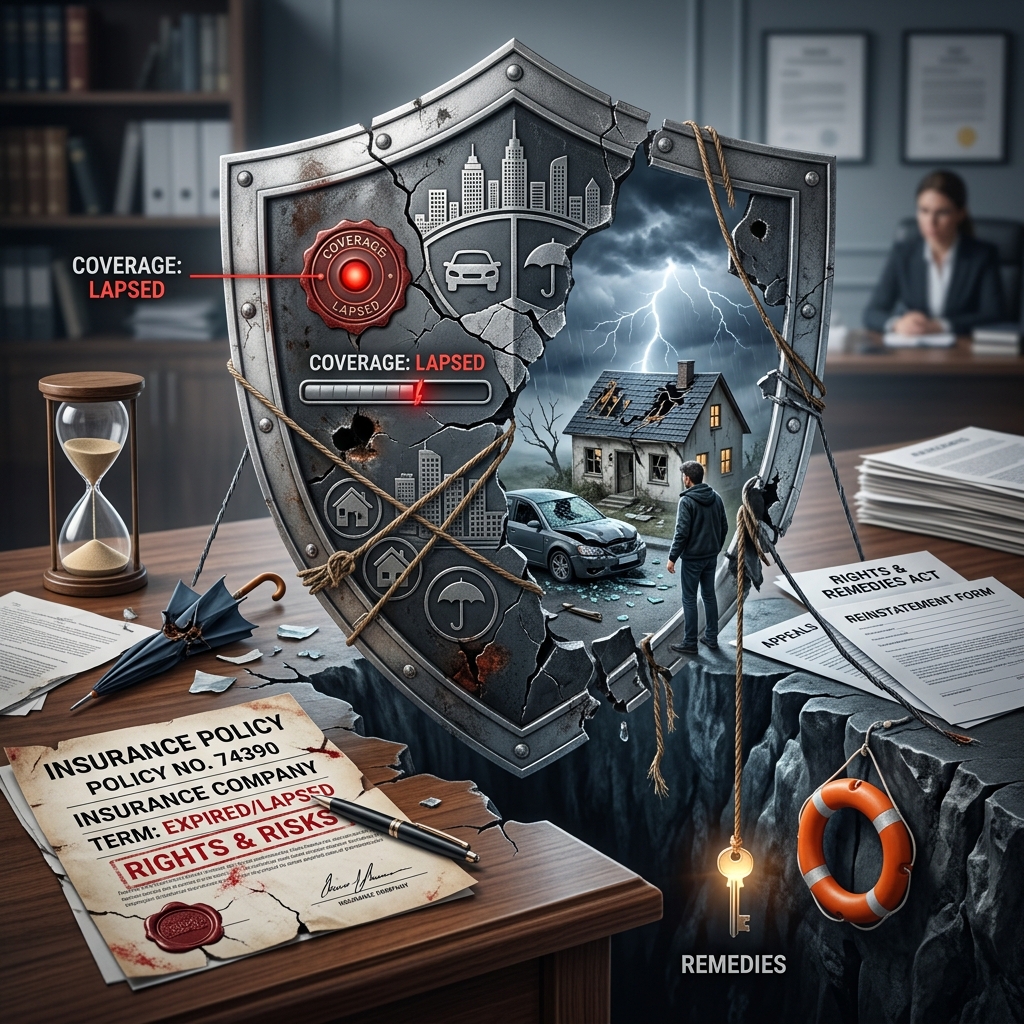
Insurance is designed to be there when something goes wrong. A lapse in coverage is a period when that protection disappears because the policy is no longer in force. Understanding why a policy lapses, what happens during the gap, and how to restore coverage is critical for anyone who relies on insurance to manage risk.
What Is a Lapse in an Insurance Policy?
In insurance and contract law, a lapse occurs when the rights or benefits under a contract stop because a required condition was not met or the contract expired without renewal. When an insurance policy lapses, the coverage and rights under the policy become inactive until the policy is reinstated or a new policy is issued.
A policy lapse typically means:
- The insurer no longer has a duty to pay claims for events occurring during the lapse.
- The policyholder has no contractual right to benefits for incidents that happen while coverage is inactive.
- Any legal or regulatory requirement to carry insurance (such as auto liability coverage) may be violated during the lapse.
The concept applies across many types of insurance, including auto, home, health, and life, but the practical consequences and rules can vary by policy type and by jurisdiction.
Common Reasons Insurance Policies Lapse
Although every policy has its own terms, most lapses share a few core causes. According to financial and insurance industry guidance, the most frequent triggers are administrative or payment-related rather than intentional decisions to give up coverage.
1. Non-Payment of Premiums
The leading cause of lapses is failure to pay premiums on time.
- Missed due dates: Forgetting a monthly or annual payment.
- Insufficient funds: Automatic payments fail because of low bank balance.
- Persistent non-payment: Several missed payments after reminders, leading to cancellation.
Insurers typically specify a payment schedule and what happens when payments are late. If the policyholder does not cure the missed payment within the allowed period, the insurer may cancel the policy and mark it as lapsed.
2. Failure to Renew or Respond
Some policies require explicit renewal at the end of a term. A lapse can occur when:
- The policy term ends and the policyholder does not return renewal forms or pay the renewal bill.
- Notices are ignored or not received due to address changes or email issues.
In such cases, coverage typically stops at the end of the policy period if renewal steps are not completed.
3. Intentional Termination Without Replacement
Policyholders sometimes cancel a policy on purpose, but a lapse occurs when they do not secure replacement coverage before termination becomes effective. For example, a motor vehicle agency may treat a gap of ten days or more between the end of one auto policy and the start of another as a lapse of coverage.
4. Breach of Policy Conditions
Insurers may cancel or decline to renew a policy if they determine that the policyholder has breached conditions or increased risk beyond acceptable levels. Examples include:
- Fraudulent claims or misrepresentation on the application.
- Serious changes in risk, such as repeated accidents or hazardous activities.
In these cases, the policy may end, and if the policyholder does not obtain replacement insurance, they experience a lapse.
Grace Periods: A Short Safety Net
Most insurance contracts include some form of grace period—a limited time after the premium due date during which coverage continues even though payment is late. A grace period is designed to prevent immediate loss of coverage for minor delays.
Key characteristics of grace periods include:
- Limited duration: For auto insurance, many insurers and state laws allow roughly 10–20 days after the due date before cancellation.
- Continued coverage: Claims arising during the grace period may still be covered, provided the premium is paid by the end of the period.
- Automatic lapse if unpaid: If the premium remains unpaid after the grace period, the policy is typically cancelled and coverage lapses.
Grace periods are not a guarantee of reinstatement. Once the grace period expires without payment, many insurers require a formal process to restore coverage or may decline reinstatement altogether.
What Happens When Coverage Lapses?
A lapse has both immediate practical effects and longer-term financial and legal consequences. These effects vary by policy type but share one core element: no coverage exists during the gap.
Immediate Consequences of a Lapse
| Aspect | What Changes When a Policy Lapses |
|---|---|
| Coverage | No protection for losses occurring during the lapse; claims for incidents in that period are generally not payable. |
| Legal compliance | For mandatory insurance (e.g., auto liability), a lapse can trigger fines, license or registration suspension, and other sanctions. |
| Financial exposure | Policyholder is fully responsible for damage, medical bills, and legal costs arising from accidents or losses during the gap. |
| Contract rights | Rights and benefits under the contract are inactive; the insurer is not obligated to defend or indemnify the policyholder. |
Legal and Regulatory Penalties
For certain lines of insurance—especially auto liability—law often requires continuous coverage. A lapse can therefore lead to enforcement actions by regulatory agencies. For example:
- A state Department of Revenue may treat any gap of ten days or more between policies as a lapse and impose civil penalties.
- In New York, an insurance lapse on a registered vehicle can result in suspension of both the vehicle registration and driver license if coverage is absent for 91 days or more.
- Penalties may include fines, license suspension, impoundment of the vehicle, and even jail time for repeated violations.
Financial Impact and Future Premiums
Beyond immediate out-of-pocket costs, a lapse may make future insurance more expensive and harder to obtain. Industry analyses show that a documented lapse in auto coverage can raise premiums and signal higher risk to insurers.
Consequences can include:
- Premium increases: Even short lapses under 30 days may raise rates; longer lapses can lead to larger surcharges.
- Limited insurer options: Some insurers decline applicants with recent lapses or require special filings, such as proof of financial responsibility.
- Additional requirements: In some jurisdictions, drivers with lapses must file documentation (such as an SR-22 certificate) to show they carry minimum required coverage.
Reinstatement: Can a Lapsed Policy Be Brought Back?
Once a policy lapses, restoring coverage may be possible but is never guaranteed. Insurers typically have formal procedures to decide whether to reinstate a cancelled policy or require the customer to purchase a new one.
Typical Reinstatement Process
While details vary, the reinstatement process often involves these steps:
- Contacting the insurer: The policyholder should promptly call or write to the insurer to confirm whether coverage has lapsed and the exact date the policy became inactive.
- Requesting reinstatement: If a lapse occurred, the policyholder can ask the insurer to reinstate the policy. Insurers may consider factors such as how long the lapse lasted and why it happened.
- Paying amounts due: Reinstatement usually requires payment of all outstanding premiums and possibly a reinstatement fee.
- Underwriting review: The insurer may re-evaluate risk, ask for updated information, or impose new terms before agreeing to reinstate.
Insurers are more likely to reinstate when the lapse is short and the cause is a clear administrative oversight or temporary difficulty. Longer lapses or lapses associated with claims disputes or fraud make reinstatement less likely.
Reinstatement vs. New Policy
If reinstatement is not possible, the policyholder must obtain new coverage from the same insurer or another company. Starting a new policy:
- May carry higher premiums, particularly after a documented lapse.
- Creates a clear gap in coverage history rather than continuous insurance.
- Can require additional documentation or state filings in some jurisdictions.
Preventing Lapses: Practical Strategies
Because lapses can be costly and difficult to fix, prevention is far easier than cure. Many avoidable lapses result from missed deadlines or poor communication rather than a conscious choice to forego coverage.
Payment and Reminder Tools
Policyholders can reduce the chance of missed payments by:
- Using automatic payments: Authorize automatic deduction of premiums from a bank account or card so payments are made on time.
- Setting calendar alerts: Create digital reminders for due dates or renewal periods.
- Choosing manageable schedules: Some insurers offer annual or semiannual payment options that reduce the number of due dates to track.
Maintaining Continuous Coverage
When switching insurers or changing policy types, it is essential to avoid gaps between the end of one policy and the start of another:
- Confirm the exact termination date of the old policy and the effective date of the new one.
- Arrange for the new policy to begin before or on the same date the old policy ends.
- Provide all required information to the new insurer well in advance to avoid delays.
Policy Review and Communication
Regularly reviewing policy terms and staying in contact with the insurer can help prevent unexpected lapses:
- Review renewal notices, updated terms, and changes in underwriting policies.
- Notify the insurer promptly about changes of address or contact information so that bills and notices reach the policyholder.
- Discuss changes in risk (such as new drivers, property renovations, or business activities) so the policy remains appropriate and compliant.
Special Focus: Auto Insurance Lapses
Auto insurance illustrates policy lapses particularly clearly because many jurisdictions require drivers to carry at least minimum liability coverage at all times. When auto coverage lapses, the policyholder is typically driving uninsured, which can create serious legal and financial problems.
Key auto-specific issues include:
- Driving without insurance: In most states, operating a vehicle without required insurance is illegal and may lead to fines and license suspension.
- Administrative reporting: Insurers often report cancellations to motor vehicle agencies, which then track lapses and issue notices.
- State-defined lapse periods: Some states explicitly define when a gap constitutes a lapse, such as ten days with no overlapping coverage.
Because auto accidents can lead to large bodily injury and property damage claims, a lapse in auto insurance exposes the policyholder to substantial personal liability.
Frequently Asked Questions (FAQs)
Does every missed payment cause an immediate lapse?
No. Most policies include a grace period that allows a short delay in payment without immediate cancellation. However, if payment is not made by the end of the grace period, the policy will typically lapse and coverage will end.
Are losses during a lapse ever covered?
As a general rule, losses that occur during a lapse are not covered because the policy is inactive at the time of the incident. Even if the policy is later reinstated, the insurer usually does not retroactively cover events that happened while the contract was not in force.
How does a lapse affect future premiums?
Insurers treat a lapse as a risk factor. Industry data indicates that drivers with a lapse in auto coverage often face higher premiums and sometimes additional conditions when they seek new coverage. The longer and more recent the lapse, the more significant the potential rate impact.
Can regulators suspend my license or registration because of a lapse?
Yes. In jurisdictions where continuous auto liability insurance is required, agencies such as departments of motor vehicles may suspend vehicle registrations and driver licenses when a lapse is recorded, particularly if it lasts beyond a certain threshold.
What should I do immediately if I discover my policy has lapsed?
First, stop activities that require coverage—such as driving a car—until you are insured again. Then contact your insurer to confirm the status of the policy, ask about reinstatement options, and, if necessary, secure new coverage as quickly as possible.
References
- Lapse Definition — Investopedia. 2022-05-18. https://www.investopedia.com/terms/l/lapse.asp
- Lapse or Loss of Insurance Coverage — Georgia Department of Revenue. 2024-02-01. https://dor.georgia.gov/motor-vehicles/insurance/lapse-or-loss-insurance-coverage
- Insurance Lapses — New York State Department of Motor Vehicles. 2023-09-10. https://dmv.ny.gov/insurance/insurance-lapses
- What Happens If My Car Insurance Lapses? — Mercury Insurance. 2023-07-12. https://www.mercuryinsurance.com/resources/basics-101/what-happens-if-my-car-insurance-lapses.html
- Understanding Car Insurance Lapse & Grace Periods — Baldwin Risk Partners. 2022-11-03. https://baldwin.com/insights/understanding-car-insurance-lapse-grace-periods/
- Car Insurance Lapse & Grace Periods Explained — Progressive. 2023-04-15. https://www.progressive.com/answers/car-insurance-lapse/
- Does a Lapse in Car Insurance Coverage Affect Rates? — U.S. News & World Report. 2024-01-08. https://www.usnews.com/insurance/auto/does-coverage-lapse-affect-rates
Similar Articles








Read full bio of Sneha Tete




