
Understanding Automobile Insurance Vehicle Coverage
Learn the essential types of automobile insurance coverage, what they protect, and how to choose the right limits for your vehicle and budget.
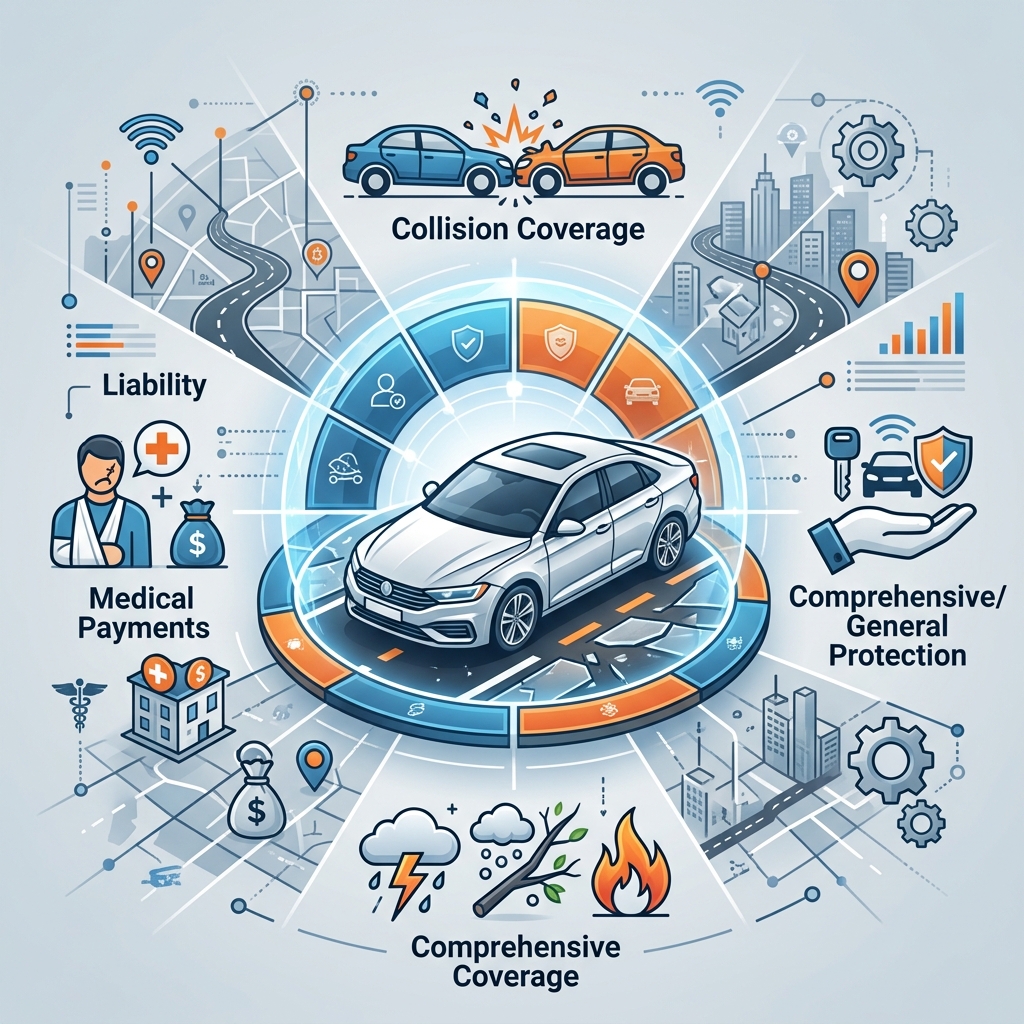
Automobile insurance is designed to protect you financially when a vehicle is damaged, stolen, or involved in an accident. It combines several types of coverage into a single policy, each addressing a different risk, from injuries to others to damage to your own car. While some protections are required by law, others are optional add-ons that help you tailor coverage to your needs and budget.
Why Automobile Insurance Coverage Matters
Driving without adequate insurance can expose you to substantial costs. Medical bills, vehicle repairs, and legal claims can quickly exceed the cost of a policy, especially if you are found legally responsible for an accident. Nearly all U.S. states require drivers to carry at least a minimum level of liability insurance, and many lenders require additional coverage when a vehicle is financed.
Understanding how the main coverage types work helps you:
- Comply with state financial responsibility laws that mandate certain minimum limits.
- Protect your assets from lawsuits or large out-of-pocket expenses after a crash.
- Repair or replace your vehicle when it is damaged by a covered event.
- Cover medical costs for you, your passengers, and others injured in an accident.
Core Components of an Auto Insurance Policy
An auto policy typically includes several major categories of coverage. Insurers often group them into protections for others, for your vehicle, and for you and your passengers.
| Coverage Type | Main Purpose | Required or Optional |
|---|---|---|
| Liability | Pays for injuries and property damage you cause to others. | Required in almost all states. |
| Uninsured/Underinsured Motorist | Protects you if the at-fault driver has no or too little insurance. | Required or strongly encouraged in many states. |
| Collision | Pays for damage to your vehicle from a crash, regardless of fault. | Optional, but often required by lenders. |
| Comprehensive | Pays for non-collision damage (theft, fire, vandalism, storms). | Optional, often paired with collision.[10] |
| Medical Payments / PIP | Covers medical bills and related costs for you and passengers. | Required in some states, optional in others. |
Liability Coverage: Protecting Others from Your Actions
Liability insurance is the foundation of most auto policies. It pays when you or someone driving your car is legally responsible for causing injury or property damage to others.
Bodily Injury Liability
Bodily injury liability covers costs associated with injuries or death that result from an accident you cause. Typical covered expenses include:
- Emergency care and hospital treatment
- Follow-up medical visits and rehabilitation
- Lost wages for an injured person who cannot work
- Legal defense costs if you are sued
States set minimum liability limits, often expressed in split limits such as 25/50/25 or 100/300/100 (in thousands of dollars). For example, a 100/300/100 policy may provide up to $100,000 for bodily injury to one person, $300,000 total per accident, and $100,000 for property damage.
Property Damage Liability
Property damage liability reimburses others when you damage a vehicle or other property, such as buildings, fences, or utility poles. This coverage can also pay for legal defense if the property owner sues you for the damage.
Important points about liability coverage:
- It does not pay to repair your own car; other coverages do that.
- Minimum limits in many states are relatively low; higher limits are often recommended to protect personal assets.
- Lapses in required liability coverage can result in registration or license suspension and fines in some states.
Uninsured and Underinsured Motorist Coverage
Even where insurance is mandatory, some drivers carry no coverage or only minimal limits. Uninsured motorist (UM) and underinsured motorist (UIM) coverage are designed to protect you in those situations.
UM coverage can reimburse you for injuries and related costs if an at-fault driver has no insurance at all, including certain hit-and-run accidents. UIM coverage applies when the other driver’s policy exists but is insufficient to pay for serious injuries or damages.
UM/UIM coverage typically helps with:
- Medical bills for you and your passengers
- Lost wages due to injury
- Some non-economic losses, if permitted by state law
Many states strongly encourage or require UM/UIM coverage, and regulators often list it as a core protection for consumers choosing auto insurance.
Collision Coverage: Damage from Crashes
Collision coverage addresses physical damage to your vehicle caused by impact with another vehicle or object, or by a rollover, regardless of who is at fault. This coverage is especially important for newer or financed vehicles.
Collision insurance may cover:
- Repairs after a crash with another vehicle
- Damage from hitting fixed objects like guardrails or poles
- Vehicle damage from potholes or rollovers, subject to policy terms.
Key features include a deductible, the amount you pay out of pocket before insurance covers the rest. Higher deductibles typically reduce premiums but increase your share of repair costs.
Although no state law requires collision coverage, lenders commonly demand it when you finance or lease a vehicle, to protect their interest in the car.
Comprehensive Coverage: Non-Collision Damage
While collision coverage focuses on crashes, comprehensive coverage protects your vehicle from many other types of loss. It generally applies to events that are not collisions with another vehicle.[10]
Common examples of comprehensive claims include:
- Theft of the entire vehicle or parts
- Vandalism, such as keyed paint or broken windows
- Fire damage
- Weather-related damage, including hail, flood, or falling branches
- Impact with animals, depending on policy wording
Like collision, comprehensive generally includes a deductible. Many policyholders choose the same deductible for both, although you can select different amounts depending on your risk tolerance and finances.
Comprehensive and collision are often sold together as part of a “full coverage” package, but you can usually buy one without the other if the lender allows it.
Medical Payments and Personal Injury Protection
In addition to liability coverage for others, many policies include insurance specifically for your own medical costs. Two common forms are medical payments (MedPay) and personal injury protection (PIP).
Medical Payments Coverage (MedPay)
MedPay covers medical and funeral expenses for you, your passengers, and family members who are injured in an auto accident, regardless of who caused it. It typically helps pay for:
- Ambulance and emergency room costs
- Hospital stays and surgery
- Diagnostic tests such as X-rays
- Funeral expenses after a fatal crash
MedPay is required in some states and optional in others, making it a flexible way to add a layer of medical coverage above what your health insurance provides.
Personal Injury Protection (PIP)
PIP is commonly associated with “no-fault” insurance systems and is required in certain jurisdictions, such as Florida. It goes beyond MedPay by covering not only medical bills, but also other related expenses, often regardless of who is at fault.
PIP may pay for:
- Necessary medical treatment up to policy limits
- Portions of lost income due to injury
- Costs for essential services you cannot perform, such as home care
- Funeral expenses following a fatal accident
For example, Florida requires at least $10,000 in PIP coverage and $10,000 in property damage liability for vehicles registered in the state.
Additional and Specialized Vehicle Coverage Options
Beyond the major categories, insurers offer a range of optional protections. While not all are discussed in detail in official guidance, several are widely used:
- Glass coverage: Supplemental protection for windshields and other vehicle windows, which may allow repairs with little or no deductible.
- Rental reimbursement: Helps pay for a rental car while your vehicle is being repaired after a covered loss.
- Gap insurance: Covers the difference between what you owe on a loan or lease and the vehicle’s actual cash value if it is totaled, often required by some lenders.
- Classic or collector car insurance: Specialized policies that account for the unique value and usage of antique or collector vehicles.
Each add-on affects your overall premium and should be evaluated based on the vehicle’s value, how you use it, and the financial risk you wish to avoid.
State Requirements and Lender Rules
Auto insurance is governed primarily by state law, so minimum requirements vary. Nearly all states and Washington, D.C., mandate liability insurance to cover bodily injury and property damage caused to others. Some states also require MedPay, PIP, or uninsured motorist coverage.
Examples from public agencies include:
- Florida: Requires $10,000 in PIP and $10,000 in property damage liability for vehicles registered in the state, with continuous coverage and penalties for lapses.
- Pennsylvania: Requires all registered vehicles to maintain insurance, with potential fines and license or registration suspension for driving uninsured.
- Colorado: Highlights liability, UM/UIM, physical damage (collision and comprehensive), and medical payments as key coverage types to consider.
In addition, lenders and leasing companies typically insist on collision and comprehensive coverage, and may require gap insurance to protect the loan balance, especially for newer cars.
How to Choose Coverage Limits Wisely
Selecting coverage is a balance between cost and protection. Consumers are advised by regulators and insurers to look beyond state minimums when possible.
Consider the following when deciding how much coverage you need:
- Your assets: Higher liability limits help shield savings, homes, and other assets if you are sued after a serious accident.
- Vehicle value and financing: Newer or financed vehicles justify collision, comprehensive, and perhaps gap insurance. Older cars may not need full physical damage coverage.
- Health insurance: If your health insurance has high deductibles or limited benefits, MedPay or PIP can provide important additional protection.
- Driving habits: Long commutes, high-traffic areas, or frequent road trips may call for broader coverage and higher limits.
Regulators advise drivers to shop around, compare quotes, and ask about discounts like bundling with homeowner’s insurance, safe driving programs, and loyalty benefits.
Common Mistakes to Avoid
When building your policy, watch out for these frequent errors:
- Relying only on state minimums that may not be enough to cover serious injuries or property damage.
- Dropping coverage prematurely and creating gaps, which can raise future premiums and lead to penalties.
- Ignoring UM/UIM protection in areas with many uninsured drivers.
- Underestimating vehicle repair costs, especially for newer models with advanced technology.
FAQs About Automobile Insurance Vehicle Coverage
Is liability insurance always required?
Almost every U.S. jurisdiction requires drivers to carry bodily injury and property damage liability coverage to legally operate a vehicle. The specific minimum limits vary by state, and some may also mandate additional coverages.
Does full coverage mean I am covered for every situation?
The term “full coverage” typically refers to a policy that includes liability, collision, and comprehensive coverage, and sometimes medical payments or PIP. It does not guarantee payment for every possible event, so you should review your policy exclusions and limits carefully.
What happens if I have a lapse in required coverage?
States can impose penalties for lapses, such as suspension of vehicle registration or driver’s license, fines, and reinstatement fees. Insurers may also consider lapses when setting future premiums.
Do I need collision and comprehensive if my car is paid off?
These coverages are not legally required, but they can be valuable if repairing or replacing your car after a loss would be financially difficult. Owners of older or low-value vehicles sometimes choose to reduce or remove them to save on premiums.
How can I reduce my auto insurance premium without losing vital protection?
Regulators and insurers suggest shopping around, adjusting deductibles, taking advantage of discounts, and customizing optional coverages rather than simply lowering liability limits. Maintaining a clean driving record also helps keep costs down over time.
References
- Auto insurance basics—understanding your coverage — Insurance Information Institute. 2024-01-10. https://www.iii.org/article/auto-insurance-basics-understanding-your-coverage
- Types of car insurance coverage — Allstate. 2023-07-15. https://www.allstate.com/resources/car-insurance/types-of-car-insurance-coverage
- Car Insurance Coverage Types — GEICO. 2023-06-01. https://www.geico.com/information/aboutinsurance/auto/
- Florida Insurance Requirements — Florida Department of Highway Safety and Motor Vehicles. 2023-02-01. https://www.flhsmv.gov/insurance/
- Auto Insurance — Colorado Division of Insurance. 2023-05-20. https://doi.colorado.gov/types-of-insurance/auto-insurance
- Auto Insurance — Commonwealth of Pennsylvania. 2022-11-30. https://www.pa.gov/agencies/insurance/consumer-help-center/learn-about-insurance/auto-insurance
- Car insurance coverage types — Liberty Mutual. 2023-08-05. https://www.libertymutual.com/vehicle/auto-insurance/coverage
Similar Articles








Read full bio of medha deb




