
Inside a Criminal Trial: From Jury Selection to Verdict
A clear, step‑by‑step guide to what really happens in the courtroom during the trial phase of a criminal case.
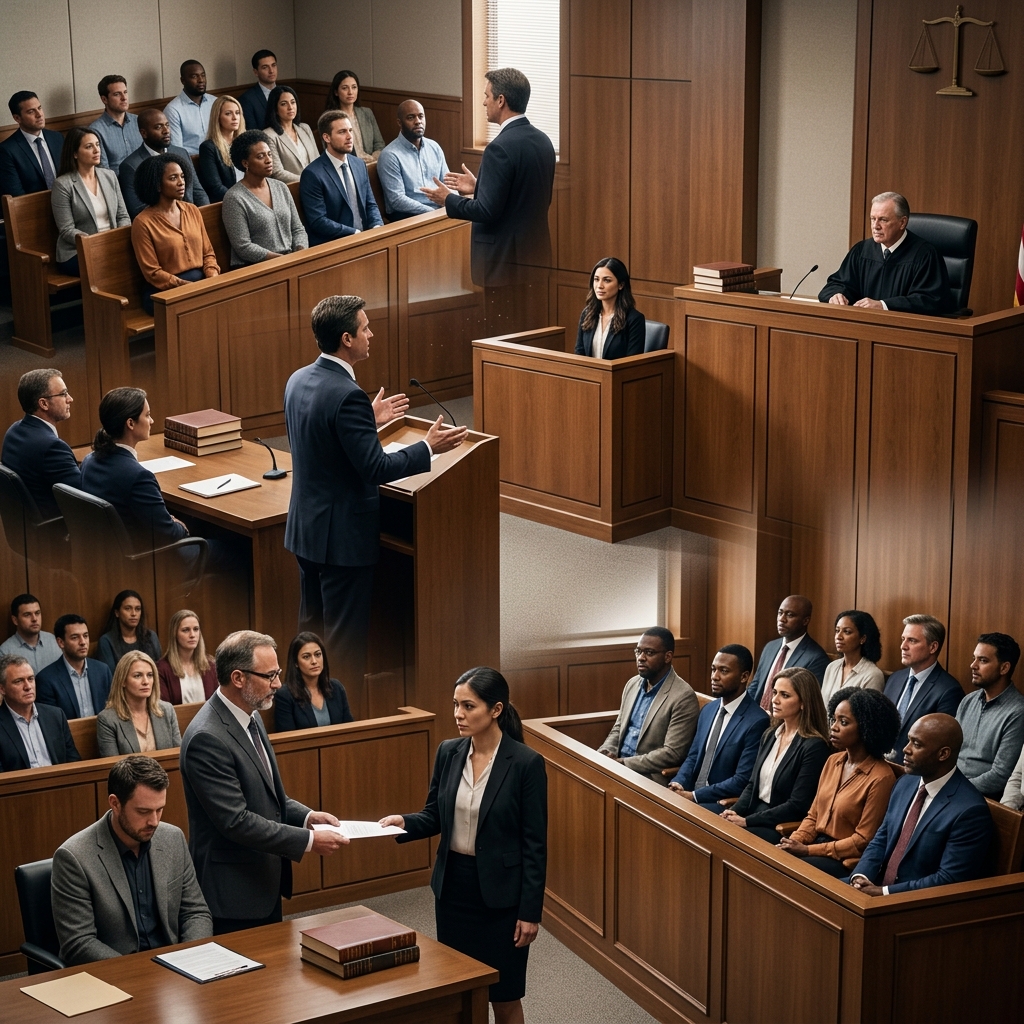
A criminal trial is the part of a case most people picture when they think of court: a judge in a robe, lawyers questioning witnesses, and a jury deciding guilt or innocence. In reality, the trial phase follows a structured sequence of steps governed by constitutional rules and state or federal procedures. Understanding these stages can make the process less confusing and help defendants, victims, and witnesses know what to expect.
This guide walks through the typical trial phase of a criminal case in the United States, focusing on what happens after a case is set for trial, how decisions are made, and what comes next if there is a conviction.
1. How a Case Reaches the Trial Stage
Trials do not happen automatically after an arrest. Several earlier steps must occur before a case arrives on the trial calendar.
- Charges are filed by a prosecutor through a complaint or indictment, formally accusing a person of committing specific crimes.
- Initial appearance and arraignment, where the judge informs the defendant of the charges and rights, and the defendant enters a plea (often “not guilty” if the case is going to trial).
- Pretrial proceedings, including discovery (exchange of evidence), plea negotiations, and motions asking the court to decide certain legal issues before trial.
- Decision to go to trial, when the case is not dismissed and no plea agreement resolves the charges.
Only after these steps does the trial phase begin, usually on a scheduled date with all parties ordered to appear in court.
2. Jury Trial vs. Bench Trial
Most criminal trials in the United States are jury trials, meaning a group of citizens decides whether the prosecution has proven its case beyond a reasonable doubt. However, in some situations a defendant may choose a bench trial, where the judge alone acts as the fact‑finder.
| Feature | Jury Trial | Bench Trial |
|---|---|---|
| Decision‑maker | Panel of citizens (jurors) | Judge only |
| Role of judge | Rules on law and procedure; instructs jury | Decides both law and facts |
| Typical use | Most felony and many misdemeanor cases | Some misdemeanors or complex legal issues |
| Verdict requirement | Usually unanimous in criminal cases | Single decision by the judge |
Whether a case proceeds as a jury trial or bench trial affects how the trial is conducted, but many core steps—such as presenting evidence and making legal objections—are similar.
3. Jury Selection: Choosing the Decision‑Makers
In a jury trial, the first in‑court step is the process of selecting jurors, commonly called voir dire. Potential jurors are brought to the courtroom from the larger pool called for jury duty.
During jury selection, the judge and attorneys typically:
- Ask questions to uncover potential bias, such as prior experiences with crime or law enforcement.
- Explain the basic nature of the case (without presenting evidence).
- Evaluate whether each person can be fair and follow the law as instructed.
Lawyers may remove potential jurors in two ways:
- Challenges for cause: Asking the judge to excuse a juror who clearly cannot be impartial (for example, someone who says they cannot presume the defendant innocent).
- Peremptory challenges: A limited number of removals that do not require explaining the reason, though they cannot be used to discriminate based on race or sex under constitutional law.
After enough jurors are approved, they are sworn in, forming the trial jury that will hear the case and ultimately reach a verdict.
4. Opening Statements: Roadmaps, Not Evidence
Once the jury is seated, the parties begin with opening statements. The prosecution always goes first because it bears the burden of proof.
- Prosecution opening: Outlines the story the prosecution expects the evidence to tell and explains how it plans to prove each element of the charged crimes.
- Defense opening: May immediately follow the prosecution or be delayed until after the prosecution rests, depending on local practice. It offers the defense perspective and points to weaknesses or gaps in the prosecution’s case.
Openings are often described as a roadmap for the jury. They are not testimony, documents, or physical exhibits, and jurors are instructed that opening statements are not evidence.
5. The Prosecution’s Case: Evidence and Witnesses
After opening statements, the prosecution begins its case‑in‑chief, presenting evidence to prove the defendant’s guilt beyond a reasonable doubt.
Common types of prosecution evidence include:
- Witness testimony, such as victims, eyewitnesses, police officers, and experts.
- Physical evidence, like weapons, clothing, or fingerprints.
- Documents and records, including phone logs, financial records, or video footage.
Each witness goes through several stages:
- Direct examination: The prosecutor asks questions to bring out the witness’s knowledge in a logical story.
- Cross‑examination: The defense questions the same witness, testing reliability and credibility.
- Redirect and recross (sometimes): Short follow‑up questioning by each side to clarify or address new issues raised on cross.
The prosecution presents all of its witnesses and exhibits in this way. When it has nothing further to present, it “rests” its case.
6. Mid‑Trial Motions: Asking for a Judgment Without Defense Evidence
After the prosecution rests, the defense often has an opportunity to ask the court for a ruling before it presents any evidence. One key request is a motion for a judgment of acquittal (sometimes called a directed verdict in some jurisdictions).
In this motion, the defense argues that even if the jury believes all of the prosecution’s evidence, it still does not legally add up to proof of guilt beyond a reasonable doubt. If the judge agrees, the case can end at this point with an acquittal. If the judge denies the motion, the trial continues.
7. The Defense Case: Optional but Often Critical
The defense is not required to present evidence. The Constitution places the burden on the prosecution, and the defendant is presumed innocent unless proven guilty. However, many defenses choose to call witnesses or introduce evidence to create reasonable doubt.
The defense may:
- Have the defendant testify (though the defendant also has the right to remain silent).
- Call witnesses who challenge the prosecution’s version of events.
- Present expert testimony to interpret forensic or technical evidence.
- Offer documents, photos, or other physical evidence supporting the defense theory.
Defense witnesses are examined using the same pattern as the prosecution’s: direct, cross, and possible redirect or recross. When the defense has finished, it also rests its case.
8. Rebuttal and Surrebuttal Evidence
Trials are not always strictly one‑side‑then‑the‑other. If the defense evidence raises new issues that the prosecution could not address earlier, the prosecution may offer rebuttal evidence in response.
Likewise, some courts allow the defense a brief surrebuttal if the prosecution’s rebuttal raises brand‑new matters. These additional rounds are usually limited and focused, designed to respond to specific points rather than reopen the entire case.
9. Objections and Evidence Rules During Trial
Throughout the trial, both sides may challenge questions or evidence by making objections. Judges rely on rules of evidence and procedure, which are designed to keep unreliable or unfairly prejudicial information from influencing the decision.
Common reasons for objections include:
- Relevance: The question or exhibit does not help prove or disprove any fact that matters in the case.
- Hearsay: A witness attempts to repeat an out‑of‑court statement that is offered to prove the truth of the matter stated, which is generally barred unless an exception applies.
- Speculation: A witness is asked to guess about facts they do not actually know.
- Leading questions on direct: The attorney suggests the answer in the question when rules require open‑ended questions.
- Undue prejudice: Evidence is more likely to inflame emotions than to help the jury decide the facts.
When an objection is made, the judge decides whether to sustain (agree) or overrule (disagree). Sustained objections may lead to rephrased questions or instructions telling the jury to disregard certain testimony.
10. Closing Arguments: Persuading the Fact‑Finder
After all evidence is presented, both sides deliver closing arguments. This is their final opportunity to speak directly to the jury (or judge in a bench trial) about how the evidence should be interpreted.
- Prosecution closing: Reviews the evidence, explains how it satisfies each legal element of the offenses, and argues that the proof meets the standard of beyond a reasonable doubt.
- Defense closing: Highlights inconsistencies, weaknesses, or alternative explanations in the evidence; emphasizes the presumption of innocence and the high burden of proof.
- Rebuttal closing: In many courts, the prosecution is allowed a short rebuttal argument because it carries the burden of proof.
Just like openings, closing arguments are not evidence. They are advocacy based on the evidence and the law to persuade the decision‑maker.
11. Jury Instructions: The Law Given to the Jury
Before the jury deliberates, the judge reads jury instructions, which explain the legal standards the jurors must apply.
Typical instructions cover:
- The presumption of innocence and the prosecution’s burden to prove guilt beyond a reasonable doubt.
- Legal definitions of the crimes charged and any lesser‑included offenses.
- How to evaluate witness credibility and weigh conflicting testimony.
- Rules on how to consider circumstantial and direct evidence.
- Requirements for reaching a verdict, such as unanimity.
The judge may also provide a written copy of the instructions for the jury to take into the deliberation room. Jurors are strictly required to follow these instructions, even if they personally disagree with the law.
12. Jury Deliberations and Reaching a Verdict
After receiving instructions, the jury retires to a private room to discuss the case. Deliberations are confidential; jurors cannot share their discussions with outsiders.
During deliberations, jurors:
- Select a foreperson to organize discussion and complete the verdict form.
- Review the evidence and apply the law from the instructions.
- Take informal votes and work through disagreements.
In criminal cases in federal court and in most states, the jury must reach a unanimous verdict to convict or acquit. If they decide they cannot agree after extended discussion, the judge may declare a mistrial due to a hung jury, and the prosecution must decide whether to retry the case.
Once a verdict is reached, the foreperson notifies the bailiff, and everyone returns to the courtroom. The judge or clerk reads the verdict aloud, and it is entered into the court record.
13. Sentencing After a Guilty Verdict
If the defendant is found guilty, the case moves to a separate phase for sentencing. Sentencing may happen immediately for minor offenses or at a later hearing for more serious crimes.
At a sentencing hearing:
- The judge considers statutory penalties and sentencing guidelines (for example, the Federal Sentencing Guidelines in federal court).
- The prosecution and defense present information about the defendant’s background, prior record, and any aggravating or mitigating factors.
- Victims may have a right to provide impact statements, describing the harm they experienced.
- The defendant usually has the opportunity to speak directly to the judge before the sentence is imposed.
Possible outcomes include jail or prison time, probation, fines, restitution, community service, or a combination of penalties. The exact sentence depends on the jurisdiction’s law, the seriousness of the offense, and the individual circumstances of the case.
14. After the Trial: Appeals and Post‑Trial Options
The end of the trial does not always end the legal process. A defendant who is convicted typically has the right to seek review in a higher court.
- Appeal: Asks an appellate court to decide whether legal errors during the trial affected the outcome. Appeals focus on the record of what happened in court, not new evidence.
- Post‑conviction motions: Requests to the trial court to set aside the verdict or reduce the sentence based on specific grounds, such as newly discovered evidence or ineffective assistance of counsel.
- Record clearing options: In some jurisdictions and for certain offenses, there may later be opportunities for expungement or record sealing after completion of the sentence.
These procedures are governed by strict deadlines and technical rules, so defendants usually need legal assistance to pursue them.
15. Practical Tips for Defendants and Witnesses
Knowing the structure of a trial is only part of preparing for court. Practical behavior and communication can also influence how a case unfolds.
- Arrive early to allow time for security screening and locating the correct courtroom.
- Dress conservatively to show respect for the court and avoid drawing unnecessary attention.
- Follow all court orders, including instructions not to discuss the case with jurors or other witnesses.
- Listen carefully to questions and answer only what is asked if you are a witness.
- Communicate with your lawyer about concerns or questions; do not try to address the judge or jury directly without guidance.
Although the trial process can be intimidating, it exists to protect both society and the rights of the accused by requiring the government to prove criminal charges under fair and transparent rules.
Frequently Asked Questions About Criminal Trials
Do all criminal cases go to trial?
No. Many criminal cases are resolved through plea agreements, dismissals, or diversion programs before trial. Only a fraction of cases proceed all the way to a full trial.
Can a defendant be forced to testify at trial?
No. The Fifth Amendment protects a defendant’s right not to testify in a criminal case. The jury is usually instructed that they cannot hold the defendant’s silence against them.
What does “beyond a reasonable doubt” mean?
It is the highest standard of proof in the legal system. While it does not require absolute certainty, it requires that the evidence leaves jurors firmly convinced of the defendant’s guilt before they may convict.
What happens if the jury cannot agree?
If a jury cannot reach a unanimous decision after reasonable deliberation, the judge may declare a hung jury and a mistrial. The prosecution then decides whether to retry the case or dismiss the charges.
Is the public allowed to watch a criminal trial?
In most cases, yes. Criminal trials are generally open to the public, although judges may limit access in rare circumstances involving sensitive issues, national security, or witness safety.
References
- Stages of a Criminal Trial — Justia. 2023-04-01. https://www.justia.com/criminal/procedure/stages-criminal-trial/
- How Courts Work: Pretrial, Trial, and Post-Trial — American Bar Association. 2022-06-15. https://www.americanbar.org/groups/public_education/resources/law_related_education_network/how_courts_work/pretrial_appearances/
- The Legal Process in the United States: A Criminal Case — Animal Legal Defense Fund. 2021-10-05. https://aldf.org/article/the-legal-process-in-the-united-states-a-criminal-case/
- The Trial Process — Judicial Learning Center, St. Louis. 2020-09-01. https://judiciallearningcenter.org/student-center/how-the-courts-work/your-day-in-court/
- Criminal Trial Process — Arizona Judicial Branch. 2023-01-10. https://www.azcourts.gov/legalinfohub/Legal-Info-Sheets/Criminal/Criminal-Trial-Process
- Criminal Court Overview — California Courts Self Help Guide. 2022-11-20. https://selfhelp.courts.ca.gov/criminal-court/overview
- Steps in the Federal Criminal Process — U.S. Department of Justice. 2020-07-17. https://www.justice.gov/usao/justice-101/steps-federal-criminal-process
Similar Articles








Read full bio of medha deb




