
Understanding Possession of Instruments of Crime
A clear guide to how everyday objects become criminal instruments, when possession is illegal, and what defenses may apply under U.S. criminal law.
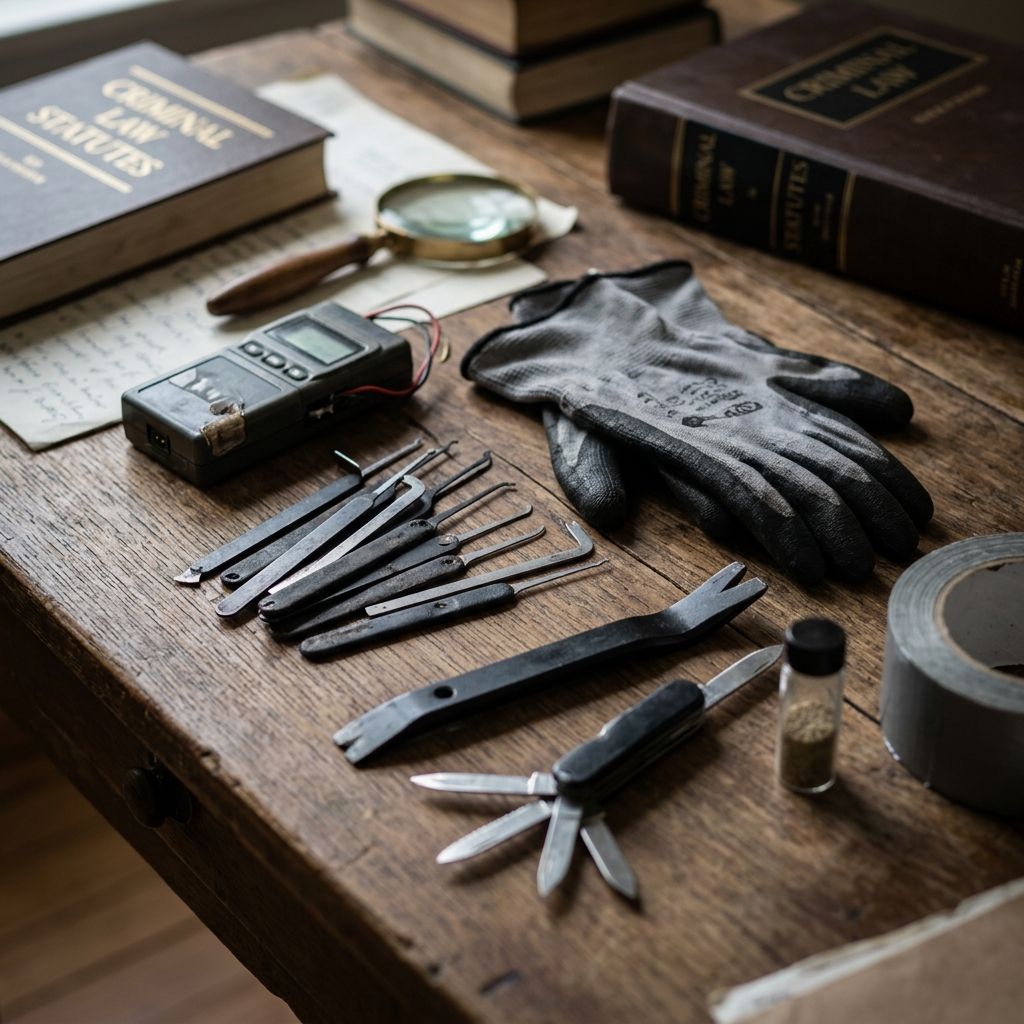
Many criminal charges do not focus on the final harmful act, but on the tools and preparation that make crime possible. Possessing an instrument of crime is one of those offenses. It allows prosecutors to charge people for possessing items that, in context, are intended for unlawful use rather than for their everyday, legitimate purposes.
This article explains how U.S. jurisdictions commonly treat possession of criminal instruments or criminal tools, what kinds of objects are covered, how intent transforms ordinary items into contraband, the potential penalties, and the defenses that may be available. It is a general educational overview and not a substitute for legal advice about any specific case.
Core Legal Concept: What Is an Instrument of Crime?
Most states use similar language: a person commits the offense of possessing an instrument of crime when they possess an instrument of crime with a purpose to employ it criminally. The emphasis is on both the nature of the item and the possessor’s intent.
Typical Statutory Definitions
While terms and numbering differ among states, the legal definition of an instrument of crime often includes two main categories:
- Items specially made or adapted for criminal use — for example, tools modified to bypass locks or devices built to defeat security systems.
- Items commonly used for criminal purposes and possessed under circumstances that are not clearly appropriate for their lawful uses — such as a firearm or crowbar carried in a way or setting that suggests planned criminal activity.
These definitions come from state criminal codes influenced by the Model Penal Code and similar frameworks, which describe instruments of crime as items either specially designed for unlawful use or commonly used in crimes when possessed in suspicious circumstances.
Ordinary Objects vs. Criminal Instruments
Many items are lawful and harmless in ordinary settings. A key part of these statutes is that context and intent can change how the law views them.
Consider the following contrast:
| Item | Ordinary Lawful Use | Potential Criminal Instrument Use |
|---|---|---|
| Flashlight | Lighting dark areas for work or home repairs | Used, for example, with tape over the lens to avoid detection while committing a burglary |
| Crowbar | Construction, demolition, or home improvement tasks | Tool to pry open doors or windows during a break-in |
| Firearm | Hunting, sport shooting, or lawful self-defense | Weapon carried concealed with intent to use it in a robbery or assault |
| Mobile phone | Communication, navigation, everyday personal use | Dedicated “burner” phone used to coordinate drug trafficking or other crimes |
Courts often stress that simply using something in connection with crime is not always enough to classify it as an instrument of crime. In some jurisdictions, the item must be used in the crime itself, not merely to facilitate it, before the possession statute applies.
Essential Elements of the Offense
Although the precise wording varies by state, prosecutors usually must prove several core elements beyond a reasonable doubt to obtain a conviction for possessing instruments of crime or criminal tools.
1. Nature of the Item
The first element is that the object qualifies as a substance, device, instrument, article, or weapon within the meaning of the statute. This is typically a tangible item that can be possessed or controlled.
Examples include:
- Weapons, such as guns, knives, or other devices capable of lethal use
- Tools or equipment, from bolt cutters and lock picks to improvised devices
- Specially adapted objects intended to evade security or to break into property
- Certain forms of body armor used in the commission of a felony in some states
2. Possession or Control
The second element is possession or control. In most jurisdictions, this means the item is on the person, in their immediate surroundings, or on property they control, and that they know the item is there and what it is.
Key points about possession include:
- You do not have to know the item is illegal; you must simply know that you have it.
- Possession can be actual (on your person) or constructive (in a vehicle or home you control).
- Shared or joint possession can exist when more than one person has authority over the item or location.
3. Intent to Use the Item Criminally
The third and most critical element is criminal intent. Prosecutors must show that at the relevant time the defendant intended to use the item for a criminal purpose.
This intent requirement distinguishes legally possessed tools from criminal instruments. Without specific unlawful purpose, possession of otherwise lawful objects generally remains legal.
Prosecutors may rely on evidence such as:
- Statements made by the accused or co-defendants
- Time, place, and manner of possession (for example, late at night near a closed business while carrying burglary tools)
- Association with other criminal activity, like planned or attempted offenses
- Prior acts showing similar use of tools for criminal purposes
Common Variations in State Law
Although the underlying principles are similar, states structure possession-of-instruments-of-crime statutes in different ways. A few patterns appear frequently in U.S. law.
General Instruments vs. Weapons and Body Armor
Some criminal codes divide the offense into separate subcategories, for example:
- General criminal instruments — possessing any instrument of crime with intent to employ it criminally, typically classified as a misdemeanor of the first degree.
- Possession of weapons — possessing a firearm or other weapon concealed upon the person with criminal intent, also commonly treated as a serious misdemeanor.
- Unlawful body armor — in some states, using or possessing body armor during the commission or attempted commission of a felony is charged as a felony offense.
Elsewhere, the law may refer more broadly to criminal tools and allow prosecutors to charge either a misdemeanor or felony version of the offense depending on whether the intended underlying crime was a felony or a non-felony.
Penalties and Grading
Penalties vary by jurisdiction but often reflect the seriousness of the intended crime.
- In some states, possession of instruments of crime is a Class A misdemeanor, a high-level misdemeanor that can carry substantial jail time and fines.
- Other states classify general possession of instruments of crime or PIC as a first-degree misdemeanor, with possible terms of imprisonment of several years and significant financial penalties.
- Where body armor or specially dangerous tools are involved in a felony, the offense can be a felony in its own right, sometimes of the third or fifth degree, which may expose defendants to longer incarceration and more severe collateral consequences.
Because grading depends heavily on local statutes and the intended underlying offense, anyone charged with possession of criminal tools or instruments of crime should consult the specific laws of their state or territory.
How Prosecutors Approach These Cases
Prosecution strategies in instruments-of-crime cases often focus on establishing intent and linking the item directly to an actual or planned offense.
Proof of Criminal Intent
Criminal intent is rarely proven through direct evidence alone. Instead, prosecutors build a picture using surrounding circumstances:
- Location of the arrest relative to targeted property or victims
- Presence of multiple tools commonly associated with specific crimes
- Attempted concealment of items or efforts to avoid police observation
- Co-existing charges such as burglary, robbery, or drug offenses
In some states, statutes create presumptions about intent. For example, if someone possesses a firearm or other weapon in certain locations or circumstances, the law may presume intent to employ it criminally unless specific exceptions apply, such as lawful possession in one’s home, licensed carrying, or use in sporting activities.
Merger with Underlying Crimes
Where the defendant is charged both with an underlying offense (like burglary) and with possession of criminal tools, defense counsel sometimes argue that the possession charge should “merge” into the primary offense or that it is unnecessary duplication.
Whether merger applies depends on local law and how courts interpret the relationship between preparatory conduct and the completed crime.
Defenses to Possession of Instruments of Crime
Despite the broad language of many statutes, defendants have several potential avenues to challenge PIC or criminal tools charges. The viability of each defense depends on the facts and jurisdiction.
Challenging the Item as an Instrument of Crime
One approach is to argue that the item does not meet the statutory definition of an instrument of crime or criminal tool. This may be especially relevant when the object is an everyday item with many lawful uses.
Defense arguments can include:
- The item is not specially adapted or designed for criminal use.
- The item is not commonly used for criminal purposes.
- The circumstances of possession are consistent with legitimate uses and do not support an unlawful purpose.
Disputing Possession or Control
Another defense is to challenge whether the accused actually possessed or controlled the item.
- Arguing the item belonged to someone else and was not under the defendant’s control
- Contesting knowledge of the item’s presence
- Highlighting that the item was found in a common area accessible to multiple people
Since possession requires some level of control and awareness, raising doubt about those elements can undermine the prosecution’s case.
Attacking Proof of Criminal Intent
Because intent is central, many defenses focus on showing that the accused did not plan to use the item criminally.
Common strategies include:
- Presenting evidence of lawful purposes, such as employment-related use or recreational activities
- Questioning the reliability of circumstantial evidence used to infer intent
- Pointing to inconsistent or weak testimony from witnesses
If jurors have reasonable doubt about the defendant’s criminal intent, they generally must acquit.
Suppression of Illegally Obtained Evidence
Defendants may also argue that the item was discovered through an unlawful search or seizure in violation of constitutional protections. If a court agrees, the evidence may be suppressed, making it difficult or impossible for prosecutors to prove the charge.
Suppression arguments often involve:
- Challenging the legality of traffic stops or street encounters
- Questioning warrants or their execution
- Contesting whether exceptions to warrant requirements applied
Practical Tips for Individuals and Businesses
Although the offense focuses on criminal intent, awareness of how tools and equipment are perceived can help individuals and businesses reduce risk.
For Individuals
- Store potentially dangerous tools securely and use them only in settings consistent with legitimate purposes.
- Be cautious about carrying items like weapons or specialized tools in public, especially at unusual times or locations.
- If questioned by law enforcement, exercise the right to remain silent and seek legal counsel before making statements about the purpose of items in your possession.
For Businesses
- Develop policies for employees who carry tools or equipment that could be misconstrued as criminal instruments.
- Maintain clear records showing legitimate business use of specialized devices, particularly in security, construction, or transportation industries.
- Train staff on lawful handling and transport of tools, especially when crossing state lines with differing legal definitions.
Frequently Asked Questions (FAQ)
Does owning a tool that could be used in crime automatically make it illegal?
No. The core of the offense is intent. Ownership of tools with ordinary lawful uses is generally legal. The problem arises when prosecutors can show you possessed the item with a purpose to use it criminally.
Can I be charged even if no underlying crime was completed?
Yes. Possession of instruments of crime is often an inchoate offense, meaning it targets preparatory conduct. You can be charged based on possession plus unlawful intent, even if no completed offense occurred.
Is possession of instruments of crime a felony or a misdemeanor?
That depends on the jurisdiction and the nature of the intended offense. In some states, it is usually a high-level misdemeanor, while in others it can be a felony if linked to a planned felony or involving certain items like body armor.
What should I do if I am arrested for possessing criminal tools?
Seek qualified legal counsel immediately. A defense lawyer can assess whether the item meets statutory definitions, whether police obtained it lawfully, and whether prosecutors can prove intent, and can advise you on the best strategy under local law.
Are gun owners at special risk of these charges?
Lawful gun ownership is widely recognized, but firearms can become instruments of crime when possessed with criminal intent or outside lawful exceptions such as licensed carry, home possession, or sport use. Understanding and complying with your state’s weapons laws is essential.
References
- Arkansas Code § 5-73-102 (Possessing instrument of crime) — Arkansas General Assembly. 2024-01-01. https://law.justia.com/codes/arkansas/title-5/subtitle-6/chapter-73/subchapter-1/section-5-73-102/
- Section 907, Title 18, Crimes and Offenses (Possessing instruments of crime) — Pennsylvania General Assembly. 2023-01-01. https://www.palegis.us/statutes/consolidated/view-statute?txtType=HTM&ttl=18&div=0&chpt=9&sctn=7&subsctn=0
- Possession of Criminal Tools, Ohio Rev. Code § 2923.24 (Overview) — Joslyn Law Firm. 2022-06-01. https://www.criminalattorneycolumbus.com/criminal-defense/weapons-charges/possessing-criminal-tools/
- Charged With Possession of Criminal Tools—What to Know — Gafirm.com. 2021-09-01. https://www.gafirm.com/legal-blog/possession-of-criminal-tools/
- Possessing Instruments of Crime (Based on MPC) — Criminal Law Web. 2019-01-01. https://www.criminallawweb.net/web1/mpc/PART1/snippets/possession.htm
- Possessing Instrument of Crime Charges in Pennsylvania — Shrager, Spivey & Sachs. 2020-04-01. https://www.pittsburghcriminalattorney.com/firearms-weapons-charges/possessing-criminal-instruments/
- Philadelphia Possessing Instruments of Crime Lawyer — Goldstein Mehta LLC. 2022-03-01. https://goldsteinmehta.com/philadelphia-possessing-instruments-of-crime-charges-defense-lawyer
Similar Articles








Read full bio of Sneha Tete




