
Resisting or Obstructing Police Without Physical Force
Understanding when non‑violent conduct can still lead to criminal charges for resisting or obstructing a law enforcement officer.
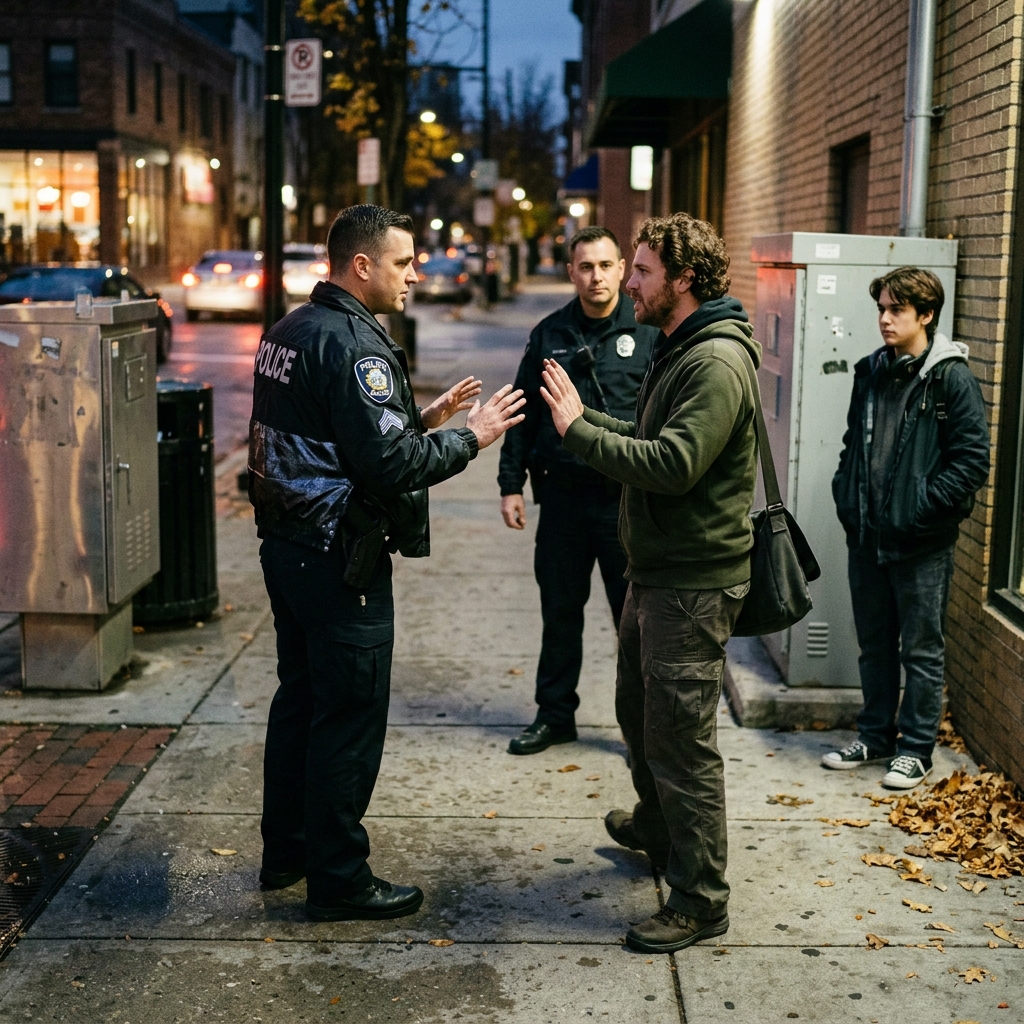
In many jurisdictions, a person can be charged with resisting or obstructing a law enforcement officer even when no punches are thrown and no obvious violence occurs. These laws reach a wide range of conduct, from refusing lawful commands to providing false information, and in some cases carry serious criminal penalties.
1. Why Non‑Physical Resistance Still Matters in Criminal Law
Resisting or obstructing police has traditionally been associated with physical struggles during arrest. Modern statutes, however, often define these offenses broadly to cover any intentional interference with an officer’s lawful duties, whether or not physical force is used.
This expansion reflects several policy concerns:
- Officer safety: Even minor interference can escalate tense situations.
- Efficiency of investigations: Delays or obstruction can hinder emergency responses and criminal investigations.
- Respect for lawful authority: Legislatures aim to discourage deliberate noncompliance with lawful orders.
At the same time, courts must balance these goals against constitutional protections for speech, protest, and due process, which is why the law distinguishes protected conduct from criminal resistance.
2. Core Legal Concepts: “Resisting” vs. “Obstructing”
Although terminology varies by state, two concepts appear repeatedly:
- Resisting: Opposing or attempting to prevent an officer from carrying out a specific action, such as an arrest or detention.
- Obstructing: Hindering, delaying, or interfering with an officer’s broader duties, often by creating obstacles or providing false information.
Some statutes use a single phrase such as “resisting, evading or obstructing an officer,” grouping these behaviors into one offense. Others treat resisting arrest and obstruction of justice as distinct crimes with separate elements and penalties.
2.1 Typical Statutory Language
Several examples illustrate how broadly these laws can be drafted:
- Wisconsin: It is a crime to “knowingly resist or obstruct” an officer acting in an official capacity and with lawful authority.
- California: Knowingly impeding, resisting, or hindering an officer in the performance of duties—whether by physical means or refusal to follow directions—can constitute resisting arrest.
- New Mexico: “Resisting, evading or obstructing an officer” covers actions like refusing to stop a vehicle when signaled by a uniformed officer.
- Local ordinances: Some cities prohibit “obstructing, impeding or interfering” with officers in the execution of their duties.[10]
| Jurisdiction (Example) | Key Phrase | Scope of Conduct |
|---|---|---|
| Wisconsin | “Knowingly resists or obstructs an officer” | Opposition or obstruction while officer acts with lawful authority. |
| California | “Knowingly impeding, resisting, or hindering” | Includes refusal to obey lawful orders and non‑violent conduct. |
| New Mexico | “Resisting, evading or obstructing an officer” | Examples include ignoring signals to stop a vehicle and other evasion. |
3. What Counts as Resistance Without Physical Force?
Non‑physical resistance generally refers to conduct that interferes with lawful police activity without direct violence. Examples can include:
- Refusing to comply with a lawful order to move, stay, or leave a particular area.
- Tensing up, pulling away, or otherwise failing to submit to handcuffing.
- Blocking an officer’s path or access to a location or person.
- Providing false identification or misleading information during an investigation.
- Ignoring commands to stop a vehicle after clearly visible or audible signals.
Some statutes treat these behaviors as sufficient for a misdemeanor charge even when there is no striking, kicking, or direct physical attack.
3.1 Conduct vs. Attitude
A critical distinction is between attitude and conduct. Under many state laws:
- Conduct such as pulling away, refusing to be handcuffed, or physically blocking movement may constitute resistance.
- Attitude—including arguing, expressing disagreement, or questioning police—usually does not, standing alone, amount to resisting or obstructing.
Courts often look for actions that actually hinder or delay officers rather than mere verbal dissent, especially because speech may be protected by constitutional free‑expression principles.
4. Elements Prosecutors Must Prove
To secure a conviction, prosecutors must prove specific elements beyond a reasonable doubt. Although the details vary by jurisdiction, common elements include:
- Intent: The defendant must have acted knowingly or willfully, rather than through mistake or confusion.
- Interference: The conduct must hinder, delay, or obstruct the officer’s performance of official duties.
- Official capacity: The officer must have been acting in an official role, performing duties they are legally authorized to perform.
- Lawful authority: In many states, the officer’s actions must be lawful; resistance to an unlawful arrest may not meet the statutory definition.
- Knowledge of officer status: Some laws require proof that the defendant knew or had reason to know that the person was an officer.
4.1 Misdemeanor vs. Felony Levels
Non‑physical resistance is usually treated as a misdemeanor, while resistance involving violence or threats may be charged as a felony.
- Misdemeanor resisting or obstructing: Often involves non‑violent interference, such as refusing commands or providing false information.
- Felony resisting with force or violence: Requires proof of violence, threats, or injury to an officer.
For example, one state defines “resisting a police officer with force or violence” as using threatening force or violence toward an officer engaged in official duties, including injury or attempted injury, and imposes up to three years’ imprisonment.
5. Possible Penalties and Consequences
Penalties differ widely across states, but even low‑level offenses can have lasting impacts.
5.1 Typical Misdemeanor Penalties
In many jurisdictions, misdemeanor resisting or obstructing carries potential:
- Jail time: Often up to several months or a year.
- Fines: Commonly up to $750–$1,000 for misdemeanor offenses.
- Probation or community service: Courts may impose supervision and service requirements.
- Criminal record: A conviction can appear on background checks and affect employment or housing prospects.
For instance, one state treats obstructing a peace officer as a misdemeanor punishable by up to 120 days in jail and a fine of up to $750. Another state allows up to one year in jail and a $1,000 fine for misdemeanor resisting arrest.
5.2 Felony‑Level Exposure
When resistance involves force, violence, or serious harm, felony charges may apply.
- Longer incarceration: Felony resisting can result in 16 months to several years in prison.
- Higher fines: Fines for felony convictions may reach several thousand dollars.
- Collateral consequences: Felony records can restrict voting rights, firearm possession, and professional licensing, depending on state law.
6. Defenses and Legal Issues in Non‑Physical Resistance Cases
Because non‑physical resistance charges often hinge on interpretation of behavior and intent, several defenses may be available, depending on the facts and jurisdiction.
6.1 Challenging the Lawfulness of Police Conduct
In jurisdictions where lawful authority is an element, the defense may argue that the officer was not acting lawfully or within the scope of official duties.
- If the officer lacked legal grounds for a stop or arrest, resistance may not satisfy statutory elements.
- Unlawful entry or search may undermine the prosecution’s case.
6.2 Intent, Mistake, and Confusion
Courts frequently examine whether the defendant acted willfully or whether confusion, fear, or misunderstanding explains their behavior.
- Mishearing or misunderstanding a command may negate the required mental state.
- Panic reactions, such as freezing or pulling away reflexively, may be argued as non‑intentional.
6.3 Constitutional Rights and Protected Conduct
In some circumstances, alleged resistance overlaps with constitutionally protected rights:
- Free speech: Speaking, criticizing officers, or verbally disputing actions may be protected and not sufficient for obstruction on its own.
- Filming police: Courts have recognized a right to record officers in public, subject to reasonable time, place, and manner restrictions.
- Refusal to consent: Declining to consent to a search can be a lawful exercise of rights, not obstruction, when done without interference.
6.4 Self‑Defense and Excessive Force
In limited situations, defendants may argue they were responding to excessive force rather than resisting lawful actions.
- If an officer uses unreasonable force, defensive reactions might be framed as protective, not obstructive.
- These arguments are fact‑intensive and often require careful legal analysis and evidence, such as video recordings or witness testimony.
7. Practical Guidance for Encounters with Law Enforcement
Understanding how non‑physical behaviors are interpreted can help individuals navigate police encounters more safely and legally. While the best approach varies with circumstances, several general principles emerge from legal guidance and case patterns.
7.1 Steps to Reduce Legal Risk
- Stay calm: Sudden movements or emotional reactions can be misinterpreted as resistance.
- Follow clear, lawful commands: Complying with basic instructions, such as presenting identification when required by law, reduces the risk of obstruction charges.
- Assert rights respectfully: If you choose to remain silent or decline consent to a search, state this calmly without physically interfering.
- Avoid physical contact: Even minimal physical opposition—like pulling away or blocking movement—can support charges.
- Seek legal help promptly: If arrested or charged, consult a qualified criminal defense attorney before making statements.
7.2 After a Resisting or Obstructing Charge
If you are accused of resisting or obstructing an officer:
- Document events: Write down details as soon as possible, including times, locations, officer names or badge numbers, and witness information.
- Preserve evidence: Save videos, photographs, or messages related to the encounter.
- Limit social media posts: Public commentary about the incident can be used by prosecutors.
- Discuss defenses with counsel: A lawyer can evaluate whether the officer’s conduct was lawful and whether your actions truly meet statutory elements.
8. Frequently Asked Questions (FAQs)
8.1 Can I be charged with resisting arrest even if the arrest is unlawful?
Some states allow resisting arrest charges even if the underlying arrest later turns out to be unlawful. Others require that the officer act with lawful authority as part of the offense. The answer depends heavily on the local statute and case law, which is why legal advice from an attorney in your jurisdiction is crucial.
8.2 Is refusing to answer questions considered obstruction?
In many situations, individuals have a right to remain silent. Simply refusing to answer questions is not automatically obstruction, especially when a person expressly invokes the right to remain silent. However, providing false information—such as fake identification or knowingly untrue statements—may constitute obstruction in some jurisdictions.
8.3 Does verbal abuse or yelling at an officer qualify as resisting?
Verbal abuse alone is usually not enough to establish resisting or obstructing, because courts often require some form of conduct that interferes with official duties. That said, loud or disruptive behavior in certain contexts can lead to different charges, such as disorderly conduct, depending on local law.
8.4 What happens if I refuse a command I believe is unlawful?
If a command is clearly outside an officer’s legal authority, refusing may be a lawful exercise of rights. The challenge is that people rarely have full information in the moment, and officers may still arrest on suspicion of resisting. Whether the refusal was lawful will usually be evaluated later by a court. Legal counsel can help assess whether the command was valid under the relevant statutes and constitutional rules.
8.5 Is pulling away when being handcuffed considered physical force?
Many jurisdictions treat actions like pulling away, tensing up, or refusing to place hands behind the back as physical resistance, even though they are less severe than striking or pushing. This can support a criminal charge for resisting, particularly when combined with refusal to follow repeated commands.
References
- Obstructing or Resisting a Police Officer without Physical Force — LegalMatch Law Library. 2023-01-01. https://www.legalmatch.com/law-library/article/obstructing-or-resisting-a-police-officer-absent-physical-force.html
- Resisting / Obstructing a Peace Officer (720 ILCS 5/31-1) — Illinois law enforcement commentary. 2017-05-01. https://www.facebook.com/christopherpolicedepartment/posts/resisting-obstructing-a-peace-officer-720-ilcs-531-1under-illinois-law-a-person-/1333068438857234/
- Obstructing a Peace Officer: How Do Courts Interpret Resistance and Noncompliance? — Leier Law Office. 2022-08-15. https://www.leierlawoffice.com/blog/obstructing-a-peace-officer-how-do-courts-interpret-resistance-and-noncompliance/
- Definition of Resisting Arrest — Bradley Corbett Criminal Defense. 2021-06-10. https://www.bradleycorbettlaw.com/definition-of-resisting-arrest/
- Understanding Charges for Resisting Arrest or Obstructing Justice — Dan Mellen Attorney. 2023-03-01. https://www.danmellenattorney.com/blog-1/understanding-charges-for-resisting-arrest-or-obstructing-justice/
- New Mexico Statutes Section 30-22-1: Resisting, Evading or Obstructing an Officer — New Mexico Legislature. 2025-01-01. https://law.justia.com/codes/new-mexico/chapter-30/article-22/section-30-22-1/
- Wisconsin Statutes Section 946.41: Resisting or Obstructing Officer — Wisconsin Legislature. 2024-01-01. https://docs.legis.wisconsin.gov/document/statutes/946.41
- Resisting an Officer with Force or Violence (La. R.S. 14:108.2) — Louisiana State Legislature. 2023-01-01. https://legis.la.gov/Legis/Law.aspx?d=508535
- Obstructing, Impeding or Interfering with Police — Auburn, Nebraska City Code. 2020-01-01. https://codelibrary.amlegal.com/codes/auburnne/latest/auburn_ne/0-0-0-4865
Similar Articles








Read full bio of Sneha Tete




