
Refusing a DUI Test in Florida: Implied Consent Explained
Understand how Florida’s implied consent law treats DUI test refusals, license suspensions, and criminal penalties before you decide whether to blow.
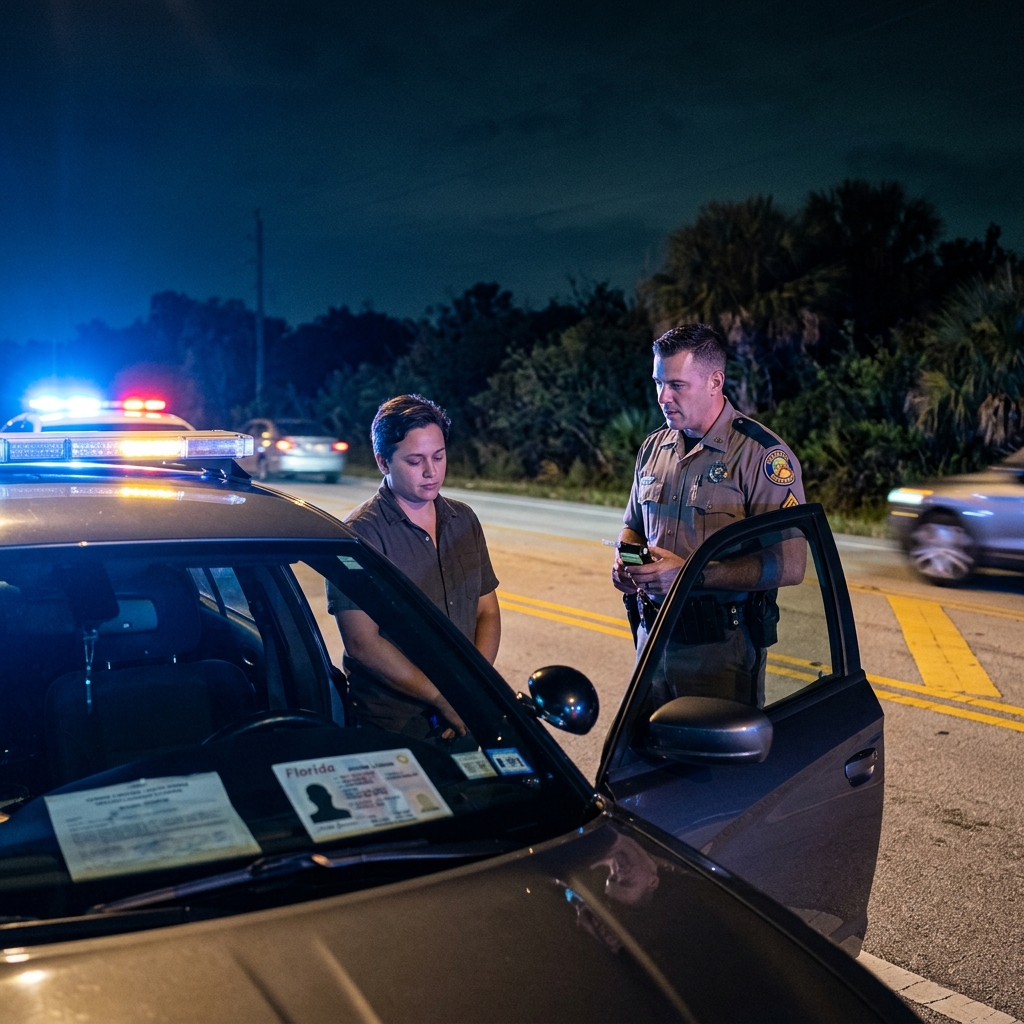
Florida treats DUI chemical testing differently from many routine traffic procedures. When you drive in the state, you are not only agreeing to follow speed limits and stop at red lights – you are also agreeing in advance to cooperate with certain alcohol and drug tests if you are lawfully arrested on suspicion of driving under the influence. This agreement is called implied consent, and it has serious consequences if you decide to refuse a test after a DUI arrest.[10]
This article explains how Florida’s implied consent law works, what happens if you refuse a breath, blood, or urine test, the difference between administrative and criminal penalties, and why a refusal can still be powerful evidence in court. It is designed as an educational overview and is not a substitute for personalized legal advice.
Core Idea of Implied Consent in Florida
Florida’s implied consent rule is built into the state’s traffic laws. Under Florida Statutes section 316.1932, anyone who accepts the privilege of driving on Florida roads is deemed to have given consent to approved chemical or physical tests – such as breath or urine tests – if they are lawfully arrested for an offense involving driving under the influence.[10]
In simple terms, by driving in Florida you agree that, if an officer has lawful grounds to arrest you for DUI, you will submit to a chemical test aimed at determining whether you are impaired by alcohol or controlled substances.[10]
- Who is covered? Any person operating a motor vehicle on Florida roads.
- When does it apply? After a lawful DUI-related arrest, not merely at the roadside during an initial stop.[10]
- What tests are included? Breath, urine, and in some situations blood tests to detect alcohol or certain drugs.[10]
This framework gives law enforcement a tool to gather evidence while limiting when and how chemical tests may be demanded. Officers are generally restricted to breath or urine tests unless specific conditions justify a blood draw.
Types of DUI Tests and When They Are Requested
Florida law recognizes several different testing methods in DUI investigations. Each test serves a particular purpose, and the officer’s choice can affect what happens if you refuse.
Breath Tests
The most common DUI test is the breath test, often conducted on an approved machine at a police station or mobile unit. This test measures the alcohol content in your breath, which is then used to estimate blood alcohol concentration (BAC). The legal limit for most drivers in Florida is 0.08 grams of alcohol per 210 liters of breath.
Urine Tests
When an officer suspects impairment from controlled substances or certain chemical substances – rather than alcohol alone – they may request a urine test. Under Florida law, drivers are deemed to have consented to urine testing to detect the presence of drugs or chemical substances after a lawful arrest for a DUI-related offense.[10]
Blood Tests
Blood testing is more limited. Generally, officers must obtain a warrant, or the driver must freely consent, before blood can be drawn for DUI testing. However, Florida law authorizes blood tests when there is probable cause to believe a DUI crash caused death or serious bodily injury.
| Test Type | Primary Purpose | Typical Use | Special Legal Notes |
|---|---|---|---|
| Breath Test | Measure alcohol concentration | Standard DUI arrest for suspected alcohol impairment | Implied consent covers breath tests after lawful DUI arrest.[10] |
| Urine Test | Detect controlled substances or chemicals | Suspected drug-related impairment or mixed substance use | Drivers are deemed to consent to urine testing for drugs after arrest.[10] |
| Blood Test | Direct measurement of blood alcohol or drug levels | Serious injury or fatal crashes with probable cause for DUI | Typically requires a warrant or consent; special statutory authority in serious cases. |
What Counts as Refusing a DUI Test?
A refusal does not have to be a clear verbal “no.” Any conduct that prevents the completion of the test after a lawful request can be treated as a refusal. Florida law focuses on whether you submit to the requested chemical or physical test, not just the words you use.[10]
Common forms of refusal can include:
- Clearly stating that you will not take the test.
- Remaining silent or nonresponsive after the officer explains the consequences.
- Blowing weakly or intermittently into the breath machine so it cannot produce a valid result.
- Claiming medical issues without cooperating with alternative testing options.
- Walking away or otherwise withdrawing cooperation after the test has been requested.
Once an officer has made a lawful DUI arrest and properly requested a test, a refusal generally triggers automatic administrative penalties, regardless of whether you are later convicted of DUI.
Administrative License Suspensions for Refusal
Florida’s implied consent scheme is backed by strict driver license suspension rules. These suspensions are called “administrative” because they are imposed by the Florida Department of Highway Safety and Motor Vehicles (DHSMV), separate from any criminal court sentence.
First Refusal
If you refuse a lawful request for a breath, urine, or blood test and have never had a prior refusal-related suspension, the administrative penalty is generally:
- One-year license suspension by DHSMV.
- The refusal is admissible as evidence in any DUI criminal proceeding.[10]
Second or Subsequent Refusal
If you previously had your license suspended for refusing a DUI test, a new refusal carries harsher consequences:
- 18-month license suspension for a second or later refusal.
- The refusal remains admissible in criminal court.
- The conduct may also support a separate criminal charge, discussed below.
These suspensions apply even if your underlying DUI charge is reduced, dismissed, or you are found not guilty. The administrative process is focused on whether you refused a lawfully requested test, not on your ultimate guilt or innocence of DUI.
Criminal Consequences of Refusing a DUI Test
Florida treats repeat refusals as more than just an administrative licensing issue. A second or subsequent refusal after a prior refusal-related suspension can be prosecuted as a first-degree misdemeanor under Florida law.
While exact penalties depend on charging decisions and the specifics of your case, a first-degree misdemeanor under Florida law is generally punishable by up to one year in jail and significant fines. The statute makes clear that a second or later refusal is a distinct crime, separate from any DUI offense that may also be charged.
In addition:
- Refusal can be used by the prosecution to argue that you were aware you would likely fail the test.
- Jurors may be instructed that they can consider a refusal when deciding whether you were impaired.
- The refusal does not prevent the state from pursuing the underlying DUI case based on other evidence such as officer observations, field sobriety tests, or witness testimony.
How Refusal Evidence Is Used in Court
Florida’s implied consent statute specifically states that a refusal to submit to a chemical or physical breath test is admissible in any criminal proceeding arising from the incident.[10] The DHSMV also recognizes that refusal evidence may be used in DUI prosecutions.
In a courtroom, refusal evidence can be powerful because:
- It gives prosecutors a narrative that you refused because you feared the results.
- It allows the state to argue you were aware of impairment and chose not to cooperate.
- It helps bridge the gap when there is no numerical BAC result.
Defense strategies may focus on whether the arrest was lawful, whether the implied consent warning was properly given, and whether the alleged refusal was truly a refusal or a misunderstanding or equipment issue. These are fact-specific questions that often require legal representation.
Special Situations: Unconscious Drivers and Serious Crashes
Implied consent also addresses what happens when a driver cannot consciously agree or refuse. Florida law provides that a person who is incapable of refusal – for example, because of unconsciousness or certain medical conditions – is not deemed to have withdrawn their consent. In those situations, a blood test may be administered even without an explicit warning about license suspension.
In serious crash cases, Florida statutes authorize a blood draw when there is probable cause to believe that a DUI crash caused death or serious bodily injury. In these circumstances, refusal rules interact with broader constitutional protections such as the warrant requirement and case law on exigent circumstances.
Practical Consequences of Refusing vs. Submitting
From a practical perspective, many drivers wonder whether refusing a test is “better” than submitting. Florida’s legal structure makes that a complex question, because refusal carries guaranteed licensing penalties and may lead to additional criminal exposure.
Potential Downsides of Refusal
- Automatic license suspension (one year for a first refusal, 18 months for later refusals).
- Possible first-degree misdemeanor for second or subsequent refusals.
- Loss of eligibility for certain diversion or reduced-penalty options that might be available in DUI cases.
- Refusal admitted as evidence in court, possibly viewed negatively by jurors.[10]
Potential Implications of Submitting
- A high BAC or positive drug test may strengthen the prosecution’s case.
- However, some defendants may retain driving privileges or benefit from reduced penalties compared with refusal-based suspensions.
- Submitting can sometimes support negotiations for plea agreements or treatment-based outcomes.
Because the stakes are significant and outcomes depend on individual facts, attorneys often emphasize that the decision to refuse or submit should be evaluated in the context of a specific situation, not based on general rules. If you have already refused or submitted and face charges, promptly consulting counsel is critical.
Frequently Asked Questions About DUI Test Refusal in Florida
1. Does implied consent apply at the roadside, before arrest?
Implied consent is tied to a lawful arrest for a DUI-related offense, not merely an investigative stop.[10] Preliminary roadside tests such as portable breath devices or field sobriety exercises may be requested under different rules and are often more discretionary.
2. Can I challenge an administrative suspension for refusal?
Yes. Florida law allows drivers to contest administrative suspensions through DHSMV procedures, typically by requesting a formal review hearing within a short timeframe after the suspension notice. At that hearing, issues may include whether the officer had lawful grounds for the arrest and whether a refusal truly occurred.
3. If my DUI charge is dismissed, will I automatically get my license back?
Not necessarily. Administrative suspensions for refusal operate independently from the criminal case. Even if the DUI charge is dismissed, the refusal-based suspension may remain in effect unless it is separately overturned through DHSMV procedures.
4. Is a refusal always treated as a first-degree misdemeanor?
No. The first-degree misdemeanor classification applies to a second or subsequent refusal after a prior refusal-related suspension. A first-time refusal generally results in administrative suspension but not a separate criminal refusal charge.
5. Can commercial drivers face additional consequences?
Yes. State administrative rules provide that a commercial driver who refuses a DUI-related test while operating a commercial motor vehicle may be disqualified from holding a commercial license for extended periods. In some cases, a second refusal can result in permanent disqualification, with no hardship reinstatement permitted.
Key Takeaways for Florida Drivers
- By driving in Florida, you are deemed to consent to certain DUI-related tests after lawful arrest.[10]
- Refusing a breath, urine, or blood test carries automatic license suspensions and, for repeat refusals, potential criminal charges.
- Refusal evidence is admissible in court and can support the prosecution’s theory of impairment.[10]
- Decisions about whether to refuse or submit should be made with full awareness of both administrative and criminal risks.
- Anyone facing a DUI or refusal-based suspension should consider seeking legal advice promptly to understand time-sensitive hearing rights and possible defenses.
References
- The 2025 Florida Statutes, Section 316.1932 (Implied Consent; Refusal) — Florida Legislature (Online Sunshine). 2025-01-01. https://www.leg.state.fl.us/Statutes/index.cfm?App_mode=Display_Statute&URL=0300-0399/0316/Sections/0316.1932.html
- 2011 Florida Statutes, Section 316.1932 — Florida Senate. 2011-01-01. https://www.flsenate.gov/laws/statutes/2011/316.1932
- Florida DUI and Administrative Suspension Laws — Florida Department of Highway Safety and Motor Vehicles (DHSMV). 2023-06-01. https://www.flhsmv.gov/driver-licenses-id-cards/education-courses/dui-and-iid/florida-dui-administrative-suspension-laws/
- Florida DUI Laws — National College for DUI Defense. 2022-09-01. https://www.ncdd.com/florida-dui-laws
- Implied Consent Update — Florida Law Enforcement Liaison Program. 2022-03-01. https://www.floridalel.info/resources/implied-consent
- How Does the Implied Consent Law Affect My DUI Case? — Carlson, Meissner, Hart & Hayslett, P.A. 2022-08-15. https://carlsonmeissner.com/blog/how-implied-consent-law-affects-dui-case/
- Refused to Blow? Florida DUI & Implied Consent Law — George Law. 2023-05-10. https://georgelaw.com/blog/refused-to-blow-florida-dui-defense/
Similar Articles








Read full bio of Sneha Tete




