
Off‑Site Injuries and Workers’ Compensation
Understand when workers’ compensation covers injuries away from the main job site and how to protect your right to benefits.
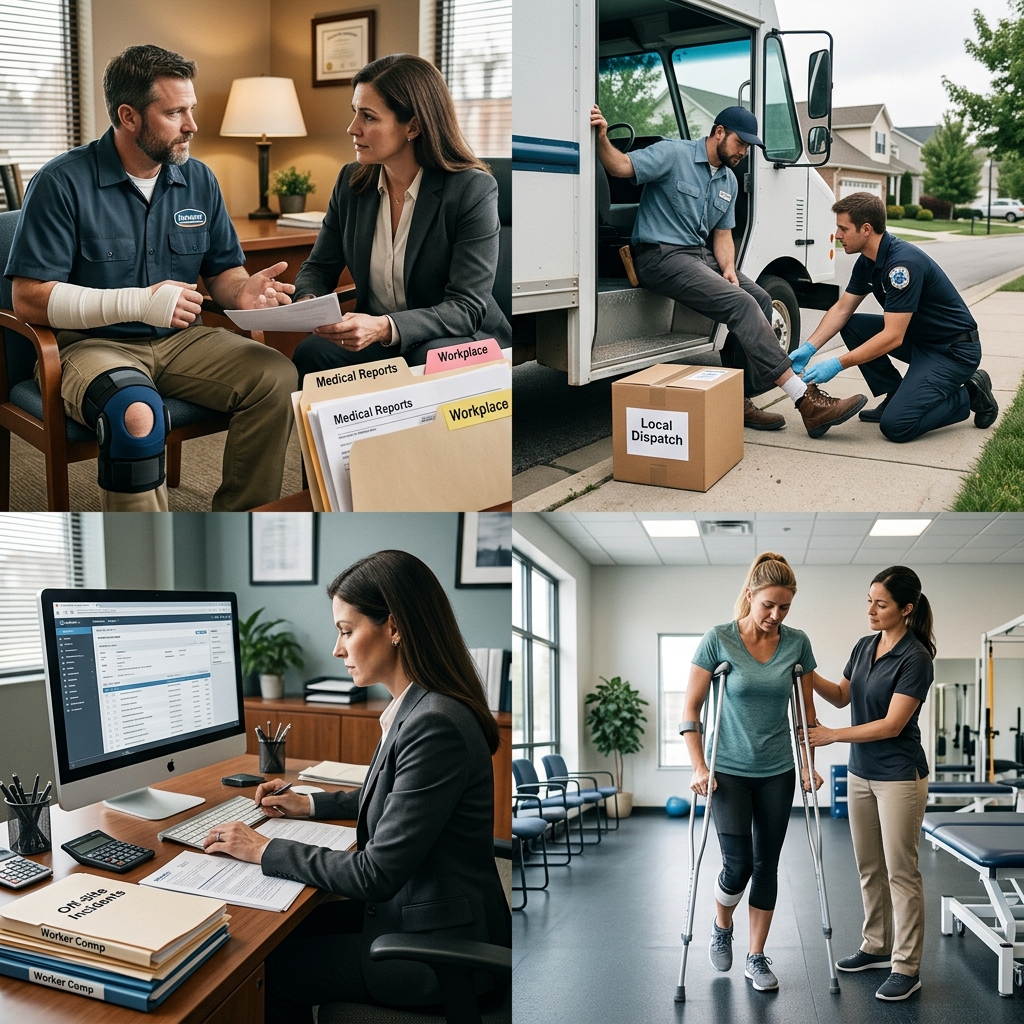
Workers’ compensation does not only apply to accidents inside a factory, office, or store. Many employees are hurt at client locations, on the road, in parking lots, during business trips, or while working from home. Whether those injuries are covered usually turns on a central question: were you acting within the course and scope of your job when you got hurt.
This guide explains how workers’ compensation can apply to off‑site injuries, the common rules and exceptions, and what you should do after an accident away from the main workplace. It is general information, not legal advice; specific outcomes depend on your state law and the details of your case.
1. Core Idea: “Course and Scope” Matters More Than Location
In most states, the physical location of your injury is not the deciding factor. What matters is whether the accident arose out of and occurred in the course of employment — often called the course and scope requirement.
In plain language, this usually means:
- You were doing something for your employer’s benefit, or
- You were performing duties reasonably related to your job, and
- The activity was authorized or expected as part of your employment.
Because workers’ compensation is typically a no‑fault system, you may be eligible for benefits even if nobody was negligent or if you made a mistake, so long as the injury is work-related.
2. Typical Situations Where Off‑Site Injuries May Be Covered
The same general principles apply across many states, even though the details differ. The examples below are common categories where off‑site injuries are often considered work-related.
2.1 Traveling between job locations
Employees whose duties require them to travel during the day (for example between job sites or customers) are often covered while they are on the road.
Often covered scenarios include:
- Driving between multiple project locations as part of your shift.
- Visiting a client’s office at your employer’s direction.
- Traveling from a central office to a remote site to perform assigned work.
If the travel is a necessary part of doing the job, injuries during that travel usually occur in the course and scope of employment.
2.2 Business trips, conferences, and off‑site meetings
When an employer sends a worker to another city or state for business, injuries can be compensable for much of the trip. Many jurisdictions treat employees on business trips as being within the course of employment for activities that are reasonably related to travel and work, such as lodging and meals.
- Injuries during mandatory meetings, seminars, or training sessions.
- Accidents at the hotel while preparing for a meeting or using employer‑required equipment.
- Injuries at a company‑organized event that is part of the business trip agenda.
Coverage may become more complicated when the employee significantly deviates from work for purely personal recreation.
2.3 Employer errands and special missions
Many states recognize a “special mission” or “special errand” concept: when an employer asks an employee to do something outside their normal schedule or routine, the travel for that mission may be covered.
Examples can include:
- Picking up supplies for the business on the way to work at your supervisor’s request.
- Delivering documents to a client after normal hours.
- Driving to an emergency job site when you are called in unexpectedly.
Here, the key question is whether the trip primarily served the employer’s interest, not your personal convenience or errands.
2.4 Employer‑controlled parking lots and access routes
Some states consider injuries on property that is controlled by the employer — such as certain parking lots, sidewalks, or private access roads — to be potentially work-related, even if they are just outside the building.
You may have a stronger claim if:
- The employer owns, leases, or maintains the area, or pays a third party to maintain it.
- The route is the customary way employees must use to reach the worksite.
- The injury occurs immediately before or after your shift while you are entering or leaving the premises.
2.5 Remote work and home offices
With more employees working from home, off‑site injury questions now routinely include accidents in home offices or other remote locations. Government guidance recognizes that home‑based injuries can be compensable when they happen while the employee is performing work tasks in the home environment.
Potentially covered situations:
- Tripping over work equipment while walking to answer a work call.
- Injuries due to faulty employer‑provided equipment during a remote shift.
- Accidents that occur during an approved rest break when the activity is incidental to work (for example, getting water in your normal home setup) depending on state law.
Because the home environment is shared with personal activities, documentation of what you were doing at the time of injury is especially important.
3. When Off‑Site Injuries Are Commonly Not Covered
Workers’ compensation does not insure every injury that happens to an employee. Certain categories of off‑site incidents are frequently excluded, though there are exceptions.
3.1 Ordinary commute: the “coming and going” rule
Many states apply a “coming and going rule,” which generally denies coverage for injuries suffered during the regular commute between home and a fixed worksite.
The reasoning is that the daily commute is usually considered a personal activity, not part of the job. Accordingly:
- Auto accidents on the way from home to work are often not compensable.
- Injuries while returning home at the end of the shift are typically excluded.
However, there can be exceptions when the commute itself is part of the job (for example, for traveling employees or those with no fixed worksite).
3.2 Purely personal errands and detours
Even during work hours, if an employee significantly departs from work duties for a personal purpose, injuries during that detour may not be covered.
Examples of potentially non‑compensable situations include:
- Leaving a client site during a scheduled visit to run personal errands unrelated to work.
- Taking a substantial deviation from a business route to handle personal business.
- Engaging in risky recreational activities on a business trip that have no connection to work.
3.3 Off‑duty social or recreational activities
Injuries at social events, sports, or recreational activities that are merely optional and primarily for fun are often not covered, even if co‑workers or supervisors are present. Some states recognize coverage only when participation is required or provides a direct, clear benefit to the employer.
3.4 Intentional or highly improper conduct
Workers’ compensation generally does not cover injuries caused by an employee’s intentional self‑harm, serious criminal acts, or behavior far outside any reasonable work duty. State statutes usually carve out these categories to prevent abuse of the system.
4. Comparing Common Off‑Site Scenarios
The following table illustrates how different off‑site situations might be analyzed. State law varies, but this comparison highlights typical reasoning.
| Situation | Likely Coverage? | Key Factor |
|---|---|---|
| Driving from office to client meeting during workday | Often covered | Travel is part of job duties and serves employer’s business |
| Regular commute from home to fixed workplace | Often not covered | “Coming and going” rule: commute is generally personal |
| Sent on a special errand for employer after hours | Often covered | Trip is primarily for employer’s benefit and is requested by employer |
| Slip in employer‑controlled parking lot before shift | May be covered | Injury on property owned or controlled by employer |
| Injury at home while off the clock doing personal tasks | Usually not covered | No connection to work duties or employer benefit |
5. Steps to Take After an Off‑Site Work‑Related Injury
What you do in the minutes, hours, and days after an off‑site accident can strongly affect your workers’ compensation claim. Official guidance stresses prompt reporting, accurate documentation, and appropriate medical care.
5.1 Get medical help and tell providers it is work-related
- Call emergency services if needed.
- Tell doctors, nurses, and other providers that the injury occurred while you were doing your job.
- Follow the treatment plan and keep all medical records.
Medical notes that clearly connect the injury to your work activity can become vital evidence later.
5.2 Report the injury to your employer quickly
Many states require employees to notify their employer of a work injury within a specific timeframe; failing to do so can limit or bar benefits.
- Notify your supervisor, manager, or HR as soon as possible.
- Provide a written report (such as an email) describing when, where, and how the accident happened.
- Keep a copy of your report and any employer accident forms.
5.3 Document the scene and circumstances
Because off‑site accidents often occur on property not controlled by your employer, your own documentation can be crucial.
- Take photos or videos of the area, hazards, vehicles, or equipment involved.
- Collect names and contact information for witnesses, including anyone who saw the accident or its aftermath.
- Save receipts, travel logs, mileage records, or hotel bills showing you were on a work assignment.
- Write down a detailed timeline while the event is still fresh in your memory.
5.4 Cooperate with claim forms and insurance requests
After you report the injury, your employer or its insurer may provide claim forms or ask for more information.
- Complete workers’ compensation forms carefully and truthfully.
- Describe the specific work task you were performing at the time of the injury.
- Provide any requested documents showing that you were on the job, such as schedules, emails, or dispatch orders.
6. Evidence That Helps Prove an Off‑Site Injury Is Work‑Related
Off‑site claims sometimes face more scrutiny because there may be questions about what you were doing at the time of the accident. The stronger your evidence, the more clearly you can show that the injury arose in the course of employment.
Helpful types of evidence include:
- Work communications – Emails, text messages, or dispatch records assigning you to a site or confirming a business trip.
- Witness statements – Co‑workers, clients, or bystanders who can confirm your presence and activity.
- Travel and expense records – Mileage logs, hotel invoices, toll receipts, or flight details for business travel.
- Photographs and videos – Images of a dangerous condition, damaged equipment, or vehicle impact.
- Medical reports – Doctor’s notes linking the diagnosis to the incident you describe.
7. Interaction with Other Benefits
If an off‑site injury is not covered by workers’ compensation because it falls outside the course and scope of employment, other protections may still help. For example, federal law provides unpaid but job‑protected leave for certain medical conditions through the Family and Medical Leave Act (FMLA)
- Workers’ compensation generally covers medical costs and part of lost wages for work-related injuries.
- FMLA may provide up to 12 weeks of unpaid, job‑protected leave for eligible employees with serious health conditions, regardless of fault.
- Private disability insurance may supplement income when an injury is not covered by workers’ comp or when benefits are limited.
Understanding how these programs fit together can help you plan financially while you recover.
8. Frequently Asked Questions About Off‑Site Workers’ Compensation Claims
8.1 Does it matter that my employer was not at fault?
In most workers’ compensation systems, fault is not the focus. The central question is whether the injury is work-related and occurred in the course and scope of employment. You may still receive benefits even if no one was negligent.
8.2 What if I was partly responsible for the accident?
Unlike many personal injury cases, workers’ compensation usually does not reduce benefits because you were careless, as long as you were performing job duties and did not engage in intentional misconduct or serious criminal behavior.
8.3 Can I file a workers’ compensation claim if I was hurt at a client’s site?
Yes, injuries at client locations can be compensable if you were there for work purposes, such as performing services, conducting inspections, or meeting with the client as part of your job. In some cases you may also have a separate claim against the property owner if dangerous conditions contributed to the injury.
8.4 How long do I have to report an off‑site work injury?
Deadlines vary by state, but many laws require you to notify your employer within a relatively short period, often 30 days or less. Some states also impose deadlines for filing the formal claim. Failing to meet these timelines can affect your right to benefits, so early reporting is important.
8.5 Can remote workers receive workers’ compensation?
Yes. Employees working from home or other remote locations may be covered when their injury occurs while performing their work duties, even though they are not on the employer’s premises. Because the home environment includes personal activities, detailed documentation helps show that the injury was work-related.
8.6 Do I need a lawyer for an off‑site workers’ compensation claim?
While it is possible to file a claim without an attorney, off‑site cases can be more complex because insurers may dispute whether the injury truly occurred in the course and scope of employment. Many workers consult a lawyer when coverage is denied, benefits are delayed, or the injury is severe.
9. Key Takeaways
- Off‑site injuries may be covered if they arise within the course and scope of employment, regardless of whether they occur on employer property.
- Travel between job sites, business trips, special errands, and remote work injuries can all qualify when they primarily serve the employer’s business.
- Ordinary commuting, purely personal detours, and recreational activities are common areas where coverage may be denied.
- Prompt reporting, thorough documentation, and consistent medical records substantially strengthen off‑site workers’ compensation claims.
Because each state’s workers’ compensation system is different and facts matter, consider speaking with a qualified local attorney or contacting your state workers’ compensation agency for guidance about your specific situation.
References
- Can You Get Workers’ Comp Benefits for an Off-Site Injury in California? — WorkCompSimplified. 2022-05-10. https://www.workcompsimplified.com/can-you-get-workers-comp-benefits-for-an-off-site-injury-in-california/
- Employee Injured Outside of Work — AmTrust Financial. 2023-03-15. https://amtrustfinancial.com/blog/small-business/workers-comp-cover-employee-injured-outside-work
- Off-Site & Traveling Employee Injuries in NJ Workers’ Comp — Shebell & Shebell, LLC. 2023-09-20. https://shebell.com/workers-compensation/offsite-traveling-injuries/
- Will Workers’ Comp Cover an Accident Off-Site? — Rooth Law Firm. 2021-04-01. https://www.roothlawyer.com/blog/will-workers-comp-cover-an-accident-off-site/
- How to Prove a Work-Related Injury When Working Off-Site — Matt White Attorney at Law. 2023-06-05. https://mattwhiteattorney.com/prove-a-work-related-injury-working-off-site/
- I Was Injured at Work — What Do I Do? — California Department of Industrial Relations, Division of Workers’ Compensation. 2024-01-01. https://www.dir.ca.gov/dwc/injuredworker.htm
- Going and Coming Rule Explained: California Workers’ Comp — GEKLAW. 2022-11-18. https://www.geklaw.com/workers-compensation/going-and-coming-rule.htm
Similar Articles








Read full bio of Sneha Tete




