
Seizing Papers Beyond a Search Warrant: Rights and Limits
A practical guide to how the Fourth Amendment restricts police seizures of books, documents, and other papers not specifically listed in a search warrant.
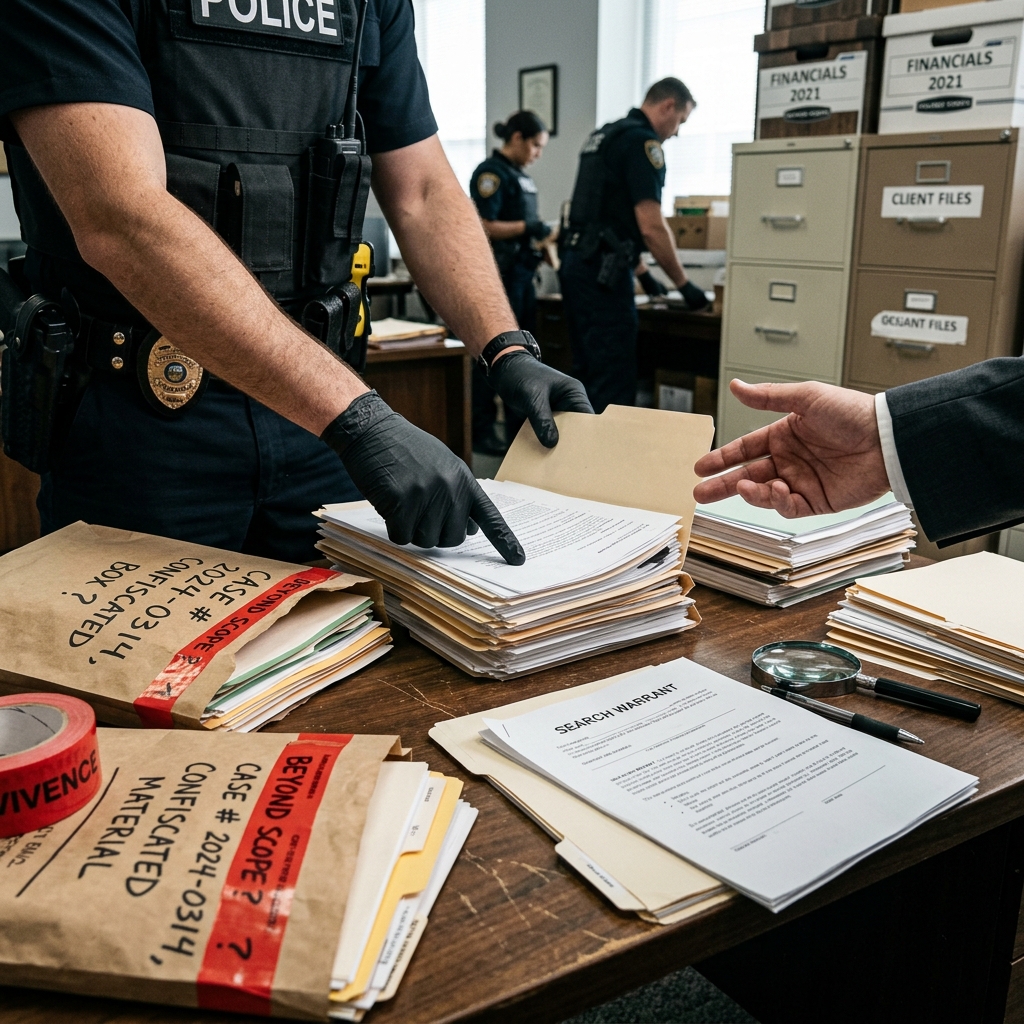
When police execute a search warrant, they are not free to seize every item they find. The Fourth Amendment demands that warrants describe the place to be searched and the things to be seized with particularity, especially when it comes to books, documents, and other papers.
Yet in real investigations, officers often encounter written or electronic records that were not specifically listed in the warrant application. Whether those items may lawfully be seized—and whether they can be used in court—depends on a mix of constitutional rules, statutory procedures, and case law.
Fourth Amendment Foundations: Privacy in Papers
The starting point is the text of the Fourth Amendment, which protects people against unreasonable searches and seizures of their persons, houses, papers, and effects and requires that warrants be based on probable cause and describe the place to be searched and the persons or things to be seized.
This protection applies to both physical and digital records. Courts treat many categories of documents—financial files, business records, diaries, letters, and electronic communications—as highly sensitive because they reveal intimate details about a person’s life, associations, and beliefs.
Key constitutional principles include:
- Reasonable expectation of privacy: Protection applies only where a person has a legitimate expectation of privacy, judged by whether the individual actually expected privacy and whether society recognizes that expectation as reasonable.
- Particularity requirement: Warrants must particularly describe both the place to be searched and the items to be seized; a vague warrant authorizing seizure of “all records” is constitutionally suspect.
- Probable cause: The affidavit supporting the warrant must show probable cause to believe specific documents or papers constitute evidence of a crime.
What a Valid Search Warrant Must Include
Before officers can lawfully seize documents, a judge must issue a warrant that meets core requirements. Under federal rules and most state statutes, a warrant must:
- Identify the place to be searched (such as a home, office, or digital storage medium)
- Specify the property or documents to be seized
- Be supported by an oath or affirmation and a showing of probable cause
- Be executed within any applicable time limits and procedural safeguards
Rule 41 of the Federal Rules of Criminal Procedure, for example, requires that a warrant identify both the person or property to be searched and any person or property to be seized. With electronically stored information, a warrant may authorize seizure of storage media or copying of data, followed by later review consistent with the warrant’s terms.
| Element | Purpose |
|---|---|
| Place to be searched | Limits where officers may look for documents |
| Items to be seized | Defines which books, papers, or files may be taken |
| Probable cause statement | Connects the specific documents to suspected criminal activity |
| Execution and inventory procedures | Ensures proper handling, listing, and accountability for seized items |
Plain View Doctrine: When Unlisted Papers Can Be Seized
One of the most important doctrines governing seizure of unlisted items is the plain view doctrine. If officers are lawfully present at a location and lawfully conducting a search, they may seize evidence that is clearly visible, even if it is not described in the warrant, so long as certain conditions are met.
Courts typically require three elements:
- Lawful vantage point: The officer must be in a place they have a legal right to be, such as inside a home under a valid warrant.
- Lawful access: The officer must have lawful access to the item (for example, a document lying on a desk in a room where the warrant permits searching).
- Immediately apparent incriminating character: It must be immediately apparent that the item is evidence of a crime, contraband, or otherwise subject to lawful seizure.
Applied to papers and records, this doctrine is narrower than it may sound. Unlike a visible weapon or drugs, the incriminating nature of a document often is not obvious without reading it. Many courts are wary of turning plain view into a blank check for broad document review, especially when the warrant is limited to certain categories of records.
Limits on Plain View for Documents
Some legal standards and agency policies restrict how far officers may go when examining documents that fall outside the warrant’s scope. For instance, one state rule requires officers who seize documents to make reasonable efforts not to review aspects of those documents that are not covered by the warrant.
Practical limitations include:
- Officers may be permitted to briefly scan or “spot check” a document to determine if it falls within the warrant’s categories.
- If a document clearly relates to the specified offense, it may be seized even if not precisely described, especially where the warrant authorizes seizure of “records relating to” a defined crime.
- If an item’s relevance is unclear without extensive reading and its subject matter appears unrelated to the warrant, prolonged examination can raise Fourth Amendment concerns.
Overbroad and Defective Warrants: Particularity Problems
Warrants that authorize seizure of large volumes of papers without meaningful limits can be attacked as overbroad or lacking particularity. The Supreme Court has held that a warrant cannot be saved by the fact that the application described the items in detail if the warrant itself did not.
Overbreadth issues commonly arise when warrants:
- Use generic phrases like “all records” without specifying time frames, accounts, or types of transactions
- Fail to connect documents to particular offenses or individuals
- Permit search of entire homes or offices for papers when probable cause supports only discrete categories
In such cases, courts may suppress evidence or limit the admissible use of seized documents, especially where the warrant essentially becomes a general search, something the Fourth Amendment was explicitly designed to prevent.
Inventory and Handling of Seized Papers
When officers seize documents, they must follow procedures to document what was taken. Federal rules require the executing officer to prepare and verify an inventory of seized property, typically in the presence of another officer and, if possible, the person from whom the property was taken.
Proper handling of papers and records serves several goals:
- Accountability: A detailed list of seized items enables the court and defense counsel to assess whether officers exceeded the warrant.
- Protection of privacy: Restrictions on reviewing irrelevant portions of documents guard against unnecessary exposure of personal information.
- Preservation of evidence: Careful storage reduces the risk of alteration or loss of important records.
Challenging Seizure of Unlisted Documents
If officers seize books, documents, or other papers not listed in the warrant, the defense can seek to exclude those materials by filing a motion to suppress. The main tool is the exclusionary rule, which bars the use of evidence obtained through an unreasonable search or seizure.
Typical arguments include:
- Officers exceeded the scope of the warrant by seizing records outside the categories authorized.
- The warrant itself was overbroad or insufficiently particular, making the search unconstitutional.
- The plain view doctrine does not apply because the incriminating nature of the documents was not immediately apparent.
- Officers conducted an impermissible general search, reading large volumes of personal documents beyond any lawful justification.
If a court agrees that an unreasonable search or seizure occurred, the documents and any direct evidence derived from them may be suppressed. In some situations, derivative evidence (“fruit of the poisonous tree”) can also be excluded, though exceptions such as inevitable discovery and independent source may limit that remedy.
Good Faith Exception and Its Limits
The good faith exception allows certain evidence seized under a defective warrant to be admitted if officers reasonably relied on the warrant, believing it to be valid.
However, this exception has important limits, particularly in the context of document seizures:
- It does not apply when the warrant is so facially deficient—for example, lacking meaningful description of items to be seized—that no reasonable officer could rely on it.
- It may be inapplicable where officers knew or should have known they were exceeding the warrant’s scope, such as by seizing entire filing cabinets when only particular records were authorized.
- It does not cure deliberate or reckless disregard of the particularity requirement.
Digital Documents and Modern Search Practices
Today, many “papers” exist as electronic documents: emails, spreadsheets, cloud-based files, and logs kept by service providers. Rule 41 and similar provisions recognize that a warrant may authorize seizure or copying of electronic storage media and later review of electronically stored information, but that review must remain consistent with the warrant’s limits.
Modern challenges include:
- How to segregate data within a device so that only information within the warrant’s scope is examined
- Whether keyword searches or forensic tools are reasonably tailored to the crimes alleged
- How to handle privileged materials, such as attorney–client communications, that may be intermixed with other data
Some courts and agencies have adopted protocols—like filter teams or special masters—to review seized digital documents and prevent improper access to unrelated or privileged material. While details vary by jurisdiction, the underlying principle remains the same: the government’s power to inspect a person’s papers is bounded by particularized probable cause and procedural safeguards.
Practical Tips for Individuals and Businesses
If agents arrive with a search warrant, understanding how document seizures work can help protect your rights.
- Ask to see the warrant: Confirm the address, date, and specific categories of items authorized.
- Do not obstruct, but calmly observe what officers seize and take notes.
- Request a copy of the inventory once the search is complete; this is required under federal rules.
- Contact legal counsel promptly to review whether any seized books, papers, or digital records fall outside the warrant’s scope.
- Maintain organized records and backups, which can help demonstrate if officers removed more than the warrant permitted.
Frequently Asked Questions (FAQ)
Can police read every document they find during a search?
No. Officers may inspect documents to determine whether they fall within the warrant’s categories, but they are not entitled to conduct unlimited reading of records that are clearly outside the warrant or unrelated to any lawful investigative purpose. Some jurisdictions impose specific duties to avoid examining aspects of documents not covered by the warrant.
What happens if officers seize papers that are not listed in the warrant?
Those papers may be challenged through a motion to suppress. If the court finds that the seizure exceeded the warrant’s scope or that plain view did not apply, the documents and any evidence derived from them can be excluded under the exclusionary rule.
Is a warrant valid if it just says “all records” without more detail?
Warrants must particularly describe the items to be seized. Overly broad language that effectively authorizes a general search of all records is vulnerable to challenge and may be deemed unconstitutional, especially if it is not limited by time, subject matter, or connection to specific offenses.
Do these rules apply to electronic records like emails and spreadsheets?
Yes. Electronic documents are treated as “papers” or “effects” for Fourth Amendment purposes. Warrants for digital data must meet the same probable cause and particularity requirements, and any later review of seized media must remain consistent with the warrant.
Can evidence from an invalid warrant ever be used in court?
In some circumstances, yes. Under the good faith exception, evidence may be admitted if officers reasonably relied on a warrant that later turns out to be defective. However, this does not apply when the warrant is obviously deficient in describing the items to be seized or when officers knowingly overstep its bounds.
References
- Rule 41. Search and Seizure — Federal Rules of Criminal Procedure, Legal Information Institute. 2023-01-01. https://www.law.cornell.edu/rules/frcrmp/rule_41
- Search & Seizure Supreme Court Cases — Justia U.S. Supreme Court Center. 2023-01-01. https://supreme.justia.com/cases-by-topic/search-seizure/
- Understanding Search and Seizure Law — Heart of Ohio Health Center / Nolo. 2022-05-01. https://anthemeap.com/heart-of-ohio-health-center/find-legal-support/resources/criminal-law/legal-assist/understanding-search-and-seizure-law
- Search and Seizure Laws by State — LawInfo. 2023-06-01. https://www.lawinfo.com/resources/criminal-defense/search-seizure-laws-by-state.html
- 14.2 Warrants and Illegal Searches and Seizures — North Carolina Defender Manual, UNC School of Government. 2016-01-01. https://defendermanuals.sog.unc.edu/sites/default/files/pdf/14.2%20Warrants%20and%20Illegal%20Searches%20and%20Seizures.pdf
- Challenging Evidence Seized Under a Search Warrant — Melms Law. 2021-03-01. https://www.melmslaw.com/challenging-evidence-seized-under-a-search-warrant/
Similar Articles








Read full bio of Sneha Tete




