
Understanding Compulsory Licenses for Music Covers
A practical guide to compulsory mechanical licenses, cover songs, and how U.S. copyright law shapes the way musicians legally record and distribute music.
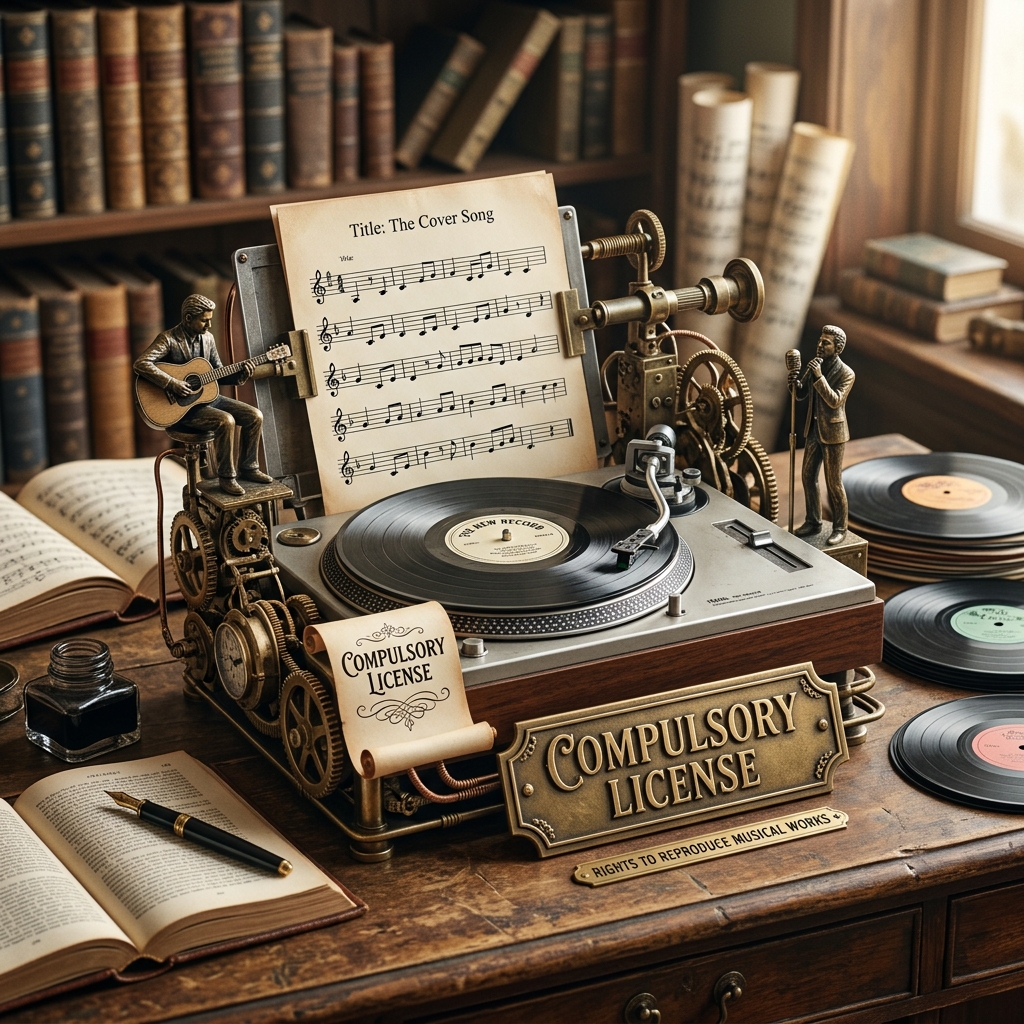
Musicians routinely record and release their own versions of existing songs, from stripped-down acoustic renditions to full studio productions. In the United States, this practice is made possible in large part by the compulsory mechanical license, a legal mechanism that allows someone to record and distribute a cover of a song without needing the copyright owner’s direct consent, as long as specific statutory conditions are met and royalties are paid.
This article explains how compulsory licenses work for musical compositions, what you can and cannot do under such a license, how royalties are calculated, and the steps required to comply with U.S. copyright law when releasing a cover version.
1. The Legal Foundations of Compulsory Mechanical Licenses
The concept of a compulsory mechanical license is rooted in federal copyright law and reflects a policy choice to balance the interests of songwriters with the public and the recording industry. Under U.S. law, composers and music publishers normally hold exclusive rights to reproduce and distribute their works in the form of phonorecords (recordings). However, for nondramatic musical works, those rights are limited by a statutory licensing system once the work has been released.
Section 115 of Title 17 of the United States Code establishes the compulsory license scheme. It states that once phonorecords of a nondramatic musical work have been distributed to the public in the United States under the authority of the copyright owner, any eligible person can obtain a compulsory license to make and distribute phonorecords of that work, including digital phonorecord deliveries (DPDs), by complying with statutory conditions.
| Element | Explanation |
|---|---|
| Work type | Nondramatic musical works (typical songs), not full dramatic works like musicals. |
| Availability trigger | Phonorecords must have previously been distributed to the public in the U.S. with the copyright owner’s authorization. |
| Main rights affected | Exclusive rights to make and distribute phonorecords are made subject to compulsory licensing. |
| Primary purpose | Phonorecords must be made primarily for distribution to the public for private use, including DPDs. |
2. What Is a Compulsory License in the Music Context?
A compulsory license in music is a statutory authorization that allows anyone meeting the legal conditions to use a copyrighted musical composition without needing the composer or publisher to sign a traditional license agreement. In practice, the most common form is the compulsory mechanical license, which covers the making and distribution of sound recordings of a song.
According to guidance from the U.S. Copyright Office, once the statutory prerequisites are satisfied, a compulsory license includes the right to make and distribute phonorecords of the eligible nondramatic musical work, including digital deliveries aimed at private listening. Industry explanations describe this as a mechanism by which musicians can record and release their own versions of songs that have already been commercially released, provided they pay the statutory mechanical rate and observe legal limits.
2.1 Core Characteristics
- Non-negotiable availability: The copyright owner cannot refuse a license once the statutory conditions are met; the law compels licensing of the composition for phonorecords.
- Standardized royalties: The royalty rates (often called the statutory mechanical rate) are set by law and periodically updated, rather than individually negotiated.
- Limited scope: The license primarily covers audio recordings made for distribution to the public for private use; it does not automatically grant broader rights such as synchronization (sync) rights for film or major alterations to the work.
- Formal procedure: Users must serve a Notice of Intention and comply with reporting and payment obligations to benefit from the compulsory license.
3. Eligibility Conditions for Releasing a Cover Song
Not every musical use qualifies for a compulsory license. The law and official guidance outline specific conditions that must be satisfied before someone can legally rely on the compulsory mechanism to record and distribute a cover.
3.1 When a Compulsory License Becomes Available
Eligibility is tied to the prior release of the work. A person can obtain a compulsory license only if:
- Phonorecords of the musical work have already been distributed to the public in the United States under the authority of the copyright owner, including by digital phonorecord delivery.
- The person’s primary purpose in making phonorecords is to distribute them to the public for private use, not for public broadcast or other uses.
- The work is a nondramatic musical composition, rather than a dramatic work or other type of copyrighted content.
Library guides on music copyright emphasize that once a song has been recorded and distributed in the United States, anyone has the right to obtain a compulsory mechanical license for non-dramatic compositions, and the owner cannot prevent a cover recording if the statutory conditions are followed.
3.2 Activities Allowed by a Compulsory License
Under a properly obtained compulsory license, you may engage in the following activities:
- Make phonorecords of the eligible nondramatic musical work.
- Distribute those phonorecords to the public for private use.
- Deliver the recording digitally (e.g., full downloads or qualifying digital phonorecord deliveries).
These rights allow a musician or label to release cover versions on physical formats such as CDs or vinyl records and as digital downloads or certain streaming distributions, subject to the applicable rules.
3.3 Important Limitations
A compulsory license does not grant unrestricted freedom. Official materials and industry explanations highlight several key limits:
- You cannot use the composition for synchronization with visual media (e.g., films, TV shows, major video projects) under Section 115; sync rights must be separately licensed.
- You may not make significant changes that would create a new derivative work beyond a faithful cover; the composer retains the exclusive right to prepare derivative works.
- Public performance rights (such as live concerts or radio broadcast) are typically handled through performance rights organizations and are not covered by the mechanical compulsory license.
4. Royalty Rates and Mechanical Payments
A central feature of the compulsory license system is that royalties are calculated according to statutory rates, rather than negotiated case by case. These mechanical royalties compensate songwriters and publishers for the use of their compositions in sound recordings.
4.1 Statutory Mechanical Rate
U.S. mechanical royalty rates are set by law and adjusted periodically. Since 2009, guidance from academic and industry sources has described the compulsory license fee for nondramatic musical compositions as the greater of a fixed per-copy amount or a per-minute amount of playing time.
- Per song per copy rate: 9.1 cents per copy of the song.
- Per-minute rate: 1.75 cents per minute (or fraction of a minute) of playing time per copy.
The applicable royalty for a particular recording is the larger of these two figures, calculated per unit manufactured and distributed, including physical copies and full digital downloads.
4.2 How Payments Are Made
According to the U.S. Copyright Office, once a compulsory license is in place, the licensee must make monthly royalty payments and provide monthly statements of account to the copyright owner or their authorized agent. Payments are typically due on or before the twentieth day of each month for uses in the preceding month.
In practice, musicians often work through intermediaries such as publishers, specialized agencies, or digital distributors to handle mechanical licensing and royalty reporting. Industry explanations note that digital streaming services often operate under blanket mechanical licensing frameworks rather than individual compulsory licenses for each track, though the underlying statutory scheme still influences rates and terms.
5. The Notice of Intention Requirement
A crucial procedural step in obtaining a compulsory mechanical license is serving a Notice of Intention to Obtain a Compulsory License (NOI). This formal notice informs the copyright owner or the Copyright Office that you intend to rely on the statutory license to make and distribute phonorecords.
5.1 Timing Rules
Section 115 and Copyright Office guidance specify clear timing requirements:
- The NOI must be served before, or not later than 30 calendar days after, making any phonorecord of the work.
- It must be served before distributing any phonorecord of the work to the public.
Failure to serve a timely NOI generally means you cannot rely on the compulsory license and would need to secure a traditional negotiated license instead.
5.2 Whom to Notify
If the identity and address of the copyright owner are known, the NOI must be sent directly to the owner or their authorized agent. Official guidance states that service is made by sending the NOI to either the last address shown in the Copyright Office’s records or another known address meeting certain conditions.
When the copyright owner cannot be identified or located, the NOI may be filed with the Copyright Office itself, which serves as a clearing mechanism to preserve the licensee’s ability to rely on the compulsory license.
6. Practical Implications for Musicians and Rights Holders
Compulsory mechanical licenses have significant effects on how music is created, distributed, and monetized. They promote broad access to compositions while preserving core rights for songwriters and publishers.
6.1 For Musicians Recording Covers
When planning to record and release a cover song, musicians should understand that:
- They may have a legal right to record and distribute a cover once the song has been lawfully released in the U.S. and the statutory conditions are met.
- They must respect the original composition, avoiding major changes that would constitute a new derivative work without permission.
- They are responsible for ensuring that an NOI is served and that mechanical royalties are paid at least at the statutory rate.
- Additional rights, such as sync licenses for video content, require separate negotiations and are not automatically provided by the compulsory scheme.
6.2 For Songwriters and Publishers
For rights holders, compulsory licenses represent both a limitation and an opportunity:
- They cannot block cover recordings once the song has been distributed and the statutory requirements are satisfied.
- They are entitled to mechanical royalties at the statutory rate or other applicable rates, which can generate steady income from multiple cover versions.
- They retain control over derivative works and uses outside the scope of Section 115, such as dramatic adaptations and synchronization, which can still be selectively licensed.
7. Common Misunderstandings and Clarifications
Despite the relative clarity of the law, several misconceptions persist about compulsory mechanical licenses. Clarifying these issues helps musicians avoid legal risk and rights holders understand the boundaries of their control.
7.1 “I Can Do Anything I Want with a Cover”
One frequent misunderstanding is the idea that a compulsory license allows unlimited creative alteration of a song. In reality, Section 115 and official guidance make clear that the license is tied to the underlying composition and does not authorize preparing a substantially new derivative work beyond typical performance variations.
While performers can interpret the music in their own style, fundamental changes to melody or lyrics generally require explicit permission from the copyright owner.
7.2 “A Compulsory License Covers Videos and Films”
Another common error is assuming that once you have a compulsory mechanical license, you can automatically use the song in video content. Sync uses are usually governed by separate rights for synchronizing music with visuals and are not covered by Section 115. Owners of these rights can negotiate, restrict, or deny such uses even if the composition is subject to a compulsory mechanical license for audio-only uses.
7.3 “Streaming Never Uses Compulsory Mechanisms”
Digital streaming involves complex licensing arrangements, including blanket licenses and collective management. Industry commentary explains that many streaming platforms operate under blanket mechanical licensing structures, which are influenced by statutory rates and rules, even though the practical implementation can differ from individual compulsory licenses used for physical or download releases.
8. Frequently Asked Questions (FAQs)
8.1 Do I need the songwriter’s permission to release a cover if the song is already released?
Under U.S. law, if the song is a nondramatic musical work and phonorecords have already been distributed to the public in the United States with the copyright owner’s authorization, you can obtain a compulsory mechanical license without needing their explicit permission, provided you comply with Section 115 requirements, including serving an NOI and paying statutory royalties.
8.2 Can I change the lyrics or melody in my cover under a compulsory license?
The compulsory license does not grant the right to create a new derivative work by significantly changing the lyrics or melody. While performance interpretations are permitted, substantial alterations typically require direct permission from the copyright owner, who retains the exclusive derivative work right.
8.3 What happens if I release a cover without serving a Notice of Intention?
If you fail to serve a timely NOI, you generally cannot rely on the compulsory license and may be infringing the copyright owner’s exclusive rights to make and distribute phonorecords unless you have obtained another valid license. The NOI must be served before or within thirty days after making the phonorecord and before any distribution.
8.4 How much do I pay in mechanical royalties for my cover?
Mechanical royalties under the compulsory license are based on statutory rates. Since 2009, sources have identified the rate as the larger of 9.1 cents per copy per song or 1.75 cents per minute of playing time (or fraction) per copy, for eligible nondramatic compositions. Rates may be updated over time by regulatory processes, so current figures should be confirmed with official sources or industry organizations.
8.5 Does the compulsory license cover live performances of my cover?
No. The compulsory mechanical license focuses on making and distributing phonorecords. Public performance rights, including live performances and broadcasts, are generally managed through performance rights organizations and separate licensing arrangements.
References
- Compulsory License for Making and Distributing Phonorecords — U.S. Copyright Office. 2019-09-01. https://www.copyright.gov/circs/circ73.pdf
- 17 U.S. Code § 115 – Scope of Exclusive Rights in Nondramatic Musical Works — Legal Information Institute, Cornell Law School. 2022-01-01. https://www.law.cornell.edu/uscode/text/17/115
- Music Copyright and Licensing — Indiana University Libraries. 2013-01-01. https://guides.libraries.indiana.edu/c.php?g=158548&p=1175962
- The Mechanics of Mechanical Licenses — Musical America Blogs. 2018-06-01. http://www.musicalamerica.com/mablogs/?p=9907
- What Is a Compulsory License? — Songtrust Help Center. 2020-05-01. https://help.songtrust.com/knowledge/what-is-a-compulsory-license
Similar Articles








Read full bio of Sneha Tete


