
West Virginia Marriage Age Rules Explained
Understand who can marry in West Virginia, what minors need, and how the license process works.
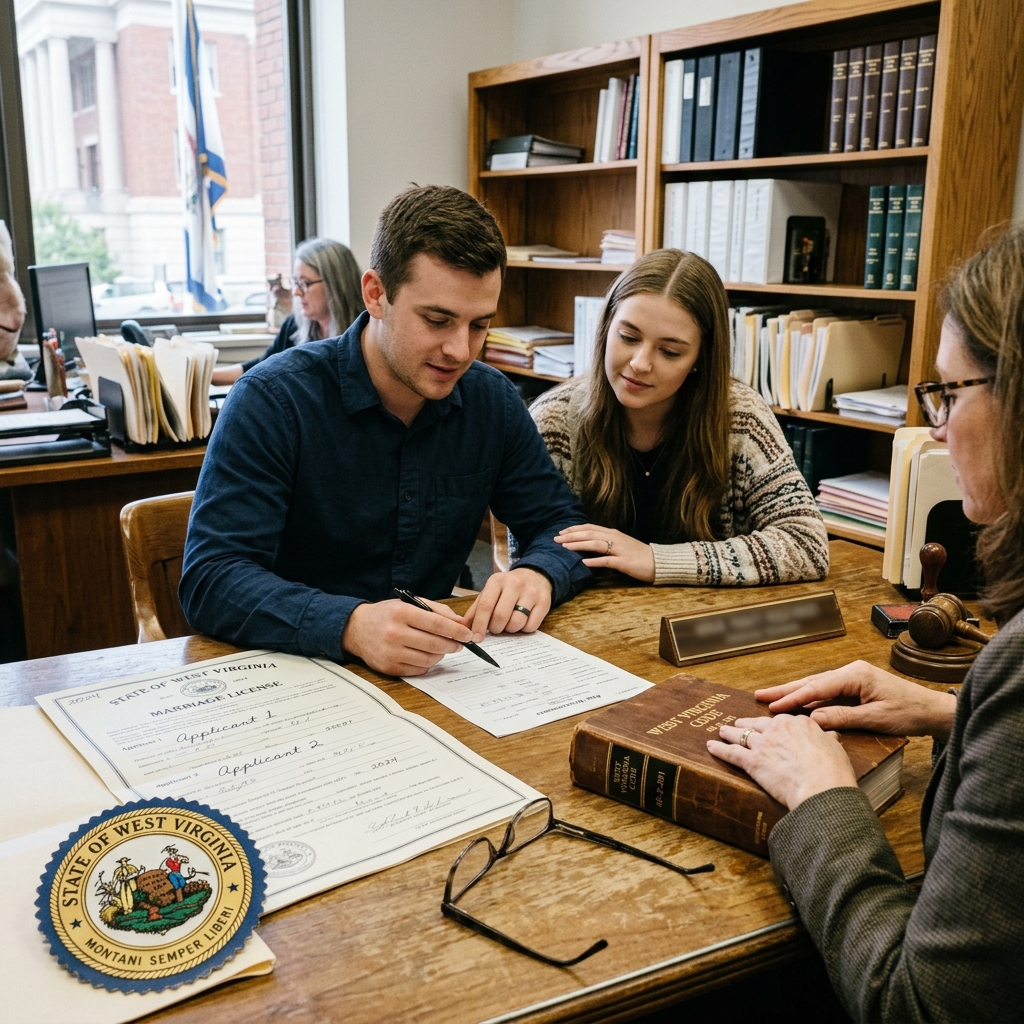
West Virginia sets the general marriage age at 18, but the law also creates a narrow path for some 16- and 17-year-olds to marry with the required approvals. The state’s rules are designed to make the process clear: adults may marry on their own, while minors must satisfy consent and other legal conditions before a license can be issued.
The basic age rule in West Virginia
As a starting point, anyone who is 18 years old has the legal capacity to marry in West Virginia without additional permission. That rule applies equally to all persons, and it is the default standard for marriage eligibility under state law.
For people under 18, the law takes a different approach. A minor does not have full capacity to marry unless the requirements in the statute are met. In practical terms, this means the clerk cannot simply issue a license because the couple wants to marry; the applicant’s age determines what documents and approvals must be provided.
What minors ages 16 and 17 must show
West Virginia allows a marriage license to be issued to an applicant who is at least 16 but under 18 if the clerk receives valid written consent from the applicant and from the applicant’s parent or parents or legal guardian or guardians. The statute also requires the minor to affirm, in writing, that the decision to marry is voluntary and free from coercion.
This consent is not informal. It must be properly acknowledged before an authorized officer, in the same way other legal acknowledgments are handled. County clerk guidance also reflects that the consent must be written and notarized or otherwise duly acknowledged, which means families should prepare for a formal process rather than a quick signature at the counter.
The age-gap limit matters
West Virginia places an important restriction on marriages involving 16- and 17-year-old applicants: the other person in the marriage may not be more than four years older. If the age difference exceeds that limit, the clerk may not issue the license to the minor applicant.
This limit is a central part of the state’s approach to minor marriage. It means that even when parental consent is available, the law still blocks certain pairings based on age disparity. For families, that makes the age of both applicants just as important as the age of the younger spouse.
What happens if an applicant is under 16
Applicants younger than 16 face a much stricter rule. The standard clerk-issued path does not apply in the ordinary way, and the statute does not give a routine approval process for those under 16. Available legal summaries and county guidance indicate that a court order is the only possible route in such cases, and that the decision depends on a judge’s determination of the minor’s best interests.
Because this is a court-based process rather than a simple administrative filing, it is more unusual and more uncertain than the procedure for 16- and 17-year-olds. Anyone dealing with this issue should expect the matter to involve judicial review and documentary proof beyond a standard license application.
How consent works in a minor marriage application
When a 16- or 17-year-old applies for a marriage license, the consent process must be specific and properly documented. The minor must affirm that the choice is voluntary and not the result of pressure or coercion. That requirement reflects the legislature’s concern that the decision be made freely, not merely approved by a parent or guardian.
County-level instructions show that the clerk may ask for proof that the parent or legal guardian has authority to consent, especially when custody is shared or divided. In a shared-custody situation, both parents may need to participate; if one parent has sole legal custody, that parent’s consent may be enough. Because custody arrangements vary, families should verify the exact documentation needed before appearing at the clerk’s office.
Marriage license basics beyond age
Age is only one piece of the marriage-license process. West Virginia counties generally require both applicants to apply together in person and to provide identification and other personal information. The clerk may also ask for evidence of prior marriages ending in divorce, death, or annulment if either applicant was previously married.
In addition, state law requires every marriage to be solemnized under a license issued by the county clerk. That means the license is not optional paperwork; it is the legal foundation for the ceremony. Applicants should therefore treat the license step as a required part of the marriage process, not as a mere formality.
Waiting periods and timing for minors
County guidance reports that when either applicant is under 18, a waiting period applies after the application is filed before the license may be issued, unless a waiver is granted in limited circumstances. The waiting period gives clerks time to verify the required paperwork and, in minor cases, to ensure that the legal conditions have been satisfied.
Timing also matters because a marriage license does not remain valid forever. County information indicates that the ceremony must occur within a set period after the license is issued, so couples should not assume they can wait indefinitely once the application is complete. Planning the ceremony too late can force the couple to restart the process.
Who can and cannot marry under West Virginia law
West Virginia law does more than define the minimum age for marriage. It also sets out prohibited family relationships, meaning some relatives cannot marry each other even if they are adults. These limits are separate from the age rules and apply regardless of consent.
The state also requires that each applicant be legally capable of entering the marriage contract. In other words, age is just one part of capacity; legal status, relationship rules, and the validity of consent all matter as well.
Practical checklist for couples
If you are preparing for a West Virginia marriage license, the safest approach is to gather everything before you visit the clerk. Adults should confirm identification, prior-marriage records if applicable, and county-specific filing details. Minors should also confirm the correct consent documents and any additional proof required for guardianship or custody.
- Verify each applicant’s age and whether any minor applicant falls within the 16- or 17-year-old category.
- Confirm whether the relationship between the applicants creates an age-gap problem for a minor marriage.
- Collect written consent from the correct parent, parents, or guardian, with proper acknowledgment.
- Prepare proof of identity and any prior-marriage termination documents.
- Ask the county clerk about filing location, waiting periods, and any local processing rules.
Why the law focuses on consent and age
The structure of West Virginia’s marriage-age law suggests two goals: recognizing adult autonomy and adding protections where minors are involved. The 18-year rule gives adults a clear default, while the consent requirements for 16- and 17-year-olds add safeguards against hasty or pressured decisions.
The written affirmation against duress or coercion is especially important because it shows that the state wants the minor’s own decision to be part of the record. That makes the application process not just administrative, but protective.
Frequently asked questions
Can an 18-year-old marry without parental consent in West Virginia?
Yes. A person who is 18 or older has the legal capacity to marry without parental consent.
Can a 16- or 17-year-old marry in West Virginia?
Yes, but only if the required written consents and affirmations are obtained and the age-gap restriction is satisfied.
Can someone under 16 marry?
That is not the ordinary rule. Available summaries indicate that a court order may be required, and the decision would depend on judicial discretion and the minor’s best interests.
Does the other spouse’s age matter?
Yes. For a 16- or 17-year-old applicant, the other person may not be more than four years older.
Do both parents have to consent?
Not always. The needed consent depends on the applicant’s custody and guardianship situation, and county guidance notes that shared or sole custody can change who must sign.
Is the marriage license process the same in every county?
The state law is the same across West Virginia, but counties may have their own clerical procedures, document-check practices, and filing instructions.
References
- West Virginia Code §48-2-301 — West Virginia Legislature. 2026-07-10. https://code.wvlegislature.gov/48-2-301/
- West Virginia Wedding Laws — Universal Life Church. 2026-07-10. https://www.ulc.org/wedding-laws/west-virginia
- State-by-State Marriage “Age of Consent” Laws — FindLaw. 2026-07-10. https://www.findlaw.com/family/marriage/state-by-state-marriage-age-of-consent-laws.html
- Marriage License — Monroe County, West Virginia. 2026-07-10. https://www.monroecountywv.gov/clerk/marriage-license/67
- West Virginia Code Chapter 48, Article 2 — West Virginia Legislature. 2026-07-10. https://code.wvlegislature.gov/email/48-2/
Similar Articles








Read full bio of Sneha Tete


