Understanding Vehicle Horn Regulations Across America
Vehicle horns serve as critical safety devices on roadways, alerting other drivers and pedestrians to potential hazards. However, many drivers are unaware that using a horn for purposes beyond safety warnings is actually illegal in most of the United States. Approximately 41 states have enacted statutes that restrict horn usage, creating a complex legal landscape that drivers should understand. These regulations exist primarily to reduce noise pollution and maintain order on public roadways, yet the way they are enforced varies significantly depending on local law enforcement priorities and individual officer discretion.
The fundamental principle behind horn restriction laws is straightforward: horns should be used exclusively as warning devices during emergency situations or to alert others of immediate dangers. When drivers use horns for other purposes—such as expressing approval, showing disapproval, or celebrating—they may technically be violating state or local traffic codes. Understanding these regulations is essential for any driver who wants to avoid unexpected citations and potential legal consequences.
State-Level Horn Legislation and Variations
While 41 states maintain some form of horn use restriction, the specific language and exceptions vary considerably from jurisdiction to jurisdiction. California’s legislation, for example, explicitly prohibits horn use except when warning of a potential safety hazard. This narrow interpretation means that even well-intentioned honking—such as supporting a political demonstration or celebrating a local victory—technically violates the law in California. Other states may have slightly different frameworks, allowing for limited discretionary use in certain circumstances or providing clearer definitions of what constitutes a legitimate warning.
These state-level variations create challenges for drivers who travel across state lines or live near borders. What is legally permissible in one jurisdiction might result in a citation just miles away. Furthermore, cities and counties within states often establish additional local ordinances that impose stricter standards or provide supplementary regulations regarding noise levels and horn usage times. Before assuming your horn use is legal, drivers should verify the specific statutes applicable in their current location.
The Role of Police Discretion in Horn-Related Citations
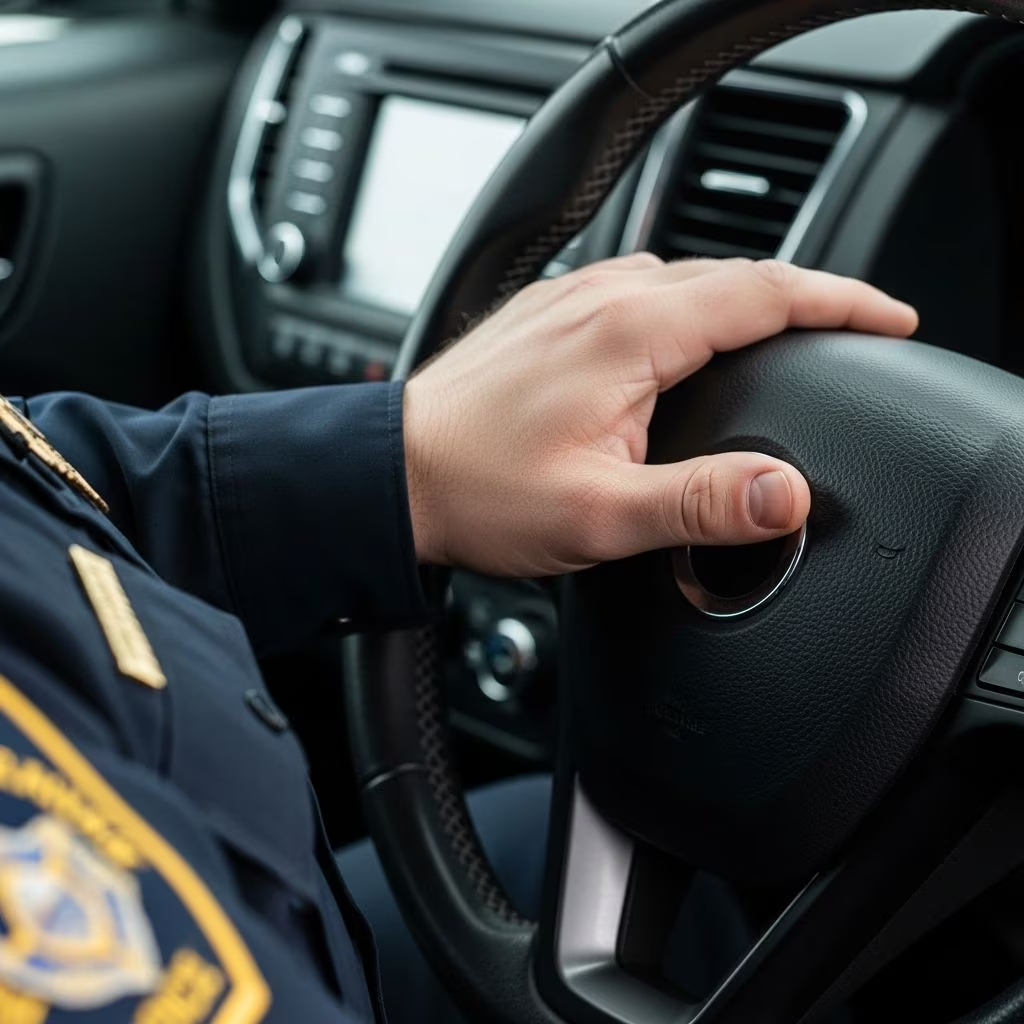
Despite the existence of horn restriction laws, enforcement remains inconsistent and heavily dependent on individual officer judgment. Police discretion—the authority granted to law enforcement officers to make decisions about whether to issue citations, make arrests, or pursue other enforcement actions—plays a crucial role in determining how often drivers face horn-related charges. Two officers in the same jurisdiction might witness identical horn usage and reach completely different conclusions about whether enforcement action is warranted.
This discretionary power reflects a broader principle in policing philosophy: the recognition that legal authority to enforce a rule does not always translate to an obligation or even an advisability to enforce it. Officers must weigh numerous factors when deciding whether to cite someone for improper horn use, including:
- Whether the horn use posed any actual danger to traffic safety
- The context and motivation behind the honking incident
- Current departmental priorities and resource allocation
- The officer’s personal judgment about proportionality
- Community relations implications of the enforcement action
- Whether other factors were present that might justify the behavior
In practical terms, this means that horn-related citations are relatively rare despite the widespread existence of these laws. Most drivers who honk their horns for non-safety purposes never face legal consequences because officers exercise their discretion not to enforce these regulations in situations where no genuine public safety threat exists.
A Landmark Case: The Politics of Horn Honking
The tension between horn restriction laws and individual rights became the subject of significant litigation when 69-year-old Susan Porter was cited for improper horn use in California. In 2017, Porter drove past a demonstration outside her congressman’s office and briefly honked her horn in support of the protest. A deputy sheriff observed this action and immediately stopped Porter, issuing her a citation for illegal horn use. When Porter questioned whether such a law actually existed, the deputy confirmed that California law prohibits horn use except to warn of safety hazards.
Porter’s experience might have ended with a simple traffic citation, but she was concerned about potential future enforcement if she continued to express political viewpoints through horn honking. Consequently, she worked with her legal team to challenge the citation on constitutional grounds, arguing that using a horn to express political opinion constitutes protected speech under the First Amendment. Her case raised important questions about how traditional traffic regulations interact with constitutional protections for free expression.
The initial citation was dismissed when the citing deputy failed to appear for the scheduled court hearing. However, Porter proceeded with her constitutional challenge, eventually filing a lawsuit against both the California Highway Patrol and the San Diego County Sheriff’s Department. This case escalated through the federal court system, gaining attention from legal scholars and civil liberties organizations interested in the intersection of traffic law and constitutional rights.
Federal Court Proceedings and Constitutional Analysis
When Porter’s case reached federal court, judges had to grapple with complex constitutional questions. The First Amendment does provide broad protection for free speech and political expression, but this protection is not absolute. Courts recognize that certain categories of speech receive no constitutional protection, including threats, extortion, harassment, and slander. Additionally, even protected speech can be subject to reasonable time, place, and manner restrictions if those restrictions serve important governmental interests and are narrowly tailored.
The central question in Porter’s case became whether California’s horn restriction law constitutes a permissible time, place, and manner restriction on political speech. The state argued that limiting horn use protects public safety and reduces noise pollution—legitimate governmental objectives. The state further contended that Porter had alternative methods of expressing her political viewpoint, such as signs, verbal communication, or participation in organized demonstrations.
Notably, a dissenting judge in the appellate proceedings highlighted the absence of evidence that political horn honking actually jeopardizes traffic safety or violates noise control standards. This judge questioned whether the state’s asserted governmental interests were sufficiently served by restricting horn honking in the specific context of political expression by a single driver at low volume.
Current Legal Status and Supreme Court Consideration
As of recent developments, Porter’s case has progressed to the United States Supreme Court’s docket. The nation’s highest court has not yet decided whether to hear the case, leaving the question of horn honking and political expression in constitutional limbo. Lower courts have previously ruled that restrictions on horn honking are permissible in the interest of public safety, suggesting that the constitutional right to political expression may be subordinate to traffic safety concerns. However, the Supreme Court’s potential acceptance of the case indicates that significant legal questions remain unresolved.
The outcome of this case could have far-reaching implications for how horn restriction laws are applied nationwide. A Supreme Court decision protecting horn honking as political speech might substantially limit police enforcement authority, while a decision upholding restrictions would provide strong legal justification for citations. The uncertainty surrounding this case demonstrates that horn law enforcement remains an evolving legal area with important constitutional dimensions.
Practical Implications for Drivers and Officers
For drivers, the primary practical implication is clear: using your horn for purposes other than safety warnings creates legal risk, even if enforcement is unlikely. While most horn honking goes unpunished, officers technically have authority to issue citations in most states. If you receive a citation for horn use, you will likely need legal assistance to defend yourself effectively. Many traffic and criminal defense attorneys offer free initial consultations to evaluate your situation and explain your options.
For law enforcement officers, the horn honking issue presents a case study in responsible discretion. An officer with 20 years of experience might approach horn violations differently than a newer officer unfamiliar with departmental practices. The decision to cite someone for horn use should reflect careful consideration of whether genuine public safety concerns exist or whether the enforcement action might be disproportionate to the actual violation. Officers who issue citations in situations where no safety hazard is evident may face scrutiny or legal challenges, particularly if the honking occurred in a political expression context.
Preparing Your Defense if Cited
Should you receive a traffic citation for improper horn use, several defensive strategies might be available depending on your specific circumstances. First, gather all relevant evidence about what actually occurred, including the exact time, location, and context of the incident. If witnesses were present, attempt to obtain their contact information and statements. Document your understanding of the events while memories are fresh.
Next, research the specific statute cited in your ticket. Review the exact language of the law to determine whether your actions actually violated it. Some statutes include explicit exceptions or require proof of specific intent. Understanding the legal standard is essential for evaluating your case’s strength.
Consult with a traffic attorney in your jurisdiction immediately. An attorney experienced in local courts will understand how judges typically handle horn-related cases and may identify procedural or substantive defenses applicable to your situation. Your attorney can review whether the officer had legitimate grounds to stop you and whether the citation was properly issued.
When You Should Contact a Legal Professional
Several circumstances warrant immediate consultation with a traffic or criminal defense attorney if you have been cited for horn use. If the citation occurred during political expression or protest activity, constitutional issues may be involved that require specialized expertise. If the citation resulted from a situation where you were attempting to warn of a genuine safety hazard, evidence supporting your defensive claim should be preserved and presented professionally.
Additionally, if you have prior traffic violations or if this citation could impact your driving record significantly, legal representation becomes more important. Some jurisdictions allow prosecutors to dismiss citations if the driver completes traffic safety courses or other educational programs, and an attorney can often negotiate such arrangements on your behalf.
Frequently Asked Questions
Q: Is it actually illegal to honk at a police officer?
A: Honking your horn at a police officer is not inherently illegal. However, if the honking violates your state’s horn restriction statute—such as using the horn for purposes other than safety warnings—you could receive a citation. The fact that the recipient is a police officer does not change the legal analysis of whether the horn use violated traffic law.
Q: How often are drivers actually cited for horn violations?
A: Horn citations are relatively uncommon despite existing in 41 states. Most police officers exercise discretion not to enforce these laws in situations lacking genuine public safety concerns. The rarity of enforcement reflects officers’ understanding that such citations are often disproportionate to minor violations.
Q: Can I use my horn to express political opinions?
A: This question remains partly unresolved legally. While the First Amendment protects political expression, courts have indicated that horn restriction laws may constitute permissible limitations on where and how such expression occurs. Susan Porter’s case to the Supreme Court may ultimately clarify this question.
Q: What should I do if I receive a horn violation ticket?
A: Contact a traffic or criminal defense attorney in your jurisdiction. Many provide free consultations. Your attorney can evaluate the specific circumstances, review the applicable statute, and determine what defensive strategies might be available. Depending on your situation, the ticket might be dismissed, reduced, or subject to alternative resolution.
Q: Does every state have horn restriction laws?
A: No. While 41 states have horn restriction statutes, some states may lack comprehensive horn use regulations. Additionally, even within states with such laws, specific provisions and exceptions vary. Check your state and local traffic codes for precise requirements.
References
- Justia Ask A Lawyer – Question About Horn Honking at Police Officers — Justia. 2017-05-05. https://answers.justia.com/question/2017/05/05/my-question-is-is-it-illegal-to-honk-at-268534
- Ticket for Horn Honking on Supreme Court Docket Reveals the Far Reach of Police Discretion — Police1. https://www.police1.com/patrol-issues/ticket-for-horn-honking-on-supreme-court-docket-reveals-the-far-reach-of-police-discretion