
Right-To-Work Laws: 28 States And What They Mean For Employers
Explore how right-to-work laws impact unions, employees, and businesses across U.S. states.
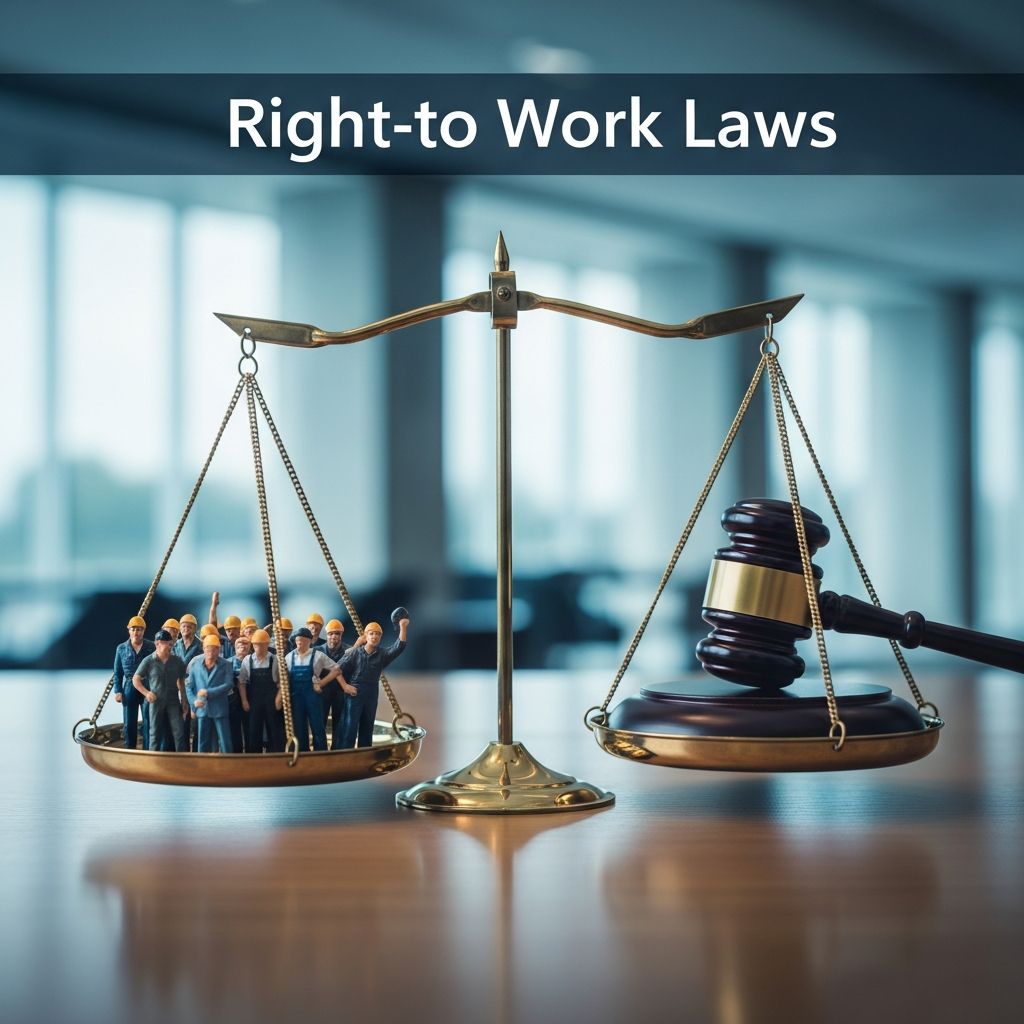
Right-to-work laws represent a cornerstone of U.S. labor policy, empowering individual workers to decide on union participation without fear of job loss. These statutes, enacted at the state level, prohibit employers and unions from mandating membership or dues as a condition of employment. As of 2026, they shape workplace dynamics in nearly half the nation, influencing hiring, negotiations, and employee relations.
The Core Concept Behind Right-to-Work Legislation
At its heart, a right-to-work law ensures no employee can be forced to join a labor union or pay its fees to secure or maintain employment. This principle stems from Section 14(b) of the Taft-Hartley Act of 1947, which grants states authority to ban union security agreements like union shops or agency shops. Unlike federal law that already outlaws closed shops—where union membership is required pre-hire—these state measures extend protections against any compulsory financial support for unions.
Proponents argue this upholds personal freedom, allowing workers to benefit from union contracts without contributing. Critics contend it enables ‘free riders,’ who enjoy negotiated benefits like higher wages or better conditions without sharing costs, potentially weakening unions. Businesses often favor these laws for flexibility in multi-state operations, as they simplify compliance and attract non-union labor pools.
Historical Evolution of Right-to-Work Policies
The journey began with the National Labor Relations Act of 1935 (Wagner Act), which bolstered union organizing. Congress reversed course in 1947 via Taft-Hartley, amending the law to permit state-level opt-outs from union security pacts. Early adopters like Arizona and Florida passed measures in the late 1940s, often in the South and West where anti-union sentiments ran strong.
Public-sector labor saw a seismic shift in 2018 with Janus v. AFSCME, a Supreme Court decision ruling agency fees unconstitutional for government workers nationwide. This effectively extended right-to-work protections to all public employees, regardless of state law. Recent years have seen expansions—Missouri voters approved repeal in 2018 but faced legislative overrides, while others like New Hampshire joined in 2017.
Current Landscape: States with Right-to-Work Status
Twenty-eight states currently enforce right-to-work laws, covering about 58% of the U.S. workforce. These apply mainly to private-sector jobs, with public-sector rules uniform post-Janus.
| Region | Right-to-Work States (Examples) | Non-Right-to-Work States (Examples) |
|---|---|---|
| South | Texas, Florida, Georgia, Alabama | – |
| Midwest | Indiana, Michigan, Wisconsin | Illinois, Minnesota |
| West | Arizona, Nevada, Idaho | California, Oregon |
| Northeast | New Hampshire, Virginia (recent) | New York, Massachusetts |
This patchwork demands vigilance for interstate businesses. Local ordinances exist in some areas, like Kentucky municipalities, upheld by federal courts.
Key Distinctions: Types of Union Security Arrangements
- Closed Shop: Banned federally; requires union membership before hiring.
- Union Shop: Employees must join post-hire; prohibited in right-to-work states.
- Agency Shop/Maintenance of Membership: Non-members pay fees for representation; also banned where right-to-work applies.
- Open Shop: Default in right-to-work states—union optional, no dues compulsion.
Even non-members in unionized right-to-work workplaces receive contract protections, creating the free-rider dynamic.
Implications for Employers Operating Nationwide
Multi-state companies must navigate varying rules. In non-right-to-work states, unions might negotiate dues checkoffs; elsewhere, employees opt in voluntarily. The National Labor Relations Board (NLRB) oversees private-sector rights, prohibiting coercion by either side. At-will employment persists universally—right-to-work doesn’t alter firing or quitting freedoms, only union ties.
Businesses report easier recruitment in these states, citing lower labor costs and flexibility. A 2023 study noted higher manufacturing growth in right-to-work regions, though causation debates persist. Compliance tip: Post notices clarifying rights and train HR on state-specific postings.
Worker Perspectives: Benefits and Drawbacks
For employees, these laws offer choice—join for voice or abstain without penalty. Public workers gained fee exemptions via Janus, potentially saving hundreds annually. However, unions argue weakened funding hampers bargaining power, leading to stagnant wages. Data shows union density 10% lower in right-to-work states, correlating with 3-5% wage gaps.
- Pros for Workers: Financial autonomy, no forced affiliation.
- Cons: Possible reduced union strength, affecting all via weaker contracts.
Younger workers, per surveys, lean toward opt-out flexibility amid declining union support.
Unions’ Role in Right-to-Work Environments
Unions thrive or struggle based on voluntary buy-in. They retain organizing rights and bargaining power but can’t compel support. Strategies include member perks like legal aid or discounts to boost dues payers. NLRB protects against employer interference, ensuring fair elections. Post-Janus, public unions pivoted to opt-in models, stabilizing in some areas.
Legal Framework and Federal Oversight
The NLRB enforces the National Labor Relations Act, safeguarding organizing rights sans coercion. States can’t ban unions outright—right-to-work targets security clauses only. Recent NLRB shifts under varying administrations tweak enforcement, like joint-employer rules impacting franchisors.
Business Strategies in Right-to-Work Jurisdictions
Firms leverage these laws for lean operations: no union dues drag on payroll, fostering direct employee relations. Relocations to states like Tennessee highlight economic incentives. Yet, strong unions persist via culture—auto plants in the South unionized successfully in 2024.
Best Practices:
- Review state labor departments for updates.
- Implement voluntary recognition policies.
- Monitor NLRB for unfair practice risks.
Debates and Future Prospects
Supporters hail freedom; opponents decry power imbalances. Federal bills to ban state laws fizzle, maintaining status quo. With workforce mobility rising, hybrid models may emerge.
Frequently Asked Questions (FAQs)
Does right-to-work prevent union formation?
No, unions can form and negotiate freely; only mandatory membership/dues are barred.
Are public employees covered everywhere?
Yes, post-2018 Janus ruling, no agency fees for government workers nationwide.
Can cities enact their own laws?
Limited; some Kentucky locals can, but states generally control.
Do these laws affect wages?
Studies show mixed results: lower union density often links to modestly reduced pay.
How many states have them?
28 as of 2026, spanning South, Midwest, West.
References
- Right to Work State | Protecting the Right to Organize Act — PBMares. 2023-05-15. https://www.pbmares.com/insights-what-is-a-right-to-work-state/
- Right to Work Frequently-Asked Questions (FAQ) — National Right to Work Legal Defense Foundation. 2024-01-10. https://www.nrtw.org/right-to-work-frequently-asked-questions/
- Right-to-work law — Wikipedia (citing primary sources). 2026-03-20. https://en.wikipedia.org/wiki/Right-to-work_law
- Employer/Union Rights and Obligations — National Labor Relations Board (NLRB). 2025-11-12. https://www.nlrb.gov/about-nlrb/rights-we-protect/your-rights/employer-union-rights-and-obligations
- Learn About Right-to-Work Laws — American Association of Community Colleges (AACC). 2019-09-30. https://www.aacc.nche.edu/wp-content/uploads/2021/03/Learn_About_Right_to_work.pdf
- How So-Called “Right to Work” Laws Aim to Silence Working People — Demos. 2022-07-18. https://www.demos.org/research/how-so-called-right-work-laws-aim-silence-working-people
- Right to Work — AFL-CIO. 2024-06-05. https://aflcio.org/issues/right-work
Similar Articles








Read full bio of medha deb




