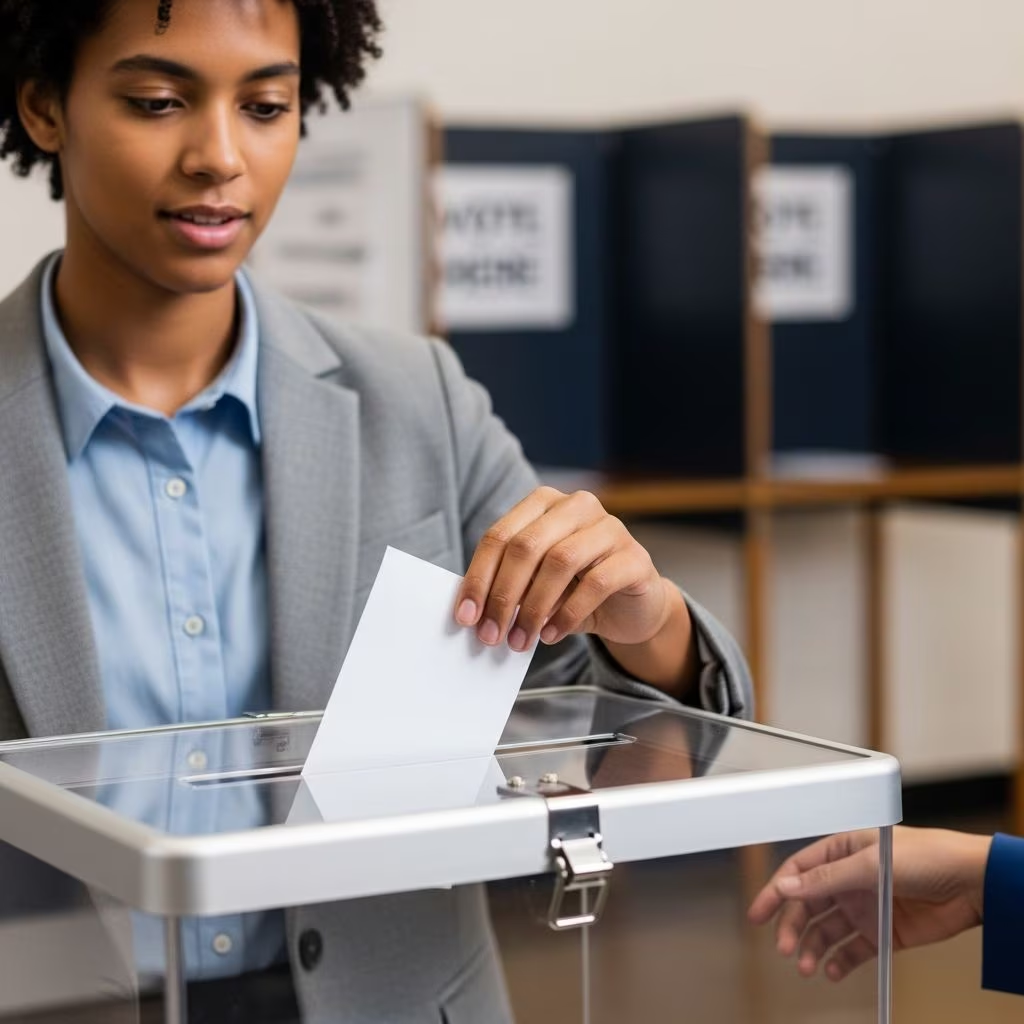
Reaching the age of 18 on Election Day raises a common question for many young Americans: does your birthday align perfectly with voting eligibility? The answer hinges on state-specific laws, which generally require voters to be 18 by Election Day but offer nuances like pre-registration and limited primary participation for 17-year-olds. This comprehensive guide explores these rules, helping you navigate eligibility, registration processes, and exceptions to ensure your civic voice is heard.
Understanding Federal and State Voting Age Requirements
The U.S. Constitution sets the national voting age at 18 through the 26th Amendment, ratified in 1971, but leaves implementation details to the states. Most states mandate that you must be 18 years old on or before Election Day to cast a ballot in general elections. However, interpretations vary: some allow voting if you turn 18 at any point on Election Day, while others require you to have reached 18 prior to polls closing.
For instance, in states like Alabama and Arizona, pre-registration is permitted if you will be 18 on or before Election Day, signaling that turning 18 that day qualifies you. This distinction is crucial—check your state’s election office for precise language, as “on or before” often includes the full Election Day.
Pre-Registration: Getting Ahead Before 18
Nearly every state now offers pre-registration for minors, allowing teens as young as 15 or 16 to declare their intent to vote. This system streamlines the process, updating your status automatically on your 18th birthday. Vote.gov emphasizes that pre-registration is available in most states, D.C., and territories, but you cannot vote until 18.
Pre-registration benefits include:
- Automatic activation on your birthday, avoiding last-minute hurdles.
- Habit-building for civic engagement among youth.
- State-specific age minimums, like 15 in Colorado or 16 in California.
A detailed state breakdown reveals wide variation:
| State | Pre-Registration Age | Notes |
|---|---|---|
| California | 16 or 17 | Full access for conditional registration. |
| Colorado | 15+ | One of the lowest age thresholds. |
| Michigan | 16; full at 17.5 | Progressive youth policies. |
| Texas | 17 years 10 months | Must turn 18 by Election Day. |
| Washington | 16 or 17 | Same-day registration possible later. |
These options empower younger students to engage early. Rock the Vote tracks that over 40 states have such programs, boosting turnout among first-time voters.
Special Rules for Primary Elections and 17-Year-Olds
Some states permit 17-year-olds to vote in primaries if they will turn 18 by the general election. Maryland exemplifies this: 17-year-olds affiliated with major parties (Democratic or Republican) can participate in primaries for partisan races and school board contests, but not special or municipal elections.
A court ruling in Maryland clarified this in 2008, allowing provisional ballots for eligible teens, with votes counted only for permitted contests. This table from Maryland’s elections board illustrates:
| Scenario | Party Affiliation | Allowed Contests |
|---|---|---|
| 17, turns 18 by General | Dem/Rep | Partisan + School Board (provisional ballot) |
| 17, turns 18 by General | Other/None | School Board only (provisional) |
| 17, turns 18 after General | Any | None |
Similar provisions exist elsewhere, like Virginia for 17-year-olds in general election-bound primaries. Always verify with your state board, as rules evolved from attorney general opinions and court decisions.
How to Register If You’re Turning 18 on Election Day
Deadlines vary—no national standard exists, with some states requiring 30 days advance registration. Methods include online portals, mail, DMV visits, or Election Day in same-day registration states. For Maryland residents, you can register at 16 but vote at 18 for the next qualifying election.
Steps to register:
- Confirm eligibility: U.S. citizen, state resident, 18 by Election Day, not disqualified (e.g., certain felonies).
- Gather ID: Driver’s license, state ID, or last four SSN digits in many states.
- Choose method: Online via Vote.gov or state site; in-person at DMV.
- Declare party if required for primaries.
- Track confirmation and updates.
Montgomery County, MD, notes no mental guardianship disqualifies unless court-specified. Pre-registering ensures seamless transition if your birthday is Election Day.
State-by-State Guide: Key Examples
Laws differ significantly. Here’s a snapshot:
- Alabama: Pre-register if 18 by Election Day—yes for general.
- Alaska: Within 90 days of 18th birthday.
- Connecticut: 17 if 18 by next election.
- Mississippi: 18 by next general.
- Missouri: 17.5 if 18 by Election Day.
- Maryland: Register at 16; primary voting for 17-year-olds under conditions.
For full lists, consult NCSL’s preregistration summary, which details 42 states plus D.C. If your state lacks pre-reg, wait until 18 but monitor deadlines.
Common Challenges and How to Overcome Them
Young voters face hurdles like ID confusion or address changes (e.g., college moves). Solutions:
- Use student ID with proof of residency.
- Update registration promptly via state portals.
- Vote provisionally if eligibility is questioned—counts if verified.
- Seek help from VoteRiders for ID issues.
Felony disenfranchisement varies; most states restore rights post-sentence. Always check official sources to avoid myths.
Frequently Asked Questions (FAQs)
Can I vote if I turn 18 at midnight on Election Day?
Depends on the state—many say yes if “on or before” includes Election Day; confirm with your election office.
What’s the youngest age for pre-registration?
As low as 15 in Colorado; most start at 16 or 17.
Can 17-year-olds vote in primaries everywhere?
No, only select states like Maryland (with conditions) or Virginia.
Do I need ID to register?
Often driver’s license number or state ID; alternatives exist.
What if I’m moving for college?
Register where you reside; some states allow absentee from home.
Empowering the Next Generation of Voters
Turning 18 on Election Day shouldn’t silence your voice. By pre-registering early and understanding local rules, you position yourself to participate fully. Resources like Vote.gov and state election sites provide real-time updates. Encourage peers to join—youth turnout shapes policy on education, climate, and more. Register today and step into democracy.
References
- Preparing to vote: age 18 and under — Vote.gov. Accessed 2026. https://vote.gov/guide-to-voting/preparing-age-18-and-under
- Nationwide Voter Pre-Registration for Under 18 — Rock the Vote. Accessed 2026. https://www.rockthevote.org/how-to-vote/nationwide-voting-info/voter-pre-registration/
- Voting Rights — Maryland People’s Law Library. Accessed 2026. https://www.peoples-law.org/voting-rights
- Voting Rights for 17 Year Olds — Maryland State Board of Elections. 2008-02-08. https://www.elections.maryland.gov/voter_registration/17_year_olds.html
- Voter Registration FAQs — Montgomery County MD Elections. Accessed 2026. https://www.montgomerycountymd.gov/Elections/FrequentlyAskedQuestions/voter-registration-faqs.html
- Maryland Voter Information — VoteRiders. Accessed 2026. https://voteriders.org/states/maryland/
- Voter Registration Introduction — Maryland State Board of Elections. Accessed 2026. https://elections.maryland.gov/voter_registration/index.html