
Traffic Stops, Filming Police, and the First Amendment
Understanding when and how you can legally record traffic stops and police encounters under the First Amendment.
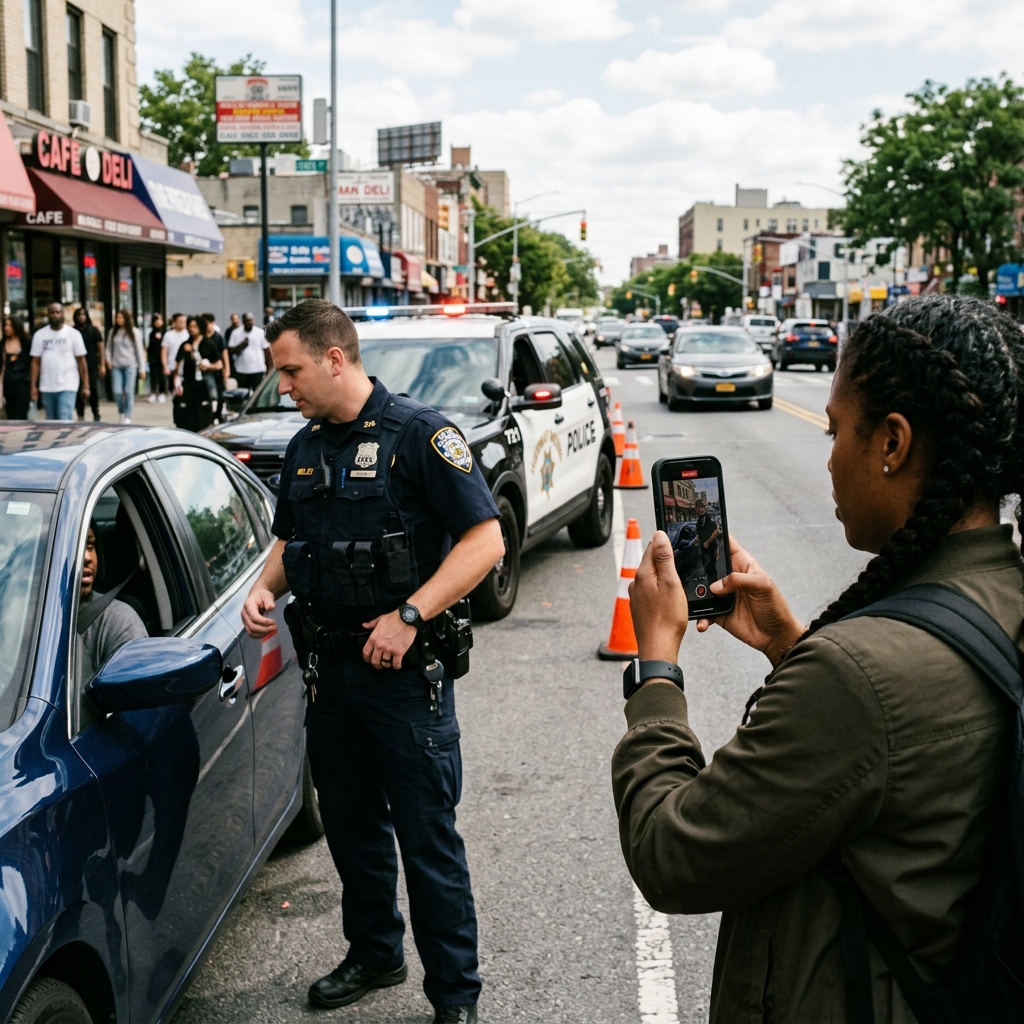
Smartphones have turned nearly everyone into a potential documentarian of public life. Few situations test this technological reality more sharply than a police traffic stop. When officers pull over a car, can drivers or passengers legally record what happens? What about bystanders on the sidewalk? And how far does the First Amendment go in protecting those recordings?
This article explains the modern law of filming and livestreaming traffic stops and other police encounters, with an emphasis on the First Amendment, limits on the right to record, and practical guidance for people who want to document interactions with law enforcement responsibly.
1. Why Traffic Stops Raise First Amendment Questions
Traffic stops sit at the intersection of several legal interests:
- Free speech and press rights when people gather and share information about public officials.
- Police authority to manage potentially dangerous roadside encounters and protect officer and public safety.
- Privacy concerns for drivers, passengers, and bystanders whose faces or conversations might be captured on video.
Courts have increasingly recognized that recording police in public is part of the broader process of gathering and disseminating information about government — activity that lies at the core of the First Amendment. That recognition applies directly to traffic stops, which are both common and potentially high-stakes encounters between citizens and the state.
2. The Core First Amendment Right to Record Police
The starting point is now relatively clear at the federal appellate level: individuals generally have a First Amendment right to record government officials, including police officers, performing their duties in public spaces, subject to reasonable time, place, and manner restrictions.
Key principles that emerge from appellate decisions and legal scholarship include:
- Recording is speech-related activity: Courts have held that making audio or video recordings is part of the protected speech process because it enables later dissemination of information.
- Press and public have the same right: The right does not belong exclusively to journalists; ordinary citizens are equally protected when they document public officials.
- Public places are critical: The strongest protection applies when officers act in locations where the public is lawfully present — streets, sidewalks, and other traditional public fora.
As one federal appellate court summarized, the First Amendment right of access to information includes a corresponding right to record police carrying out official duties in public areas. This framework has shaped how courts treat recording during traffic stops, both by bystanders and by the people in the vehicle.
3. Recording Your Own Traffic Stop vs. Recording as a Bystander
| Scenario | Typical First Amendment Protection | Common Limitations |
|---|---|---|
| Driver or passenger recording their own stop | Generally protected if recording does not interfere with lawful police duties or safety. | Officers may direct occupants to keep hands visible, remain seated, or stop movements that they reasonably see as safety risks. |
| Bystander recording from a public place | Generally protected if the person is lawfully present and not obstructing officers. | Reasonable distance requirements and restrictions on entering crime scenes or restricted areas may apply. |
| Livestreaming a traffic stop | Some courts have held that livestreaming is an extension of the right to record and disseminate information. | Governments sometimes argue heightened safety or anti-doxxing concerns; courts evaluate these under First Amendment standards. |
4. How Courts Have Framed Livestreaming and Real-Time Sharing
As technology has shifted from static recording to real-time broadcasting, courts have started to address whether livestreaming enjoys the same protection as recording for later publication. At least one federal appellate court has stated that individuals have a First Amendment right to livestream their own traffic stops, recognizing that creating and disseminating information are both protected speech activities.
This reasoning treats livestreaming as simply another method of distribution: whether a recording is posted after the fact or shared in real time, the underlying act of capturing public officials at work remains part of the speech process. However, the analysis does not automatically resolve all disputes. Law enforcement agencies sometimes argue that real-time broadcasting can:
- Reveal officers’ locations in a way that endangers them or others.
- Invite interference from third parties who are watching the stream.
- Expose sensitive tactical information during active operations.
Courts weighing these arguments examine whether specific restrictions on livestreaming are narrowly tailored to genuine safety interests and whether less speech-restrictive alternatives would suffice. The basic trend, though, is to treat livestreaming as part of protected First Amendment activity, at least in the context of routine traffic stops and similar public encounters.
5. Time, Place, and Manner Limits on Recording
Even when recording is protected, the government may impose content-neutral time, place, and manner restrictions if they satisfy constitutional standards. For police encounters, these restrictions typically focus on safety and operational needs.
Common limits include:
- Distance requirements: Requiring bystanders to stand a reasonable distance away so officers can safely conduct the stop, manage traffic, and maintain situational awareness.
- No physical obstruction: Prohibiting individuals from blocking patrol cars, roadways, or officers’ movements while recording.
- Compliance with lawful orders: If officers issue specific, lawful commands for safety reasons (e.g., asking a passenger to keep hands visible rather than manipulating a phone), refusal may affect how courts view the encounter.
- Restricted zones: Entering crime scenes, secure perimeters, or clearly marked restricted areas is generally not protected, regardless of whether someone is recording.
Importantly, officers cannot single out recording because they dislike being filmed or wish to avoid public scrutiny. Restrictions must be tied to legitimate, content-neutral concerns, not a desire to suppress criticism or documentation.
6. What Police May and May Not Do About Your Recording
Knowing your rights is only useful if you also understand what officers are legally prohibited from doing in response to your recording. According to major civil liberties organizations and legal scholarship, in most public-encounter situations officers:
- May not confiscate your phone or camera without a warrant or a valid, recognized exception to the warrant requirement.
- May not require you to delete photos or video, or delete them themselves, even if they believe recording was improper.
- May not arrest or detain you solely because you recorded them in a place where you are lawfully present and you did not interfere with their duties.
At the same time, officers may investigate or take action if there is an independent legal basis — for example, trespass, failure to obey lawful safety orders, or obstruction of justice. Where disputes arise, courts often examine whether the asserted justification was genuine or a pretext to punish recording.
7. Practical Tips for Recording a Traffic Stop Safely
Legal rights exist alongside practical realities. Even if the law is on your side, it is wise to record in a way that minimizes escalation and preserves your safety.
7.1 If You Are the Driver or Passenger
- Keep your hands visible and avoid sudden movements; use a mounted phone or start recording before the officer approaches if possible.
- Calmly state that you are recording “for everyone’s safety” rather than making it sound like a confrontation.
- Comply with lawful commands about where to place your hands, whether to exit the vehicle, or how to position yourself, even while continuing to record if you can safely do so.
- If ordered to stop recording and you choose to comply, do so without deleting existing footage; note the officer’s name, badge number, and the time of the command as soon as you safely can.
7.2 If You Are a Bystander
- Remain on public property — sidewalks, public rights-of-way, or other places where you are lawfully allowed to be.
- Maintain a respectful distance and avoid blocking vehicles, officers, or individuals involved in the stop.
- Do not physically interfere, argue with officers engaged in the stop, or attempt to direct their actions.
- If officers tell you to move, calmly ask if you may record from a different location and comply with any reasonable distance instructions.
8. Qualified Immunity and Civil Lawsuits Over Recording
People whose recording rights are violated often pursue civil rights lawsuits under federal law. A recurring legal hurdle is qualified immunity, a doctrine that shields government officials from personal liability unless they violated “clearly established” law.
In the recording context, some courts have held that while a First Amendment right to record clearly exists, the specific circumstances of a case — such as livestreaming, or particular limitations imposed during a traffic stop — were not clearly established at the time, preventing damages against individual officers. This does not mean the conduct was constitutional; it means the law was not sufficiently settled for personal liability.
Nevertheless, lawsuits can still lead to:
- Injunctive relief, such as court orders requiring departments to change policies.
- Municipal liability if plaintiffs show that unconstitutional practices stemmed from an official policy or custom.
These cases, and the policy changes they trigger, contribute to the evolving legal landscape around recording traffic stops.
9. Balancing Officer Safety, Privacy, and Public Accountability
The debate over recording traffic stops is not simply theoretical. It reflects real tensions in modern policing:
- Officer safety: Law enforcement agencies argue that people recording too closely, especially at night or in chaotic scenes, can compromise officers’ ability to manage unfolding threats.
- Privacy: Drivers and passengers may not want their interactions broadcast, especially when sensitive personal information or upsetting events are involved.
- Accountability and transparency: Civil liberties advocates stress that recording is often the only effective way to document misconduct or resolve disputed accounts of what occurred.
Courts and policymakers attempt to reconcile these interests by protecting recording as a default rule, while allowing limited, carefully tailored restrictions for safety and operational reasons. Many departments also adopt internal policies acknowledging citizens’ rights to record and instructing officers on how to respond professionally and lawfully.
10. FAQs on Recording Traffic Stops and Police Encounters
Can I record a police officer who pulled me over?
In most circumstances, yes. If you are lawfully stopped and your recording does not interfere with the officer’s duties or safety, courts and civil liberties organizations recognize a First Amendment right to document the encounter.
Do I have to tell the officer I am recording?
Generally, no. In public spaces, open visual recording typically does not require consent, and major civil liberties groups state that you do not have to inform officers that you are recording them performing their duties. However, specific state wiretapping or eavesdropping laws may affect secret audio recordings, especially in non-public settings.
Can a police officer make me stop recording?
Officers may issue lawful orders tied to safety or operational concerns, such as asking you to move back or keep your hands visible, and you should comply with those. But they generally cannot order you to stop recording purely because they dislike being filmed or because the recording might be critical of them.
Can police take my phone or make me delete a video?
Absent a valid warrant or recognized legal exception, officers cannot seize your device or force you to delete footage. Deleting your recordings can itself raise separate constitutional concerns, including potential violations of your First and Fourth Amendment rights.
What should I do if I think my rights were violated during a traffic stop?
Once you are safe, write down as many details as possible: the date and time, location, officers’ names and badge numbers, vehicle numbers, and contact information for any witnesses. Preserve any recordings and consider consulting an attorney or a civil rights organization experienced in police accountability cases.
Is the right to record the police the same in every state?
The general First Amendment principle is widely recognized among federal appellate courts, but details can vary by jurisdiction, and not every circuit has addressed every scenario. State laws on privacy, wiretapping, and obstruction can also affect how the right is applied. Checking local law or consulting legal counsel is prudent if you regularly document police activity.
11. Key Takeaways for Everyday Encounters
- You usually have a First Amendment right to record or livestream police performing their duties in public, including traffic stops, as long as you do not interfere.
- Both drivers and passengers can typically record their own stops, and bystanders may record from areas where they are lawfully present.
- Recording can be subject to reasonable time, place, and manner restrictions, primarily rooted in safety and operational concerns rather than officer discomfort or public relations.
- Police generally cannot confiscate your device or force deletion of recordings without a warrant or valid exception.
- Keeping interactions calm, clear, and non-confrontational can protect both your legal rights and your physical safety.
References
- Fourth Circuit: Individuals Have a First Amendment Right to Livestream Their Own Traffic Stops — Electronic Frontier Foundation. 2023-02-28. https://www.eff.org/deeplinks/2023/02/fourth-circuit-individuals-have-first-amendment-right-livestream-their-own-traffic
- Amicus Brief in Support of Petition for Writ of Certiorari (Question Presented: Right to Observe and Record Law Enforcement) — U.S. Supreme Court Docket 23-227. 2023-10-12. https://www.supremecourt.gov/DocketPDF/23/23-227/284898/20231012161314149_23-227%20Amicus%20Brief%20TRI.PDF
- Recording Police in Public: What You Need to Know — Foundation for Individual Rights and Expression (FIRE). 2023-08-02. https://www.fire.org/research-learn/recording-police-public-what-you-need-know
- Responding to First Amendment Audits: Is Filming Protected by the First Amendment? — University of North Carolina School of Government Canons of Construction Blog. 2022-11-14. https://canons.sog.unc.edu/blog/2022/11/14/responding-to-first-amendment-audits-is-filming-protected-by-the-first-amendment/
- Recording Law Enforcement is a First Amendment Right — American Civil Liberties Union. 2021-07-30. https://www.aclu.org/news/free-speech/recording-law-enforcement-is-a-first-amendment-right
- Citizens’ Right to Record the Police — First Amendment Clinic, University of Georgia School of Law. 2020-09-10. https://firstamendment.law.uga.edu/work/citizens-right-to-record-the-police/
- Citizen Video Audits: Know Their Rights…And Yours — Hall Booth Smith, P.C. 2019-01-15. https://hallboothsmith.com/citizen-video-audits-know-their-rights-and-yours/
Similar Articles








Read full bio of Sneha Tete




