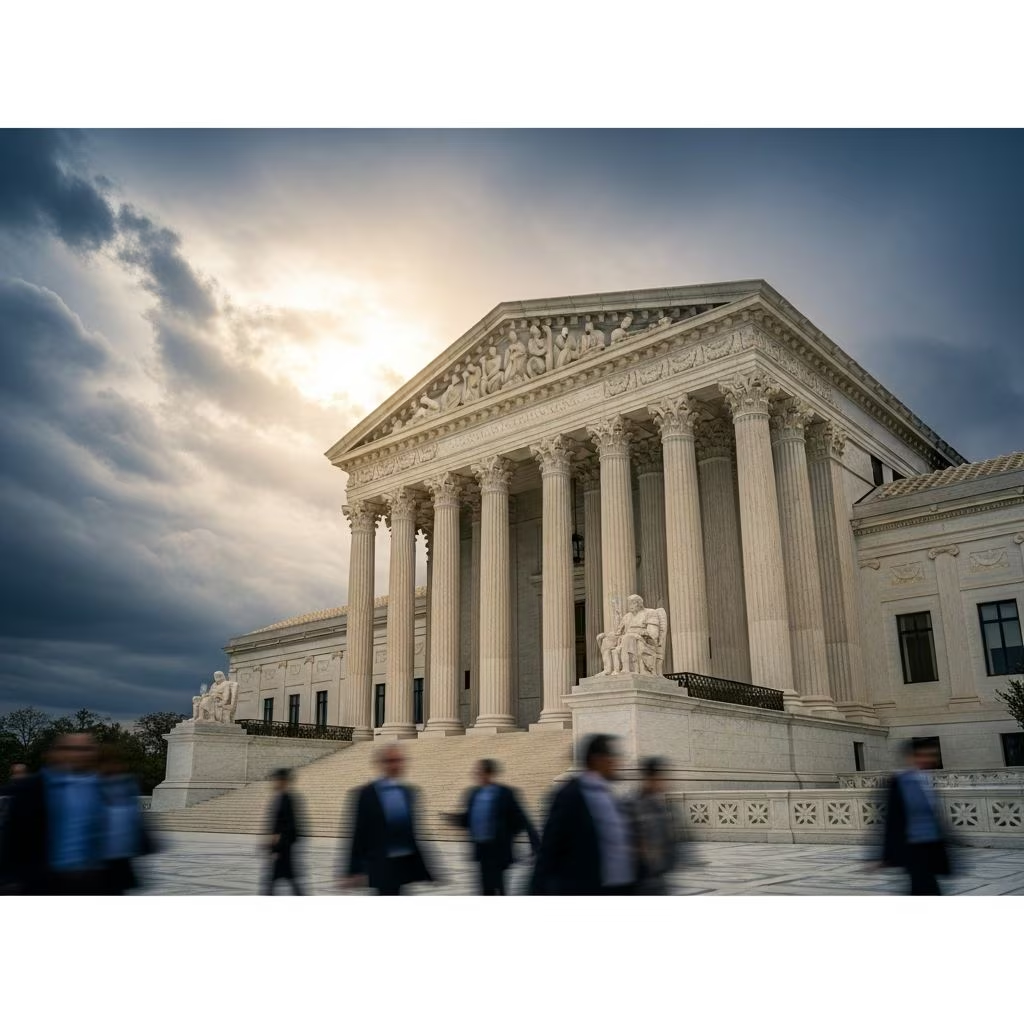
The U.S. Supreme Court stands as the pinnacle of the American legal system, where a select group of attorneys argue cases that define national policy, constitutional rights, and societal norms. Success here demands not just legal acumen but also strategic mastery, deep preparation, and an intuitive grasp of judicial dynamics. Over the years, certain lawyers have risen above the rest, amassing impressive victory tallies that reflect their prowess. This article delves into the leading advocates, their career highlights, affiliated firms, and the factors contributing to their triumphs, drawing from empirical analyses of recent terms.
Historical Giants of Supreme Court Advocacy
Supreme Court history is dotted with legendary figures whose repeated appearances and wins shaped jurisprudence. Early 20th-century advocates like William H.H. Miller and William H. Moody, both serving as Attorneys General, logged dozens of arguments, with Miller reaching up to 36 and Moody 39, according to Oyez records of top advocates. These officials often represented the government in pivotal matters, setting precedents that endure today.
Moving into modern eras, career Department of Justice litigators have dominated. Michael Dreeben, Malcolm Stewart, and Edwin Kneedler consistently garnered the most favorable justice votes, leveraging their intimate knowledge of federal law and Court procedures. Former Solicitor General Donald Verrilli followed closely, benefiting from the prestige and resources of the SG’s office. These government alumni transitioned seamlessly into private practice, where their experience translated into high-stakes wins.
Dominance in Recent Terms: 2013-2017 Standouts
Empirical data from the 2013-2017 terms reveals Paul Clement as the standout, securing the most wins in closely decided five-vote majority cases with four victories. Neal Katyal and Scott Keller each notched three such wins, excelling in razor-thin decisions that often hinge on persuasive oral advocacy. Clement argued the highest number of cases overall, with Katyal and Solicitor General Donald Verrilli trailing closely, underscoring their prolific output.
Firms also shone brightly. Hogan Lovells (Katyal’s firm) and Kirkland & Ellis (Clement’s) led with four wins in tight cases each, followed by Gibson Dunn, the Texas Solicitor General’s office, and WilmerHale. In non-unanimous decisions since 2013, Goodwin Procter’s William Jay topped with three wins, and Clement added two more. Perfection was rare but notable: Jenner & Block’s Adam Unikowsky achieved a flawless 6-0 record across terms, winning in cases like Sveen v. Melin and Puerto Rico v. Sanchez Valle.
Win Percentages and Perfect Records
Raw victory counts matter, but percentages reveal efficiency. Unikowsky’s 86.27% vote share across justices from 2013 onward outpaced peers, surpassing Andrew Pincus (75.76%) and John Bursch (64.29%) by wide margins. William Jay succeeded in 4 of 5 cases, while Pincus, Eric Schnapper, and Stephen McAllister each went 3-1. Firms like Alliance Defending Freedom posted perfect 4-0 records, advocating for religious freedoms in landmark rulings such as Masterpiece Cakeshop, Ltd. v. Colorado Civil Rights Commission.
Top firms by win rate included Goodwin Procter, Jenner & Block, Perkins Coie, and Orrick Herrington, blending boutique expertise with big-law resources. WilmerHale amassed 223 justice votes, powered by Seth Waxman, Mark Fleming, and others, while Hogan Lovells secured the second-most with Katyal leading.
Elite Firms and Their Winning Strategies
A handful of firms control much of Supreme Court litigation, as recent studies confirm. Williams & Connolly was the most active in the 2022 term, appearing seven times and winning three, all argued by Lisa Blatt, chair of their Supreme Court practice. O’Melveny & Myers won two of three, with Michael Dreeben contributing a key victory. Over 2020-2024 terms, Williams & Connolly and Jones Day led big-law wins, with three others rounding out the top five.
| Firm | Recent Activity (2020-2024) | Win Highlights |
|---|---|---|
| Williams & Connolly | Top activity, 7 args in 2022 term | 3 wins by Lisa Blatt |
| Jones Day | Consistent top performer | High win rate post-petition |
| Kirkland & Ellis | Clement-led successes | 4 tight-case wins (2013-17) |
| Hogan Lovells | Katyal’s domain | Second-most justice votes |
| WilmerHale | 223 justice votes | Waxman, Fleming stars |
These firms invest heavily in appellate teams, pairing subject-matter experts with Court specialists for ‘winning combinations,’ as WilmerHale’s Mark Fleming noted.
Subject-Matter Mastery: Category Leaders
Success varies by legal domain. In criminal procedure (covering accused rights excluding prisoner due process), Seth Waxman of WilmerHale achieved 100% across nine cases, including Hall v. Florida (2013). Paul Clement dominated another area with seven wins in eight cases, trailed by Ted Olson. Experience clusters advocates: superstars face superstars, while novices match up similarly, moderating win-rate gaps.
- Criminal Procedure: Waxman 9-0
- General Federal: Clement 7-1
- Closely Decided Cases: Clement 4 wins in 5-4 rulings
Superstar Attorneys and Diversity Insights
Paul Clement, with over 60 private-sector arguments atop his Solicitor General tenure, exemplifies the superstar. Lisa Blatt boasts an 88.9% win rate among elites—the highest tracked—sparking questions on gender dynamics, as she’s the sole woman on many lists. Professors Mitu Gulati, Tracey E. George, and Albert H. Yoon analyzed 50+ years of data, finding experienced lawyers win more, though not exponentially so, and matchups influence outcomes.
Other notables include Kannon Shanmugam (big-law), Tom Goldstein (boutique), and Jeffrey Fisher (Stanford clinic), blending public and private paths. Their influence extends beyond wins, steering policy through argument selection and framing.
Patterns of Success: What Sets Winners Apart
Empirical patterns emerge: government experience (e.g., ex-SGs Clement, Katyal, Waxman) yields top vote shares. Prolific arguers like Clement and Katyal sustain volume via firm support. Voter share metrics, matching attorney positions to justice votes, highlight persuaders like Unikowsky. Firms thrive on alliances and specialization, controlling petitioner advantages.
Yet challenges persist: superstars’ win rates fluctuate widely due to opponent quality and case complexity. Rising stars like Blatt prove diversity can fuel dominance, potentially increasing calls post-studies.
Frequently Asked Questions
Who has the most Supreme Court arguments historically?
Figures like William H. Moody (39) and William H.H. Miller (36) lead early lists, per Oyez. Modern leaders include Paul Clement with 60+ private arguments.
What firm wins most at SCOTUS recently?
Williams & Connolly topped 2022 activity with 3 wins; over 2020-2024, it and Jones Day lead.
Is government experience key to success?
Yes—ex-DOJ litigators like Dreeben and SGs like Verrilli top vote shares.
Who has the highest win percentage?
Adam Unikowsky at 86.27%; Lisa Blatt at 88.9% among elites.
Do firms or individuals drive wins?
Both: individuals like Blatt shine, but firms like WilmerHale (223 votes) provide infrastructure.
These FAQs address common curiosities, optimized for searcher intent on SCOTUS advocates.
Future Trends in Supreme Court Practice
As terms evolve, expect elite concentration to persist, with big-law and ex-government lawyers dominating. Diversity may grow, following Blatt’s trail. Data-driven strategies, tracking justice votes and matchup dynamics, will refine approaches. Aspiring advocates must build records through clinics, state AG offices, or firm apprenticeships, mirroring paths of Unikowsky and Keller.
Ultimately, Supreme Court wins blend art and science: rigorous briefing, oral agility, and anticipating the nine justices’ ideologies. The top tier’s records not only affirm their skill but also influence which cases reach the docket, perpetuating their cycle of success.
References
- Empirical SCOTUS: Supreme Court all-stars 2013-2017 (Corrected) — SCOTUSblog. 2018-09. https://www.scotusblog.com/2018/09/empirical-scotus-supreme-court-all-stars-2013-2017/
- Advocates that Drive the Justices’ Votes — Empirical SCOTUS. 2019-04-22. https://empiricalscotus.com/2019/04/22/advocates-drive/
- Professors’ Paper Explains How a Handful of Elite Lawyers Dominates Supreme Court Litigation — University of Virginia School of Law. 2025-02. https://www.law.virginia.edu/news/202502/professors-paper-explains-how-handful-elite-lawyers-dominates-supreme-court-litigation
- The Firms That Won Big At The Supreme Court — MoloLamken LLP. 2023-07. https://www.mololamken.com/assets/htmldocuments/Law%20360_The%20Firms%20That%20Won%20Big%20At%20The%20Supreme%20Court_July%202023.pdf
- Who Wins at the Supreme Court? Exploring the Patterns of Victory — Legalytics Substack. N/A. https://legalytics.substack.com/p/who-wins-at-the-supreme-court-exploring
- The Supreme Court’s Inner Circle: Top Firms Over the Past Five Terms — Legalytics Substack. N/A. https://legalytics.substack.com/p/the-supreme-courts-inner-circle-top
- Top Supreme Court Advocates — Oyez.org. N/A. https://www.oyez.org/top-advocates