
The Constitutional Crisis of Texas SB 4 Law
Analyzing the legal and human rights implications of Texas's SB 4 law.
Introduction to the State-Federal Immigration Conflict
In recent years, the intersection of state sovereignty and federal authority has become a highly volatile battleground, particularly regarding immigration policy. At the epicenter of this ongoing constitutional clash is Texas Senate Bill 4 (SB 4), a sweeping piece of legislation that seeks to radically redefine how immigration is managed within the state’s borders. Signed into law by Texas Governor Greg Abbott, SB 4 essentially grants state and local law enforcement the unprecedented power to arrest, detain, and even deport individuals suspected of entering the United States without authorization. This marks a profound departure from the long-established legal norm that immigration enforcement is the exclusive purview of the federal government.
The intense debate surrounding this legislation extends far beyond the physical borders of the Lone Star State. It touches upon the very core of the United States Constitution, raising fundamental questions about federalism, the distribution of powers, and the protection of basic human rights. Critics, civil liberties advocates, and legal scholars argue that the law is a blatant overreach that not only usurps federal authority but also paves the way for systemic civil rights abuses, including rampant racial profiling and the denial of due process. As the legal battles rage on, understanding the full scope and implications of SB 4 is crucial. It represents more than just a strict border enforcement policy; it is a direct challenge to the constitutional order that governs the entire nation.
The Supremacy Clause and Historical Legal Precedent
To grasp why Texas SB 4 is viewed by many legal experts as patently unconstitutional, one must look to the foundational texts of American governance. Article VI, Paragraph 2 of the U.S. Constitution, commonly known as the Supremacy Clause, establishes that federal law takes precedence over state laws. In the context of immigration, the Constitution delegates the power to establish a “uniform Rule of Naturalization” to Congress. For over a century, the Supreme Court has consistently interpreted this to mean that the federal government possesses exclusive authority over immigration and foreign policy.
The most relevant and striking modern precedent is the 2012 Supreme Court case, Arizona v. United States. In 2010, Arizona passed SB 1070, widely known as the “Show Me Your Papers” law. That legislation attempted to make it a state crime to be unlawfully present in the United States and required police to check the immigration status of individuals they stopped. In a landmark decision, the Supreme Court struck down core provisions of the Arizona law. The Court unequivocally reaffirmed that the federal government’s broad and undoubted power over immigration and alien status rests on its constitutional authority and its inherent sovereign power to control foreign relations.
Texas SB 4 goes significantly further than Arizona’s SB 1070 ever attempted. While Arizona sought to penalize undocumented presence and facilitate federal enforcement, Texas is attempting to create a standalone state-level deportation apparatus. The table below illustrates the stark contrast between traditional federal powers and the authorities claimed under SB 4.
| Legal Domain | Federal Authority | Texas SB 4 Overreach |
|---|---|---|
| Border Enforcement | Exclusive jurisdiction by U.S. Customs and Border Protection | Empowers local and state police to arrest suspected migrants |
| Deportation | Adjudicated strictly by federal immigration courts | Allows state judges and magistrates to issue removal orders |
| Asylum Processing | Federally protected right under international treaties | Effectively criminalizes asylum seekers prior to processing |
Analyzing the Mechanics of Texas SB 4
To fully understand the widespread opposition to SB 4, it is necessary to examine how the law functions on a practical, everyday level. The legislation creates a new state-level misdemeanor offense for individuals who enter or attempt to enter Texas from a foreign nation irregularly—meaning outside of an official port of entry. If an individual has previously been convicted of this offense, subsequent violations escalate to felony charges, carrying severe mandatory prison sentences.
The most controversial mechanism of SB 4, however, is its deportation provision. The law grants Texas state judges and magistrates the authority to order a migrant to return to the foreign nation from which they entered (predominantly Mexico). If the individual refuses to comply with the state judge’s removal order, they face up to 20 years in a state penitentiary.
This framework creates a logistical and diplomatic nightmare. First, state judges are not trained in complex federal immigration law. They do not have the jurisdiction to adjudicate asylum claims or evaluate whether an individual faces torture or persecution in their home country. Second, deportation fundamentally involves foreign relations—a power exclusively held by the federal executive branch. A state cannot compel a foreign sovereign nation to accept deportees. Indeed, the government of Mexico has explicitly stated that it will not accept individuals deported by the State of Texas under SB 4, highlighting the unworkable diplomatic overreach of the law.
The Human Toll: Civil Rights and Racial Profiling
Beyond the structural constitutional arguments, the human rights implications of Texas SB 4 are staggering. Civil liberties organizations have fiercely condemned the law, arguing that it virtually guarantees widespread racial profiling and discrimination against communities of color.
When local law enforcement officers are tasked with enforcing immigration law, the line between reasonable suspicion and racial prejudice becomes dangerously blurred. How does a police officer in an interior Texas city determine if someone crossed the border illegally without relying on factors like race, ethnicity, or language? The inevitable result is that Hispanic Americans, permanent residents, and legally present visa holders will be subjected to unwarranted stops, interrogations, and harassment simply because of how they look or sound.
Furthermore, SB 4 creates a profound chilling effect on public safety. When immigrant communities fear that any interaction with local police could lead to arrest or deportation, they retreat into the shadows. Victims of domestic violence, human trafficking, or armed robbery become far less likely to report crimes to the authorities. Witnesses refuse to come forward. This breakdown in community trust undermines the ability of local police to keep neighborhoods safe, creating an environment where predators can operate with impunity.
The law also poses a direct threat to asylum seekers. Under U.S. federal law and international treaties to which the United States is a signatory, individuals fleeing persecution have the legal right to seek asylum, regardless of how they entered the country. SB 4 effectively bypasses this legal right, criminalizing the very act of seeking refuge and prosecuting asylum seekers in state court before they ever have the chance to present their claims to federal immigration authorities.
Intervention by the Department of Justice
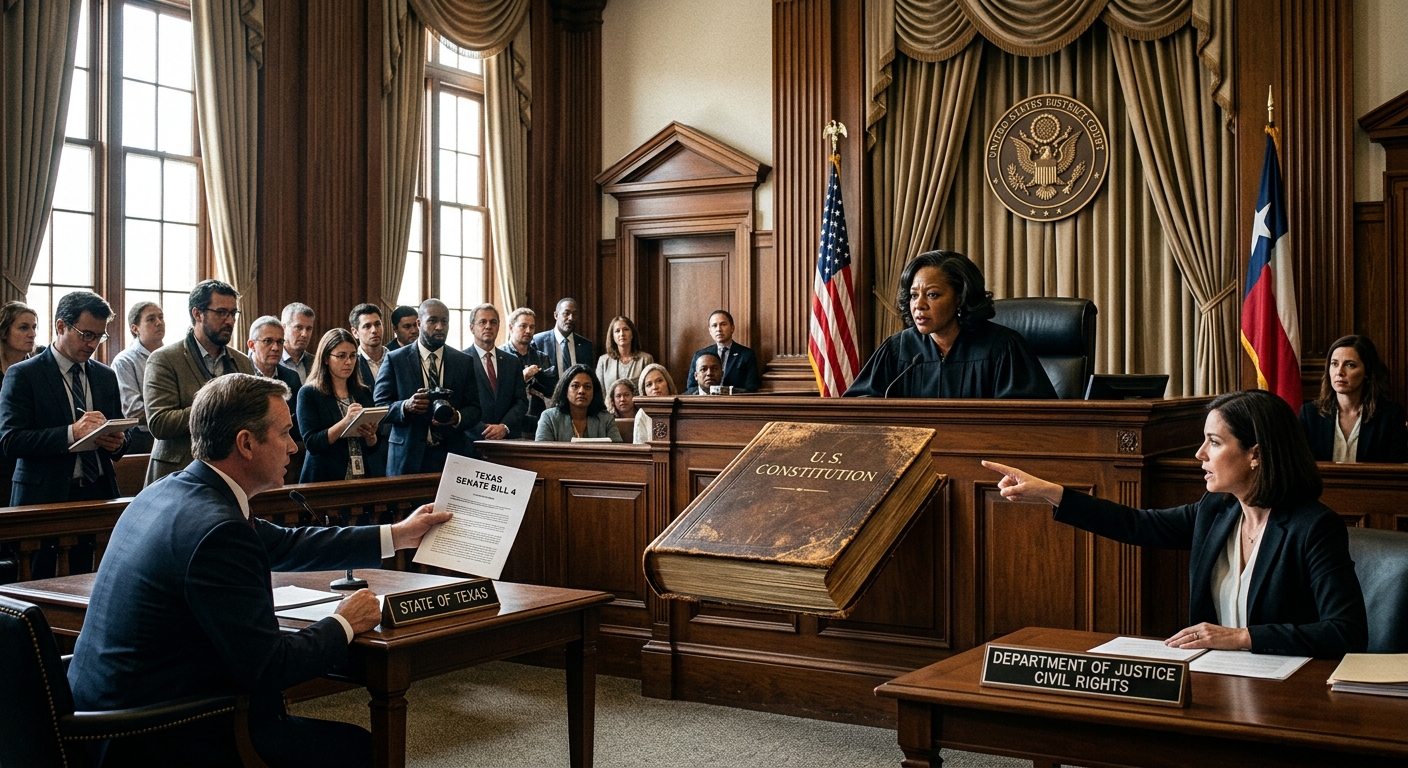
Recognizing the severe threat to federal authority, the United States Department of Justice (DOJ) filed a lawsuit against the State of Texas to enjoin the enforcement of SB 4. The lawsuit argues that the legislation is preempted by federal law and fundamentally violates the U.S. Constitution.
The DOJ’s argument hinges on the fact that SB 4 disrupts the federal government’s ability to enforce immigration laws consistently across the nation. The federal government must balance numerous priorities when managing immigration, including national security, humanitarian concerns, and foreign relations. When a single state implements its own aggressive enforcement and deportation regime, it throws this delicate, unified balance into chaos. The DOJ contends that if Texas were allowed to enforce SB 4, it would severely damage the United States’ diplomatic relations with Mexico and other nations, complicating broader bilateral agreements regarding trade, security, and migration management.
The legal battle over SB 4 has been marked by procedural whiplash, moving rapidly through federal district courts, the Fifth Circuit Court of Appeals, and up to the Supreme Court. While temporary administrative stays have been granted and lifted in rapid succession, the core constitutional question remains under fierce judicial scrutiny. The DOJ’s stance remains resolute: states cannot be permitted to balkanize the nation’s unified immigration system.
Logistical and Economic Strain on Municipalities
While state politicians champion SB 4 as a necessary security measure, local municipalities are left to grapple with the disastrous practical consequences. The law represents a massive unfunded mandate placed squarely on the shoulders of local governments and taxpayers.
Texas county jails are already operating near or at maximum capacity. SB 4 threatens to flood these facilities with thousands of individuals arrested for state-level immigration offenses, diverting immense financial resources away from local priorities. The costs of incarcerating, feeding, and providing medical care for this new population will fall directly on local taxpayers. Similarly, the state judicial system—already facing significant backlogs—will be overwhelmed by the sheer volume of new misdemeanor and felony cases generated by the law.
Moreover, many local law enforcement leaders have expressed deep concern over the law. Police chiefs and county sheriffs recognize that forcing their officers to act as de facto immigration agents diverts critical manpower and resources away from stopping violent crime and property offenses. Good policing relies inherently on community trust, and local leaders are acutely aware that SB 4 destroys the vital relationships they have spent years building with their resident immigrant populations.
Frequently Asked Questions (FAQs)
- What is the main purpose of Texas SB 4?
Texas SB 4 is a state law designed to make unauthorized entry into Texas from a foreign country a state crime. It empowers state and local law enforcement to arrest suspected undocumented immigrants and allows state judges to issue deportation orders, effectively bypassing the federal immigration system entirely. - Why is Texas SB 4 considered unconstitutional by legal experts?
The U.S. Constitution’s Supremacy Clause dictates that federal law overrides state law. Historically, the Supreme Court has ruled that the federal government has exclusive authority over immigration and foreign policy. By creating a state-level deportation system, SB 4 interferes with federal jurisdiction and violates established legal precedents. - How does SB 4 affect asylum seekers?
Under federal and international law, individuals have the right to seek asylum in the U.S. regardless of how they crossed the border. SB 4 criminalizes their entry at the state level, potentially leading to their arrest and state-ordered deportation before they can legally request asylum through the established federal channels. - What is the Department of Justice doing about this law?
The U.S. Department of Justice has sued Texas to block the implementation of SB 4. The DOJ argues that the law illegally preempts federal authority, disrupts the unified national immigration system, and severely interferes with the United States’ foreign relations.
Conclusion: The Future of Federalism
Texas Senate Bill 4 is not merely a strict border enforcement policy; it is a direct assault on the constitutional framework that binds the United States together. By attempting to seize powers exclusively delegated to the federal government, Texas is forcing a legal confrontation that could have lasting ramifications for the balance of power between individual states and the federal government. Beyond the dry legal arguments of preemption and the Supremacy Clause, the law threatens to unleash a wave of racial profiling, tear apart communities, and deny basic due process to some of the most vulnerable people in the hemisphere. As the courts continue to adjudicate this profound constitutional crisis, the outcome will dictate whether the United States maintains a cohesive national immigration system or fractures into fifty separate, conflicting borders.
References
- Arizona v. United States, 567 U.S. 387 (2012) — Library of Congress. 2012-06-25. https://www.loc.gov/item/usrep567387/
- United States v. Texas (Case 2:25-at-01612) — Department of Justice. 2025-11-20. https://www.justice.gov/
- Supreme Court Brief citing United States v. Texas, 97 F.4th 268 — Supreme Court of the United States. 2025-07-02. https://www.supremecourt.gov/
Similar Articles








Read full bio of Sneha Tete


