
How to Use a Crash Report After a Car Accident
Learn what crash reports contain, how to obtain them, and how they support claims.
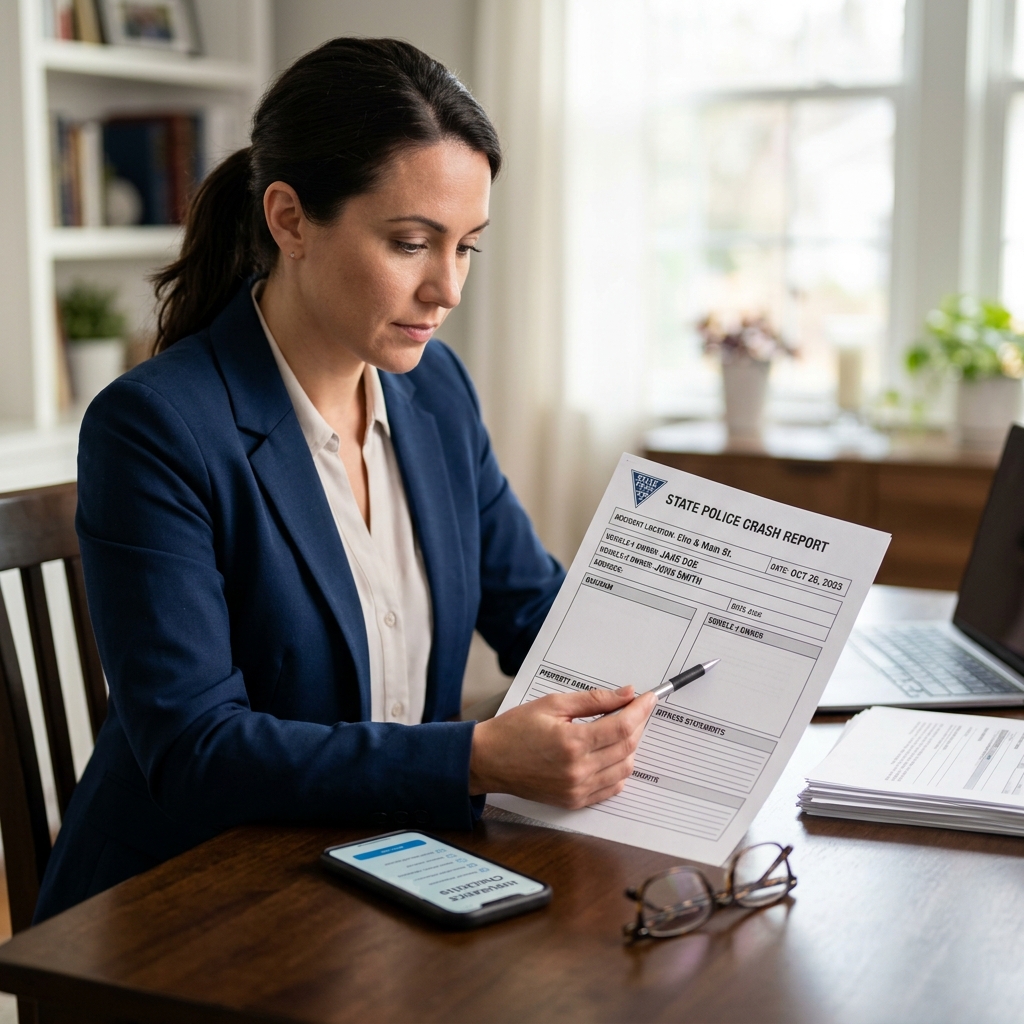
A police crash report is one of the most important records created after a collision. It can help document what happened, identify the people involved, and support an insurance claim or legal case.
Although a crash report does not automatically decide who was at fault, it often becomes a key piece of evidence when drivers, insurers, and attorneys review an accident.
Why a crash report matters
After a traffic collision, memory fades quickly and details can become disputed. A crash report provides a written snapshot of the incident made close to the time of the event. That makes it useful for confirming basic facts and reducing confusion later.
Insurance companies often rely on crash reports when they evaluate a claim. Attorneys may also review the report to understand how the crash occurred, whether any citations were issued, and whether additional evidence is needed. In some situations, the report can also help a victim locate witnesses, vehicles, or agencies involved in the investigation.
- It records the date, time, and location of the collision.
- It identifies drivers, passengers, and vehicles involved.
- It may include witness statements and officer observations.
- It can show whether traffic citations were issued.
- It often helps support insurance and compensation claims.
What information is usually included
The exact contents of a crash report vary by state and agency, but many reports contain similar categories of information. The report is typically completed by the responding officer, based on what the officer saw at the scene, what the parties reported, and any physical evidence available.
| Report section | Common details | Why it matters |
|---|---|---|
| Incident details | Date, time, road, intersection, weather, lighting | Helps place the crash in context |
| People involved | Names, contact information, injuries, passengers | Identifies who may have claims or responsibilities |
| Vehicles | Make, model, year, license plate, insurance data | Supports vehicle and coverage verification |
| Statements | Driver and witness accounts | Shows competing versions of the event |
| Officer notes | Observations, diagram, possible violations | May influence later liability analysis |
Some reports also include photographs, supplemental pages, or references to body camera footage, but those materials are not always released through the same process as the basic report.
How crash reports are created
When police respond to a collision, the officer typically speaks with the drivers, checks for injuries, looks for vehicle damage, and documents the scene. If witnesses are present, the officer may take their statements as well. The officer then completes a report based on the available information.
In some places, a crash report is filed even if police do not physically respond to the scene. Several agencies allow drivers to submit a report online for documentation purposes when the crash is minor and no immediate law-enforcement investigation is needed. In those cases, the report may be limited and may not include officer conclusions.
That distinction matters. A report prepared after an on-scene investigation may contain more detail than a self-filed report submitted later by a driver.
How to get a copy of the report
Most drivers can request a copy from the state crash database, the local police department, the sheriff’s office, or the agency that investigated the collision. Many jurisdictions now offer online retrieval systems, while others still use mail, in-person pickup, or formal records requests.
To find the report, you will usually need some combination of the following:
- The date of the crash
- The county, city, or intersection where it happened
- The names of the drivers involved
- The report number, if you already have it
- The agency that responded to the crash
Some systems process reports within a few days, while others take longer depending on whether the officer has finalized the paperwork. If the report is not yet available, checking again after several days is often necessary.
Who can usually request the report
Access rules vary, but crash reports are often available to people with a direct interest in the incident. That commonly includes drivers, passengers, vehicle owners, parents or guardians of minors, attorneys, insurers, and authorized representatives.
Some agencies restrict access to sensitive reports, especially those involving fatalities, juveniles, arrests, or ongoing investigations. In those situations, the report may have to be requested by mail or through a special records process rather than an online portal.
- Involved drivers and passengers
- Vehicle owners
- Insurance companies
- Attorneys or legal representatives
- Family members with legal authority
What to do if the report is inaccurate
Crash reports are valuable, but they are not perfect. Officers may rely on incomplete information, and witnesses may disagree about what happened. If you notice a factual mistake, such as the wrong vehicle description, incorrect insurance information, or an inaccurate street name, you may be able to request a correction or submit a supplemental statement.
Not every disagreement can be changed. An officer’s interpretation of fault may remain in the report even if one driver objects. Still, if there is a clear factual error, it is worth contacting the agency that prepared the document and asking about the correction process.
It is also useful to save your own evidence. Photos, repair estimates, medical records, dashcam footage, witness contact information, and written notes can help if the report leaves out important facts.
How crash reports affect insurance claims
Insurers use crash reports to confirm basic claim details and to evaluate whether a policy may cover the loss. A report may help establish the timing of the accident, the vehicles involved, and whether police issued a citation. Even when the report does not assign legal fault, it can still shape an insurer’s view of the case.
For example, if the officer notes that one driver failed to yield, the insurance company may treat that as persuasive evidence. On the other hand, if the report is neutral or incomplete, the insurer may ask for additional documents before making a decision.
Because of that, a crash report should usually be treated as one part of a larger evidence file rather than the only proof of what happened.
How a lawyer may use the report
A personal injury lawyer may use the crash report to locate witnesses, compare accounts, and identify legal issues such as speeding, distraction, or failure to obey traffic control devices. The report may also help determine which insurance policies apply and whether another party beyond the other driver may share responsibility.
If a claim becomes contested, the report can serve as a starting point for a more detailed investigation. Attorneys may then gather scene photos, traffic camera footage, expert opinions, vehicle inspections, and medical records to build the case.
In many cases, the report is especially useful because it anchors the timeline and creates an official record from the beginning of the dispute.
When a crash report may not be enough
There are limits to what a crash report can prove. An officer usually does not witness the collision itself, so the report often depends on statements and observable evidence. That means the document may not fully capture everything that happened in the seconds before impact.
It may also be incomplete if the scene was chaotic, if drivers were injured and unable to speak clearly, or if no witnesses were available. In serious disputes, lawyers and insurers often need to compare the report with other records before drawing conclusions.
For that reason, drivers should preserve any supporting evidence they have rather than rely on the report alone.
Practical steps after a collision
After a crash, the best approach is to gather as much information as possible while the details are still fresh. Even if police create a report, your own records can make the claims process easier and more accurate.
- Call law enforcement if the crash involves injury, serious damage, or a dispute.
- Exchange names, insurance details, and vehicle information with the other driver.
- Take photos of vehicles, license plates, road conditions, and visible injuries.
- Ask witnesses for contact information.
- Seek medical care promptly if you are hurt.
- Request the crash report once it becomes available.
These steps can help protect both your health and your claim. They also make it easier to compare the facts in the report with the information you collected at the scene.
Common questions about crash reports
Does the crash report decide who was at fault?
Not always. A report may include officer observations, but fault is often determined later by insurers, attorneys, or a court using the full body of evidence.
How long does it take to get one?
Timing depends on the agency and whether the report has been finalized. Some are available within days, while others take longer.
Can I get the report online?
Many jurisdictions offer online crash-report systems, but some reports must be requested through mail, in person, or through a records office.
What if I was not the driver?
Passengers, vehicle owners, and other authorized people may still be able to request a copy if they have a legitimate interest in the report.
Should I keep my own records too?
Yes. Photos, witness information, repair estimates, and medical documentation can all help if the report is incomplete or disputed.
Why this document is worth saving
A crash report may seem like a routine form, but it often becomes a central record in the days and weeks after an accident. It can support an insurance claim, help resolve disagreements, and preserve details that might otherwise be forgotten.
For many drivers, the report is the first official document that captures the collision. Keeping a copy and understanding what it says can make the aftermath of a crash much easier to manage.
References
- Report a Crash and Obtain a Crash Record — Colorado Department of Revenue, Division of Motor Vehicles. 2026-07-10. https://dmv.colorado.gov/crash-records
- Ohio Crash System – Crash Online — Ohio Department of Public Safety. 2026-07-10. https://ohtrafficdata.dps.ohio.gov/crashretrieval
- File a Crash Report — City of Columbus, Ohio. 2026-07-10. https://www.columbus.gov/Services/Public-Safety/Find-a-Police-Report/File-a-Crash-Report
- Obtain A Traffic Collision Report — Los Angeles Police Department. 2026-07-10. https://www.lapdonline.org/office-of-the-chief-of-police/office-of-special-operations/transit-services-bureau/file-a-traffic-collision-report/
- How to Obtain a Car Accident Report in Ohio — NPHM. 2026-07-10. https://www.nphm.com/blog/auto-accident/how-to-get-an-accident-report-in-ohio/
Similar Articles








Read full bio of Sneha Tete




