
Criminal Law Basics: How Crimes Are Defined and Punished
A clear, practical guide to how criminal law defines wrongful conduct, protects accused persons, and imposes punishment within the justice system.
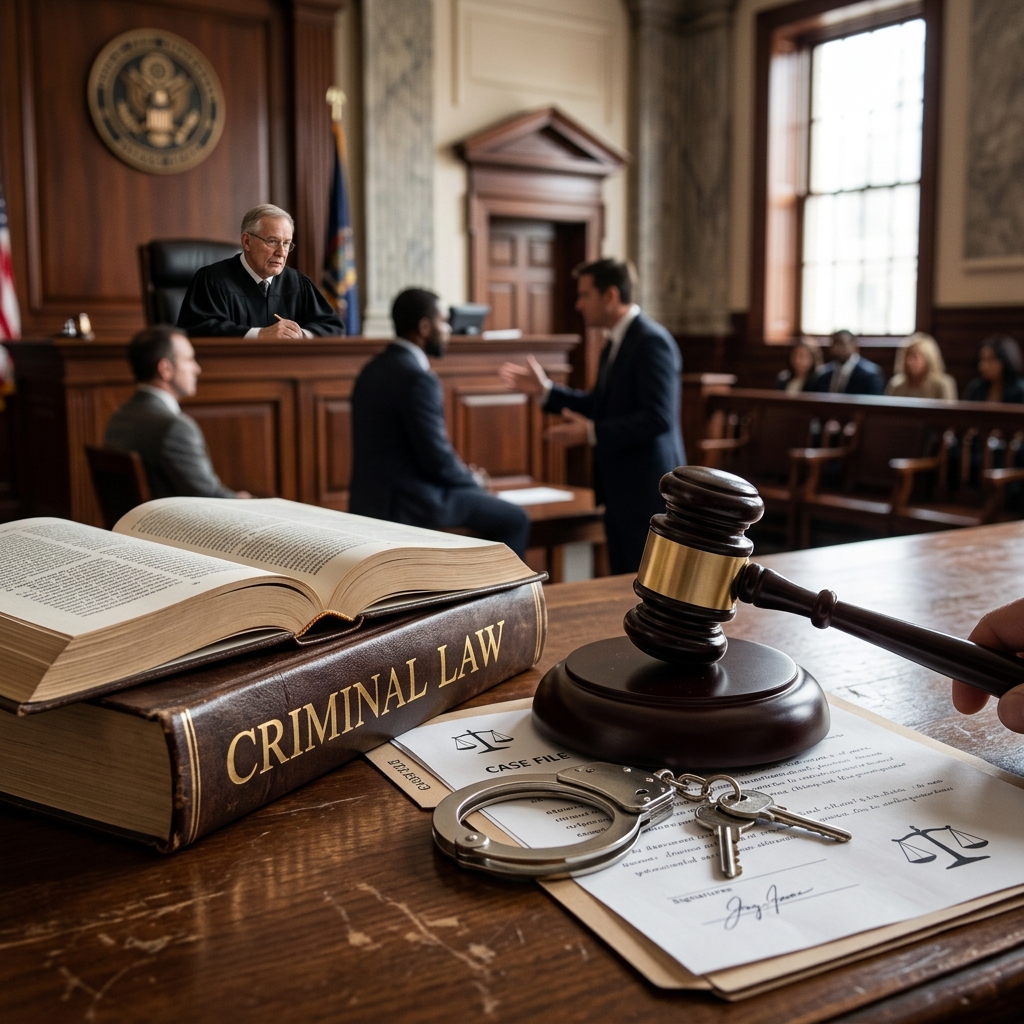
Criminal law is the part of the legal system that decides which behaviors are so harmful to the community that they should be treated as crimes, investigated by the state, and punished by courts. It sets out what counts as a criminal offense, how guilt must be proven, and what consequences follow when someone is convicted. Understanding these foundations helps you make sense of police investigations, criminal charges, trial procedures, and sentencing decisions.
Criminal Law vs. Civil Law: What Is Being Protected?
Criminal law focuses on wrongs against society as a whole, even when a specific person is harmed, while civil law deals mainly with disputes between private parties over rights and responsibilities.
- Criminal cases involve the government prosecuting an individual for conduct defined as a crime, such as theft, assault, or fraud.
- Civil cases generally involve one party suing another for compensation or other remedies, such as breach of contract or personal injury.
Because criminal convictions can result in loss of liberty, criminal law imposes strict standards for proof and ensures special procedural protections for the accused.
What Is a Crime?
A crime is any act or omission that violates a criminal statute and is punishable by the government. In most systems, the legislature must define an offense in advance before anyone can be prosecuted for it. This principle is often described as legality: conduct cannot be treated as criminal without a prior law clearly prohibiting it.
Core Components of a Criminal Offense
Most crimes share a set of basic components—sometimes called the elements of the offense—which prosecutors must prove beyond a reasonable doubt.
| Element | Meaning |
|---|---|
| Actus reus | The physical act or omission that constitutes the prohibited conduct. |
| Mens rea | The mental state—such as intent, knowledge, recklessness, or negligence—required for the offense. |
| Causation | The link between the defendant’s conduct and the harmful result, often framed as but-for or proximate cause. |
| Concurrence | The requirement that the guilty mind and the guilty act occur together to produce the crime. |
| Illegality | The existence of a valid criminal law that clearly defines the conduct as an offense before it was committed. |
Except for certain strict liability offenses, which dispense with the need to show a culpable mental state, all of these elements must be established before criminal liability can result.
Actus Reus: The Criminal Conduct
Actus reus refers to the external, observable part of a crime: a physical action or a legally significant omission. The law generally requires that this behavior be voluntary; reflexes or movements compelled by external forces usually do not qualify.
- Affirmative acts: Examples include striking another person, taking property without consent, or entering a building unlawfully.
- Omissions: Failing to act can be criminal when there is a legal duty, such as duties arising from statutes, contracts, or special relationships.
The specific statute defining an offense spells out what conduct counts as the actus reus for that crime, and the prosecution must show that the defendant’s behavior fits that description.
Mens Rea: The Guilty Mind
Mens rea is the required mental state at the time the actus reus occurs. It captures the level of blameworthiness—whether the person acted deliberately, carelessly, or with conscious disregard of risks.
Common mens rea categories include:
- Purpose or intent: Acting with the aim of bringing about a specific result, such as intending to cause injury.
- Knowledge: Awareness that certain facts exist or that harmful consequences are practically certain.
- Recklessness: Consciously ignoring a substantial and unjustifiable risk.
- Negligence: Failing to perceive a significant risk that a reasonable person would have noticed.
Different offenses require different mental states, and the statute will specify which level of mens rea applies to each element of the crime.
Categories of Crimes
Criminal law classifies offenses into categories that reflect their seriousness and associated penalties. These labels shape everything from bail decisions to sentencing ranges.
- Felonies: The most serious offenses, often punishable by more than one year of imprisonment. Examples include homicide, rape, and major drug trafficking.
- Misdemeanors: Less serious crimes typically carrying up to one year in jail, fines, or community-based sanctions. Common examples are petty theft or simple assault.
- Infractions or violations: Minor offenses, such as certain traffic violations, usually punishable only by fines.
- Inchoate offenses: Crimes that involve steps toward another offense, such as attempt, solicitation, or conspiracy.
- Strict liability offenses: Crimes for which no mens rea is required; liability attaches once the prohibited act occurs, subject to constitutional limits.
Why Societies Use Criminal Punishment
Criminal penalties serve several overlapping goals. Legal scholars often describe five main purposes of punishment:
- Retribution: Holding offenders morally accountable and giving them their “deserved” penalty.
- Deterrence: Discouraging future offending by the individual (specific deterrence) and by others who see the consequences (general deterrence).
- Incapacitation: Protecting the public by restricting the liberty of dangerous offenders, typically through incarceration.
- Rehabilitation: Helping offenders change their behavior through treatment, education, or training.
- Restitution: Compensating victims or restoring losses, often through fines or restitution orders.
Sentencing decisions often balance these purposes, considering the gravity of the offense, the defendant’s history, and the impact on victims and the community.
Rights of the Accused and Burden of Proof
Because criminal convictions can lead to severe consequences, the justice system provides robust protections for accused persons. In a criminal case, the prosecution bears the burden of proving all elements of the offense beyond a reasonable doubt.
Key principles include:
- Presumption of innocence: Defendants are considered innocent unless and until the prosecution meets its heavy burden of proof.
- Right to counsel: In many systems, indigent defendants facing possible imprisonment have the right to appointed legal representation.
- Right to confront witnesses: Defendants may cross-examine prosecution witnesses and challenge the reliability of evidence.
- Protection against self-incrimination: Defendants cannot be forced to testify against themselves.
These safeguards ensure that criminal liability is imposed only when the government’s evidence is strong and reliable.
Defenses in Criminal Cases
Defendants can respond to criminal charges with a variety of defenses. Some challenge whether the prosecution has proven each element; others justify or excuse the conduct.
Failure of Proof and Mistake
- Failure of proof: The defendant argues that the prosecution cannot establish at least one required element of the offense (for example, lack of intent or identity).
- Mistake of fact: The defendant claims an honest and, in some contexts, reasonable error about the facts—for instance, mistakenly believing property was theirs.
- Mistake of law: In limited situations, misunderstanding the legal effect of a situation may be relevant, although mere ignorance of the law is rarely a complete defense.
Justification Defenses
Justifications concede that the defendant committed the act but claim that it was the right or permissible thing to do under the circumstances.
- Self-defense: Using reasonable force to repel an imminent unlawful attack.
- Defense of others: Protecting another person from harm under similar conditions.
- Defense of property: Using limited force to prevent a felony or serious interference with property.
- Necessity: Committing a lesser wrong to avoid a greater harm, sometimes described as a “choice of evils.”
Overview of the Criminal Justice Process
Criminal law operates within a broader system that includes police, prosecutors, defense attorneys, courts, and correctional agencies. While details vary by jurisdiction, a typical case follows a recognizable sequence.
- Investigation: Police respond to reports, gather evidence, interview witnesses, and may temporarily detain suspects.
- Charging: Prosecutors review the evidence and decide whether to file formal charges, what offenses to allege, and in which court.
- Initial appearance and bail: The accused appears before a judge, is informed of charges, and bail or other release conditions are set.
- Plea bargaining: Many cases are resolved through negotiated pleas rather than trials, with defendants agreeing to plead guilty to certain charges.
- Trial: If no plea agreement is reached, the case proceeds to trial, where each side presents evidence, examines witnesses, and makes legal arguments.
- Verdict: A judge or jury decides whether the prosecution has proven guilt beyond a reasonable doubt.
- Sentencing: When a defendant is convicted, the court imposes a sentence that may include imprisonment, probation, fines, or other sanctions.
- Appeals: Defendants may challenge legal errors in the conviction or sentence through appellate review.
Common Criminal Penalties
Sentences aim to reflect the seriousness of the offense, protect public safety, and account for aggravating and mitigating factors. Typical penalties include:
- Fines: Monetary penalties, often used for less serious offenses and infractions.
- Probation: Community-based supervision with conditions such as counseling, employment, or restrictions on movement.
- Imprisonment: Confinement in jail or prison for specified terms, more common for felonies and repeat offenders.
- Community service: Court-ordered work that benefits the public.
- Restitution: Payments to victims to cover losses or damage caused by the crime.
- Capital punishment: In some jurisdictions, the death penalty may be available for the most serious crimes, though its use is heavily regulated and controversial.
FAQs About Criminal Law
Is every harmful act a crime?
No. Many harmful or unethical actions are not crimes unless a legislature has clearly defined them as offenses in advance. Civil law, professional rules, or social norms may address some wrongful conduct that does not rise to the level of criminality.
Can I be convicted without intent?
Most crimes require some level of mens rea, but certain strict liability offenses do not. For those offenses, the mere commission of the prohibited act can result in liability, subject to constitutional and statutory limits.
Who decides what crimes exist?
Legislatures typically define crimes through statutes, specifying jurisdiction, prohibited conduct, mental states, and penalties. Courts then interpret and apply those laws in specific cases.
What happens if the prosecution cannot prove all elements?
If the government fails to establish any required element beyond a reasonable doubt, the defendant should be acquitted. This is why the elements of an offense are central to both prosecution strategy and defense arguments.
Are criminal records permanent?
In many jurisdictions, convictions can remain on a person’s record indefinitely, affecting employment, housing, and civil rights. Some systems offer expungement, sealing, or pardons for certain offenses, but eligibility rules vary by location.
References
- Criminal Law — Legal Information Institute, Cornell Law School. 2023-06-01. https://www.law.cornell.edu/wex/criminal_law
- What is criminal law? — Legal glossary — Thomson Reuters. 2022-11-15. https://legal.thomsonreuters.com/blog/criminal-law-overview-related-terms-and-research-resources
- Understanding the Basics of Criminal Law — University of Pittsburgh School of Law. 2023-04-10. https://online.law.pitt.edu/blog/understanding-the-basics-of-criminal-law
- 1.1 Introduction to Criminal Law — Lumen Learning (SUNY). 2020-08-01. https://courses.lumenlearning.com/suny-fmcc-criminallaw/chapter/1-1-introduction/
- Criminal Law Outline — LexisNexis Law School Resources. 2017-01-01. https://www.lexisnexis.com/pdf/lawschool/lse-outlines/lse-crimlaw.pdf
- Overview of Criminal Law: Module 1 of 5 — LawShelf Educational Media. 2021-03-05. https://www.lawshelf.com/videocoursesmoduleview/overview-of-criminal-law-module-1-of-5/
- Components of Federal Criminal Law — Congressional Research Service. 2020-09-28. https://www.congress.gov/crs-product/R48177
Similar Articles








Read full bio of Sneha Tete




