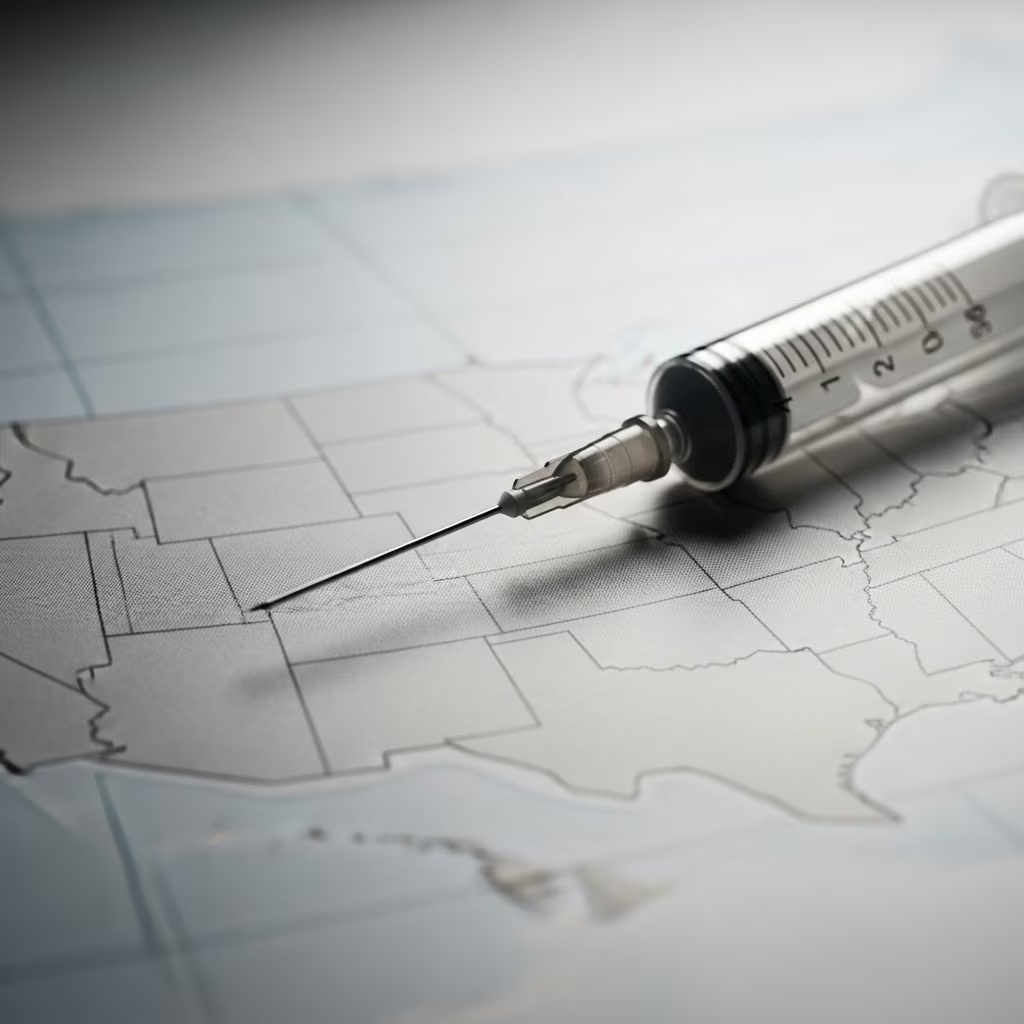
Possessing a syringe can lead to criminal charges in many jurisdictions due to its classification as drug paraphernalia, but numerous exemptions exist for legitimate medical, personal, or harm reduction purposes. These laws balance public safety concerns with efforts to curb infectious disease transmission among injection drug users.
Understanding Drug Paraphernalia and Syringes
Syringes fall under drug paraphernalia definitions when intended for injecting controlled substances, as outlined in various state statutes. Federal law under 21 U.S.C. § 863 prohibits selling or distributing paraphernalia, but states handle possession primarily. The intent behind possession often determines legality: medical use is typically protected, while evidence of illicit drug use can trigger charges.
Prosecutors must prove unlawful intent beyond a reasonable doubt, considering factors like residue, location, and quantity. Clean, unused syringes from authorized sources rarely lead to convictions, emphasizing context in enforcement.
California’s Framework for Legal Possession
California Health & Safety Code § 11364 criminalizes possessing syringes for injecting controlled substances, yet provides clear exemptions. Individuals may legally hold up to 10 needles or syringes if obtained from physicians, pharmacists, or syringe services programs (SSPs) for personal use.
Since January 1, 2021, simple possession of a syringe is decriminalized regardless of source, reflecting a shift toward harm reduction. Physicians and pharmacists can distribute to adults over 18 without prescriptions under Business & Professions Code § 4145.5(b). SSPs operate legally per § 121349(b), protecting participants.
Local ordinances, like Chico’s, ban possession except under specific conditions and mandate proper sharps disposal to avoid infractions.
State Variations in Syringe Regulations
Laws differ widely across the U.S., with some states fully decriminalizing simple possession and others imposing strict paraphernalia bans without SSP exemptions. Over 30 states permit possession under certain conditions, such as proximity to an SSP or proof of participation.
| State Category | Examples | Key Features |
|---|---|---|
| No Prohibition on Simple Possession | Michigan, New Hampshire, Oregon, Rhode Island, Vermont, West Virginia, Wyoming | Syringes not classified as paraphernalia; broad legal possession. |
| Explicit Exclusion from Paraphernalia Laws | Nevada, Oregon, Wisconsin | Laws omit injection devices entirely. |
| Definition Omits Injection Objects | Connecticut, Indiana, Massachusetts, New Hampshire, Rhode Island, South Carolina | No reference to syringes in statutes. |
| Conditional Exemptions | Colorado (SSP exemption, residue protection), Utah (sealed packages), Ohio (near SSP with proof) | Source, packaging, or location-based allowances. |
| No Exemptions | Alabama, Arkansas, Georgia, Idaho, Iowa, Kansas, Louisiana, Minnesota, Mississippi, Missouri, Montana, Nebraska, Oklahoma, Pennsylvania, South Dakota, Texas, Virginia | Full criminalization, no SSP protections. |
This table illustrates the patchwork nature of regulations, impacting access to clean needles and disease prevention.
Harm Reduction and Syringe Services Programs
Syringe services programs (SSPs) distribute sterile needles to reduce HIV, hepatitis C, and other bloodborne infections among people who inject drugs (PWID). Where legalized, SSPs include protections against paraphernalia charges for participants.
- Colorado: SSP exemption with residue protection; local approval needed.
- California: Full authorization, pharmacy sales allowed.
- States like Missouri and Texas: No SSPs, no protections, heightening risks.
Research shows legal barriers discourage SSP use, leading to syringe sharing. Decriminalization correlates with lower disease rates. Police enforcement near SSPs can deter participation, even with legal syringes.
Legal Defenses and Exemptions
Common defenses include proving medical necessity, authorized sourcing, or lack of intent. In California, possession under 10 from approved providers negates charges. Nationally:
- Immunity for disclosing syringes to officers pre-search (e.g., Colorado, Kentucky).
- Sealed, unused status (Utah).
- Residue alone insufficient for conviction in some courts (California precedent).
Defendants should document SSP participation or prescriptions. Proper disposal in sharps containers avoids additional violations.
Penalties for Violations
Paraphernalia possession is typically a misdemeanor, with fines up to $1,000 and jail time up to one year, varying by state and priors. Repeat offenses may escalate. Federal charges are rare for simple possession but apply to distribution.
In strict states, charges compound with drug residue, leading to felony possession counts. Harm reduction advocates push for reform to prioritize health over punishment.
Public Health Implications
Criminalizing syringes drives underground markets, reusing, and sharing, fueling epidemics. States with flexible laws see 30-50% HIV/HCV reductions via SSPs. Policymakers increasingly recognize decriminalization’s role in overdose prevention and safe disposal.
Broader access via pharmacies without prescriptions, as in California, expands reach without SSP infrastructure.
Best Practices for Compliance
To avoid legal issues:
- Obtain syringes only from licensed providers, SSPs, or pharmacies.
- Limit quantities to legal caps (e.g., 10 in CA).
- Use sharps containers for disposal; never in trash.
- Carry proof of source if possible.
- Know local laws, as cities may add restrictions.
Frequently Asked Questions
Is possessing one clean syringe illegal?
Depends on state: legal in many with no paraphernalia prohibition; check exemptions elsewhere.
Can pharmacies sell syringes without a prescription?
Yes, in states like California for adults 18+.
What if a syringe has drug residue?
May lead to separate charges; some states protect SSP returns.
Are SSPs legal nationwide?
No, authorized in about half; others vary or ban them.
How to dispose of used syringes safely?
Use FDA-approved sharps containers; drop at facilities, never curbside.
Recent Developments and Future Outlook
Post-2021 reforms in places like California signal momentum toward decriminalization. Federal support for SSPs via CDC funding encourages states to adopt protections. Ongoing litigation challenges residue prosecutions, potentially expanding safe access.
As opioid crises persist, expect more states to prioritize harm reduction, reducing paraphernalia barriers.
References
- Drug Paraphernalia Laws Drug Possession Lawyer – HS 11364 FAQs — WK Law. Accessed 2026. https://www.wklaw.com/possession-drug-paraphernalia-faqs.html
- California Health and Safety Code Section 11364 HSC: Possession — Los Angeles Criminal Lawyer. Accessed 2026. https://www.losangelescriminallawyer.pro/california-health-and-safety-code-section-11364-hsc-possession-o.html
- Policies — LA Community Health Project — CHPLA. Accessed 2026. http://www.chpla.org/policies
- Syringe Access in Your State – National Harm Reduction Coalition — Harm Reduction Coalition. Accessed 2026. https://harmreduction.org/issues/syringe-access/landscape-report/state-by-state/
- Syringe Possession Laws | LawAtlas — LawAtlas. Accessed 2026. https://lawatlas.org/datasets/paraphernalia-laws
- 9.43.140 Possession of hypodermic needles and syringes — City of Chico Code. Accessed 2026. https://codelibrary.amlegal.com/codes/chico/latest/chico_ca/0-0-0-23345
- State Laws Governing Syringe Services Programs and Participant Syringe Possession — United States, 2014–2019 — PMC/NCBI. 2020-07-31. https://pmc.ncbi.nlm.nih.gov/articles/PMC7407055/