
Supreme Court Decisions Reshaping Civil Rights After King
Exploring pivotal judicial rulings that transformed American equality protections.
The Evolution of Constitutional Equality Through Judicial Interpretation
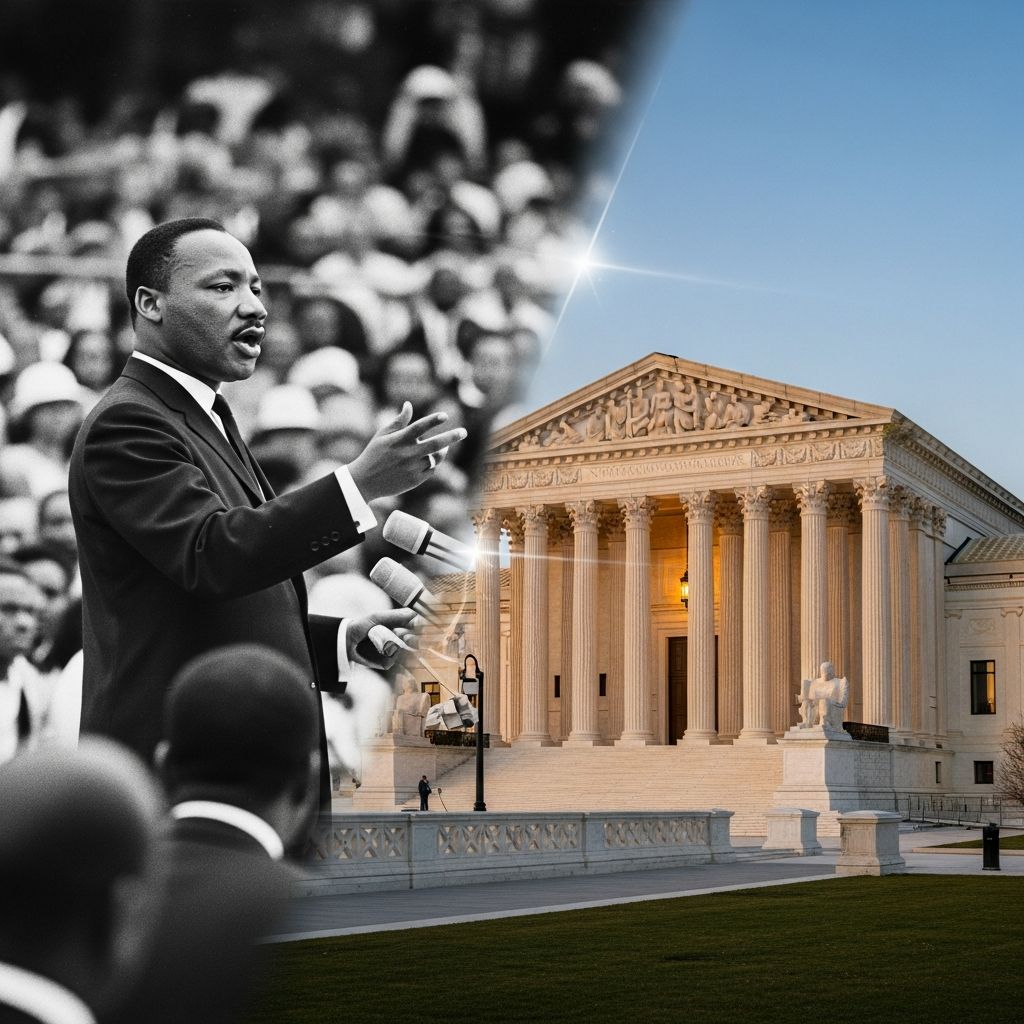
The American legal system has undergone profound transformations since Martin Luther King Jr. delivered his historic address on the steps of the Lincoln Memorial in 1963. While that momentous speech articulated a vision of a nation where individuals would be judged not by the color of their skin but by the content of their character, the Supreme Court has spent decades wrestling with how to translate such aspirational ideals into enforceable constitutional law. The judiciary’s role in advancing civil rights has proven complex and contested, with courts interpreting the Constitution’s guarantees of equality in ways that have sometimes expanded protections and other times narrowed them. Understanding the trajectory of key Supreme Court decisions provides insight into how American jurisprudence has grappled with implementing racial justice and protecting fundamental rights.
Gender Discrimination and the Path to Constitutional Recognition
One of the most significant legal developments emerged from an unexpected source: a case involving inheritance law in Idaho. In the 1970s, attorney Ruth Bader Ginsburg, then working with the American Civil Liberties Union, strategically selected a challenge to a state statute that automatically designated husbands as administrators of family estates. The case arose when Sally Reed sought to serve as administrator of her deceased adopted son’s estate, only to discover that Idaho law preferred her ex-husband for the role. Rather than arguing that gender discrimination was morally wrong, Ginsburg framed the challenge on constitutional grounds, asserting that the law violated the Fourteenth Amendment’s guarantee of equal protection. The Supreme Court agreed, marking the first time the judiciary had struck down a law explicitly because it discriminated based on sex. This watershed moment established that gender-based classifications, like those based on race, faced heightened constitutional scrutiny and required substantial justification to withstand legal challenge.
The significance of this ruling cannot be overstated. For decades, courts had upheld statutes that treated men and women differently under the law, often under the guise of protecting women or maintaining social order. By invalidating Idaho’s probate law, the Supreme Court signaled that the Constitution’s promise of equal protection extended beyond racial discrimination to encompass all forms of invidious classification based on immutable characteristics. This precedent opened doors for subsequent challenges to laws discriminating in employment, education, and numerous other domains. The decision demonstrated how judicial review could advance civil rights not through sweeping declarations but through careful application of constitutional principles to concrete legal rules.
Student Expression and the Boundaries of School Authority
While gender discrimination required gradual constitutional recognition, student free speech rights emerged more quickly from the civil rights ferment of the 1960s. During the height of the Vietnam War, a group of high school students in Des Moines, Iowa, designed a quiet form of protest: wearing black armbands to school to express opposition to American military involvement overseas. School administrators, learning of this plan in advance, preemptively banned the armbands and suspended any student who refused to remove them. Among those sent home were teenagers Mary Beth Tinker and her brother John, who challenged their suspensions through federal court litigation.
The Supreme Court’s response established a foundational principle for student rights in public schools. The majority opinion, written by Justice Abe Fortas, rejected the school’s argument that maintaining order and discipline required suppressing the students’ symbolic speech. Instead, the Court articulated a balanced standard: students retain their constitutional rights to freedom of expression while in school, but schools may restrict speech if it materially disrupts classroom learning or infringes upon the rights of other students. This framework, known as the “Tinker standard,” has endured for decades and shaped countless disputes over student newspapers, political clubs, and other forms of student expression. The decision affirmed that young people do not surrender their constitutional protections simply by entering school buildings, a principle that resonated with the era’s broader civil rights consciousness and the growing recognition of youth agency in social movements.
Wartime Powers and Constitutional Constraints on Executive Authority
In the decades following the Civil Rights Movement’s peak, new challenges emerged at the intersection of national security and individual liberty. After the September 11, 2001 terrorist attacks, the federal government detained numerous individuals suspected of ties to terrorist organizations, often holding them indefinitely without access to courts or legal counsel. One such detainee was Yaser Hamdi, an American citizen captured in Afghanistan while allegedly fighting alongside Taliban forces. The government transferred Hamdi to military custody and denied him access to an attorney, invoking national security and wartime emergency powers as justification for these extraordinary measures.
Hamdi’s father filed a legal challenge seeking habeas corpus relief—asking a court to determine whether the government was lawfully detaining his son. The Bush administration argued that courts should defer to executive judgment during wartime and that the judiciary lacked authority to second-guess military and intelligence officials’ decisions. The Supreme Court rejected this sweeping assertion of executive power. While acknowledging that the government possessed legitimate authority to detain enemy combatants, the Court held that American citizens retained fundamental due process protections. The government could not indefinitely hold a citizen without providing some meaningful opportunity to contest the factual basis for detention. This decision established that even in emergencies, constitutional rights do not evaporate, and courts retain a role in ensuring that executive power operates within constitutional bounds. The ruling demonstrated that civil rights protections extend beyond the classroom and voting booth to encompass physical liberty and procedural fairness.
Speech Rights and Political Participation
The Supreme Court’s approach to free speech has also shaped the landscape of political participation and expression in post-civil rights America. During World War I, socialist activists Charles Schenck and Elizabeth Baer distributed pamphlets encouraging men to resist military conscription, which they argued constituted involuntary servitude prohibited by the Thirteenth Amendment. They were convicted under the Espionage Act for attempting to interfere with military recruitment. When they appealed, claiming their convictions violated First Amendment protections for political speech, the Supreme Court upheld the convictions, establishing that free speech rights are not absolute and may be restricted when speech poses a clear and present danger to national security.
Though this early decision did not always protect dissenters, it established a framework for analyzing when speech could be restricted. Over time, courts became increasingly protective of political expression and skeptical of government restrictions. The Schenck case itself was eventually superseded by broader free speech protections, reflecting evolving judicial understanding of the First Amendment’s scope. This evolution paralleled civil rights movements’ demands that marginalized communities have forums to voice grievances and challenge unjust laws through protected speech.
The Enduring Questions and Contemporary Debates
The decades following King’s historic speech have witnessed sustained judicial engagement with civil rights questions, though consensus remains elusive. Contemporary disputes over affirmative action and race-conscious admissions policies reflect competing interpretations of what racial equality requires. Some argue that King’s vision demands race-blind policies that ignore historical discrimination, while others contend that meaningful equality necessitates acknowledging past injustices and taking corrective measures. These debates have reached the Supreme Court repeatedly, pitting constitutional language against different visions of what the Fourteenth Amendment requires. The courts remain arenas where fundamental questions about the scope and meaning of constitutional equality continue to be contested and refined.
Key Developments in Civil Rights Jurisprudence
- Gender-based classifications received constitutional protection against discrimination through judicial interpretation of equal protection principles
- Student expression rights were balanced against school authority through standards requiring material disruption to justify speech restrictions
- Due process protections were reaffirmed as applicable even to national security detention of American citizens
- Political speech and dissent received constitutional protection across multiple contexts and time periods
- Courts established frameworks for analyzing when fundamental rights could be limited based on compelling governmental interests
Frequently Asked Questions About Civil Rights and Supreme Court Law
Q: What standards do courts use to evaluate laws that discriminate based on race or gender?
A: Courts apply “strict scrutiny,” requiring the government to prove that discriminatory classifications serve a compelling governmental interest and are narrowly tailored to achieve that interest. This demanding standard means few such laws survive judicial review.
Q: Can schools restrict student political expression and protests?
A: Schools may restrict student speech only if it causes material disruption to education or infringes upon other students’ rights. Mere disagreement with students’ messages or desire to avoid controversy is insufficient justification under the Tinker standard.
Q: Do constitutional rights apply during national emergencies?
A: Yes. While the government may have broader authority during emergencies, fundamental constitutional protections remain in force. Courts retain authority to ensure that emergency measures are proportionate, temporary, and provide meaningful due process protections.
Q: Has the Supreme Court definitively resolved debates about affirmative action?
A: No. The Court has ruled on specific affirmative action programs but continues to receive challenges involving new contexts and formulations. Competing interpretations of racial equality remain contested in contemporary litigation.
Q: What role do lower courts play in developing civil rights law?
A: Federal district courts and appellate courts interpret and apply Supreme Court precedents to new situations, sometimes extending principles in novel directions. Their decisions, particularly from appellate courts, influence how rights are protected in practice across different regions.
References
- Landmark Supreme Court Cases — Brennan Center for Justice. 2024. https://www.brennancenter.org/our-work/research-reports/landmark-supreme-court-cases
- Timeline of the American Civil Rights Movement — Britannica Educational Partnership. 2024. https://www.britannica.com/list/timeline-of-the-american-civil-rights-movement
- Chapter 1: I Have a Dream, 50 Years Later — Pew Research Center. August 22, 2013. https://www.pewresearch.org/social-trends/2013/08/22/chapter-1-i-have-a-dream-50-years-later
- 10 Fascinating Facts About the “I Have A Dream” Speech — National Constitution Center. 2024. https://constitutioncenter.org/blog/10-fascinating-facts-about-the-i-have-a-dream-speech
- About Dr. Martin Luther King, Jr. — The King Center. 2024. https://thekingcenter.org/about-tkc/martin-luther-king-jr
Similar Articles








Read full bio of medha deb




