
Supreme Court 4-4 Ties: Legal Impact Explained
Unpacking what happens when the U.S. Supreme Court deadlocks 4-4: precedents upheld, cases stalled, and future uncertainties.
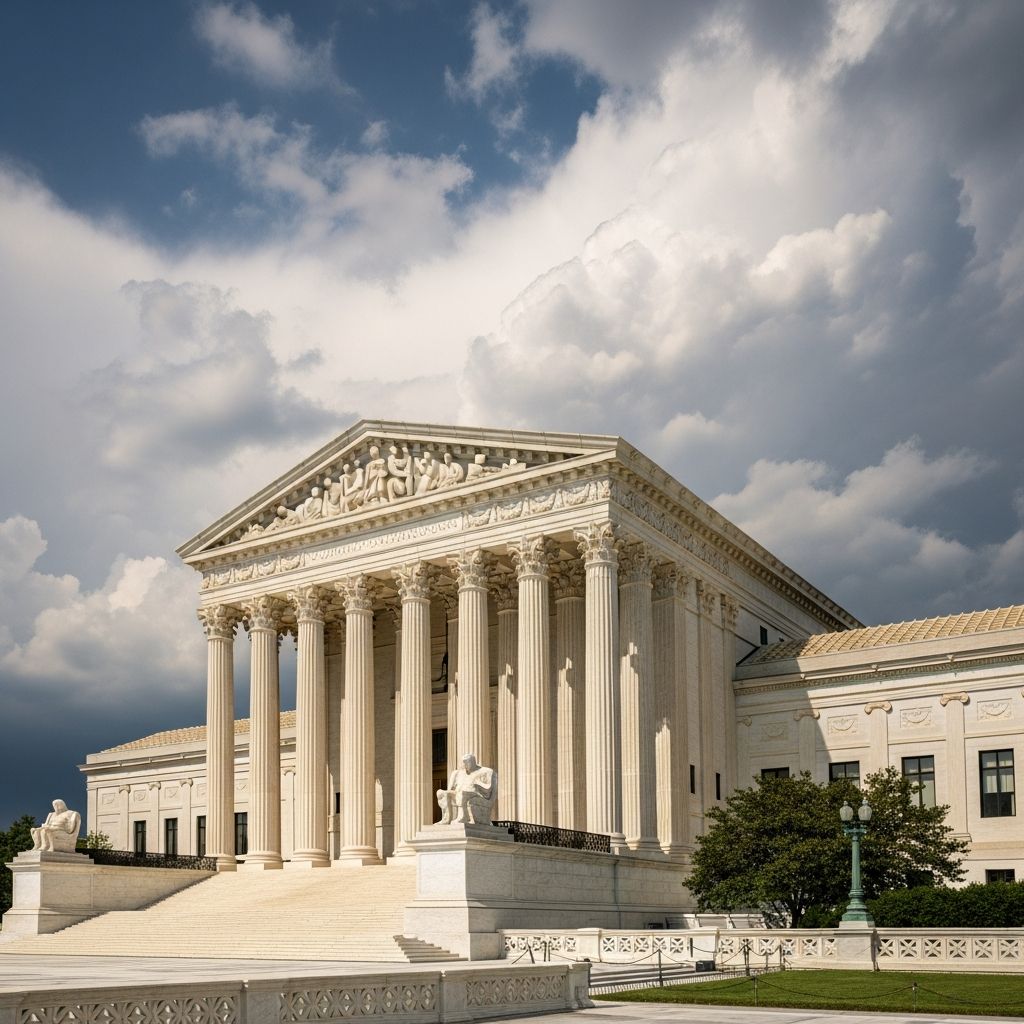
The United States Supreme Court, as the highest judicial authority, shapes national law through its rulings. However, when justices split evenly at 4-4, the Court faces a unique procedural hurdle that leaves profound marks on legal precedents and policy landscapes. This deadlock, often arising from recusal or vacancy, results in no new binding opinion, effectively upholding the decision from the court below. Such outcomes preserve the status quo but can stall broader legal evolution, influencing areas from employment rights to religious freedoms.
Mechanics of a 4-4 Supreme Court Decision
A 4-4 tie occurs when the nine-justice Court lacks a majority due to an even split among participating justices. Typically triggered by one justice’s recusal or an unfilled vacancy, the Court issues a terse, unsigned order stating the lower court’s judgment is “affirmed by an equally divided Court.” This phrase, rooted in longstanding practice, binds only the parties involved and sets no nationwide precedent. Unlike full opinions, these orders provide no reasoning, leaving legal analysts to infer positions from oral arguments or prior cases.
Historically, ties are rare but impactful. The Court’s rules, under 28 U.S.C. § 1, ensure operations continue seamlessly, yet the absence of guidance amplifies uncertainty. For instance, during Justice Antonin Scalia’s unexpected passing in 2016, several pending cases risked 4-4 outcomes, altering expectations in labor law disputes. The procedural simplicity belies complex ramifications: lower rulings stand, but without Supreme Court endorsement, they remain vulnerable to future challenges.
Historical Precedents and Notable Examples
Ties have punctuated Supreme Court history, often at pivotal moments. In the wake of Scalia’s death, cases like Friedrichs v. California Teachers Association teetered on the edge of deadlock. This public-sector union fee challenge, argued with a conservative tilt, ended in a 4-4 affirmance, preserving agency fees in 23 states and D.C. without overturning them nationwide.
More recently, in May 2025, the Court deadlocked 4-4 in a case challenging Oklahoma’s ban on religious charter schools, specifically St. Isidore of Seville Catholic Virtual School. Justice Amy Coney Barrett’s recusal left eight justices, affirming the state supreme court’s rejection of public funding for a Catholic-operated charter. This outcome maintained the church-state separation but signaled ongoing tensions.
- Key Historical Ties:
- 2016: Multiple labor cases post-Scalia, including union fees and religious exemptions.
- 2025: Religious charter school funding, upholding state-level bans.
- Pre-2000 examples: Ties in antitrust and civil rights, often reargued later.
These instances illustrate how vacancies or recusals—due to conflicts like prior involvement—can force ties, reshaping dockets without resolution.
Immediate Procedural Consequences
When a tie emerges, the Court prioritizes finality. The lower decision binds the litigants, ending their appeal. No precedential value extends beyond, allowing circuit splits to persist. This fragmentation invites forum-shopping, where parties select favorable jurisdictions.
| Aspect | 4-4 Tie Outcome | Full Majority Outcome |
|---|---|---|
| Precedent Set | None (party-specific) | Nationwide binding rule |
| Lower Court Ruling | Affirmed as is | Potentially reversed |
| Future Cases | Circuit splits possible | Uniform application |
| Opinion Issued | One-page order | Detailed reasoning |
Courts may reschedule cases for reargument post-new appointment, as seen historically. Yet political delays, like post-2016 Senate holds, prolong uncertainty, affecting term schedules and public trust.
Broader Policy Ramifications Across Sectors
Ties reverberate beyond courtrooms, freezing policy evolution. In labor law, the Friedrichs deadlock sustained agency fees, bolstering unions but frustrating non-members’ First Amendment claims. Employers navigated patchwork rules, impacting collective bargaining nationwide.
Religious liberty cases highlight deeper divides. The 2025 St. Isidore tie preserved Oklahoma’s stance against funding religious charters, safeguarding public education’s secular nature. Critics argue it discriminates, while supporters see firewall protection. This leaves 50 states varying: some permit religious charters, others ban them, fueling litigation.
Public education faces existential threats from unresolved ties. A pro-religious ruling could redirect billions in funds, eroding universal access. Advocates urge legislative firewalls, but ties underscore judicial supremacy’s limits.
Strategic Responses from Litigants and Courts
Parties adapt creatively. Petitioners may seek rehearing or relitigate in friendly circuits. The Court occasionally vacates and remands for lower reconsideration. Congress could intervene via statutes clarifying ambiguities left by ties.
- Legal Strategies:
- Reargument Requests: Post-vacancy full benches.
- Legislative Fixes: Codify status quo.
- State Actions: Uniform laws to preempt splits.
Long-term, ties pressure nominations. Post-Scalia gridlock exemplified partisan battles, delaying justice for over a year.
Implications for Church-State Separation
Religious charter disputes epitomize tie vulnerabilities. St. Isidore’s bid for public funds tested Establishment Clause boundaries. The 4-4 affirmance averts immediate precedent but invites retries, potentially with a ninth vote. This “stay of execution” alarms secularists, who fear voucher expansions proselytizing via taxes.
Stakeholders mobilize: ACLU and church-state groups litigate; states legislate bans. Ties preserve pluralism temporarily, but unresolved splits erode constitutional clarity.
Frequently Asked Questions (FAQs)
What exactly happens in a Supreme Court 4-4 decision?
The lower court’s ruling stands without change or precedent-setting opinion from the Supreme Court.
Can a 4-4 tie create new law?
No, it only affirms the specific case; no broader legal rule emerges.
How often do these ties occur?
Rarely—fewer than 1% of cases—but cluster during vacancies or recusals.
Does a tie mean the Court agrees with the lower court?
Not necessarily; it reflects division, not endorsement.
What if a justice recuses, causing the tie?
The decision proceeds with available justices, as in the 2025 religious charter case.
Can ties be avoided?
Via full benches post-appointment or denying certiorari to high-risk cases.
Future Outlook: Navigating Judicial Uncertainty
As the Court evolves, ties remain flashpoints amid ideological balances. Recent 2025 events signal persistent religion-education friction. With potential vacancies ahead, stakeholders brace for more deadlocks. Robust nomination processes and alternative dispute resolution could mitigate impacts, ensuring the Court’s deliberative role endures.
Ultimately, 4-4 decisions underscore democracy’s checks: when justices divide, lower courts and legislatures fill voids, fostering federalism. Yet prolonged ties risk eroding public confidence, demanding vigilant civic engagement.
References
- The Deadly 4-4 SCOTUS Split: What Happens in the Wake of Justice Scalia’s Death — Hinshaw & Culbertson LLP. 2016-02-23. https://www.hinshawlaw.com/en/insights/blogs/employment-law-observer/the-deadly-4-4-scotus-split-what-happens-in-the-wake-of-justice-scalias-death
- On a 4-4 vote, the U.S. Supreme Court leaves ban on religious charter schools in Oklahoma in place — Baptist Joint Committee for Religious Liberty. 2025-05-23. https://bjconline.org/supreme-court-leaves-ban-on-religious-charter-schools-052325/
- A Tie at the Top: Why the Supreme Court’s 4-4 Split on Religious Charter Schools Still Spells Trouble for Public Education — Cloaking Inequality. 2025-05-22. https://cloakinginequity.com/2025/05/22/a-tie-at-the-top-why-the-supreme-courts-4-4-split-on-religious-charter-schools-still-spells-trouble-for-public-education/
- Supreme Court Hands Down First 4-to-4 Decision Since Antonin Scalia’s Death — Regan Law. 2016-04-01. https://reganlaw.net/supreme-court-hands-down-first-4-to-4-decision-since-antonin-scalias-death/
Similar Articles








Read full bio of medha deb




