
School Searches: Student Rights, Limits, And Remedies Guide
Understand your rights against unreasonable school searches and how the Fourth Amendment applies on campus.
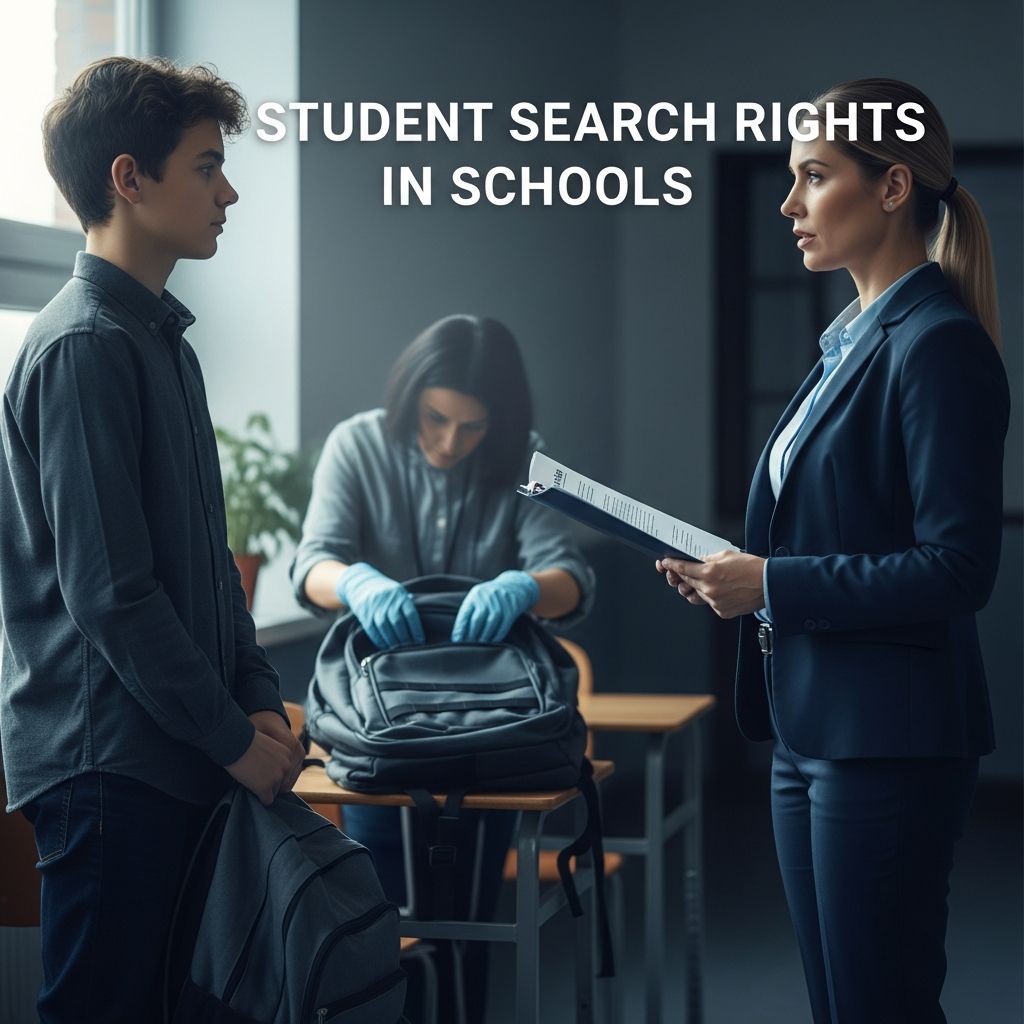
Public school students in the United States enjoy certain protections under the Fourth Amendment against unreasonable searches and seizures, but these rights are adjusted to accommodate the unique needs of the educational environment. Schools must balance maintaining safety and discipline with respecting student privacy, leading to a legal framework that permits searches under a lower threshold than in other settings.
Foundational Legal Principles
The Fourth Amendment states that people are secure in their persons, houses, papers, and effects against unreasonable searches and seizures, typically requiring probable cause and a warrant for law enforcement actions. In schools, however, the Supreme Court has recognized that students retain these rights but they are not absolute. The special circumstances of schools—where maintaining order and safety is paramount—allow administrators to act without the full protections afforded adults outside school grounds.
Prior to key court decisions, schools often invoked the doctrine of in loco parentis, positioning themselves as substitutes for parents with broad authority over students. This view shifted with judicial scrutiny, affirming that students do not shed their constitutional rights at the schoolhouse gate, though those rights are tempered by institutional necessities.
The Landmark T.L.O. Decision
The pivotal case establishing the modern standard is New Jersey v. T.L.O. (1985), where the Supreme Court ruled that school officials need only reasonable suspicion—not probable cause—to search a student. In this case, a vice principal searched a 14-year-old girl’s purse after she was caught smoking, uncovering marijuana paraphernalia. The Court held that the search was reasonable because it was justified at inception (suspected rule violation) and appropriately scoped.
This two-prong test defines legality: first, the search must be based on specific, objective facts suggesting a violation of law or school rules, not mere hunches; second, its scope must match the suspicion’s nature, considering the student’s age, gender, and infraction severity. For instance, a minor infraction like tardiness wouldn’t justify a full body search.
Defining Reasonable Suspicion
Reasonable suspicion requires articulable facts pointing to wrongdoing. Examples include observing drug use, witnessing a fight, or receiving credible reports of stolen items. Courts evaluate the totality of circumstances, such as a student’s furtive behavior or odors associated with contraband.
- Suspicion must be individualized; blanket searches of entire classes are generally invalid unless tied to specific threats.
- Random searches are permissible only for compelling school-wide safety needs, like metal detector scans, and must be truly random without targeting.
- Lockers, as school property, can be searched anytime, though student privacy expectations still apply to contents.
School policies should clearly outline search protocols, including documentation of suspicion, witnesses present, and handling of findings, to protect both students and administrators.
Scope and Intrusiveness of Searches
Not all searches are equal; intrusiveness matters. A backpack check for weapons aligns with suspicion of violence, but escalating to strip searches demands heightened justification. Courts strike down overly invasive actions, such as strip searches for minor thefts, as unreasonable.
| Type of Search | Typical Justification | Examples | Legal Notes |
|---|---|---|---|
| Backpack/Bag | Low-level suspicion | Smoking, missing items | Commonly upheld if suspicion-based |
| Personal Pat-Down | Moderate suspicion | Weapons, drugs | Must consider age/gender |
| Strip Search | Strong suspicion | Serious contraband | Rarely justified; often illegal |
| Cell Phone | Specific evidence | Text threats, photos | Limited to relevant content |
Administrators must halt searches once objectives are met; fishing expeditions violate the scope prong.
Cell Phones and Digital Privacy
Cell phones amplify privacy concerns due to vast personal data. Schools may confiscate disruptive devices but cannot routinely scour contents without reasonable suspicion of rule-breaking evidence, like cyberbullying texts. Advocacy efforts have curbed overreach; for example, a Florida high school revised its policy after challenges, limiting searches to justified cases. Courts apply the T.L.O. test: suspicion must target specific violations, and scope confines review to relevant areas. Students should verbally refuse non-justified demands and request witnesses.
Role of Police in School Searches
When law enforcement enters, standards elevate. If police act independently, probable cause applies; school-led searches with officers present may still use reasonable suspicion if officials initiate. However, police cannot extend searches beyond school authority without warrants. This distinction protects students from full criminal procedure intrusions in disciplinary contexts.
Student and Parental Recourse
If a search feels unlawful, students can refuse consent—though non-compliance risks discipline if suspicion holds. Document details: who searched, why, witnesses, and outcomes. Parents can challenge via administrative appeals, excluding tainted evidence from hearings.
Civil remedies under 42 U.S.C. §1983 allow suits against officials for constitutional violations, seeking damages for harm like emotional distress or academic setbacks. Successful cases reverse suspensions or yield settlements. Consulting legal aid specializing in education rights is advisable.
School Policies and Best Practices
Effective policies inform students of expectations, require written consent acknowledgments, and detail contraband handling. Training ensures staff apply T.L.O. correctly, documenting to defend actions. Balancing privacy with safety fosters trust.
- Notify parents post-search when feasible.
- Avoid humiliation; conduct privately.
- Return non-contraband items promptly.
Frequently Asked Questions
Can schools search my locker without permission?
Yes, lockers are school property subject to search anytime, but contents must align with reasonable policies.
Do I have to unlock my phone for a search?
No, you can refuse; forced access without strong suspicion may be illegal. Discipline for refusal requires valid grounds.
What if police are involved?
Probable cause may apply if they lead; school officials use reasonable suspicion.
Are random drug tests allowed?
For athletes or special needs, yes under precedents like Vernonia School District v. Acton, but not arbitrarily.
What remedies exist for illegal searches?
Evidence suppression, appeals, or §1983 lawsuits for damages.
Recent Developments and Ongoing Debates
Post-T.L.O. cases refine boundaries, like upholding class searches only with individualized suspicion. Digital tech challenges persist, with courts scrutinizing phone forays. Advocacy groups push for stronger protections amid rising safety concerns. Schools adapting policies reflect evolving jurisprudence.
Educators must prioritize documentation and proportionality. Students benefit from knowing rights, empowering informed responses without defiance.
References
- Search and Seizure – NYRA — National Youth Rights Association. Accessed 2026. https://www.youthrights.org/issues/student-rights/search-and-seizure/
- When Can a School Official Search a Student? — Roth Davies LLC. Accessed 2026. https://www.rothdavies.com/criminal-defense/frequently-asked-questions-about-criminal-defense/searches/when-can-a-school-official-search-a-student
- Illegal Search and Seizure of Students and Minors — Horn Wright, LLP. Accessed 2026. https://www.hornwright.com/civil-rights-law/illegal-search-seizure/illegal-search-and-seizure-of-students-and-minor/
- The Right to Search Students — ASCD. Accessed 2026. https://www.ascd.org/el/articles/the-right-to-search-students
- Searches of Students — My School My Rights. Accessed 2026. https://www.myschoolmyrights.com/rights/searches-of-students/
- Search and Seizure in the Public Schools — EBSCO Research Starters. Accessed 2026. https://www.ebsco.com/research-starters/law/search-and-seizure-public-schools
- School Searches and Seizure — Kids Legal. Accessed 2026. https://kidslegal.org/school-searches-and-seizure
Similar Articles








Read full bio of medha deb




