
Split Custody vs Joint Custody: Key Differences
Unravel the distinctions between split custody and joint custody to make informed decisions for your children's future during divorce.
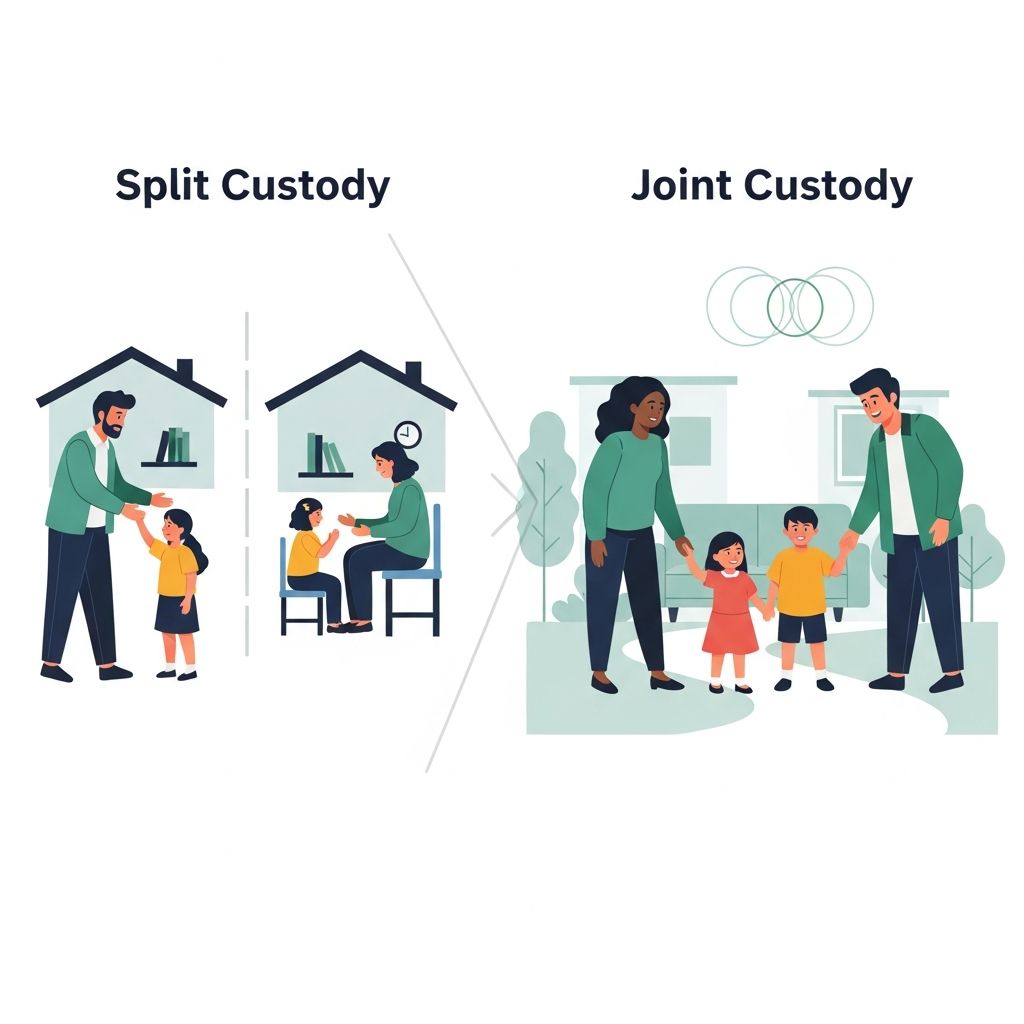
Navigating child custody arrangements during a divorce or separation requires understanding the various options available to parents. Two common yet distinct arrangements are
split custody
andjoint custody
. Split custody involves dividing siblings between parents, while joint custody emphasizes shared responsibilities and time. This article breaks down these concepts, their subtypes, advantages, drawbacks, and court considerations to help parents prioritize their children’s well-being.Defining Child Custody Fundamentals
Child custody refers to the legal rights and responsibilities parents have regarding their children’s care, upbringing, and residence post-separation. Courts primarily focus on the child’s best interests, evaluating factors like parental fitness, child preferences (if age-appropriate), and stability.
Custody splits into two main categories: legal custody, which covers decision-making on education, health, religion, and extracurriculars, and physical custody, which determines where the child lives and daily care.
- Legal Custody: Authority to make major life decisions for the child.
- Physical Custody: Determines the child’s primary residence and visitation schedules.
These elements form the foundation for both split and joint custody arrangements.
Exploring Joint Custody in Depth
**Joint custody**, also called shared custody, promotes ongoing involvement from both parents. It assumes parents can collaborate effectively, fostering a balanced relationship with the child.
Joint Legal Custody
In joint legal custody, both parents hold equal say in significant decisions. This includes choices about schooling, medical treatments, religious practices, and cultural activities. Courts favor this unless one parent is unfit or cooperation is impossible.
For example, if a child needs surgery, both parents consult and agree, preventing unilateral actions.
Joint Physical Custody
Joint physical custody means the child spends substantial time with each parent, often nearly equal, though not always precisely 50/50. Schedules might alternate weeks, mid-week visits, or holiday splits to minimize disruption.
This setup allows children to maintain strong bonds with both parents, mirroring pre-divorce dynamics as closely as possible. Parents often live nearby, share expenses, and use parenting apps for coordination.
| Aspect | Description | Common Schedule Example |
|---|---|---|
| Time Split | Nearly equal parenting time | Week-on/week-off |
| Decision-Making | Shared equally | Joint consultations required |
| Financials | Shared costs; possible support | Higher earner may contribute |
Unpacking Split Custody Arrangements
**Split custody** differs markedly, assigning different children to live primarily with different parents. This is rarer and often a last resort, as courts disfavor separating siblings unless beneficial.
Typical Split Custody Scenarios
Parents might place older children with one parent and younger with the other, or divide by gender (e.g., boys with father, girls with mother), though this is uncommon today. The goal is reducing travel or addressing sibling conflicts.
Even in split custody, joint legal custody is frequent, meaning both parents decide on each child’s major issues collaboratively.
- Sibling rivalry making cohabitation untenable.
- Geographic distance between parents.
- Child’s expressed preference to live with a specific parent.
Visitation and Support in Split Custody
The non-residential parent for a child gets visitation rights, such as weekends or holidays. Child support calculations adjust based on time spent and incomes.
Courts approve split custody only with parental agreement and evidence it’s in the children’s interests, like improved emotional health.
Comparative Analysis: Split vs Joint Custody
| Feature | Split Custody | Joint Custody |
|---|---|---|
| Child Placement | Siblings split between homes | All children share time with both |
| Legal Decisions | Often joint for all kids | Always joint |
| Physical Time | Primary with one per child | Substantial/equal with both |
| Court Preference | Rare, needs justification | Default if feasible |
| Best For | Conflicted siblings | Cooperative parents |
The table highlights how joint custody supports unity, while split custody addresses unique family dynamics.
Benefits and Challenges of Each Approach
Advantages of Joint Custody
- Strengthens child-parent bonds with both.
- Promotes stability through consistent involvement.
- Reduces child support disputes via shared costs.
- Models healthy co-parenting.
Drawbacks of Joint Custody
- Requires high parental cooperation; conflicts harm kids.
- Logistical issues if parents live far apart.
- Frequent transitions can stress young children.
Advantages of Split Custody
- Minimizes back-and-forth travel.
- Allows tailored environments per child.
- Reduces sibling conflicts.
Drawbacks of Split Custody
- Separates siblings, risking emotional isolation.
- Courts rarely approve without strong evidence.
- Complicates family events and holidays.
Court Considerations and Legal Processes
Family courts prioritize the child’s best interests, per state laws. Factors include parental history, child needs, and abuse evidence. Mediation is common to craft parenting plans.
In Texas, shared custody requires at least 35% time per parent. Florida presumes joint custody absent harm. Parents submit proposed plans; judges rule if disputed.
Modifications occur with substantial changes, like relocation or health issues.
Practical Tips for Parents
Successful arrangements hinge on communication. Use apps for schedules, maintain flexibility, and prioritize kids’ needs. Consult attorneys early; consider therapy for transitions.
- Document agreements in writing.
- Live near each other when possible.
- Focus on child’s emotional health.
Frequently Asked Questions (FAQs)
What is the main difference between split and joint custody?
Split custody divides siblings between parents’ homes, while joint custody shares time and decisions for all children equally.
Do courts prefer joint or split custody?
Courts favor joint custody for sibling unity unless split serves the children’s best interests.
Can split custody include joint legal custody?
Yes, parents often share legal decisions even if physical custody is split.
Is 50/50 time always joint physical custody?
50/50 refers to equal physical time under joint custody, but joint doesn’t require exact equality.
How is child support handled in these arrangements?
In joint, costs share based on time; in split, standard calculations apply per child.
Conclusion: Choosing the Right Path
Selecting between split and joint custody demands weighing family specifics against legal standards. Professional guidance ensures arrangements support long-term child development. Open dialogue and flexibility often yield the best outcomes.
References
- Joint Custody vs. Sole Custody: What Parents Need to Know — Sinatra Legal. 2025-03-06. https://www.sinatralegal.com/blog/2025/03/06/joint-custody-vs-sole-custody-what-parents-need-to-know/
- Primary Custody, Shared Custody and Split Custody: Understanding the Differences — Johns Flaherty. N/A. https://www.johnsflaherty.com/blog/primary-custody-shared-custody-and-split-custody-understanding-the-differences
- The Differences between Joint, Shared, and Split Custody — MKFM Law. N/A. https://www.mkfmlaw.com/blog/joint-shared-split-custody
- Understanding the Distinction: Joint Custody vs. 50/50 Custody — Freed Marcroft. N/A. https://freedmarcroft.com/understanding-the-distinction-joint-custody-vs-50-50-custody/
- Full Custody vs. Joint Custody: Understanding the Differences — Freed Marcroft. N/A. https://freedmarcroft.com/full-custody-vs-joint-custody-understanding-the-differences-and-making-the-best-decision-for-your-child/
- Joint Legal Custody: Examples, Benefits, & State Laws — Our Family Wizard. N/A. https://www.ourfamilywizard.com/blog/joint-legal-custody
- Child Custody: Understanding Legal Rights & Processes — MetLife. N/A. https://www.metlife.com/stories/legal/child-custody/
- Child Custody — Texas Department of Family and Protective Services. N/A. https://www.dfps.texas.gov/Parent-Helpline/Custody/Child-Custody/
Similar Articles








Read full bio of medha deb




