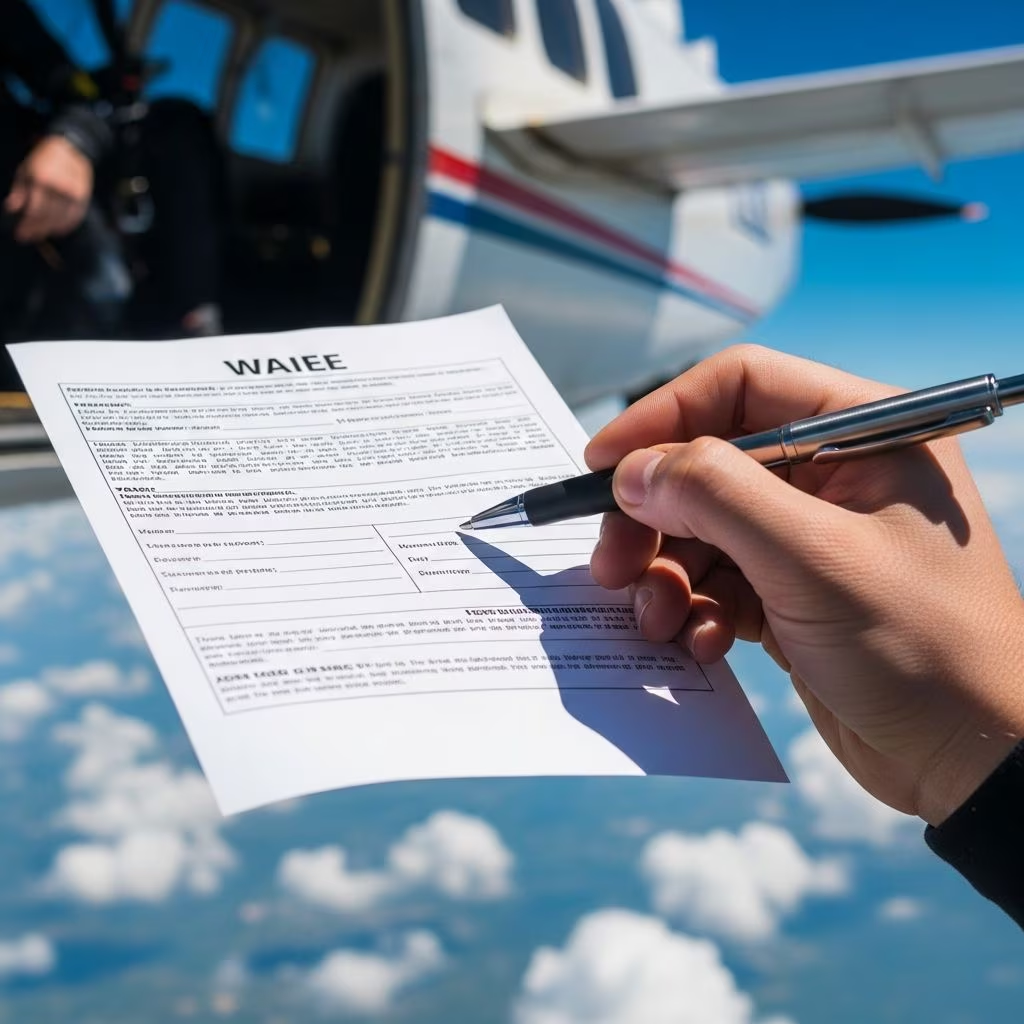
The Framework of Skydiving Risk Management Through Legal Documents
When you prepare to experience the thrill of skydiving, one of the first documents you encounter is a liability waiver. This legal instrument represents far more than routine paperwork—it embodies a fundamental agreement between you and the skydiving operation regarding the inherent dangers of the activity. Understanding what these documents accomplish, their limitations, and your residual rights is essential before you ascend to altitude.
A liability waiver in the skydiving context functions as a risk-allocation mechanism. It serves as documentation that you comprehend the extreme nature of the activity you are about to undertake and that you willingly proceed despite understanding those perils. The waiver typically addresses multiple dimensions of potential harm, from equipment-related incidents to environmental factors and human performance variables.
Dissecting the Core Components of Standard Skydiving Waivers
Most liability waivers used by skydiving facilities incorporate several essential elements that collectively create a comprehensive risk disclosure. These components work together to establish the operator’s position regarding potential liability while informing participants about the nature of the risks they face.
The Risk Acknowledgment Provision
The foundational element of any skydiving waiver is explicit recognition of the dangers inherent to the activity. This section clearly articulates that serious injury, permanent disability, or fatality can result from various causes including but not limited to equipment malfunction, human error by instructors or support staff, adverse weather phenomena, and physiological responses to altitude or acceleration. By signing this provision, you formally affirm that you understand these possibilities and accept them as part of your decision to participate.
The risk acknowledgment goes beyond vague generalizations. Comprehensive waivers itemize specific hazards such as equipment failure during deployment, incorrect body positioning during freefall, landing-related injuries, and aircraft-related incidents. This specificity serves a legal function—courts are more likely to enforce waivers that clearly delineate the particular risks involved rather than those containing broad, undefined language about “general danger.”
The Assumption of Risk Component
Distinct from merely acknowledging risks, the assumption of risk clause actively transfers responsibility for those known dangers to the participant. This section explicitly states that you understand skydiving constitutes an extreme sport and that you voluntarily elect to engage in it despite full awareness of the hazards. The language typically emphasizes your independent decision-making capacity and your freedom from coercion in participating.
Legal precedent suggests that assumption of risk clauses are particularly effective when they avoid overly technical language that might confuse participants. Courts examine whether the waiver language would be comprehensible to a reasonable person of average education, not merely to attorneys or risk management professionals. Waivers written in clear, direct terminology tend to withstand judicial scrutiny more effectively than those laden with arcane legal terminology.
The Release and Indemnification Section
Perhaps the most significant component for skydiving operators is the release and indemnification language. This section expressly releases the skydiving company, its instructors, aircraft owners, maintenance personnel, and affiliated entities from liability for injuries or fatalities. Beyond merely releasing them from responsibility, indemnification clauses often require participants to defend these parties against claims brought by others, such as family members or other injured parties.
The reach of these clauses has expanded significantly over time. Modern skydiving waivers frequently extend liability protection to equipment manufacturers, facility owners, ground support staff, and even related businesses. Some operations include “and any other parties involved in skydiving activities,” language that casts an exceptionally wide protective net. The enforceability of such broad language varies significantly by jurisdiction, with some states reluctant to validate extremely expansive indemnification provisions.
The Enforceability Question: When Waivers Hold Legal Weight
A critical misconception about skydiving waivers is that they represent absolute shields against all liability. In reality, the enforceability of these documents depends on multiple factors that courts evaluate on a case-by-case basis. Understanding when courts will enforce waivers versus when they will strike them down is vital to comprehending your actual legal position.
Jurisdictional Variations in Waiver Recognition
State law dramatically influences how courts treat skydiving waivers. Some jurisdictions have developed strong presumptions favoring the enforceability of voluntary assumption of risk agreements, particularly for extreme sports. These states reason that individuals who voluntarily engage in inherently dangerous activities have the capacity to make informed decisions about their participation and should be held to those decisions.
Other jurisdictions apply more skeptical scrutiny to waiver language. These courts examine whether the waiver’s language was sufficiently clear, whether the participant had reasonable opportunity to understand its implications, and whether the waiver violated public policy. A few states have developed legal doctrines that disfavor waivers of liability for certain categories of negligence or misconduct, limiting operators’ ability to completely insulate themselves from responsibility.
Standards Courts Apply in Evaluating Waivers
When litigation arises following a skydiving accident, courts typically apply several interpretive standards. First, they examine whether the waiver’s language clearly and explicitly addresses the type of harm that occurred. A waiver might clearly address injury risks from freefall but contain ambiguous language regarding aircraft-related incidents. Courts generally will not extend waiver language to cover unaddressed categories of injury.
Second, courts consider whether the waiver was presented under circumstances indicating genuine informed consent. Waivers rushed through immediately before jumping, those written in excessively complex language, or those inadequately explained may fail to satisfy enforceability requirements. The participant’s opportunity to read, comprehend, and question the waiver’s terms significantly affects judicial assessment of its validity.
Third, courts evaluate whether enforcement would violate public policy. Some jurisdictions maintain that certain categories of gross negligence or intentional misconduct cannot be waived because doing so would undermine fundamental public interests in safety and accountability. A skydiving operation cannot validly waive liability for deliberately using sabotaged equipment or knowingly allowing an intoxicated instructor to supervise jumps.
Critical Exceptions: When Waivers Provide No Protection
Understanding the boundaries of waiver effectiveness is just as important as understanding their general enforceability. Multiple categories of conduct fall outside the protective umbrella that waivers provide, leaving operators exposed to liability despite participants’ signatures on release documents.
Gross Negligence and Reckless Conduct
The distinction between ordinary negligence and gross negligence defines a critical boundary in waiver enforceability. While waivers typically shield operators from liability for ordinary negligence—the failure to exercise reasonable care under normal circumstances—they generally do not protect against gross negligence or reckless behavior. Gross negligence involves conduct substantially more culpable than ordinary carelessness, encompassing deliberate disregard for others’ safety or behavior so reckless that it demonstrates conscious indifference to potential harm.
Examples of gross negligence in the skydiving context might include permitting an instructor to conduct jumps while intoxicated, using equipment known to be defective despite availability of functional alternatives, or violating established Federal Aviation Administration regulations regarding jump operations. Courts distinguish these serious breaches from normal operational risks, reasoning that participants cannot effectively consent to conduct that demonstrates fundamental disregard for their welfare.
Intentional Misconduct and Fraud
Waivers cannot shield operators from liability for intentional misconduct or fraudulent misrepresentation. If an operator deliberately conceals known equipment defects, misrepresents an instructor’s qualifications, or intentionally falsifies safety records, the fraudulent conduct vitiates the waiver’s effectiveness. Courts refuse to permit parties to use contractual language to shield themselves from liability for their own dishonesty.
Similarly, if an operator makes affirmative misstatements about the safety of their operations or the expertise of their personnel, and a participant relies on those false statements in deciding to jump, a fraud claim may survive waiver language. The reasoning is straightforward: a waiver cannot protect against liability arising from the very misconduct that induced the participant to sign the waiver in the first place.
Violations of Statutory Safety Requirements
Federal and state regulations establish minimum safety standards for skydiving operations, including equipment specifications, instructor qualifications, and operational procedures. If an operator violates these statutory requirements and an injury results, waivers often provide limited protection. Courts reason that statutory requirements represent legislative judgments about acceptable risk levels, and allowing contractual waivers to override statutory safety standards would undermine the legislative purpose.
For example, if federal regulations require parachute inspection at specific intervals and an operator fails to conduct required inspections, resulting in equipment failure, the waiver provides minimal protection against liability. Courts view statutory violations as evidence of conduct beyond the scope of risks participants reasonably assumed.
Defective Equipment and Product Liability
While participants may assume risks inherent to skydiving as properly conducted, they do not reasonably assume risks from defectively manufactured parachutes or harnesses. If an accident results from a manufacturing defect in equipment rather than from operational factors, both the skydiving operator and the equipment manufacturer may face liability. Participant waivers typically cannot shield equipment manufacturers from product liability claims arising from defective products, as the manufacturer did not enter into the waiver agreement with the participant.
Your Residual Rights: What Waivers Cannot Eliminate
A fundamental misunderstanding pervades popular perception of liability waivers: the belief that signing eliminates all legal rights. This characterization is inaccurate. Waivers limit certain claims but do not erase fundamental protections against unsafe business practices, regulatory violations, or conduct falling outside the scope of assumed risks.
Protection Against Unsafe Practices
Even after signing a waiver, you retain the right to expect that the skydiving operation maintains its facilities, equipment, and aircraft in safe working condition. If the operator fails to conduct required maintenance, ignores known equipment problems, or operates in violation of safety protocols, you may have valid injury claims despite waiver language. The waiver does not transform an unsafe operation into a safe one or eliminate the operator’s duty to maintain basic safety standards.
Compliance with Regulatory Requirements
Federal, state, and local regulations establish mandatory safety requirements for skydiving operations. These regulations exist to protect the public interest in safety and cannot be waived by individual contracts. If an operator violates established regulatory requirements and you suffer injury as a result, the waiver provides limited protection. Your right to regulatory compliance cannot be waived away through contract language.
Professional Competence and Proper Training
Waivers do not permit operators to employ unqualified instructors or provide inadequate training. You retain the right to expect that personnel supervising your jump possess appropriate certifications, training, and experience. If an instructor was improperly certified, inadequately trained, or demonstrably incompetent, their negligence may fall outside waiver protection, particularly if that negligence constituted gross negligence.
How Courts Interpret Ambiguous or Problematic Waiver Language
When waiver language is unclear, ambiguous, or potentially misleading, courts typically resolve interpretive questions against the drafter—usually the skydiving operator. This principle, known as contra proferentem, reflects the policy judgment that parties drafting contracts should bear responsibility for drafting clearly.
Clarity and Specificity Requirements
Vague waivers containing undefined terms or overly broad language face heightened scrutiny. A waiver stating merely that participants assume “all risks” may fail enforcement scrutiny if it does not specifically identify the categories of risks involved. Courts prefer waivers that enumerate particular hazards, such as “injury from parachute deployment,” “landing-related trauma,” or “aircraft-related incidents,” rather than those using generalized language.
Conspicuousness and Presentation
Courts examine how waivers were presented to participants. Was the document prominent and easy to locate, or buried in fine print? Was critical liability-limiting language highlighted or drew attention through formatting, or was it obscured within paragraphs of boilerplate? Waivers presented in a manner designed to obscure their significance may not satisfy enforceability requirements, particularly regarding the most onerous terms.
FAQs Regarding Skydiving Liability and Waivers
Q: Does signing a skydiving waiver absolutely prevent me from suing?
A: No. While waivers limit liability for ordinary negligence and inherent risks, they do not shield operators from liability for gross negligence, intentional misconduct, equipment defects, statutory violations, or fraudulent misrepresentation. Your ability to sue depends on the specific circumstances of your injury and the nature of the operator’s conduct.
Q: What constitutes gross negligence in skydiving?
A: Gross negligence involves conduct substantially more culpable than ordinary carelessness, such as using sabotaged equipment, allowing an intoxicated instructor to supervise jumps, or deliberately disregarding known hazards. It demonstrates conscious indifference to participant safety rather than simple failure to exercise reasonable care.
Q: Can a skydiving operation waive liability for equipment manufactured by third parties?
A: No. Equipment manufacturers are not parties to the participant’s waiver agreement. If a defectively manufactured parachute or harness causes injury, the manufacturer may face product liability claims regardless of the participant’s agreement with the skydiving operator.
Q: Do skydiving waivers cover medical expenses?
A: Waivers do not cover or pay medical expenses. They release the operator from liability for damages, including medical costs. Responsibility for medical bills typically falls on the injured participant unless insurance coverage applies or the operator’s liability is successfully established in litigation.
Q: How do courts determine if a waiver is enforceable?
A: Courts examine multiple factors including clarity of language, opportunity for informed consent, whether the waiver was conspicuously presented, state law on waivers for extreme sports, and whether enforcement would violate public policy. Ambiguous waivers are generally interpreted against the operator.
Q: If an instructor made an error during my jump, can I sue despite signing a waiver?
A: It depends on the nature and severity of the error. Ordinary instructional mistakes typically fall within assumed risks. However, if the error constituted gross negligence—such as failing to attach equipment properly or violating fundamental safety procedures—you may retain actionable claims.
Practical Recommendations Before Signing
Given the complexity surrounding waiver enforceability and your rights, several practical considerations merit attention before you execute a skydiving waiver. First, take adequate time to read the entire document carefully. Do not permit operators to rush this process. If language is unclear, ask for clarification or seek legal counsel before signing.
Second, understand that signing a waiver does not eliminate all risk or all legal remedies. It represents a calibration of responsibility, not an absolute transfer of all liability to you. Third, verify that the skydiving operation holds current certifications, maintains required insurance coverage, and demonstrates commitment to safety protocols. Operations that pressure you to sign waivers without adequate explanation or present poorly written documents warrant skepticism about their overall safety commitment.
References
- Skydiving Liability Waiver Explained: What You Sign, Your Legal Rights — Skydive Guides. 2024. https://www.skydiveguides.com/skydiving-liability-waiver-explained/
- What Are My Legal Rights If I Am Injured During a Skydiving or Parachuting Accident? — Bart Bernard Injury Lawyers. 2024. https://bartbernard.com/what-are-my-legal-rights-if-i-am-injured-during-a-skydiving-or-parachuting-accident/
- Sports Liability Waivers and Transactional Unconscionability — Seton Hall University Law Review. Scholarship Commons. https://scholarship.shu.edu/cgi/viewcontent.cgi?article=1076&context=sports_entertainment
- Skydiving and Liability: Is It Negligence? — Smiley & Smiley Law, LLP. 2024. https://www.smileylaw.com/skydiving-and-liability-is-it-negligence/
- Legal Options for Skydiving & Parasailing Injuries — For Your Rights Legal Blog. 2024. https://www.foryourrights.com/blog/legal-considerations-for-skydiving-and-parasailing-injuries/