
Sinkhole Laws: State Rules, Insurance, Liability Guide In 2025
Navigating state-specific regulations on sinkholes: liability, insurance, and prevention strategies for property owners.
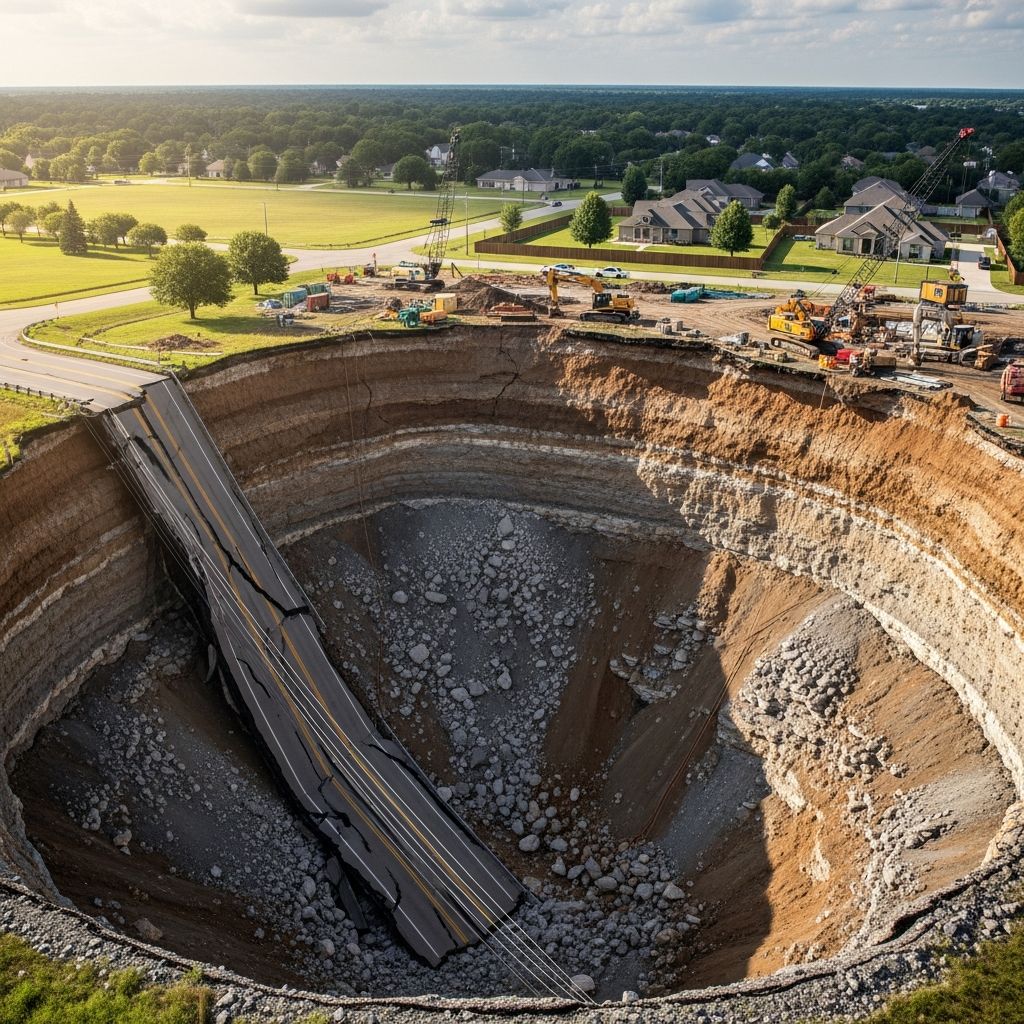
Sinkholes represent a significant geological hazard in the United States, particularly in regions with karst topography where soluble rocks like limestone underlie the surface. These sudden ground collapses can cause substantial property damage, pose safety risks, and lead to complex legal disputes. While no comprehensive national database tracks sinkhole incidents, state laws vary widely in addressing liability, insurance coverage, remediation requirements, and prevention measures. This article explores these regulations, drawing on federal proposals and state-specific approaches to provide property owners, planners, and legal professionals with actionable insights.
Understanding Sinkholes: Geological and Legal Foundations
Sinkholes form when subsurface bedrock dissolves, creating voids that eventually cause the overlying soil and structures to collapse. Factors such as heavy rainfall, drought, groundwater extraction, and human activities like mining accelerate this process. The U.S. Geological Survey (USGS) notes that no centralized database exists for sinkhole occurrences, complicating risk assessment and response efforts.
Legally, sinkholes intersect property law, insurance contracts, environmental regulations, and tort claims. Property owners may face challenges proving causation for damage, while insurers debate coverage under ‘earth movement’ exclusions. States in high-risk areas like Florida, Pennsylvania, and Texas have developed specialized statutes, often mandating insurance or disclosure in real estate transactions.
- Common Causes: Aquifer depletion, extreme weather, and mining dewatering.
- High-Risk Regions: Florida, Texas, Alabama, Kentucky, and Pennsylvania due to carbonate rock formations.
- Annual Impact: Millions in damages, though exact figures are unavailable without national tracking.
Federal Initiatives to Map and Mitigate Sinkhole Risks
Recognizing the need for better data, lawmakers have proposed federal measures to standardize sinkhole monitoring. The Sinkhole Mapping Act of 2021 (H.R. 3681), reported favorably by the House Committee on Natural Resources, directs the USGS to create a program mapping high-risk zones. This would include studying short- and long-term triggers like droughts and water management changes, culminating in public interactive maps for planners and emergency responders.
Recent efforts, such as the 2025 reintroduction by Reps. Darren Soto and Gus Bilirakis, aim to establish a national database, addressing Florida’s acute needs where porous limestone makes sinkholes commonplace. Without dedicated funding, implementation relies on existing USGS resources, estimated at $4 million over five years. Such a system could revolutionize prevention by enabling predictive modeling and informed land-use decisions.
State-Specific Insurance Mandates and Coverage Rules
Insurance is a cornerstone of sinkhole law, with states like Florida leading in mandatory coverage. Florida Statute §627.706 requires insurers offering property policies to provide sinkhole coverage or clearly disclose its absence. ‘Sinkhole loss’ is defined as structural damage to buildings from abrupt ground settlement, excluding gradual soil subsidence. Policies issued post-2011 amendments must align with statutory definitions of ‘structural damage,’ ensuring coverage for foundation cracks and wall shifts directly tied to sinkhole activity.
| State | Insurance Requirement | Key Definition | Notable Exclusions |
|---|---|---|---|
| Florida | Mandatory offer of coverage | Structural damage from sudden settlement | Earth movement, flooding |
| Texas | Optional, high-risk zones | Collapse due to subsurface erosion | Mining-related unless specified |
| Pennsylvania | No mandate; case-by-case | Nuisance if hazardous | Act of God events |
In contrast, states like New Jersey lack statewide mandates, relying on general property insurance that often excludes sinkholes. Homeowners must pursue claims under negligence or strict liability if adjacent activities contribute.
Liability and Tort Claims in Sinkhole Disputes
When sinkholes damage neighboring properties, liability hinges on causation and foreseeability. Common law claims include trespass by subsidence—where underground support is removed—or nuisance, as seen in Pennsylvania cases where quarries were deemed responsible for off-site collapses. Courts apply tests like whether the defendant knew or should have known of risks from dewatering operations.
In a landmark ruling, a Pennsylvania court denied a quarry’s mining permit extension after expert evidence linked deep excavation to nearby sinkholes, invoking statutes on health and safety hazards. Kansas law exemplifies trespass by subsidence, requiring proof of intentional entry via underground movement. Plaintiffs often succeed by demonstrating hydrological connections between defendant activities and the collapse.
- Trespass Claims: Subsidence or water intrusion without surface entry.
- Nuisance Actions: Ongoing hazards forcing agency intervention.
- Defenses: Act of God, plaintiff negligence, or statutory compliance.
Remediation Standards and Government Oversight
Addressing sinkholes requires professional intervention. The Natural Resources Conservation Service (NRCS) outlines Practice Standard 527 for sinkhole treatment, emphasizing compliance with federal, state, and local laws. Treatments involve filling voids with grout or compacted soil, but may alter local hydrology, necessitating permits and utility locates.
New Jersey’s Department of Environmental Protection classifies sinkholes as geologic, man-made, or erosion-related, advising professional engineers for remediation—no state funds are available. In mining-prone areas, agencies like Pennsylvania’s Department of Environmental Protection mandate hydrological studies before permit approvals, prioritizing public safety.
Real Estate Disclosure and Buyer Protections
Sellers in sinkhole-prone states must disclose known risks. Florida requires sellers to report prior sinkhole activity or insurance claims via standardized forms. Failure invites fraud claims. Buyers should commission Phase I environmental assessments and review USGS karst maps. In Texas, the Seller’s Disclosure Notice explicitly asks about sinkholes, shifting burden post-sale.
Preventative measures include ground-penetrating radar surveys and avoiding construction over known voids. Community planners use proposed federal maps to zone high-risk areas away from development.
Case Studies: Lessons from High-Profile Incidents
A Florida recreation area collapse injured a visitor after the owner ignored warnings, leading to a duty-to-inspect ruling. In another, a school’s karst study proved a quarry’s dewatering caused campus sinkholes, blocking permit revisions under mining laws. These underscore expert testimony’s role in litigation.
Preventing Sinkholes: Best Practices for Property Owners
Proactive steps mitigate risks:
- Monitor for cracks, tilting trees, or depressions.
- Install French drains to manage water flow.
- Consult geotechnical engineers for site assessments.
- Secure sinkhole-specific insurance where available.
- Report suspected sinkholes to local authorities and USGS.
Landowners should notify utilities before any digging and obtain permits, as per NRCS guidelines.
Frequently Asked Questions (FAQs)
What should I do if I discover a sinkhole on my property?
Secure the area, avoid entry, and contact local emergency services, a geotechnical engineer, and your insurer. Report to USGS for mapping.
Does homeowners insurance cover sinkhole damage everywhere?
No; Florida mandates coverage offers, but most states exclude it under earth movement clauses. Check policy endorsements.
Who is liable if a neighbor’s activity causes my sinkhole?
Potentially the neighbor via trespass or nuisance if causation is proven, as in subsidence cases.
Are there federal funds for sinkhole repairs?
Generally no; remediation is private responsibility, though NRCS aids conservation efforts.
How can I check if my area is sinkhole-prone?
Use state geological surveys or await federal mapping under proposed Sinkhole Mapping Act.
Future Outlook: Toward Unified National Standards
As climate change intensifies weather extremes, sinkhole frequency may rise, pressuring states to harmonize laws. Federal mapping could set benchmarks, informing insurance rates and building codes. Property owners benefit from staying informed on local statutes and leveraging high-credibility resources for protection.
References
- House Report 117-677 – SINKHOLE MAPPING ACT OF 2021 — U.S. House Committee on Natural Resources. 2022-10-17. https://www.govinfo.gov/content/pkg/CRPT-117hrpt677/html/CRPT-117hrpt677.htm
- Conservation Practice Standard Sinkhole Treatment (Code 527) — USDA Natural Resources Conservation Service. 2022-09. https://www.nrcs.usda.gov/sites/default/files/2022-09/Sinkhole_Treatment_527_NHCP_CPS_2019.pdf
- When Sinkholes Become Legal Problems — University of South Florida Digital Commons. 2018. https://digitalcommons.usf.edu/cgi/viewcontent.cgi?article=1053&context=sinkhole_2018
- Proposed federal law aims to keep better track of sinkhole locations and causes — WUSF Public Media. 2025-02-11. https://www.wusf.org/politics-issues/2025-02-11/proposed-federal-law-aims-to-keep-better-track-of-sinkhole-locations-and-causes
- When It Comes to Sinkholes, Contracts, Statutes and Regulations — Butler Legal. Undated (post-2011). https://www.butler.legal/when-it-comes-to-sinkholes/
- Sinkholes and Remediation — New Jersey Department of Environmental Protection. Undated. https://dep.nj.gov/wp-content/uploads/njgws/home/sinkholes-and-remediation.pdf
- I have (or think I have) a sinkhole on my property. What should I do? — U.S. Geological Survey. Undated (current as of 2026). https://www.usgs.gov/faqs/i-have-or-think-i-have-a-sinkhole-my-property-what-should-i-do
Similar Articles








Read full bio of medha deb




