
Revoking a Power of Attorney: Practical Legal Guide
Learn when and how to legally revoke a power of attorney, protect your rights, and notify agents and institutions the right way.
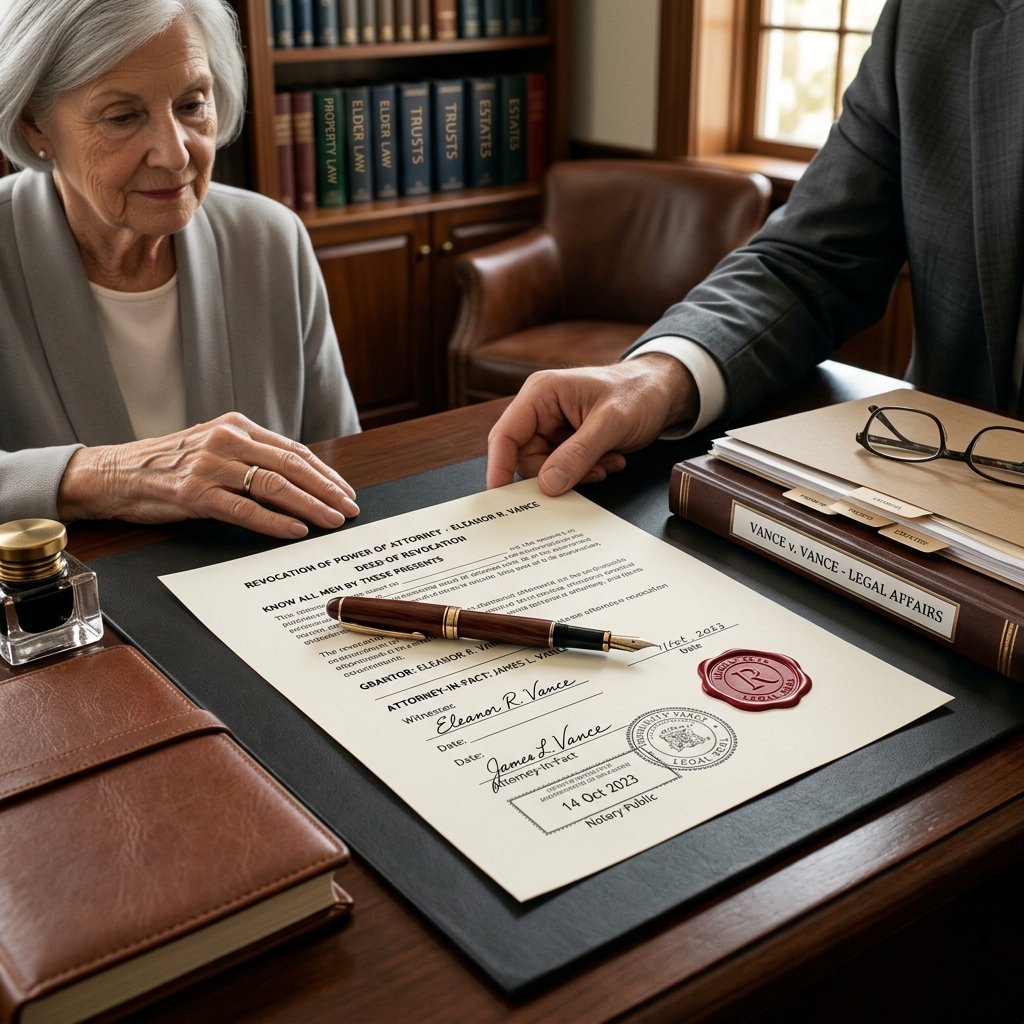
A power of attorney (POA) gives someone else authority to act on your behalf, often over finances, property, or healthcare decisions. That authority is powerful, but it is not permanent. In most jurisdictions, you can revoke a POA at any time as long as you still have legal capacity to understand your decisions. This guide explains when and how to revoke a power of attorney, what legal steps are involved, and how to make sure financial institutions, healthcare providers, and other third parties honor your revocation.
Understanding What Revocation of Power of Attorney Means
Revoking a power of attorney is the legal act of terminating the authority you previously granted to an agent or attorney‑in‑fact. Once properly revoked, the agent should no longer act on your behalf, and third parties should treat the original POA as invalid.
Key concepts
- Principal: The person who granted the power of attorney.
- Agent (attorney‑in‑fact): The person authorized to act for the principal under the POA.
- Revocation: A written or legally recognized action that cancels the agent’s authority.
- Legal capacity: Being mentally able to understand the nature and consequences of revoking the POA.
In many U.S. states, you can revoke a POA for any reason: you no longer trust the agent, your circumstances changed, you want someone else to act for you, or you simply prefer to handle matters yourself.
When Should You Consider Revoking a Power of Attorney?
There is no fixed deadline for revoking a POA as long as you still have capacity. However, certain events should prompt you to review and possibly cancel your existing POA.
Common reasons to revoke a POA
- Loss of trust: You believe your agent is mismanaging money, acting outside your instructions, or not communicating with you.
- Change in relationships: Divorce, separation, estrangement, or reconciliation may make your current choice of agent inappropriate.
- Agent unavailable: Your agent moves away, becomes ill, or is otherwise unable or unwilling to continue serving.
- Updated estate plan: You create a new estate plan or want to coordinate your POA with new wills, trusts, or healthcare directives.
- New legal needs: You require a more limited or more specialized POA, such as only for real estate or healthcare.
Regularly reviewing your POA and updating or revoking it as your life changes can prevent confusion, disputes, and potential abuse of authority.
Legal Capacity: The Threshold Question Before Revocation
Almost all states require that the principal be mentally competent at the time of revocation. Capacity means you understand the nature of the POA, what revoking it will do, and the consequences of ending your agent’s authority.
Signs you may have capacity to revoke
- You can clearly state who your agent is and what powers they currently hold.
- You can explain why you want to end those powers.
- You understand that after revocation, the agent should no longer act on your behalf.
- You are not under the influence of substances or coercion that impair judgment.
If there is doubt about capacity, courts may become involved. In some situations, a court‑appointed guardian or conservator may be able to revoke an existing POA on behalf of an incapacitated principal. Because capacity rules differ by jurisdiction, consulting a local attorney is advisable if there is any uncertainty.
Main Ways to Revoke a Power of Attorney
State law controls exactly how a POA must be revoked, but several methods are commonly recognized. Often, a written revocation is required, and in many states it must be notarized.
| Method | How It Works | Typical Requirements |
|---|---|---|
| Written revocation document | You sign a document expressly canceling the existing POA. | Often must be signed and notarized; may need filing or registration if original POA was recorded. |
| Destroying the original POA | Some jurisdictions allow deliberate destruction of the POA (burning, tearing, or canceling) with intent to revoke. | Principal must be competent and act with clear intent; still should notify the agent and third parties. |
| Creating a new POA | You sign a new POA that explicitly revokes all prior POAs. | New document must comply with local POA requirements and clearly state that earlier POAs are canceled. |
| Method described in original POA | Some POAs include their own revocation procedure (for example, written notice to the agent). | Follow the specific steps laid out in the original document, plus any statutory requirements. |
Step‑by‑Step: How to Prepare a Written Revocation
The most widely accepted method of revocation is a written document usually called a “Revocation of Power of Attorney.” Legal aid organizations, law schools, and some courts offer free forms, or you can draft your own or have a lawyer prepare it.
Essential elements of a revocation document
- Your full legal name as principal.
- Agent’s full legal name whose authority you are canceling.
- Date of the original POA and, if possible, a brief description of its scope (financial, healthcare, real estate).
- Clear statement of revocation, such as “I hereby revoke the Power of Attorney dated [date] granted to [agent].”
- Statement of capacity, confirming you are of sound mind and not under duress (often included as boilerplate).
- Your signature, ideally in front of a notary public.
- Notary acknowledgment, where required by state law.
In some states, if the original POA was filed or recorded (for example, with a register of deeds or county clerk), you must also record the revocation in the same office to make it effective as to property and public records.
Notarization, Registration, and Filing Requirements
Many jurisdictions treat revocation of a POA as seriously as creation of the POA itself. That means signatures, witnesses, and notarization requirements often mirror the rules for the original document.
Notarization
- In some states (for example, North Carolina and Texas), a written revocation must be notarized to be valid.
- A notary verifies your identity and that you signed voluntarily, which helps prevent fraudulent revocations.
- Notarizing any copies you will send to banks, healthcare providers, or land records offices adds further credibility.
Registration and filing
- If your original POA was registered with a deeds office or similar agency, a revocation often must be registered in the same place.
- For POAs affecting real estate, revocation filings help ensure that the agent’s authority is visibly terminated in public property records.
- Some legal help websites and bar associations explicitly advise filing revocations in the same county records where the original POA was filed.
Failing to notarize or file the revocation where required can leave third parties uncertain or may allow the agent to continue using an apparent authority, especially in dealings with real estate or long‑term financial arrangements.
Giving Notice: Informing the Agent and Third Parties
Revocation is not complete until the people relying on the original POA know it has been canceled. Legal aid organizations and online legal form providers emphasize the importance of actual notice to the agent and to affected institutions.
Notice to the agent
- Send a copy of the signed (and notarized, if applicable) revocation to your former agent.
- Use a delivery method that provides proof, such as certified mail with return receipt, personal delivery with a signed acknowledgment, or a reputable courier.
- Once notified, the agent should immediately stop acting under the revoked POA.
Notice to third parties
- Identify institutions that may have relied on the POA: banks, brokerages, insurance companies, hospitals, clinics, long‑term care facilities, government agencies and any property registries.
- Send each a copy of the revocation along with a request to mark the POA as canceled in their records.
- Where possible, ask for written confirmation that they have updated your file.
- If the POA relates to real estate, record the revocation in the relevant land registry or county clerk’s office.
Simply mailing a revocation without tracking can leave doubt about whether the agent or institutions received it. Several legal sources recommend methods that provide proof of delivery to avoid disputes later.
Special Situations: Registered, Durable, and Limited POAs
Not all POAs are identical. Some are “durable,” meaning they remain in effect if you become incapacitated; others are springing, limited, or tied to a specific transaction. These differences can affect how revocation works.
Unregistered vs. registered POAs
- Unregistered POA: Generally revoked by a written, notarized document, destruction of the original with intent to revoke, or methods specified in the POA itself.
- Registered POA: Often requires a notarized written revocation plus registration of that revocation in the same office where the POA was originally recorded.
Durable POAs
Durable POAs are designed to continue if you lose capacity. That makes it especially important to revoke or update them while you are still competent. Once you are incapacitated, you may no longer be able to revoke the document personally, and court involvement may be necessary.
Limited or transaction‑specific POAs
Some POAs automatically end when a specific transaction concludes (for example, the closing of a property sale). Others set a clear termination date. Nevertheless, if you want to stop the agent’s authority earlier or ensure no further use of the document, a written revocation plus notice is still advisable.
Common Mistakes to Avoid When Revoking a POA
Revocation is straightforward but not informal. Mistakes can allow an agent to continue using a POA or create confusion for banks and healthcare providers.
- Failing to use written revocation: Relying only on verbal instructions to the agent may not be enough in many jurisdictions and can be hard to prove.
- Not notifying institutions: If banks or hospitals never receive a revocation, they may still honor the old POA.
- Ignoring recording requirements: Forgetting to file revocations in land records can leave property transactions at risk.
- Revoking while capacity is questionable: A revocation made when your capacity is in dispute may later be challenged.
- Leaving copies with the agent: It is prudent to ask your former agent to return or destroy any copies of the POA after revocation.
Working With Legal Professionals and Using Standard Forms
You do not always need a lawyer to revoke a POA, but professional advice can be valuable, particularly where property, complex finances, or contested family situations are involved.
Sources of help
- Estate planning attorneys can coordinate POA revocations with wills, trusts, and healthcare directives.
- Legal aid organizations provide instructions and free revocation forms tailored to state law.
- Law school clinics sometimes publish detailed guides explaining how to revoke both registered and unregistered POAs.
- Bar associations often have public information on ending POAs and the need for written revocations.
Standard forms from credible sources reduce the risk of missing key elements, such as notary acknowledgments or statutory language. However, forms should always be reviewed in light of your local law and personal circumstances.
Frequently Asked Questions About Revoking a Power of Attorney
Can I revoke my power of attorney at any time?
In general, yes. Most jurisdictions allow you to revoke a POA at any time and for any reason, provided you are mentally competent at the time of revocation.
Do I have to use a specific form?
Many states do not require a particular form, but they do require that revocation be in writing and signed. Legal aid groups and law schools offer sample forms that meet common statutory requirements.
Is notarization always necessary?
No, but it is strongly recommended and expressly required in some jurisdictions, particularly when the original POA was notarized or recorded in public records. Notarization strengthens the legal effect and helps institutions accept the revocation.
What if my agent keeps using the revoked POA?
If your former agent continues to act after clear revocation and notice, they may be acting without authority. You can contact the institutions involved, provide the revocation and proof of notice, and consider seeking legal remedies. In serious cases, civil or criminal liability may arise. Getting legal advice promptly is important.
Does creating a new POA automatically revoke the old one?
Often a new POA will include language specifically revoking all prior POAs. When it does, this can serve as a revocation of earlier documents. However, you should still notify your former agent and relevant institutions to avoid confusion.
Who can revoke a POA if the principal is incapacitated?
Usually only the principal can revoke a POA. If the principal is incapacitated, a court‑appointed guardian or conservator may be able to revoke it, depending on local law. Court approval may be required.
Checklist: Revoking Your Power of Attorney Safely
To help you organize the process, here is a concise checklist you can follow:
- Confirm that you currently have legal capacity to understand your actions.
- Review the original POA for any built‑in revocation procedures.
- Decide whether you need a simple revocation or a new POA that replaces the old one.
- Prepare a written revocation including names, dates, and a clear statement canceling the POA.
- Sign the revocation and have it notarized if required or advisable.
- File or register the revocation in the same office where the original POA was recorded, especially for real estate.
- Send copies with proof of delivery to your former agent and all relevant institutions.
- Keep copies and delivery receipts with your estate planning records.
References
- How To Revoke a Power of Attorney — Duke Law School Health Justice Clinic. 2015-01-01. https://web.law.duke.edu/sites/default/files/clinics/healthjustice/how_to_revoke_a_power_of_attorney5.pdf
- Cancel (revoke) a Power of Attorney — Washington Law Help. 2023-06-01. https://www.washingtonlawhelp.org/en/cancel-revoke-power-attorney
- Revoking or ending a power of attorney (How-to) — Illinois Legal Aid Online. 2022-05-10. https://www.illinoislegalaid.org/legal-information/ending-power-attorney-0
- How to Cancel a Power of Attorney in New York — New York City Bar Association. 2020-09-15. https://www.nycbar.org/get-legal-help/article/wills-trusts-and-elder-law/power-attorney/ending-your-power-of-attorney/
- How Do I Cancel a Power of Attorney? A Guide for Texas Families — Law Office of John C. Ruth, PC. 2023-08-01. https://txprobatelawyer.net/how-do-i-cancel-a-power-of-attorney/
- The Importance of Revoking a Power of Attorney — Hartman Law. 2024-04-10. https://www.hartman.law/blog/2024/april/the-importance-of-revoking-a-power-of-attorney/
- Free Revocation of Power of Attorney — LawDepot. 2022-11-01. https://www.lawdepot.com/us/estate/revocation-of-power-of-attorney/
Similar Articles








Read full bio of medha deb


