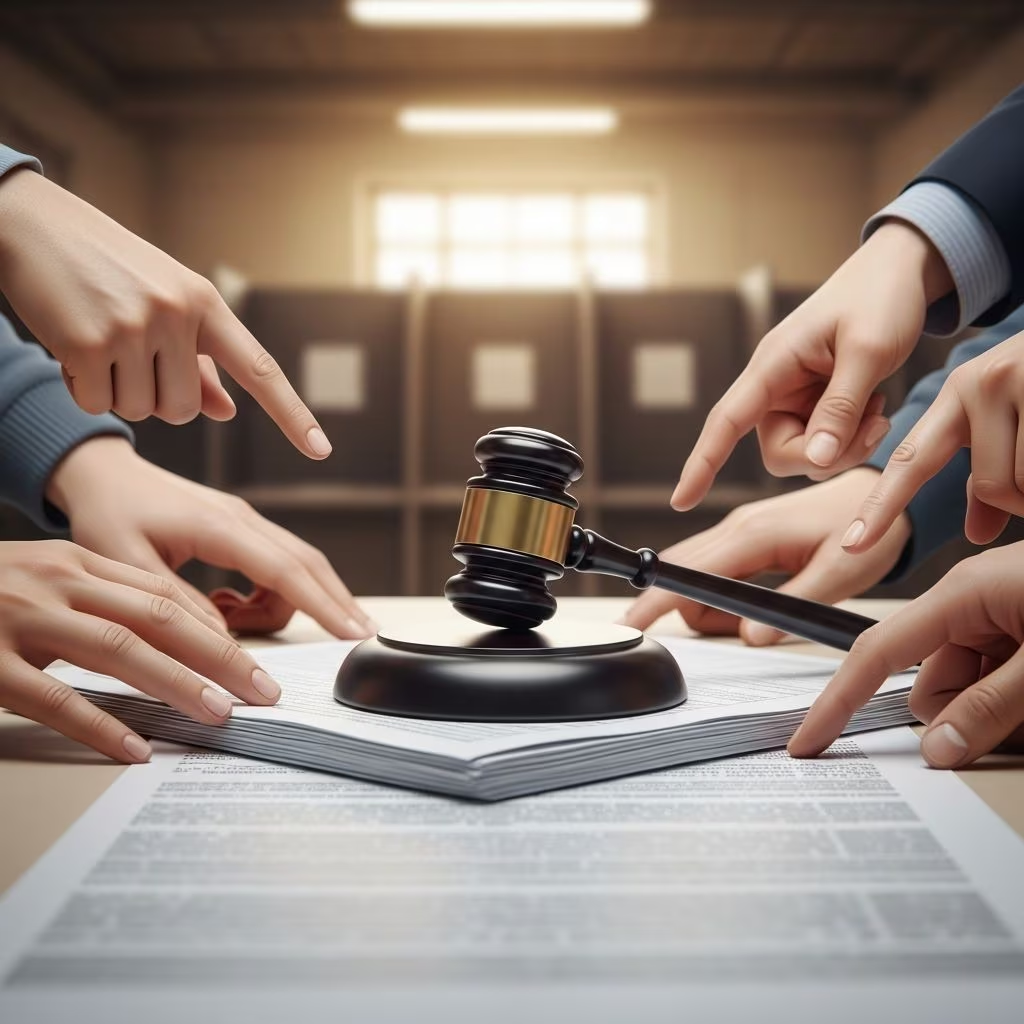
In the heart of American democracy lies a fundamental question: who gets to uphold the rules that govern our elections? While government agencies like the Department of Justice and state attorneys general play central roles, private citizens often wonder if they too can step in to ensure compliance with voter laws. This exploration delves into the legal landscape, highlighting opportunities, limitations, and real-world implications for everyday people seeking to protect the ballot box.
The Foundation of Election Law Enforcement
Election laws form a complex web of federal and state statutes designed to maintain integrity, prevent fraud, and safeguard voter access. At the federal level, statutes like the Voting Rights Act of 1965 and the Help America Vote Act establish baselines for fair elections. These laws not only outline eligibility requirements but also prohibit interference, such as intimidation or coercion. States layer their own regulations atop this framework, often with stricter penalties for violations.
Enforcement traditionally falls to official bodies. The U.S. Election Assistance Commission outlines voter rights, including the ability to cast provisional ballots and receive assistance without discrimination. Yet, when officials fall short, citizens may question their own standing to act. Historical precedents show that private actions have occasionally filled gaps left by overburdened public enforcers.
Federal Safeguards Against Voter Interference
Core to any discussion of citizen enforcement is understanding what behaviors are illegal. Federal law explicitly bans intimidating, threatening, or coercing individuals to interfere with their voting rights. This protection spans the entire electoral cycle—from registration to certification. Examples of prohibited conduct include surveilling voters, blocking access to polling sites, or following individuals to drop boxes.
Armed presence near voting locations has drawn particular scrutiny. While the Second Amendment protects carrying firearms in many public spaces, using them to create a chilling effect on voting violates these statutes. Prosecutors can pursue both criminal charges and civil remedies against such actors. State attorneys general have issued guidance reinforcing these boundaries, as seen in memoranda from Michigan and Virginia emphasizing swift enforcement.
Private Citizens’ Pathways to Action
Can an individual file a lawsuit to enforce these rules? In certain cases, yes. Federal statutes like 42 U.S.C. § 1983 allow citizens to sue state actors for depriving constitutional rights, including voting freedoms. For instance, if a local official ignores intimidation, affected voters might seek injunctive relief or damages.
However, boundaries exist. Private parties generally cannot initiate criminal prosecutions—that power resides with district attorneys. Instead, citizens report violations to authorities, who then investigate. Organizations like the Campaign Legal Center encourage immediate reporting to election officials or hotlines. In voter challenge scenarios, individuals can petition to review rolls but must adhere to the National Voter Registration Act (NVRA), which bars discriminatory or last-minute purges.
- Report suspicious activity: Contact local election offices or state hotlines promptly.
- Document evidence: Photos, videos, and witness statements strengthen cases.
- Seek federal observers: Request U.S. Department of Justice monitoring for high-risk sites.
State Variations in Citizen Involvement
Election enforcement isn’t uniform. Some states empower citizens more robustly. Virginia and Connecticut’s voting rights acts provide enhanced civil remedies beyond federal baselines. In contrast, others limit private suits to prevent frivolous litigation. A table below compares key approaches:
| State Example | Citizen Enforcement Options | Key Restrictions |
|---|---|---|
| Virginia | Civil suits under state Voting Rights Act | Must prove intentional discrimination |
| Michigan | Reporting to AG for prosecution | No direct criminal filing by citizens |
| Connecticut | Enhanced intimidation penalties | Time limits on challenges |
| Nevada | Public advisories and hotlines | Focus on official response |
These differences underscore the need for location-specific research before acting.
Challenges to Voter Rolls: A Citizen Role?
Post-election audits and list maintenance are hotspots for citizen engagement. Federal law mandates accurate rolls, prohibiting non-citizen voting under 18 U.S.C. §§ 611 and 1015. Private groups have challenged rolls, but courts scrutinize motives. The NVRA prevents mass challenges near elections if they smack of discrimination.
Recent executive actions emphasize citizenship verification, directing agencies to prioritize enforcement. Citizens can submit evidence of irregularities but risk backlash if efforts veer into harassment. Door-to-door canvassing, while protected speech, crosses into intimidation when aggressive.
Risks and Responsibilities for Vigilantes
Enthusiastic enforcement carries pitfalls. Missteps can lead to counterclaims of defamation or interference. For example, baseless accusations of fraud might violate 18 U.S.C. § 597, which bans expenditures to influence votes. Voters retain rights to privacy and non-discrimination, including language assistance.
Balanced participation means knowing limits. Citizens best serve by supporting official channels rather than vigilante justice, preserving trust in the system.
Practical Strategies for Election Protection
To contribute effectively:
- Volunteer as a poll observer through parties or non-profits.
- Monitor for disinformation on requirements—no tests or English mandates exist.
- Advocate for clear state guidelines pre-election.
- Use apps or hotlines for real-time reporting.
These steps empower without overstepping.
Frequently Asked Questions (FAQs)
Can I carry a weapon near a polling place?
State laws vary, but federal rules prohibit using arms to intimidate voters. Check local statutes and avoid loitering.
What if I see someone challenging voters aggressively?
Report to poll workers or officials immediately; do not engage directly.
Who enforces non-citizen voting bans?
Primarily the Attorney General, with states handling list maintenance per NVRA.
Can I sue my county for poor election security?
Possibly under § 1983 if rights are violated, but consult an attorney.
How do provisional ballots protect me?
They allow voting if eligibility is questioned, counted after verification.
Evolving Landscape of Election Oversight
As technology and threats evolve, so do enforcement tools. Recent guidance stresses proactive planning, like federal observers at risk sites. Citizens play a vital watchtower role, alerting authorities to gaps. Yet, the judiciary cautions against private overreach, as seen in cases dismissing unsubstantiated fraud claims.
Ultimately, robust democracy thrives on collaboration: informed citizens bolstering institutional guardians. By channeling energy through legal avenues, individuals fortify rather than fracture the process.
References
- Election Protection: Preventing and Responding to Illegal Armed Intimidation — Everytown Law. 2024. https://everytownlaw.org/report/election-protection/
- Guide to Laws Against Intimidation of Voters and Election Workers — Brennan Center for Justice. 2024. https://www.brennancenter.org/our-work/research-reports/guide-laws-against-intimidation-voters-and-election-workers
- Preserving and Protecting the Integrity of American Elections — The White House. 2025-03. https://www.whitehouse.gov/presidential-actions/2025/03/preserving-and-protecting-the-integrity-of-american-elections/
- Is Voter Intimidation Illegal? What Should I Do If I Experience It? — Campaign Legal Center. 2024. https://campaignlegal.org/update/voter-intimidation-illegal-what-should-i-do-if-i-experience-it
- What are my rights as a voter? — U.S. Election Assistance Commission. 2024. https://www.eac.gov/what-are-my-rights-as-a-voter
- 18 U.S. Code § 597 – Expenditures to influence voting — Legal Information Institute, Cornell Law School. N/A. https://www.law.cornell.edu/uscode/text/18/597