
Can Police Enter Your Home Over a Smell?
Understand when the scent of marijuana or drugs justifies a warrantless police entry into your residence and how to protect your Fourth Amendment rights.
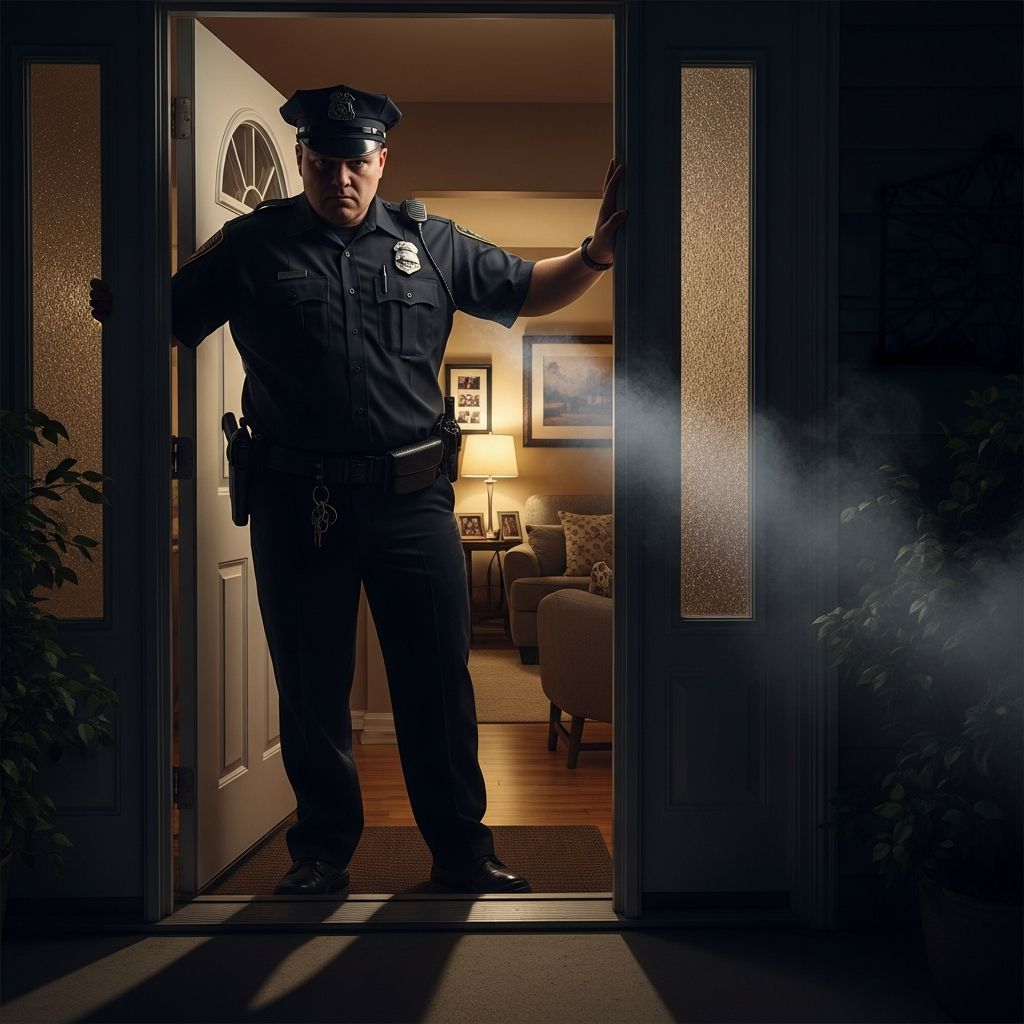
The scent wafting from your doorway can become a flashpoint in encounters with law enforcement. Officers frequently cite the unmistakable aroma of marijuana or other controlled substances as justification for entering private property without prior judicial approval. This practice raises profound questions about the balance between public safety and individual privacy rights enshrined in the U.S. Constitution.
At its core, the Fourth Amendment protects citizens from unreasonable searches and seizures, mandating that warrants be issued only upon probable cause supported by oath or affirmation. Yet, the ‘plain smell’ doctrine has evolved as a sensory extension of the plain view principle, allowing officers to act on olfactory evidence much like visible contraband. This article delves into the legal foundations, pivotal court decisions, exceptions to warrant requirements, and practical strategies for residents facing such situations.
Foundations of the Plain Smell Doctrine
The plain smell doctrine originates from longstanding precedents recognizing that senses beyond sight can provide lawful grounds for action. Just as an officer spotting drug paraphernalia in open view can seize it without a warrant, detecting a strong odor of illegal substances can establish probable cause for further investigation.
Historically, courts have upheld this approach in vehicle stops and public encounters. For homes—the most sacrosanct spaces under the Fourth Amendment—the threshold is higher. Supreme Court rulings like Payton v. New York (1980) affirm that absent consent, exigent circumstances, or hot pursuit, police must secure a warrant before crossing the threshold. However, the odor itself can serve as the probable cause needed to obtain that warrant swiftly from a magistrate.
In practice, officers often detect smells during routine interactions, such as welfare checks, noise complaints, or knocks on the door following anonymous tips. If the aroma suggests ongoing criminal activity—like marijuana cultivation or methamphetamine production—they may argue immediacy precludes waiting for judicial intervention.
Key Supreme Court Precedents Shaping Odor-Based Searches
Several landmark cases illustrate how courts evaluate smell as evidence. In Johnson v. United States (1948), the Supreme Court invalidated a warrantless entry based solely on an officer’s claim of opium odor, emphasizing the need for neutral magistrate review. This set a precedent that subjective sensory perceptions require corroboration.
Conversely, United States v. Ventresca (1965) validated affidavits relying on officers’ trained noses for probable cause, provided the smell was particularized to the premises. More recently, in the vehicle context, Illinois v. Caballes (2005) permitted dog sniffs during lawful traffic stops, reinforcing that odors in less protected spaces like cars lower the privacy expectation.
For homes, the doctrine’s application hinges on context. A faint whiff might not suffice, but pervasive fumes indicating active processing often do. State variations abound; for instance, post-legalization jurisdictions are reevaluating marijuana’s odor as inherently indicative of illegality.
When Does Smell Alone Justify Warrantless Entry?
Not every detected odor greenlights immediate entry. Courts demand ‘exigent circumstances’—urgent situations where delay risks evidence destruction, suspect flight, or imminent harm. The smell of burning marijuana might signal destruction of evidence if smoke suggests active consumption, prompting entry to secure the scene.
Consider these common scenarios:
- Active Destruction: Officers hear flushing toilets or smell fresh-burnt drugs, indicating evidence tampering.
- Production Hazards: Chemical odors from meth labs pose explosion or toxicity risks, creating public safety exigencies.
- Hot Pursuit: Chasing a suspect into a home where odor is detected extends the chase legally.
- Emergencies: Fumes suggesting gas leaks or overdoses justify welfare checks.
Without such factors, mere smell typically mandates a warrant. Anonymous tips reporting odors rarely suffice alone; they need corroboration, as per Illinois v. Gates (1983) totality-of-circumstances test.
State Variations and the Marijuana Legalization Impact
With over 20 states legalizing recreational cannabis by 2026, the plain smell doctrine faces challenges. In legalization states like Colorado and California, courts increasingly rule that marijuana odor does not inherently signal crime, mirroring alcohol’s legal status.
For example, Illinois courts post-legalization have suppressed evidence from smell-alone searches, deeming it insufficient probable cause. Conversely, in prohibition states, the doctrine remains robust. Emerging legislation, such as Georgia’s HB496, proposes limiting marijuana smell as standalone probable cause, reflecting shifting national attitudes.
This patchwork creates confusion. Visitors from legal states carrying personal amounts might face scrutiny in restrictive ones, where odor trumps possession limits.
| State Type | Marijuana Odor as Probable Cause | Key Ruling/Example |
|---|---|---|
| Legal Recreational | Often Insufficient Alone | People v. Ziedan (IL, 2022) |
| Medical Only | Context-Dependent | State v. Buller (KS, 2021) |
| Full Prohibition | Strong Indicator | US v. Thomas (6th Cir., 2019) |
Vehicle Searches: A Lower Bar
Cars enjoy lesser Fourth Amendment protection due to their mobility, per Carroll v. United States (1925). Thus, marijuana smell frequently authorizes immediate vehicle searches without warrants nationwide, even in legal states for exceeding limits or underage possession.
Recent trends show softening; Minnesota courts, for instance, now require more than odor post-legalization. Drivers should note that passengers’ rights complicate group stops.
Protecting Your Rights During an Odor Encounter
Knowledge empowers. If officers knock citing a smell:
- Do Not Consent: Politely decline entry without a warrant. Say, “I do not consent to any searches.”
- Document Everything: Note times, names, badge numbers, and statements via video if safe.
- Ask for Warrant: Insist on seeing it; telephonic warrants are valid in many jurisdictions.
- Remain Calm: Avoid resistance, which could escalate to arrest.
- Contact Counsel: Invoke your right to an attorney immediately.
Post-incident, challenge the search’s legality. Motion to suppress evidence if probable cause or exigency lacks, potentially dismissing charges.
Common Myths About Odor and Police Powers
Myth 1: Any smell equals automatic entry. Reality: Homes demand higher justification than vehicles.
Myth 2: Legal weed erases all odor issues. Reality: Impairment, excess amounts, or sales remain prosecutable.
Myth 3: Anonymous tips override privacy. Reality: They require verification.
Frequently Asked Questions
Can police search my car just for smelling weed?
Yes, in most states, vehicle searches based on marijuana odor are permissible without a warrant due to reduced privacy expectations.
What if I live in a legal state?
Odor alone often insufficient for homes; courts assess if it indicates illegal activity beyond possession.
Does a knock-and-talk allow entry on smell?
No, unless you consent or exigency exists; they must leave to get a warrant otherwise.
Can I be arrested for smell alone?
Rarely; probable cause for search doesn’t always mean immediate arrest without evidence.
What about burnt vs. raw marijuana smell?
Burnt often suggests consumption/destruction, heightening exigency claims.
Recent Developments and Future Outlook
As of 2026, federal rescheduling of marijuana to Schedule III undermines its criminal odor profile. States continue diverging, with some mandating warrants for smell-based home entries. Advocacy groups push for uniform reforms, arguing outdated doctrines clash with legalization realities.
Homeowners should stay informed via legal updates, as precedents evolve rapidly.
References
- Can Police Search Me Based on an Odor? — Milwaukee Criminal Defense Law Firm (Jason Baltz). 2023-04-01. https://www.milwaukeecriminaldefenselawfirm.com/blog/2023/april/can-police-search-me-based-on-an-odor-/
- Was warrantless search by sheriff after marijuana smell report legal? — Justia Ask A Lawyer. 2025-06-06. https://answers.justia.com/question/2025/06/06/was-warrantless-search-by-sheriff-after-1063684
- Will the smell of marijuana alone no longer count as probable cause for a search? — FOX5 Atlanta (YouTube). 2023. https://www.youtube.com/shorts/85iOEDD1gzs
Similar Articles








Read full bio of medha deb




