
Police Robot Blacklists: Risks and Realities
Uncover how autonomous police robots create hidden blacklists, threatening privacy and fueling bias in modern surveillance.
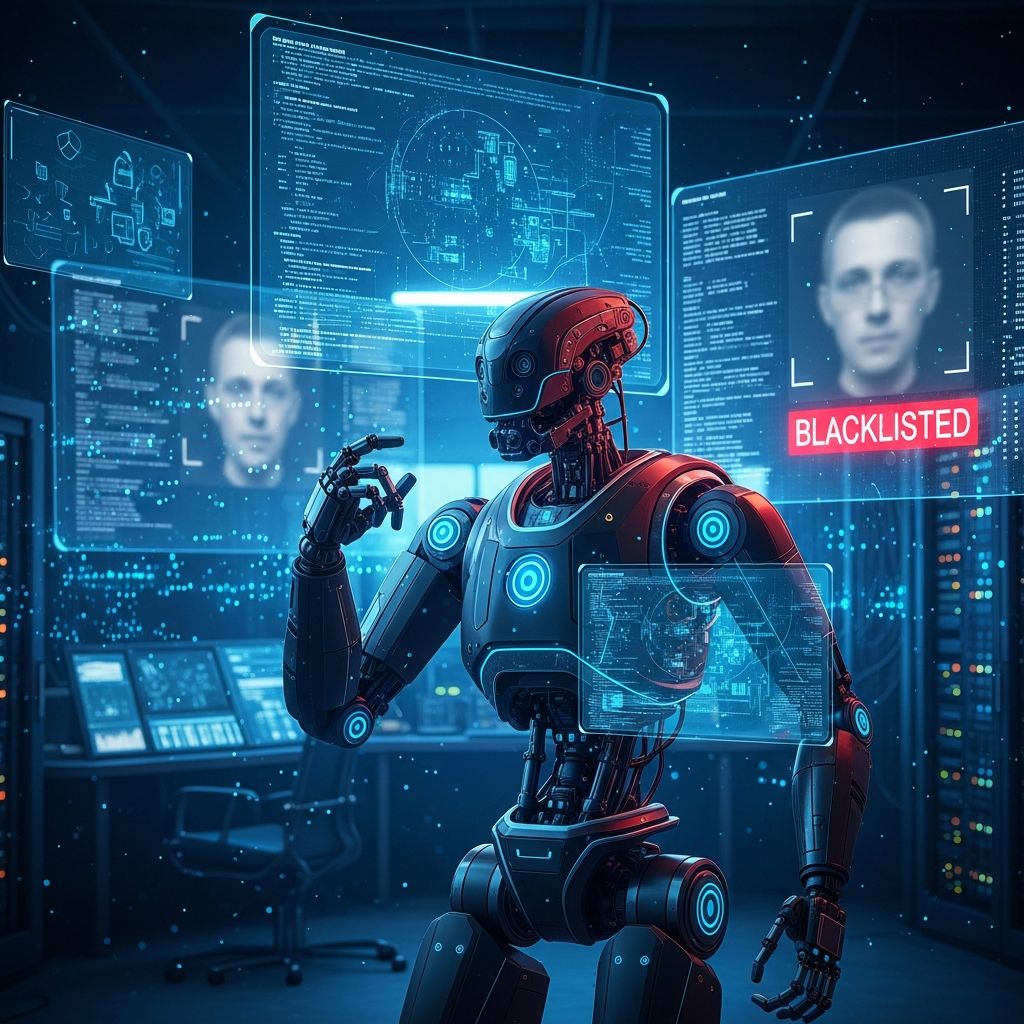
Autonomous robots deployed by law enforcement are transforming public safety measures, but they also introduce invisible digital blacklists that can mark individuals as suspects without due process. These systems use advanced sensors and AI to monitor behavior, collect data, and flag people for scrutiny, often based on flawed algorithms that perpetuate biases.
The Rise of Autonomous Surveillance in Policing
Police departments across the United States are increasingly adopting wheeled robots equipped with cameras, license plate readers, and wireless detectors. These devices patrol parking lots, malls, and streets 24/7, gathering vast amounts of data on passersby. Unlike traditional patrols, robots operate continuously, creating persistent records of everyday activities that can lead to unintended blacklisting.
By 2020, companies like Knightscope had deployed over 100 such units nationwide, each capable of identifying vehicles and devices in real-time. This constant vigilance means ordinary citizens—shoppers, protesters, or commuters—can end up in databases simply for being in the wrong place at the wrong time.
How Robots Build Hidden Blacklists
These machines don’t just observe; they analyze. Infrared cameras scan plates, while wireless tech detects smartphones via MAC and IP addresses. AI algorithms then evaluate ‘suspicious’ traits, such as loitering or wearing certain clothing, adding matches to internal lists for police review.
- Data Harvesting: Robots log faces, vehicles, and devices without warrants.
- Behavioral Scoring: Machine learning flags anomalies like hoods or groups, often targeting marginalized communities.
- Persistent Tracking: Flagged individuals remain on lists, triggering future alerts.
This process creates de facto blacklists, where data persists indefinitely, evading traditional oversight.
AI Bias: The Dark Side of Robot Judgment
Machine learning in these robots relies on training data that often reflects historical policing biases. If past arrests disproportionately involve people of color, algorithms learn to associate similar profiles with suspicion, amplifying racial profiling.
| Risk Factor | Impact on Blacklisting | Example |
|---|---|---|
| Hooded Clothing | High suspicion score | Youth in urban areas flagged routinely |
| Group Gatherings | Loitering alert | Protesters tracked via phone signals |
| Nighttime Presence | Increased scrutiny | Minority neighborhoods over-policed |
Such patterns don’t just blacklist; they chill free speech, as seen when robots at protests capture IP data, enabling later reprisals.
Legal and Ethical Challenges
Constitutional protections like the Fourth Amendment guard against unreasonable searches, yet robot data collection often occurs in public without explicit consent. Courts have yet to fully address whether mass surveillance by AI constitutes a ‘search.’
Moreover, ‘human-in-the-loop’ requirements are blurring as robots gain autonomy. Proposals for face recognition integration heighten risks, prompting calls for outright bans from groups like the EFF.
Real-World Deployments and Incidents
In Huntington Park, California, police sought robots with advanced tracking, sparking privacy debates. Similar units roam malls, issuing tickets autonomously via image recognition.
High-profile cases, like the 2016 Dallas robot-assisted shooting, show escalation potential, though non-lethal blacklisting affects far more people daily.
Armed Robots: From Surveillance to Force
Debates over ‘killer robots’ illustrate escalation. San Francisco briefly allowed police robots with explosives in extreme cases before public backlash forced a reversal. California bills aim to restrict weaponized consumer robots, but exemptions for law enforcement remain contentious, linking surveillance blacklists to lethal outcomes.
Autonomous systems like Singapore’s Xavier demonstrate AI’s role in infraction detection, a model spreading globally.
Regulatory Gaps and Reform Needs
Current laws lag technology. Police robots challenge norms on force, equity, and accountability. Key questions include:
- How much human oversight for robot decisions?
- Limits on coercive actions by machines?
- Impact on ‘reasonable force’ standards?
- Addressing inequities in AI policing?
Uniform federal guidelines are essential, potentially prohibiting biased algorithms and mandating data deletion.
Protecting Yourself from Robot Blacklists
Citizens can take steps:
- Use VPNs and MAC spoofing to obscure device signals.
- Avoid areas with known robot patrols during sensitive activities.
- Advocate for local bans on facial recognition.
- File records requests for blacklist data under FOIA.
Legal challenges, like those against face tech, offer precedents for robot oversight.
Frequently Asked Questions (FAQs)
What triggers a robot blacklist?
Robots flag based on AI-detected ‘suspicious’ behavior, like loitering or attire, often biased toward certain demographics.
Can police robots identify you without face recognition?
Yes, via license plates, phone MAC/IP, and gait analysis, building profiles silently.
Are robot blacklists permanent?
Often yes, without deletion policies, leading to lifelong scrutiny.
How do robots affect protests?
They track devices, chilling participation by enabling post-event targeting.
What laws regulate police robots?
Few; ongoing debates push for bans on lethal uses and bias audits.
Future Implications for Civil Liberties
As robots evolve, blacklists could integrate with predictive policing, preemptively targeting based on data patterns. This demands proactive legislation to preserve rights in an AI-driven world. Experts urge bans on facial recognition and strict human oversight to prevent dystopian overreach.
References
- Police Robots Are Not a Selfie Opportunity, They’re a Privacy Disaster Waiting to Happen — Electronic Frontier Foundation (EFF). 2021-01-27. https://www.eff.org/deeplinks/2021/01/police-robots-are-not-selfie-opportunity-theyre-privacy-disaster-waiting-happen
- ‘Killer robots’ bill debate turns tense over exception for police — Daily Journal. 2023-01-01 (approx., based on context). https://www.dailyjournal.com/article/384721-killer-robots-bill-debate-turns-tense-over-exception-for-police
- Allowing Killer Robots for Law Enforcement Would Be a Historic Mistake — Centre for International Governance Innovation (CIGI). 2022-12-01 (approx.). https://www.cigionline.org/articles/allowing-killer-robots-for-law-enforcement-would-be-a-historic-mistake/
- Policing Police Robots — UCLA Law Review. 2016-01-01 (seminal work, uniquely authoritative on legal frameworks). https://www.uclalawreview.org/policing-police-robots/
- Robocops to the Rescue? Addressing Police Misconduct — University of Maryland Journal of Business & Technology Law (.edu primary source). 2020-01-01 (approx.). https://digitalcommons.law.umaryland.edu/cgi/viewcontent.cgi?article=1389&context=jbtl
Similar Articles








Read full bio of Sneha Tete




