
Police Authority Over Press at Crime Scenes
Understanding when law enforcement can restrict journalists from crime scenes and the legal protections that apply.
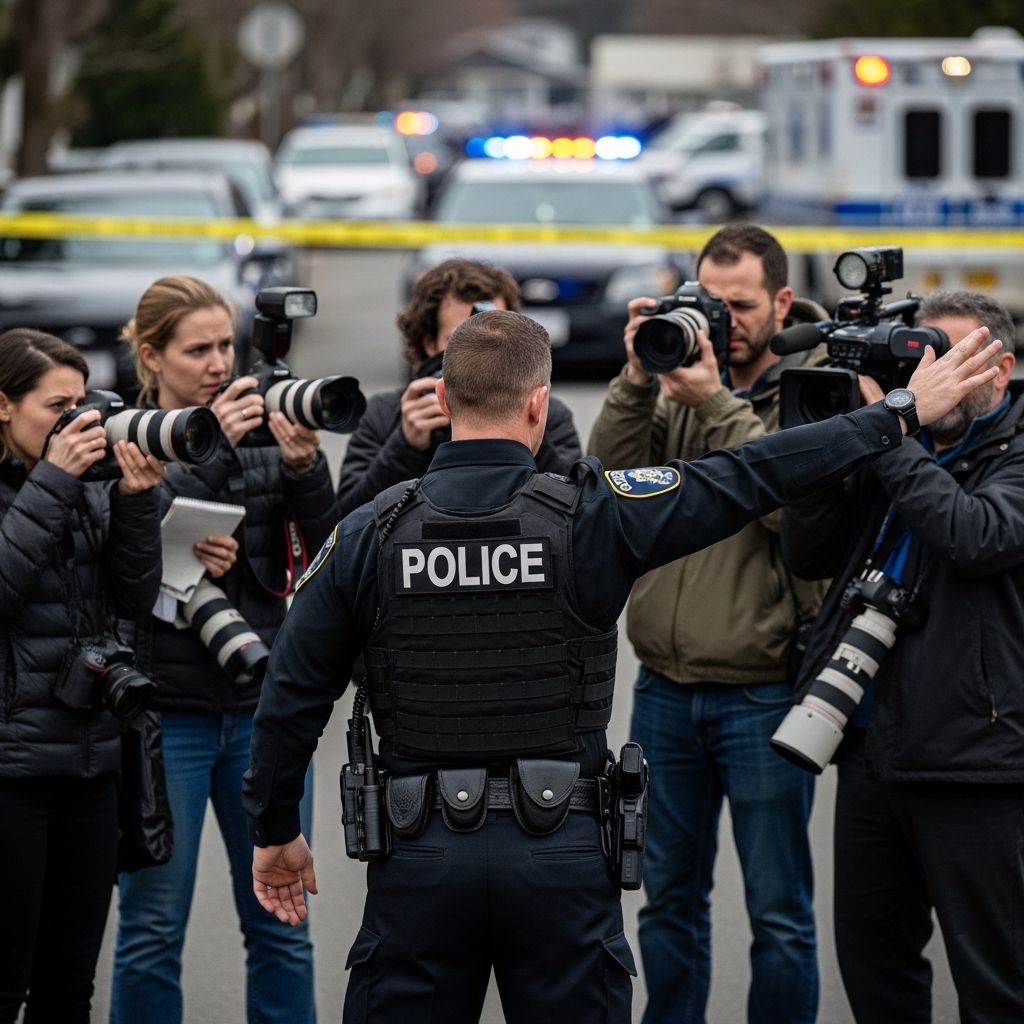
Law enforcement often secures crime scenes to protect evidence, ensure public safety, and facilitate investigations, but this can conflict with journalists’ needs to report events. While police have significant authority to control access, constitutional protections and some state laws impose limits on blanket denials to the press.
Constitutional Foundations: First and Fourth Amendments
The
First Amendment
safeguards freedom of the press, yet courts have consistently ruled that journalists hold no greater right of access to non-public areas like active crime scenes than the general public. In a notable federal case, a court rejected a photographer’s claim after he left his vehicle on a freeway to photograph a crash, emphasizing that such actions disrupted emergency responses.This ruling highlighted that common sense restricts public movement in hazardous zones, such as freeways during accidents, regardless of press status. However, if a journalist remains in a public vantage point without interfering, restrictions may violate free speech protections.
The
Fourth Amendment
protects against unreasonable searches and seizures, applying to journalists during detentions or arrests at scenes. Police must have probable cause for arrests; mere presence or photography from lawful positions typically does not suffice unless interference occurs.Distinctions Between Crime Scenes, Accidents, and Disasters
Police discretion varies by incident type. At
crime scenes
, where evidence preservation is paramount, authorities enjoy broad latitude to exclude everyone, including media, without special press access rights under federal law.In contrast,
accident and disaster sites
may trigger state-specific protections. California Penal Code § 409.5(d) mandates access for authorized news representatives to such closed areas unless it interferes with operations. Courts interpret this to require unrestricted entry barring reasonable determinations of hindrance, and any limits must be minimal and temporary.Ohio and New York offer similar safeguards: Ohio for disasters and New York via its Right to Monitor Act, allowing recording of police unless probable cause for interference exists.
| Incident Type | Federal Baseline | State Examples |
|---|---|---|
| Crime Scene | No special press access | Limited; broad police control |
| Accident/Disaster | Public access only | CA §409.5(d): Press entry required unless interfering |
| Protest/Public Event | Right to observe/record | NY Civil Rights Law: Anti-retaliation |
Key Court Cases Shaping Access Rules
Federal and state precedents clarify boundaries. In Chavez v. City of Oakland, a photographer’s arrest on a freeway was upheld because his vehicle obstructed fire access, not due to his press role. The court noted potential claims if parked legally off-road.
New Jersey’s State v. Lashinsky convicted a photographer for disorderly conduct after ignoring orders amid an accident, stressing ‘reasonable’ police directives. Conversely, a New Hampshire case freed a photographer filming from a compliant distance, deeming further limits unconstitutional.
California’s Leiserson v. City of San Diego reinforced Penal Code protections, allowing restrictions only if access demonstrably interferes with emergencies.
- Federal Limit: No absolute press right beyond public.
- State Enhancement: CA, OH provide qualified access.
- Interference Key: Actual disruption justifies exclusion.
Practical Guidelines for Journalists
To minimize confrontations, media professionals should follow best practices drawn from legal experts.
- Carry valid credentials at all times to identify as press.
- Obey police lines and avoid private property or marked exclusion zones.
- Do not remove items from scenes, risking theft charges.
- Comply with orders promptly, even if disputable, to avoid arrest; challenge later legally.
- Park vehicles safely off active lanes; use public vantage points for observation.
- Record interactions calmly, invoking rights without argument.
Press pens offer safer access during large events, though credentials alone do not guarantee entry.
Police Perspectives and Challenges
Officers balance scene integrity with public information needs. Broad ‘press’ definitions—encompassing freelancers and citizen journalists—complicate enforcement. Interference via blocking paths or equipment can justify removals.
Post-arrest, charges like trespass or disorderly conduct often arise, but many dismiss upon review recognizing journalistic intent.
Recent Developments and Broader Implications
Tensions peaked during 2020 protests, prompting lawsuits and restraining orders against targeting journalists without cause. Such rulings reinforce that police cannot retaliate for recording or reporting.
As of 2024, guides emphasize Fourth Amendment safeguards against unwarranted searches at scenes. Evolving tech like drones raises new questions, but core principles persist: non-interfering public observation is protected.
Frequently Asked Questions
Can police arrest a journalist for photographing a crime scene?
Yes, if inside restricted areas or interfering; no, if from public spaces without disruption. Probable cause required.
Does the First Amendment guarantee press entry to crime scenes?
No; access equals public’s, subject to reasonable restrictions.
What California law protects journalists at disasters?
Penal Code § 409.5(d) requires access unless interfering with operations.
Are citizen journalists afforded same rights?
Functional equivalent; broad definitions apply, but credentials aid identification.
What if police search a journalist’s equipment?
Fourth Amendment bars without warrant or exceptions like imminent harm.
Navigating Tensions for Better Outcomes
Stakeholders benefit from mutual respect: police secure scenes effectively, journalists inform publicly. Training on rights/restrictions fosters cooperation, reducing litigation.
Journalists asserting rights post-compliance preserve claims; police documenting interference strengthens positions. Ongoing dialogue via organizations like NPPA aids evolution.
References
- U.S. Court Rejects Journalist’s First and Fourth Amendment Claims — Davis Wright Tremaine. 2009-06-02. https://www.dwt.com/insights/2009/06/us-court-rejects-journalists-first-and-fourth-amen
- Journalists, Know Your Rights at Police Scenes, Protests — National Press Foundation. N/A. https://nationalpress.org/topic/covering-protests-journalist-police-relationship-mickey-osterreicher/
- Avoiding Crime Scene Confrontations — Student Press Law Center. 2011-09. https://splc.org/2011/09/avoiding-crime-scene-confrontations/
- For Reporters Confronted by Police — Reporters Committee for Freedom of the Press. 2000. https://www.rcfp.org/journals/the-news-media-and-the-law-summer-2000/reporters-confronted-police/
- Policing Press Freedom — Knight First Amendment Institute. N/A. https://knightcolumbia.org/content/policing-press-freedom
- Guide to Legal Rights in the U.S. — Committee to Protect Journalists. 2024-07. https://cpj.org/2024/07/guide-to-legal-rights-in-the-u-s-2/
- Police & Press Interactions: A Legal Understanding — Lexipol. N/A. https://www.lexipol.com/resources/blog/police-press-interactionsa-legal-understanding/
Similar Articles








Read full bio of Sneha Tete




