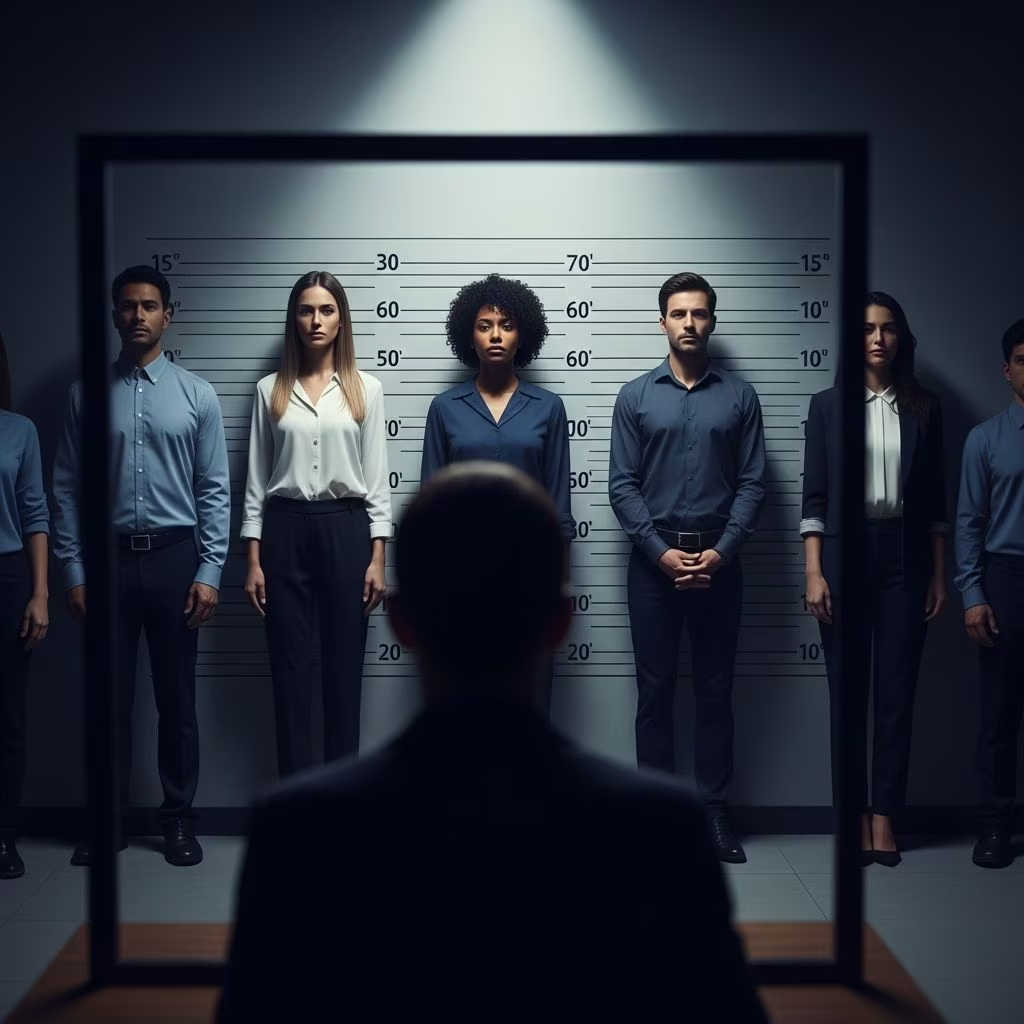
Police lineups serve as a cornerstone of criminal investigations, enabling eyewitnesses to identify potential perpetrators from a group of individuals. These procedures balance the need for effective law enforcement with fundamental constitutional protections to prevent misidentification and ensure fairness. Governed by U.S. Supreme Court precedents and departmental guidelines, lineups have evolved to incorporate safeguards against suggestiveness and error.
Understanding the Fundamentals of Identification Procedures
At their core, identification procedures help law enforcement narrow down suspects by relying on human memory. A standard lineup places a suspect alongside several non-suspects, known as fillers, allowing witnesses to select who they believe committed the crime. This method contrasts with less formal approaches and is designed to test the reliability of eyewitness accounts without undue influence.
Historically, lineups have been integral to investigations, but psychological research reveals that memory is fallible, influenced by stress, lighting, and time elapsed since the incident. Courts scrutinize these procedures to uphold due process, ensuring identifications are not tainted by police conduct.
Types of Lineups and Their Applications
- Live Lineups: Involve physical participants standing before the witness, typically 5-6 individuals including one suspect and fillers matched for age, build, and ethnicity.
- Photo Lineups: Present photographs or digital images, often sequentially rather than simultaneously, to reduce bias; common due to practicality and safety.
- Showups: Single-suspect presentations, used immediately post-crime for fresh memories but riskier due to lack of comparison options.
- Video Lineups: Emerging digital formats where participants appear on screen, allowing remote viewing and recording for transparency.
Each type carries unique risks and benefits. Live lineups offer dynamic cues like movement but demand resources, while photo arrays are efficient yet prone to clothing or pose discrepancies. Showups, though expedient, are admissible only if justified by exigent circumstances, as they heighten misidentification chances.
Step-by-Step: Conducting a Fair Lineup
Proper execution minimizes suggestiveness. Officers first secure witness consent and instructions emphasizing no obligation to identify anyone. Fillers resemble the suspect physically to avoid spotlighting. The witness views the lineup blindly—without knowing the suspect’s position—and provides confidence levels post-selection.
Recording is mandatory: video for live lineups captures interactions verbatim. Post-identification, witnesses detail their certainty, which prosecutors later evaluate for trial admissibility. Departures from protocol, like filler mismatches or hints, invite suppression motions.
| Step | Description | Best Practice |
|---|---|---|
| 1. Preparation | Select fillers and arrange lineup | Match demographics; blind administrator |
| 2. Witness Briefing | Explain process neutrally | Avoid guarantees of suspect presence |
| 3. Viewing | Present array/lineup | No coaching; sequential if photos |
| 4. Selection | Witness chooses or rejects | Record exact words and confidence |
| 5. Documentation | Log entire procedure | Video/audio; separate witnesses |
Constitutional Rights in Lineups: A Critical Overview
The Sixth Amendment guarantees counsel at ‘critical stages’ of prosecution, a category including post-indictment lineups per United States v. Wade (1967). Absent attorney presence, in-court identifications stemming from such lineups are inadmissible unless an independent source exists. Pre-indictment lineups, however, fall outside this protection, as affirmed in Kirby v. Illinois (1972).
Due process under the Fifth and Fourteenth Amendments prohibits ‘unnecessarily suggestive’ procedures fostering irreparable misidentification. Factors include lineup composition, officer comments, and witness feedback. Even valid pre-charge identifications may be suppressed if overly coercive.
The Fifth Amendment shields against compelled testimonial acts, but mere standing or speaking neutral phrases in a lineup is nontestimonial, thus permissible without Miranda warnings. Voice exemplars, if not incriminating content, similarly evade self-incrimination claims.
Right to Counsel: When and Why It Applies
Counsel’s role ensures fairness: observing composition, objecting to irregularities, and noting witness behavior. Post-Wade and Gilbert v. California, denial at critical stages taints fruit-of-the-poisonous-tree evidence. Defendants must invoke this right explicitly; silence waives it in non-critical pre-charge scenarios.
Practical benefits extend beyond mandates: attorneys prevent filler disparities or pre-lineup suspect spotlighting, bolstering evidentiary integrity. Refusal to participate may prompt court-ordered appearances, balancing rights with public safety.
Common Pitfalls and Challenges in Lineup Procedures
Suggestive practices undermine reliability: unique suspect attire, police hints like ‘we caught the guy,’ or group viewings where witnesses influence each other. Fillers too dissimilar—e.g., height mismatches—draw undue attention.
Psychological biases compound issues: witnesses confident in flawed IDs due to feedback. Reforms advocate double-blind administration (unknown suspect to officer) and confidence statements before contamination. Illegal arrests don’t automatically void lineups, but taint subsequent identifications.
- Avoided Errors: No ‘right choice’ confirmations post-pick.
- Witness Separation: Prevents cross-contamination.
- Neutral Instructions: ‘The perpetrator may not be present.’
Legal Consequences of Improper Lineups
Violations trigger remedies: suppression of out-of-court IDs and related testimony unless independently sourced (e.g., prior sightings). Courts weigh totality: opportunity to view, attention level, description accuracy, certainty, and time lag. Prosecutors bear the burden, often facing motions to suppress.
Wrongful convictions highlight stakes—hundreds exonerated via DNA after lineup-based IDs. Jurisdictions mandate reforms aligning with National Institute of Justice standards for reliability.
Modern Reforms and Best Practices
Evidence-based guidelines promote sequential photo arrays over simultaneous, reducing relative judgment errors. Video recording, filler databases, and administrator blinding are now standard in progressive departments. Some states legislate these via lineup statutes.
For suspects: Invoke counsel promptly, document irregularities, and challenge suggestiveness. Attorneys may request private lineups or motions for independent ones pre-trial.
Frequently Asked Questions (FAQs)
Do I have the right to an attorney during a police lineup?
Yes, post-indictment lineups are critical stages under the Sixth Amendment, entitling you to counsel. Pre-indictment, it’s not constitutionally required but advisable to request one.
What if I refuse to participate in a lineup?
Officers may seek a court order; physical resistance risks charges. Cooperation under safeguards protects your interests better.
Can a showup identification be used in court?
Yes, if exigent and not unduly suggestive, with clear independent source for in-court use.
How many fillers should be in a lineup?
Typically 4-5 for live (total 5-6), 5+ for photos, matching suspect description closely.
What makes a lineup unfairly suggestive?
Disparate appearances, officer cues, unique clothing, or prior suspect exposure.
Empowering Suspects: Practical Advice
Upon lineup notification, demand counsel and recording. Note lineup details for your attorney: participant numbers, witness reactions, instructions given. Post-procedure, avoid discussing with police sans lawyer. These steps fortify defenses against flawed evidence.
Lineups remain vital yet scrutinized tools. Adhering to constitutional mandates and reforms ensures justice: convicting the guilty while exonerating the innocent.
References
- Constitutional Ramifications of the Police Lineup — Villanova Law Review. 1967. https://digitalcommons.law.villanova.edu/cgi/viewcontent.cgi?article=1749&context=vlr
- What Is a Line-Up and Show Up? — Adam Thompson Law. 2023. https://www.adamthompsonlaw.com/raw-law/What-Is-a-Line-Up-and-Show-Up.php
- Lineups and Other Identification Situations and Right to Counsel — Constitution Annotated, Congress.gov. 2024-06-12. https://constitution.congress.gov/browse/essay/amdt6-6-3-4/ALDE_00013440/
- Lineup — Legal Information Institute, Cornell Law School. 2024. https://www.law.cornell.edu/wex/lineup
- 241. Lineup—Due Process — U.S. Department of Justice. 2024. https://www.justice.gov/archives/jm/criminal-resource-manual-241-lineup-due-process
- Lineups and Showups — Alameda County District Attorney’s Office. 2022. https://le.alcoda.org/publications/point_of_view/files/F11_LINEUPS.pdf
- Police Lineups: Making Eyewitness Identification More Reliable — National Institute of Justice. 2023-10-17. https://nij.ojp.gov/topics/articles/police-lineups-making-eyewitness-identification-more-reliable