
Police Dog Sniffs and the Fourth Amendment
Understanding when police canine sniffs are lawful, when they cross the constitutional line, and how courts draw that boundary.
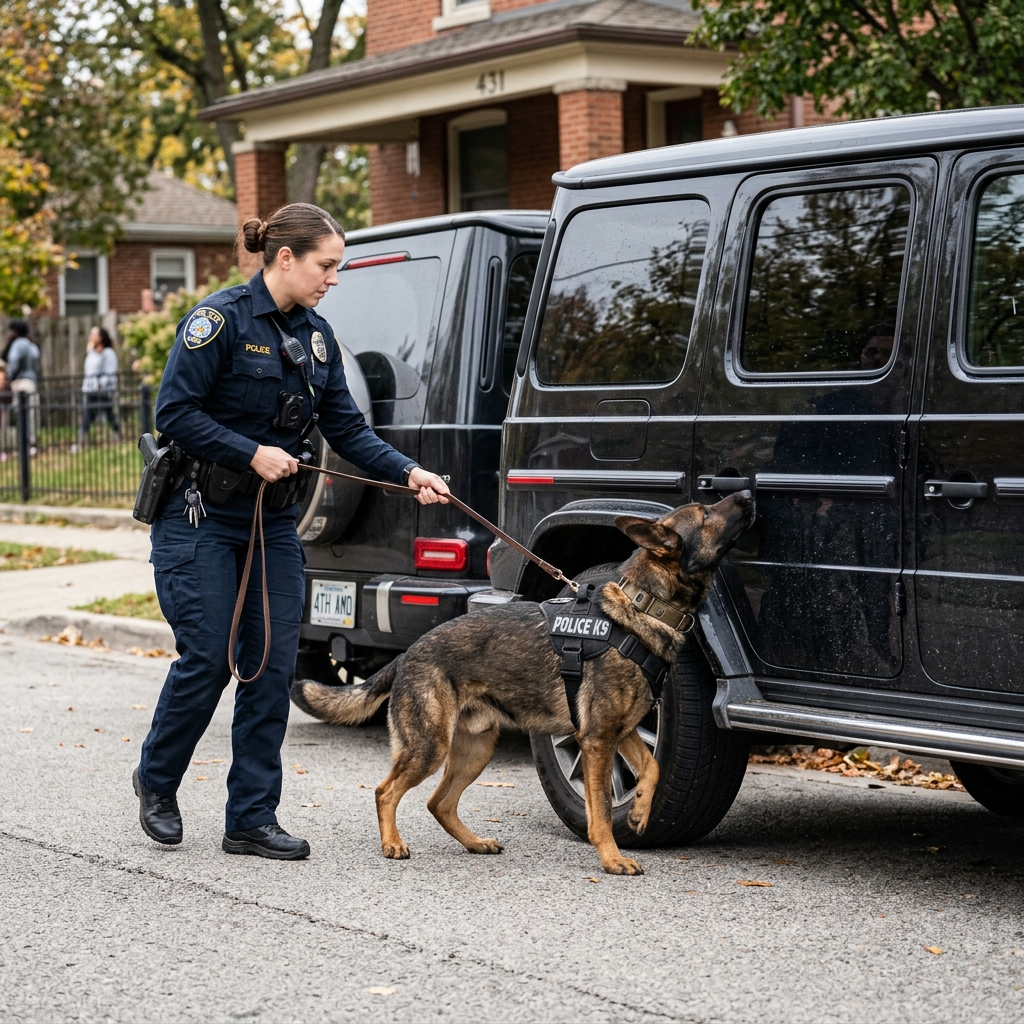
Police departments across the United States routinely use trained canines to detect drugs, explosives, and other contraband. While these police dog sniffs are a common investigative tool, they raise important questions about privacy and constitutional rights. The central issue is how the Fourth Amendment—which protects against unreasonable searches and seizures—applies to canine investigations.
This guide explains when dog sniffs are considered lawful, when they become unconstitutional, and how courts analyze these situations in everyday encounters such as traffic stops, visits to a home, and airport screenings. It is designed to give a clear, practical overview for non-lawyers while staying grounded in key court decisions and official guidance.
Core Constitutional Principles Behind Dog Sniffs
The Fourth Amendment prohibits unreasonable searches and seizures by the government. For police dog sniffs, courts focus on two main questions:
- Is the dog sniff a search within the meaning of the Fourth Amendment?
- If it is a search, was it reasonable—for example, supported by probable cause, reasonable suspicion, or a valid exception to the warrant requirement?
In several landmark cases, the U.S. Supreme Court has treated dog sniffs as a special type of investigative technique that may be less intrusive than other searches. A recurring theme is that a trained dog is supposed to detect only contraband. Since people have no legitimate privacy interest in illegal drugs, some dog sniffs receive more lenient constitutional treatment.
Dog Sniffs During Traffic Stops
Traffic stops are one of the most common settings in which police use drug detection dogs. Courts have developed specific rules about what officers can and cannot do in this context.
Lawful Stop Is the Starting Point
Before a dog is involved, officers must have a lawful reason for the traffic stop itself—such as speeding, an equipment violation, or erratic driving. If the stop is improper, any resulting dog sniff and evidence may be subject to challenge.
Exterior Sniff of a Vehicle
In a major Supreme Court decision, the Court held that a well-trained drug dog sniffing the exterior of a vehicle during a lawful traffic stop does not constitute a search under the Fourth Amendment. According to that reasoning:
- The dog is only detecting odors that emanate into public air around the vehicle.
- The sniff is targeted at discovering contraband rather than personal, lawful items.
Because of this, an exterior dog sniff during a valid stop has sometimes been allowed without individualized suspicion of drugs, so long as it does not extend the duration of the stop beyond what is reasonably necessary for the traffic matter.
Time Limits: Prolonging the Stop
Even when an exterior sniff is not deemed a search, courts closely scrutinize how long an officer detains a driver to conduct the canine investigation. The Supreme Court and state courts have emphasized that officers may not prolong a traffic stop beyond the time reasonably required to handle the traffic violation simply to conduct a dog sniff unless they have additional justification.
In practice, this means:
- The officer may attend to tasks related to the traffic stop (license check, registration, issuing a citation).
- A dog sniff that occurs while those tasks are still ongoing and does not add significant time may be permissible.
- Holding a driver longer than necessary solely to wait for a dog often requires reasonable suspicion of criminal activity beyond the traffic violation.
| Scenario | Dog Sniff Status | Key Legal Consideration |
|---|---|---|
| Quick sniff while officer checks documents | Often allowed | Does not extend stop beyond necessary traffic tasks |
| Driver kept waiting extra time only for dog to arrive | Often problematic | May require reasonable suspicion of drugs to be lawful |
| Dog circles car after officer has finished citation | Depends on circumstances | If stop is effectively over, continued detention may be unlawful absent new justification |
Reasonable Suspicion for Extended Detention
When police want to extend a traffic stop specifically to conduct a dog sniff, courts often require reasonable, articulable suspicion of drug-related crime. This means officers must be able to point to specific, objective facts—such as observed behavior, inconsistent stories, or other indicators—that together suggest possible criminal activity.
Key points:
- Reasonable suspicion is a lower standard than probable cause but must be more than a hunch.
- Courts look at the totality of the circumstances, considering all facts together.
- If reasonable suspicion is lacking, evidence from a dog sniff after an extended stop may be suppressed.
Dog Sniffs In and Around Homes
Courts treat homes as the area of highest privacy protection under the Fourth Amendment. As a result, dog sniffs near a residence are subject to stricter rules than those applied during traffic stops.
Front Porch and Curtilage
The area immediately surrounding and associated with the home—known as the curtilage—receives strong constitutional protection. Courts have held that using a drug detection dog on a person’s front porch to investigate the interior of the home can amount to a search under the Fourth Amendment.
Important consequences of this ruling include:
- Bringing a dog to sniff the front door or porch typically requires probable cause and, in many cases, a warrant.
- Officers may not rely solely on implied permission for ordinary visitors (such as approaching to knock) to conduct a targeted dog sniff of the home’s entry.
Consent and Exigent Circumstances
As with other searches, exceptions such as consent and exigent circumstances can allow canine use without a warrant:
- If a resident clearly consents to officers bringing a dog onto the property and conducting a sniff, that consent may authorize the search.
- In urgent situations—such as imminent destruction of evidence or a threat to safety—courts sometimes allow warrantless entry and associated dog use, provided the circumstances meet strict criteria.
However, because home privacy is strongly protected, courts often review such cases with particular care.
Dog Sniffs of People
Dog sniffs directed at a person’s body raise different concerns than sniffs of vehicles or luggage. Courts have recognized that close physical contact between a dog and a person can constitute a search under the Fourth Amendment.
Contact Versus Non-Contact Sniffs
Case law distinguishes between invasive, contact-based sniffs and sniffs from a short distance:
- When a dog touches a person—especially in sensitive areas—courts have treated this as a search requiring constitutional justification.
- By contrast, an unintentional or non-contact sniff from several feet away has been held by some courts not to be a search, because it is minimally intrusive and examines only odors exposed to the public air.
Even when a person-directed sniff counts as a search, it may be lawful if supported by individualized suspicion or a valid exception, and if conducted in a reasonable manner.
Dog Sniffs in Public Places and Airports
Police commonly use detection dogs in public settings such as airports, bus stations, and other transit hubs. Courts and official guidance generally treat these situations differently from home or person-focused searches.
Luggage and Public Areas
When officers run dogs along luggage or packages in public spaces, courts have often concluded that this does not rise to the level of a traditional search. The reasoning is that only the presence of contraband is revealed, not the contents of lawful personal items.
For example:
- Random dog sniffs of luggage in an airport have been treated as investigations that do not always require probable cause, provided they are conducted in a nondiscriminatory manner.
- If a dog alerts, officers may use that alert to develop probable cause for a more intrusive search of the item.
Limits in Public Settings
Even in public places, constitutional protections still apply. Key limitations include:
- Officers may not rely on dog sniffs to justify discriminatory or harassing practices.
- Detaining individuals for extended periods solely for canine investigation may require reasonable suspicion or probable cause, similar to traffic stop rules.
Reliability of Detection Dogs and Legal Challenges
The courts’ tolerance for dog sniffs depends partly on the assumption that well-trained dogs reliably detect contraband. When defense attorneys challenge searches, they often question this reliability.
Training and Certification
To support the use of canine evidence, prosecutors typically present information about the dog’s:
- Training program and certification.
- Field performance and accuracy rates.
- Handler’s qualifications and experience.
If a dog has a history of frequent false alerts or inadequate training, courts may give less weight to the dog’s signal as evidence of probable cause.
False Positives and Human Influence
Legal scholarship and court opinions have noted that dogs can sometimes respond to subtle cues from handlers or environmental factors rather than the scent of contraband. This raises concerns about:
- Confirmation bias, where handlers unintentionally encourage alerts.
- Use of dogs in situations where the probability of contraband is low.
These issues can become central in motions to suppress evidence obtained after a canine alert.
Practical Tips for Individuals Encountering Police Dogs
While each situation is fact-specific and legal advice should come from a qualified attorney, general principles can help people better understand their position when facing a police dog sniff.
During a Traffic Stop
- Remain calm and keep your interactions with the officer polite.
- Understand that an exterior dog sniff may occur without your consent if the stop is lawful and not unduly prolonged.
- If you believe you are being detained longer than necessary solely for a dog, that issue can be raised later in court through counsel.
At Home
- Recognize that your front porch and surrounding area have heightened privacy protections.
- You generally have the right to decline consent for officers to bring a dog onto your property, unless they have a warrant or exigent circumstances.
- If officers present a warrant, you may ask to see it but should avoid interfering with its execution.
In Public Places
- Dog sniffs of luggage or packages in public transit settings may occur without your individual consent.
- Extended detention for questioning after a dog alert may require legal justification, which can be challenged later by an attorney.
Frequently Asked Questions (FAQ)
Is a police dog sniff always considered a search?
No. Courts have held that certain dog sniffs—especially of the exterior of a vehicle during a lawful traffic stop—are not searches under the Fourth Amendment because they are limited to detecting contraband. However, sniffs at a home’s front door or physical contact sniffs of a person are more likely to be treated as searches.
Can police extend a traffic stop just to wait for a drug dog?
Generally, officers may not prolong a traffic stop beyond the time reasonably needed to handle the traffic violation solely to facilitate a dog sniff, unless they have reasonable suspicion of additional criminal activity. If they do prolong the stop without such justification, courts may find the detention unreasonable and suppress evidence.
Do officers need a warrant to use a dog at my front door?
In many cases, yes. Using a dog on the front porch to investigate the inside of a home has been treated as a search, triggering the Fourth Amendment’s warrant and probable cause requirements. Consent or exigent circumstances can be exceptions, but courts closely scrutinize these situations.
Can a dog sniff my luggage at the airport without probable cause?
Random dog sniffs of luggage in public areas such as airports have often been treated as investigations that do not require probable cause, on the theory that they only reveal contraband. However, if a dog alerts, that alert can contribute to probable cause for a more intrusive search.
What should I do if I think a dog sniff violated my rights?
Document details as soon as you can—location, time, officer names, what was said, and how long you were detained. Then consult a criminal defense attorney experienced in search and seizure law. Courts analyze dog sniff cases on a highly fact-specific basis, and an attorney can evaluate whether your rights under the Fourth Amendment were violated.
References
- Dog Sniffs of People and the Fourth Amendment — University of North Carolina School of Government. 2012-10-09. https://nccriminallaw.sog.unc.edu/dog-sniffs-of-people-and-the-fourth-amendment/
- Massachusetts law about drug detection dogs — Massachusetts Trial Court Law Libraries. 2022-05-12. https://www.mass.gov/info-details/massachusetts-law-about-drug-detection-dogs
- Police Dog Drug Sniffs — Payne, Powell, Truitt & Chandler Law Group. 2015-04-30. https://tpaynelaw.com/practice-areas/criminal-defense/police-dog-drug-sniffs/
- Deconstructing Dog Sniffs at Traffic Stops — Marquette Law Review. 2014-01-01. https://scholarship.law.marquette.edu/cgi/viewcontent.cgi?article=5537&context=mulr
- Your Rights Regarding Police Dogs — Kefalinos Law Firm. 2020-06-15. https://www.kefalinoslaw.com/your-rights-regarding-police-dogs/
Similar Articles








Read full bio of Sneha Tete




