
Police Searches of Car Containers: Legal Limits
Understand when police can legally open bags, boxes, and purses during vehicle stops without a warrant.
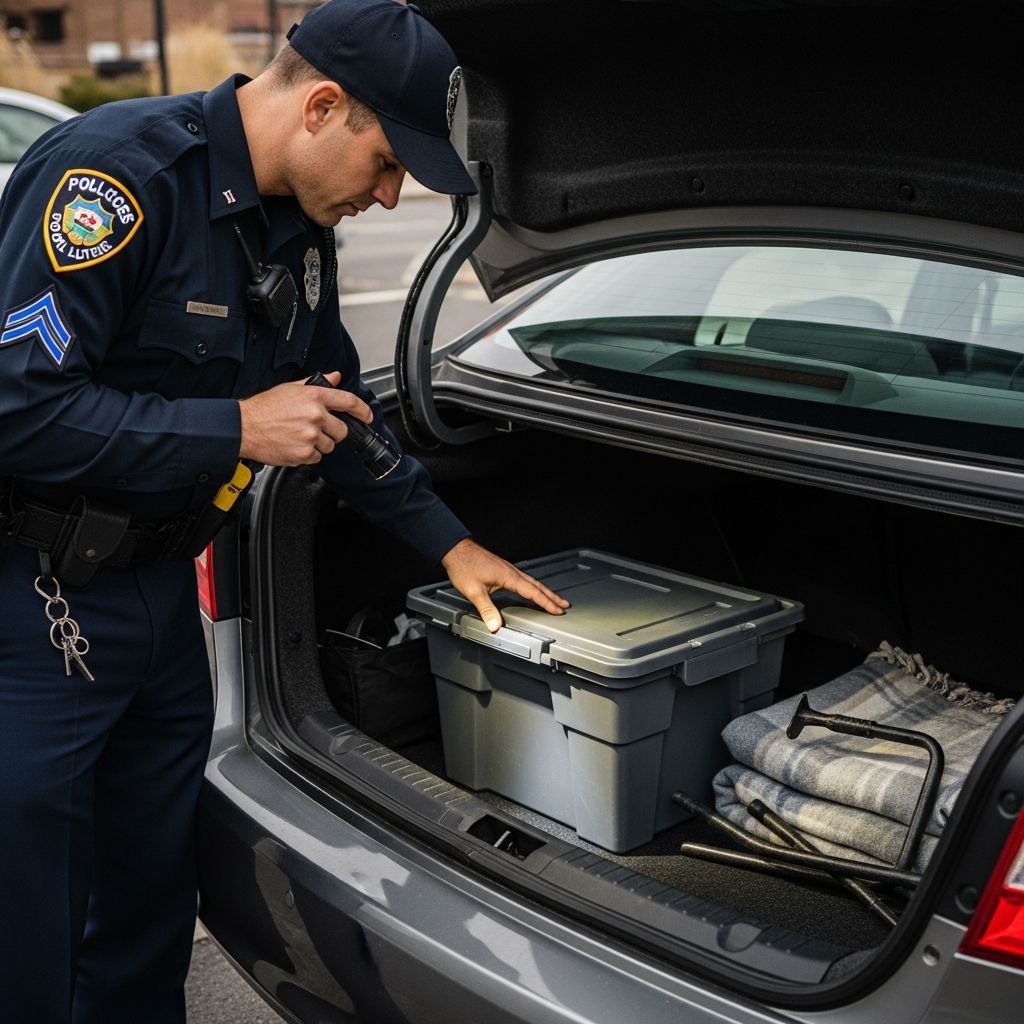
Police authority to search closed containers in vehicles hinges on the Fourth Amendment’s protection against unreasonable searches. Without probable cause or an exception, such searches are unconstitutional, potentially leading to evidence suppression.
Foundational Principles of Vehicle Searches
The Fourth Amendment safeguards individuals from unwarranted intrusions by law enforcement. Vehicles receive somewhat less protection due to their mobility, establishing the ‘automobile exception.’ This allows warrantless searches if officers have probable cause to believe contraband or evidence resides inside.
Probable cause exists when facts suggest a fair probability of criminal activity or evidence presence. Unlike mere suspicion, it demands concrete indicators like visible drugs, weapon odors, or evasive driver actions.
The Automobile Exception Explained
Courts recognize vehicles’ ready mobility as justifying immediate searches to prevent evidence loss. The U.S. Supreme Court solidified this in cases affirming that probable cause for a vehicle search extends to all accessible areas, including containers.
In practice, this means glove compartments, trunks, and passenger bags fall under scrutiny if probable cause justifies the vehicle search. Officers need not isolate specific containers; the vehicle’s probable cause suffices.
Container Searches: What Counts as Probable Cause?
Closed containers—bags, purses, locked boxes—carry expectations of privacy. However, within vehicles, this expectation diminishes under the automobile exception. If police lawfully stop a car and develop probable cause, they may open containers capable of holding the sought items.
- Plain View Doctrine: Items visible to officers, like drug paraphernalia on seats, instantly provide probable cause.
- Odor Evidence: Marijuana or alcohol smells from a vehicle establish grounds for thorough searches.
- Driver or Passenger Behavior: Fleeing attempts or admissions of guilt bolster probable cause claims.
- Officer Experience: Trained detection of subtle criminal signs, combined with observations, supports searches.
Without these, routine traffic stops do not authorize container intrusions. Prolonged detentions beyond ticketing without cause render searches invalid.
Key Court Rulings Shaping Container Search Law
Pennsylvania courts align with federal standards. In a notable Superior Court decision, officers searched a passenger’s purse during a vehicle stop after observing marijuana and flight attempts. The court upheld this, ruling probable cause for the car extended to all containers.
The U.S. Supreme Court has long endorsed similar logic, permitting container searches wherever probable cause points to vehicle-hidden contraband. This applies irrespective of container ownership—passenger items qualify if within the car.
| Case Example | Jurisdiction | Ruling Summary | Key Factor |
|---|---|---|---|
| Commonwealth v. Runyan | PA Superior Court | Purse search valid under vehicle probable cause | Marijuana in plain view, flight |
| Supreme Court Precedents | Federal | Containers searchable if probable cause for vehicle | Automobile exception |
Distinguishing Valid from Invalid Searches
Not every vehicle encounter permits container openings. Initial stops require reasonable suspicion of wrongdoing, such as traffic violations. Escalating to searches demands probable cause.
Locked containers pose nuances. During lawful vehicle searches, combinations or keys may be demanded if probable cause exists. Absent that, forced entry without warrants violates rights. Routine stops lacking suspicion cannot justify prying into secured bags.
When Searches Are Legal vs. Illegal
| Scenario | Legal? | Reason |
|---|---|---|
| Drugs visible in car | Yes | Plain view probable cause |
| Officer smells marijuana | Yes | Odor as evidence |
| No violation, no suspicion, routine check | No | Lacks probable cause |
| Locked box in traffic stop without cause | No | Excessive, no justification |
| Passenger admits to contraband | Yes | Statement provides cause |
Passenger Rights During Vehicle Stops
Passengers enjoy protections akin to drivers. Searches of their belongings require vehicle-wide probable cause, not individual suspicion. Yet, pretextual stops or baseless prolongations invite suppression motions.
Officers may order occupants out for safety, but this does not greenlight unrestricted searches. Container openings tie strictly to probable cause.
Challenging Unlawful Vehicle and Container Searches
Defendants can contest searches via suppression motions. Successful challenges exclude evidence, often derailing prosecutions.
- Attack the Stop: Prove lack of reasonable suspicion for initial detention.
- Dispute Probable Cause: Argue observations fell short of legal threshold.
- Highlight Delays: Excessive stop durations without cause invalidate subsequent searches.
- Consent Issues: Verify voluntary, informed consent if claimed.
Even with probable cause, procedural errors like failing to read Miranda rights post-arrest can taint evidence.
Alternatives to Warrantless Container Searches
Police prefer warrantless actions for efficiency, but warrants remain gold standard. Officers can secure vehicles and obtain judicial approval, especially for locked items sans exigent needs.
Exigent circumstances—imminent evidence destruction or harm—further justify immediacy. Absent these, patience for warrants preserves rights.
Frequently Asked Questions (FAQs)
Can police search my purse in a car without probable cause?
No. Probable cause for the vehicle is required; otherwise, the search violates the Fourth Amendment.
What if the container is locked during a traffic stop?
Locked items cannot be searched absent vehicle probable cause. Routine stops do not suffice.
Does marijuana odor alone justify full car and container searches?
Yes, in most jurisdictions, as it indicates contraband presence.
Are passenger bags protected differently than driver items?
No. Vehicle probable cause covers all accessible containers, regardless of ownership.
How do I fight an illegal container search?
File a motion to suppress, challenging the stop, cause, or scope through legal counsel.
Practical Advice for Drivers and Passengers
Stay calm during stops, avoid consenting to searches, and document interactions. Knowing rights empowers effective responses without escalation.
Consult attorneys promptly if searched. Timely challenges maximize suppression chances, protecting against unwarranted convictions.
Legal landscapes evolve; recent rulings reinforce automobile exception breadth while upholding probable cause necessities. Awareness ensures informed encounters with law enforcement.
References
- PA Superior Court: If Police Have Probable Cause to Search a Car, They May Search All Containers In the Car — Goldstein & Mehta. 2017-05-01. https://goldsteinmehta.com/blog/pa-superior-court-if-police-have-probable-cause-to-search-a-car-they-may-search-all-containers-in-the-car
- Can a police officer search a combination locked bag or box without a warrant during a routine traffic stop in Chicago? — Avvo Legal Answers. 2015-07-01. https://www.avvo.com/legal-answers/can-a-police-officer-search-a-combination-locked-b-5955669.html
- Container Searches Without Search Warrants — Office of Justice Programs (OJP). 1980-01-01. https://www.ojp.gov/ncjrs/virtual-library/abstracts/container-searches-without-search-warrants
- When is it Illegal to Search Your Car in Pennsylvania? — Scartelli Law Firm. 2023-01-01. https://scartelli.com/when-is-it-illegal-to-search-your-car-in-pennsylvania/
- Searches of Containers Within a Vehicle — Legal Information Institute, Cornell Law School. 2023-01-01. https://www.law.cornell.edu/constitution-conan/amendment-4/searches-of-containers-within-a-vehicle
Similar Articles








Read full bio of Sneha Tete




