
Penalties For Using Stolen Credit Cards: State & Federal Guide
Understand the severe legal consequences of using stolen credit cards, from state misdemeanors to federal felonies with decades in prison.
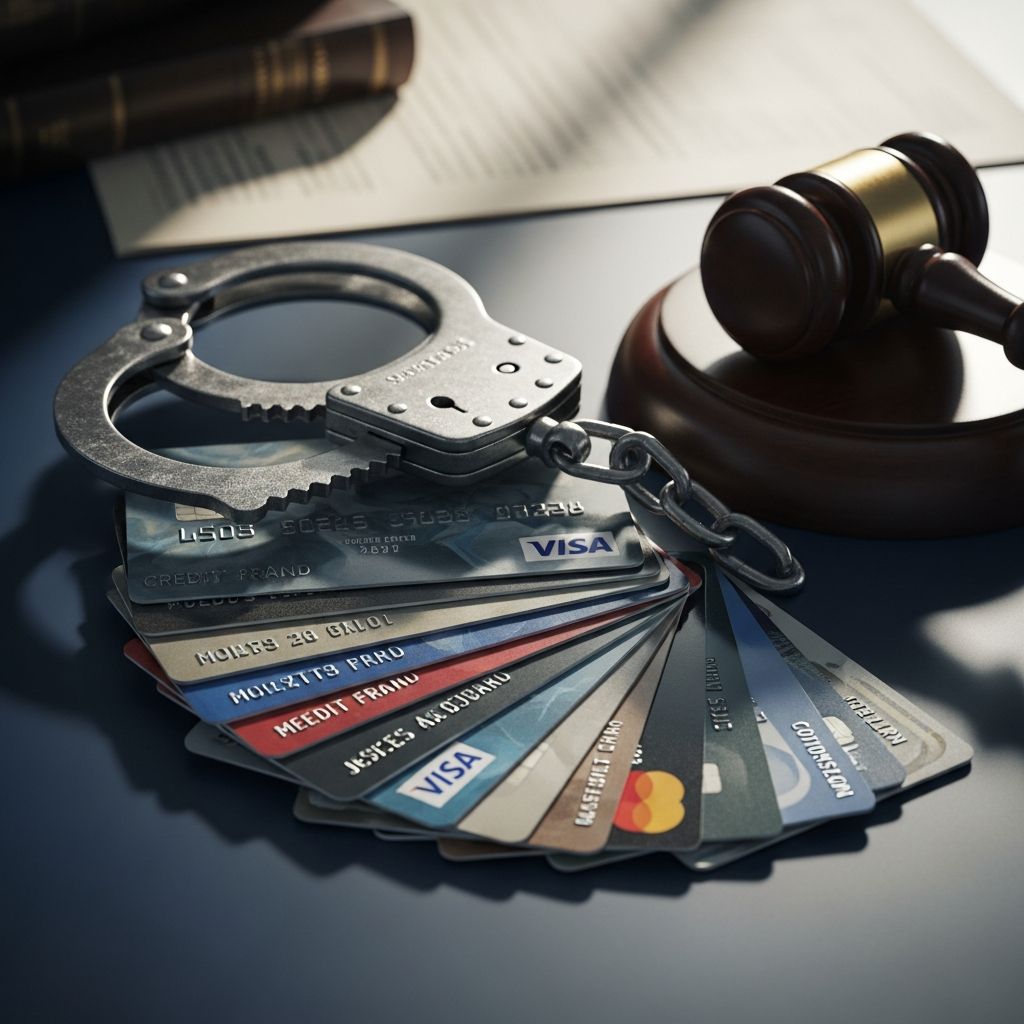
Using a stolen credit card constitutes a serious criminal offense with penalties ranging from fines and short jail terms to lengthy federal prison sentences. Penalties depend on jurisdiction, the value of goods obtained, the offender’s history, and whether interstate commerce is involved.
Understanding Credit Card Fraud Basics
Credit card fraud involves unauthorized use of someone else’s card to acquire goods, services, or money. This includes using lost, stolen, forged, or counterfeit cards. Offenders may face charges for possession, use, or trafficking of such cards. In the U.S., these acts violate both state statutes and federal laws, especially when transactions cross state lines or involve online purchases.
Key elements prosecutors must prove include knowledge that the card was illicitly obtained and intent to defraud. Simple possession without use might lead to lighter charges, while actual transactions escalate severity based on the total value defrauded over a period, often 6-12 months.
State-Level Penalties Across the U.S.
Most credit card fraud cases are prosecuted at the state level, where penalties vary by location and circumstances. States classify offenses as misdemeanors or felonies, often using thresholds like the amount stolen to determine charge level.
California’s Framework for Fraud Charges
In California, fraudulent use of access cards falls under Penal Code sections 484e through 484j. For amounts under $950 in a six-month period, it’s typically petty theft: up to 6 months in county jail and a $1,000 fine. Over $950, it becomes grand theft, a ‘wobbler’ prosecutable as misdemeanor (1 year jail, $1,000 fine) or felony (up to 3 years prison, $10,000 fine).
- Possession of stolen cards (PC 484e): Wobbler; felony up to 3 years if intent to defraud shown.
- Fraudulent use (PC 484g): Petty theft under $950; grand theft above.
- Retailer fraud (PC 484h): Similar value-based escalation.
Courts consider aggravating factors like victim vulnerability or organized crime involvement to enhance sentences.
Florida’s Strict Credit Card Theft Laws
Florida Statute 817.60 defines credit card theft broadly, covering taking without consent, retaining lost cards with intent to use, and unlawful possession. These are felonies of the third degree, punishable by up to 5 years in prison and $5,000 fines, with harsher penalties for repeat offenders or higher values.
| Offense Type | Penalty | Key Statute |
|---|---|---|
| Theft without consent | Up to 5 years prison, $5,000 fine | 817.60(1) |
| Retaining lost/mislaid card | Same as above | 817.60(2) |
| Unlawful possession | Same as above | 817.60(8) |
Florida emphasizes intent, making even receipt of multiple suspicious cards a crime.
Variations in Other States
Many states mirror these models but differ in thresholds. For instance, some use $500 or $1,000 as felony triggers. Identity theft enhancements apply if personal data is exploited, adding years to sentences. Criminal history often elevates charges: first-time offenders might get probation, while recidivists face maximums.
Federal Penalties for Interstate Fraud
When fraud affects interstate commerce—common with online buys or out-of-state cards—federal jurisdiction kicks in under 15 U.S.C. § 1644 and 18 U.S.C. § 1029. These cover use, transport, sale, or receipt of fraudulent cards or proceeds.
- Aggregate value $1,000+ in one year: Fine up to $10,000, up to 10 years prison, or both.
- Access device fraud (18 USC 1029): Up to 20 years for aggravated cases, plus asset forfeiture.
- Related crimes: Wire/mail fraud (up to 30 years), computer fraud.
Federal sentencing guidelines consider offense level, with minimal participation yielding lighter terms (average 18 months per USSC data).
Factors Influencing Severity of Punishment
Courts weigh multiple elements:
- Amount defrauded: Higher totals mean felony status and longer sentences.
- Criminal record: Prior convictions trigger enhancements.
- Victim impact: Elderly or vulnerable victims increase penalties.
- Intent and method: Organized schemes or skimming devices add charges.
- Restitution: Offenders must repay victims, often exceeding fines.
Prosecutors may offer pleas for reduced charges, especially for cooperation.
Defenses and Legal Strategies
Common defenses include lack of intent (e.g., mistaken belief card was authorized), identity errors, or insufficient evidence of knowledge. Entrapment or duress claims are rare but possible. Skilled attorneys negotiate diversions, like restitution programs, avoiding jail for first offenses.
Early reporting by victims limits liability to $50 max under federal law (often $0 per card agreements).
Preventing Credit Card Fraud as a Victim
Monitor statements, enable alerts, and report losses immediately. Federal protections shield consumers: no liability pre-use, $50 cap post-report.
Frequently Asked Questions
What is the maximum federal penalty for credit card fraud?
Up to 20 years in prison under 18 U.S.C. § 1029 for access device fraud, plus fines and forfeiture.
Does amount stolen matter in state cases?
Yes, thresholds like $950 in California determine misdemeanor vs. felony.
Am I liable for unauthorized charges?
At most $50 if reported timely; often $0.
Can possession alone lead to charges?
Yes, unlawful possession is criminalized in states like Florida and California.
How do federal cases differ from state?
Federal involves interstate elements, harsher maximums; most cases stay local.
Long-Term Consequences Beyond Prison
Convictions result in criminal records impacting jobs, housing, and loans. Felony status restricts rights like voting in some states. Restitution and court fees add financial burdens lasting years.
Rehabilitation programs and expungement (rare for felonies) offer paths forward, but prevention remains key.
References
- Penalties for Credit Card Fraud in California — Helfend Law Group. Accessed 2026. https://www.robertmhelfend.com/criminal-defense/fraud/credit-card-fraud-penalties/
- 15 U.S. Code § 1644 – Fraudulent use of credit cards; penalties — Cornell Law School. https://www.law.cornell.edu/uscode/text/15/1644
- How Serious a Crime Is Credit Card Theft and Fraud? — NerdWallet. 2022-03-10. https://www.nerdwallet.com/credit-cards/learn/credit-card-theft-fraud-serious-crime-penalty
- California Penal Code Section 484e, 484f, 484g — Los Angeles Criminal Lawyer. Accessed 2026. https://www.losangelescriminallawyer.pro/california-penal-code-section-484e-484f-484g-484h-484i-and-484j.html
- Florida Statute 817.60 — Florida Legislature. Accessed 2026. https://www.leg.state.fl.us/STATUTES/index.cfm?App_mode=Display_Statute&URL=0800-0899/0817/Sections/0817.60.html
- Am I responsible for unauthorized charges if my credit cards are lost or stolen? — Consumer Financial Protection Bureau. Accessed 2026. https://www.consumerfinance.gov/ask-cfpb/am-i-responsible-for-unauthorized-charges-if-my-credit-cards-are-lost-or-stolen-en-29/
- Quick Facts on Federal Credit Card Offenses FY16 — U.S. Sentencing Commission. https://www.ussc.gov/sites/default/files/pdf/research-and-publications/quick-facts/Credit_Card_Fraud_FY16.pdf
Similar Articles








Read full bio of Sneha Tete




