
Lava Extensions Ownership: An Essential Guide For Hawaii Owners
Unraveling the legal mysteries of who claims Hawaii's lava-formed coastal expansions and property rights amid eruptions.
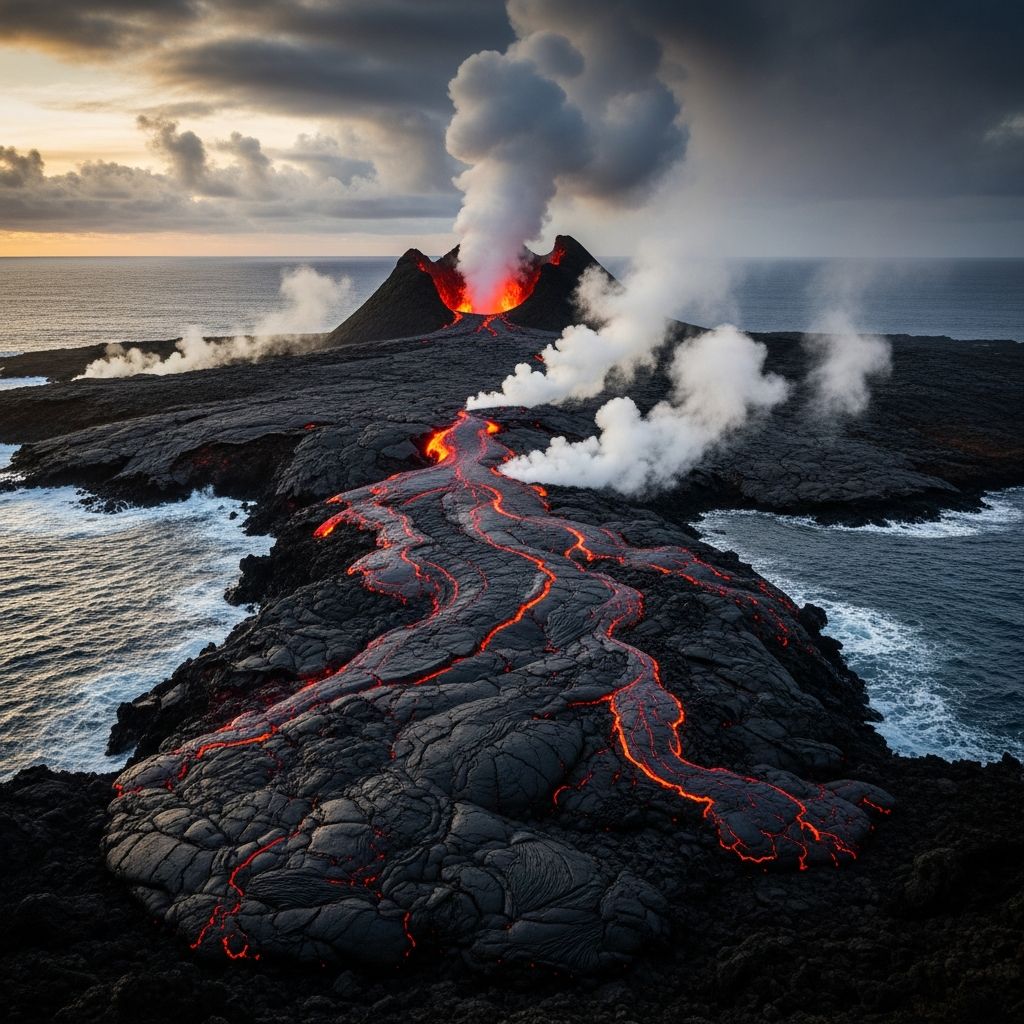
Hawaii’s active volcanoes frequently reshape the islands by adding new coastal territory through lava flows into the ocean. This phenomenon, known as
lava extensions
, raises critical questions about property ownership. Generally, such newly formed land belongs to the State of Hawaii, not adjacent private owners.The Science Behind Land Creation
Volcanic activity, particularly from Kilauea and Mauna Loa on the Big Island, propels molten lava toward the sea. Upon contact with ocean water, it cools, hardens, and solidifies, extending the shoreline outward. This process has significantly grown Hawaii’s landmass over time. For instance, eruptions can add hundreds of acres, transforming submerged areas into solid ground.
These extensions differ fundamentally from gradual accretion, like sand buildup from erosion. Volcanic additions occur rapidly and dramatically, prompting unique legal considerations rooted in Hawaii’s geography and history.
Legal Foundations of Ownership
Hawaiian law treats lava-formed land as state property, held in trust for public benefit. This stems from the public trust doctrine, where the government manages certain resources for communal use. New coastal land falls under this umbrella, preventing private monopolization.
Private property owners whose land borders the pre-eruption shoreline do not automatically gain title to the extension. Deeds describe fixed boundaries, excluding future formations. Planting vegetation or constructing on these areas does not confer ownership; it often leads to state enforcement actions.
Landmark Supreme Court Ruling: Zimring v. State
The pivotal case establishing this precedent is Zimring v. State of Hawaii (1977). During the 1955 Kilauea eruption, lava created 7.9 acres adjoining property owned by Maurice and Molly Zimring, purchased in 1960. The Zimrings treated it as theirs, landscaping and bulldozing parts despite the state’s vacation order post-1960 Kapoho eruption.
The trial court initially sided with the Zimrings, but the Hawaii Supreme Court reversed, affirming state title. Chief Justice William Richardson emphasized equity: “Rather than allowing only a few of the many lava victims the windfall of lava extensions, this court believes that equity and sound public policy demand that such land inure to the benefit of all the people of Hawaii.”
This ruling solidified that lava extensions serve “the use and enjoyment of all the people,” prioritizing public access over individual gain.
Distinctions: New Land vs. Covered Land
| Aspect | New Lava Extensions (Into Ocean) | Land Covered by Lava |
|---|---|---|
| Ownership Change | Becomes state property | Private owner retains title |
| Examples | Coastal expansions from Kilauea flows | Homes destroyed in eruptions |
| Tax Implications | State manages as public land | Assessed value drops to near zero; tax exemption possible |
| Legal Precedent | Zimring case (1977) | No automatic transfer to state |
Crucially, lava burying existing private land does not strip ownership. Owners keep title, though the land’s value plummets—often to zero—exempting them from property taxes under Hawaii County rules for parcels valued at $500 or less. Rebuilding remains an option for resilient owners, as seen in past Kalapana recoveries.
Exceptions and Special Cases
- Federal Lands: Extensions within national parks like Hawaii Volcanoes National Park belong to the federal government.
- Kuleana Lands: Traditional Native Hawaiian parcels (granted 1850-1855) retain ownership among co-tenants; lava flows do not alter this.
- Abandoned Properties: Rarely, tax-delinquent lava-covered land may go to county tax sale, but this is uncommon due to low values.
Post-2008, precedents blocked private structures like pavilions on extensions, reinforcing state control.
International Perspectives on Emergent Lands
Beyond Hawaii, international law addresses newly emerged islands via treaties like the 1958 Geneva Conventions on the Law of the Sea. Theories include occupation, contiguity, prescription, and effective control, varying by location (territorial sea, continental shelf, or deep seabed).
For volcanic islands in disputed areas like between Volcano and Mariana Islands, states might claim based on proximity or first effective occupation. However, Hawaii’s domestic rulings provide a model for subnational handling within federal systems.
Practical Implications for Property Owners
Owners near volcanic zones should review deeds for coastal boundaries and avoid improvements on potential extensions. Insurance policies often exclude volcanic damage, leaving rebuilding to personal funds or government aid programs.
State management promotes public beaches, trails, and conservation, benefiting tourism—a key Hawaiian economic driver. Yet, it frustrates some residents seeking expanded holdings.
Recent Eruptions and Ongoing Relevance
Mauna Loa (2022) and recurrent Kilauea activity underscore these laws’ timeliness. While eruptions destroy homes, they simultaneously create public assets. USGS monitors flows, predicting coastal impacts without ownership speculation.
Land use experts like University of Hawaii’s David Callies affirm: new land from ocean-spilling lava defaults to the state.
Frequently Asked Questions
Does the state take ownership of homes destroyed by lava?
No, private owners retain title to lava-covered land, though its taxable value typically falls to zero.
Can I build on new lava-formed land next to my property?
No, lava extensions are state property; unauthorized structures violate law, as ruled in 2008 cases.
What happens if lava creates land in a national park?
It becomes federal land, managed by the National Park Service.
Do Native Hawaiian kuleana lands lose ownership from lava?
No, co-tenant ownership persists unchanged.
Has the Zimring precedent been challenged recently?
It remains authoritative, cited in modern disputes over coastal extensions.
Future Considerations Amid Climate Change
Rising seas and intensified volcanism may complicate boundaries. Hawaii’s laws adapt via legislature and courts, balancing private rights with public trust. Property buyers in volcanic zones must weigh risks, consulting legal experts on accretion clauses.
This framework exemplifies how dynamic geology intersects with static property law, uniquely tailored to island ecosystems.
References
- As the Lava Flow Slows, What Happens to Hawaii’s New Land? — Connect CRE. 2018-08-08. https://www.connectcre.com/stories/as-the-lava-flow-slows-what-happens-to-hawaiis-new-land/
- Volcanoes create new land, but who owns it? — Punctual Abstract. 2018-08-08. https://www.punctualabstract.com/2018/08/08/new-land/
- Who Owns the New Land Created By a Volcano in Hawaii? — VICE. 2018-05-25. https://www.vice.com/en/article/who-owns-the-new-land-created-by-a-volcano-in-hawaii-kilauea-big-island/
- How are property rights set up in Hawaii? If a lava flow suddenly… — Hacker News. 2022-11-28. https://news.ycombinator.com/item?id=33773713
- Legal Claims to Newly Emerged Islands — San Diego Law Review (digital.sandiego.edu). N/A. https://digital.sandiego.edu/cgi/viewcontent.cgi?article=1923&context=sdlr
- Law Of The Lava – Who Owns New “Accreted” Land? — Inverse Condemnation. 2022-12. https://www.inversecondemnation.com/2022/12/law-of-the-lava-who-owns-new-accreted-land.html
- Volcano Watch — Who owns new coastal lands created by lava flows? — USGS Hawaiian Volcano Observatory. N/A. https://www.usgs.gov/observatories/hvo/news/volcano-watch-who-owns-new-coastal-lands-created-lava-flows
Similar Articles








Read full bio of medha deb




