
Obamacare’s Constitutionality: Supreme Court Verdict
Unpacking the pivotal Supreme Court decision on Obamacare's individual mandate and Medicaid expansion that redefined federal powers.
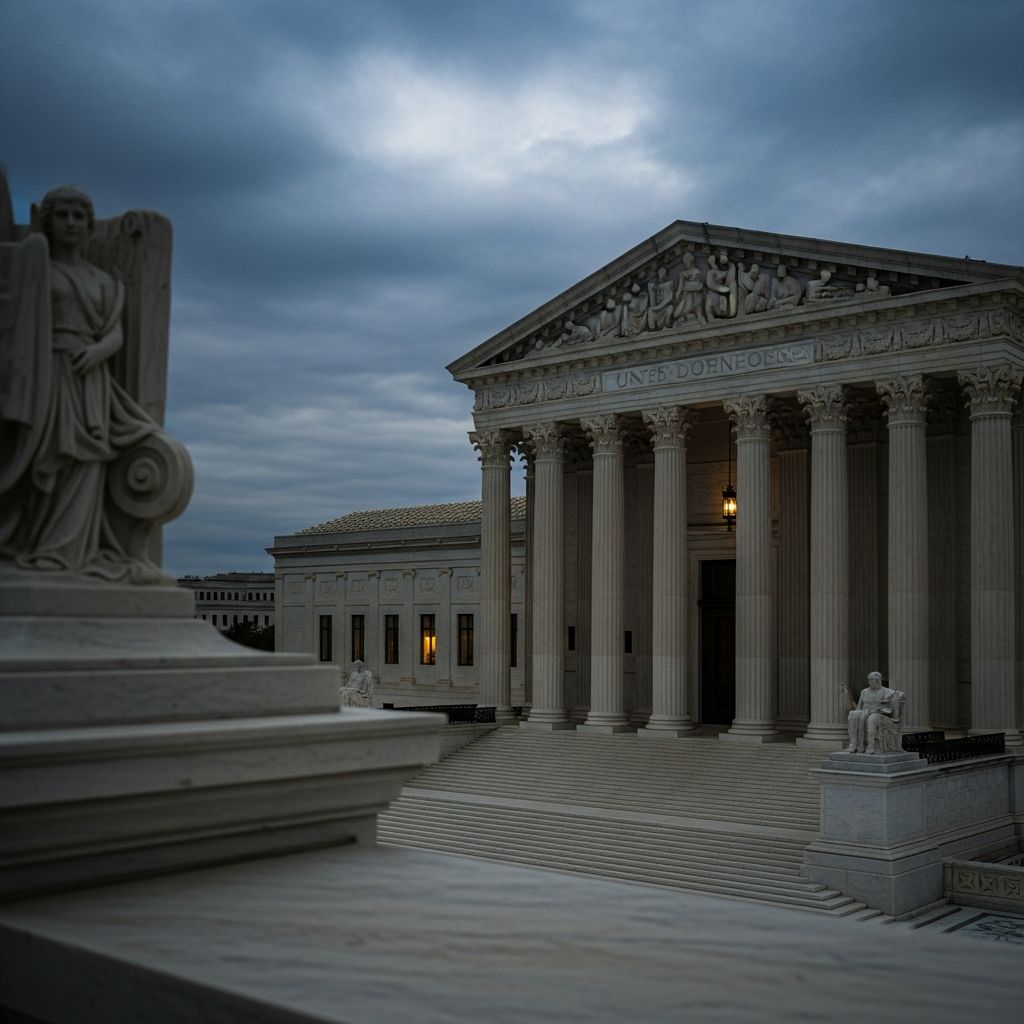
The Affordable Care Act (ACA), commonly known as Obamacare, faced intense scrutiny over its alignment with the U.S. Constitution. In a historic 5-4 decision on June 28, 2012, the Supreme Court upheld the law’s core individual mandate by reinterpreting it as a tax, while limiting the federal government’s coercive tactics in expanding Medicaid. This ruling balanced expansive federal authority with principles of limited government, influencing healthcare policy for years.
Background of the Affordable Care Act
Enacted in 2010, the ACA aimed to expand health insurance coverage to millions of uninsured Americans, curb rising costs, and improve care quality. Key provisions included protections for pre-existing conditions, essential health benefits mandates for insurers, and subsidies for low-income buyers. Central to its mechanism was the individual mandate, requiring most Americans to maintain health coverage or face a penalty, designed to stabilize insurance markets by spreading risk across healthy and sick populations.
Challenges emerged swiftly, with opponents arguing the mandate exceeded Congress’s enumerated powers under Article I, Section 8. Lawsuits consolidated into National Federation of Independent Business v. Sebelius, reaching the Supreme Court after circuit courts split. Oral arguments in March 2012 revealed deep divisions, foreshadowing a complex opinion addressing commerce regulation, taxing authority, and federal-state spending dynamics.
Core Constitutional Challenges
Plaintiffs targeted two pillars: the individual mandate and Medicaid expansion. The mandate was contested under the Commerce Clause, which empowers Congress to regulate interstate commerce, and the Necessary and Proper Clause, allowing laws essential to executing enumerated powers. Critics contended forcing inactive individuals to buy insurance transformed non-activity into regulable commerce, eroding constitutional limits.
The Medicaid expansion sought to cover adults up to 138% of the federal poverty level, with the federal government covering initial costs but threatening to withhold all existing Medicaid funds from non-compliant states. Challengers viewed this as coercive commandeering of state sovereignty under the Spending Clause.
- Commerce Clause Argument: Government claimed uninsured individuals drive up costs via uncompensated care, affecting interstate markets.
- Tax Power Defense: Alternatively, the penalty for non-coverage functions as a tax on the uninsured.
- Spending Clause Issue: Expansion’s funding conditions pressured states unduly.
The Individual Mandate: From Commerce to Tax
Chief Justice John Roberts authored the majority opinion, joined variably by Justices Breyer, Ginsburg, Sotomayor, and Kagan. A five-justice bloc, including Roberts, Scalia, Kennedy, Thomas, and Alito, rejected Commerce Clause justification. Roberts wrote that Congress cannot compel commerce to regulate it: “The Commerce Clause is not a general license to regulate an individual from cradle to grave.”
This marked a victory for limited government advocates, affirming the Clause applies to existing economic activity with substantial interstate effects, not mere potential or inactivity. However, Roberts pivoted to salvage the mandate under taxing power. He characterized the shared responsibility payment not as a direct command but a permissible tax on income-less health insurance, collectible via IRS without criminal penalties. “Taxes that seek to influence conduct are constitutional,” Roberts noted, distinguishing it from a penalty.
| Argument | Ruling | Key Justices |
|---|---|---|
| Commerce Clause | Unconstitutional | Roberts, Scalia, Kennedy, Thomas, Alito |
| Necessary & Proper Clause | Unconstitutional (tied to Commerce) | Same as above |
| Taxing Power | Constitutional | Roberts, Breyer, Ginsburg, Sotomayor, Kagan |
This reinterpretation preserved the ACA’s functionality, as the penalty operated like a tax credit’s inverse, encouraging compliance without outright coercion.
Medicaid Expansion: Limits on Federal Coercion
The Court addressed Medicaid next, where a different majority curtailed federal overreach. Originally, non-expansion risked losing all federal Medicaid dollars—about 10-20% of state budgets—deemed “economic dragooning” by Roberts. Joined by Breyer, Ginsburg, Sotomayor, and Kagan initially, but with swing votes from the conservative bloc, the Court severed the coercive threat.
States could now opt out without total funding loss, rendering expansion voluntary. Seven justices agreed it violated the Spending Clause by not providing clear notice or proportionate incentives. This preserved state autonomy, projecting 16 million fewer enrollees initially, though most states eventually participated post-incentives.
Dissenting Perspectives and Broader Implications
Justices Scalia, Thomas, Alito, and Kennedy dissented sharply on the mandate, arguing the tax label was judicial sleight-of-hand. “The case before us must be correctly labeled,” Scalia wrote, insisting it was a mandate, not tax, exceeding all powers. They warned of unbounded congressional authority, potentially regulating any behavior via penalties.
The ruling reshaped debates: politically, it blunted repeal efforts amid 2012 elections, with Mitt Romney decrying it despite his Massachusetts precursor. Constitutionally, it reinforced Commerce Clause boundaries while expanding tax precedent, influencing future cases like those on gun ownership or environmental mandates.
Long-Term Impact on Healthcare and Federalism
Post-ruling, ACA enrollment surged, reducing uninsured rates from 16% to under 9% by 2016, per government data. Subsidies and marketplaces stabilized, though premiums rose in some areas without full mandate enforcement. The 2017 Tax Cuts and Jobs Act zeroed the penalty, testing severability upheld implicitly.
Federalism-wise, Medicaid expansion became patchwork: 40 states expanded by 2026, covering 20 million more, while holdouts faced coverage gaps. This decision underscored conditional spending limits, guiding challenges to other programs.
- Coverage Gains: Over 20 million insured via exchanges and expansion.
- Cost Controls: Slowed per capita spending growth.
- Legal Precedent: Narrowed Commerce Clause, broadened tax use.
Frequently Asked Questions (FAQs)
What was the main reason the individual mandate survived?
The Court upheld it as a valid exercise of Congress’s taxing power, not commerce regulation, since the penalty functions like a tax on the uninsured.
Did the ruling kill the Medicaid expansion?
No, but it made it optional for states by invalidating threats to withhold existing funds, preserving federalism.
Who wrote the majority opinion?
Chief Justice John Roberts, navigating shifting majorities for different provisions.
Can Congress now tax anything to regulate behavior?
The decision allows taxes influencing conduct but not direct commands disguised as taxes, per dissenters’ critique.
How has the ACA fared since 2012?
Despite repeal attempts, it endures, insuring millions, though modified by later legislation.
Conclusion: A Constitutional Pivot
The Obamacare ruling endures as a masterclass in judicial pragmatism, upholding policy goals within constitutional bounds. It affirmed limited powers while enabling innovative governance, shaping American healthcare and federal-state relations profoundly. As debates persist, its tax-centric framework remains a cornerstone.
References
- Supreme Court Decides Affordable Care Act Is Constitutional — Brookings Institution. 2012-06-28. https://www.brookings.edu/articles/supreme-court-decides-affordable-care-act-is-constitutional/
- Supreme Court Upholds Health Care Law in 5-4 Decision — Commonwealth Fund. 2012-07-02. https://www.commonwealthfund.org/publications/newsletter-article/supreme-court-upholds-health-care-law-5-4-decision
- The Affordable Care Act and The Supreme Court’s Landmark Decision — Quinn Johnston. 2012-06-29. https://www.quinnjohnston.com/affordable-care-act-supreme-courts-landmark-decision/
- The Obamacare Ruling: What Does It All Mean? — Cato Institute. 2012-10-01. https://www.cato.org/policy-report/september/october-2012/obamacare-ruling-what-does-it-all-mean
- The Affordable Care Act: In the Supreme Court We Trust — PMC / NIH. 2012-05-01. https://pmc.ncbi.nlm.nih.gov/articles/PMC3365079/
- A Guide to the Supreme Court’s Affordable Care Act Decision — Kaiser Family Foundation (KFF). 2013-01-01. https://www.kff.org/wp-content/uploads/2013/01/8332.pdf
Similar Articles








Read full bio of medha deb




